


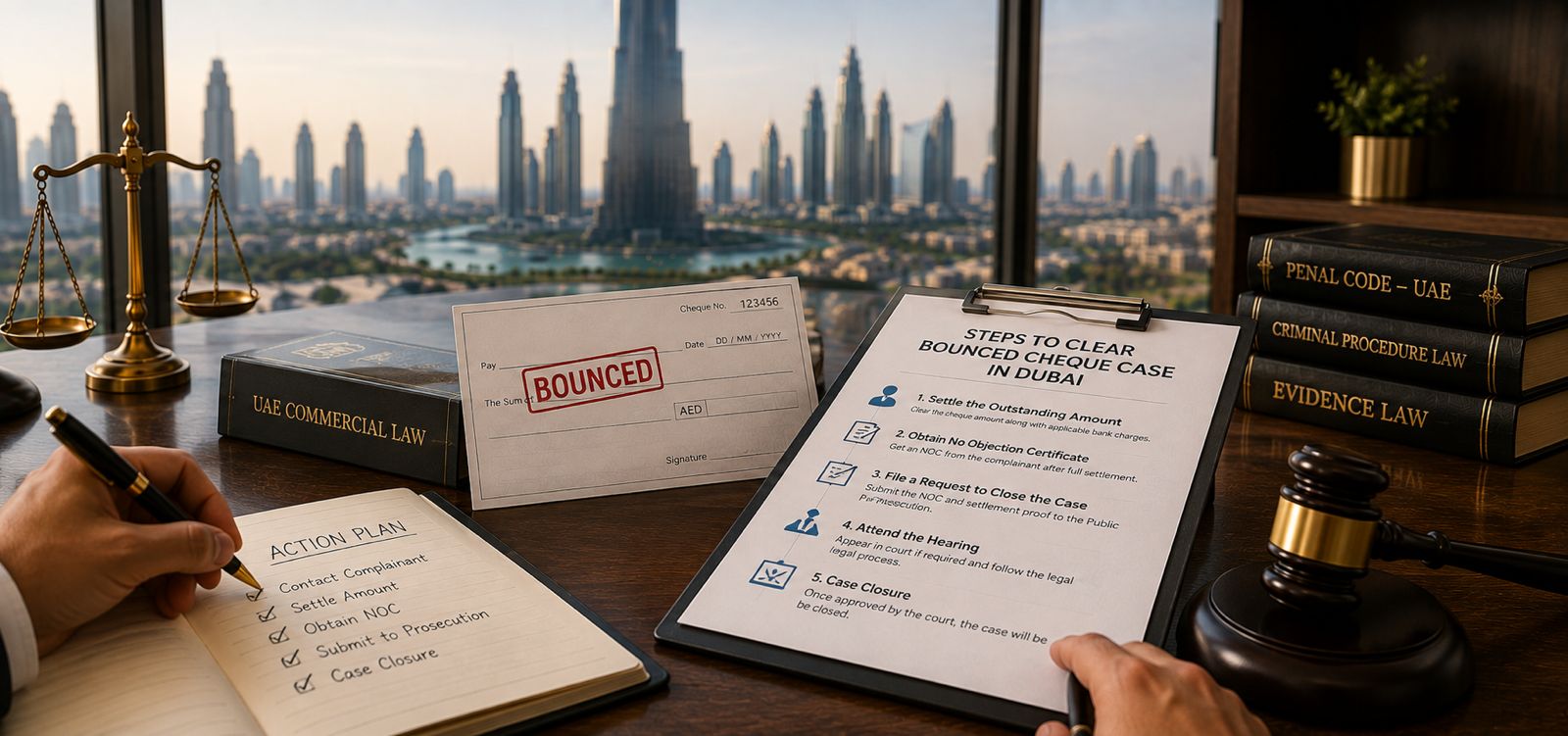

Understanding how to clear a bounced cheque case in Dubai starts with separating civil enforcement from criminal allegations. Most cases are now civil first.
Settlement is usually the fastest route. Execution Court remains available when the parties cannot agree.
What complicates matters is that payment alone does not always close every record. The administrative steps after payment are where most people get caught out.
Since 2 January 2022, most cheques returned only for insufficient funds are civil matters. A dishonoured cheque is an executive instrument, so the payee can file directly with the Execution Court without first winning a separate debt lawsuit. The fastest route is usually a documented settlement, using full payment, a payment plan, or the partial-payment mechanism. Criminal liability remains for fraud, deliberate account closure, unjustified stop payment, or forgery. Key periods are six months for presentation, three years for civil recovery, and five years for criminal prosecution. Always obtain written case closure and confirm any travel restriction is removed.
Separate the Civil and Criminal Tracks
For a closer look at this, see our guide on what happens if a company cheque bounces in the UAE.
Check every notice and case number. A civil execution file and a criminal complaint can exist separately.
| Point | Civil Execution | Criminal Complaint |
|---|---|---|
| Purpose | Payment of the cheque amount | Fraud, bad faith, or deliberate misuse |
| Trigger | Insufficient funds alone is enough | Requires evidence of deliberate conduct |
| Where It Is Filed | Execution Court, directly | Police and Public Prosecution |
| Travel Ban | May be issued at the court’s discretion | May arise separately |
| Closing It | Settlement filed in the execution case | Separate outcome from the prosecution |
Bank and credit records continue outside the court file entirely. Settlement terms should address every active track.
Do not assume payment closes every record automatically. The settlement must be filed through the authority handling each case, which is why a debt recovery lawyer in Dubai will usually map the files before proposing terms.
How to Clear a Bounced Cheque Case in Dubai: 7 Steps
Our related guide on who is the best cheque bounce lawyer in dubai can help you make that decision.
Our guide on what is the punishment for a bounced cheque case in dubai explains this further.
Step 1: Obtain the Cheque and Bank Return Records
Start with the original cheque or a reliable bank copy. Obtain the official return memo showing why payment failed.
- Cheque number, date, payee, and value.
- Bank return reason and return date.
- Account and branch details shown on the cheque.
- Underlying contract, invoice, loan, or tenancy record.
- Any later payment or settlement evidence.
The return reason helps identify civil and criminal issues. It also starts the chronology for limitation questions.
Step 2: Identify Every Existing Case
Search for police, prosecution, criminal court, and execution references. Use the exact cheque details when asking about a file.
- Police report or criminal complaint number.
- Public Prosecution reference.
- Criminal court case, if one exists.
- Execution Court file and current balance.
- Travel-ban or asset-attachment order.
- Bank or credit-report entry.
Keep a separate page for each reference. This avoids assuming that one closure document applies to another file.
Step 3: Contact the Other Party Early
A direct settlement is often faster and less costly than contested enforcement. Contact should focus on payment and closure terms.
The drawer should respond before a demand becomes an execution filing. The payee should state the cheque and amount clearly.
- Confirm the outstanding principal amount.
- Identify any accepted payment already made.
- Propose a realistic full or staged payment date.
- Address court costs and any existing orders.
- State how each case will be withdrawn or closed.
- Require written confirmation and receipts.
Avoid promises that cannot be met. A failed settlement can narrow later negotiation options.
Step 4: Document Full or Partial Settlement
A settlement should identify the cheque, parties, case numbers, payment amount, and closure steps. Verbal terms are not enough.
Full payment can resolve the debt when the amount and costs are agreed. Use a traceable payment method and a signed receipt.
A payment plan can spread the amount across agreed dates. State what happens if one instalment is missed.
The partial-payment mechanism allows a debtor to pay part of the cheque value, with the unpaid balance enforced separately using official bank documentation.
Partial payment records progress without removing the creditor’s rights over the balance. The agreement should state both amounts clearly. Our contract lawyers in Dubai can draft settlement terms that hold up if the other party later disputes what was agreed.
Step 5: File the Settlement or Begin Execution
If the parties settle after filing, record the agreement in the relevant case. Ask the court to reflect the payment and agreed action.
If there is no agreement, the payee can use the cheque as an executive instrument. A separate civil trial is generally not required first.
- Prepare the original cheque and bank return memo.
- Add the parties’ identification and addresses.
- Attach the underlying transaction records.
- File through the competent Execution Court channel.
- Request the lawful enforcement measures needed.
- Keep the filing receipt and execution number.
Step 6: Resolve Any Criminal Allegation
An ordinary insufficient-funds bounce is mainly civil. Fraud, deliberate account closure, unjustified stop payment, or forgery can remain criminal.
A criminal complaint needs evidence of deliberate conduct. The bank return memo alone does not answer every question about intent.
- Preserve account statements and bank instructions.
- Keep the complete transaction communications.
- Identify who controlled a company account.
- Preserve signature and cheque-authority records.
- Document any full payment before execution.
Criminal prosecution may be possible for up to five years from the underlying act. Where an allegation of bad faith has been made, criminal defence lawyers in Dubai should review the file before any statement is given.
Step 7: Obtain Closure and Check Every Linked Record
Payment is not the final administrative step. Obtain written evidence that the competent case has been closed or updated.
- Creditor receipt and signed clearance.
- Execution Court closure or balance update.
- Police, prosecution, or criminal court outcome.
- Travel-ban cancellation confirmation.
- Asset-release or account-unfreeze order.
- Updated bank and credit records where available.
Check the electronic status before travelling or applying for finance. Keep the complete closure file for later corrections.
Facing an Execution Case Over a Cheque?
Whether you issued the cheque or received it, the options narrow once enforcement measures are in place. Leaders Advocates can review the file and set out the realistic settlement and execution routes.
The 2022 Reform: Civil First, Not Automatically Criminal
Federal Decree-Law No. 14 of 2020 introduced reforms that took effect on 2 January 2022. Federal Decree-Law No. 50 of 2022 reinforced the framework.
A dishonoured cheque is now treated as an executive instrument. The payee can proceed directly to execution for the unpaid amount, a change that sits within the wider UAE commercial law framework.
This change focused on ordinary insufficient funds. It did not remove criminal liability for fraud, forgery, or deliberate misuse.
If You Issued the Cheque
Act before the other party files for execution. Early communication leaves more room for a payment plan or partial settlement.
- Obtain the bank return reason.
- Calculate the real outstanding balance.
- Collect proof of every payment already made.
- Prepare a realistic written settlement offer.
- Address any travel ban or asset order in the terms.
- File the signed settlement in any existing case.
Do not ignore a formal demand. Silence often moves the dispute toward the execution court and additional measures.
If You Received the Bounced Cheque
The current system gives the payee a direct enforcement route. A separate civil lawsuit to prove the debt is generally unnecessary.
- Keep the original cheque safely.
- Obtain the bank’s official return memo.
- Preserve the contract and transaction records.
- Send a clear settlement demand where appropriate.
- Record partial payments and acknowledgements.
- File directly with the Execution Court if needed.
- Use a separate criminal complaint only when supported by facts.
A strong execution file uses consistent cheque, party, and amount details. Avoid mixing several unrelated debts without explanation.
A settlement should close the debt and every linked case, not only record a payment. Our civil lawyers in Dubai can review settlement, partial payment, and execution options together rather than in isolation.
What the Execution Court Can Do
The Execution Court has measures designed to secure payment. The order used depends on the file and the judicial decision.
- Order payment of the cheque amount and legal costs.
- Freeze bank accounts.
- Attach assets.
- Issue a travel ban at the court’s discretion.
- Record partial payment and enforce the balance.
Enforcement practice can differ by emirate. Detention may still arise in certain non-Dubai jurisdictions.
Do not assume a Dubai practice applies identically in federal courts, Sharjah, or Ras Al Khaimah. Where the matter crosses emirates, our litigation lawyers in Dubai can confirm what applies in the relevant court.
When Criminal Liability Still Applies
Criminal liability requires more than an ordinary financial shortfall. It remains relevant when deliberate misconduct is alleged.
- Fraud or deliberate bad faith.
- Closing the account to avoid payment.
- Issuing a stop-payment order without valid grounds.
- Forging a signature or cheque.
The payee should preserve evidence of intent before filing. The drawer should preserve account, payment, and authority records.
Important Deadlines
Three separate periods apply, and they belong to different legal tracks. Using the wrong one is a common and costly error.
| Period | What It Applies To | Runs From |
|---|---|---|
| Six Months | Presenting the cheque for payment | The date of issuance |
| Three Years | Civil recovery of the amount | When the claim right arose, usually refusal |
| Five Years | Criminal prosecution where fraud or bad faith is involved | The underlying act |
A partial payment or written acknowledgement can interrupt and restart the civil period. The issue must be formally raised before the court.
These periods address different legal tracks. Do not substitute one deadline for another.
How Partial Payment Works in Practice
Partial payment is useful when the full amount is unavailable. It allows immediate reduction without erasing the remaining balance.
- Agree or confirm the amount accepted now.
- Obtain bank documentation showing the amount paid.
- Record the unpaid balance accurately.
- State whether future installments are agreed.
- File the payment in any active execution case.
- Keep the creditor’s rights over the balance clear.
A partial payment may also affect a limitation argument, because it can amount to recognition of the debt. Review the timing before making or accepting one.
How to Document a Settlement Properly
A settlement should answer both payment and procedure. It should not leave the parties guessing about case closure.
- Full names and identification of both parties.
- Cheque number, date, bank, and value.
- Every civil and criminal case reference.
- Amount already paid and amount still due.
- Payment dates and approved methods.
- Withdrawal, closure, and travel-ban steps.
- Consequences of a missed installment.
- Signatures and date of the agreement.
Use traceable payments. Keep a receipt for each installment and confirm the case balance after filing.
Travel Ban Checks After Settlement
A verbal settlement does not remove a travel ban automatically. The competent court must record the relevant action.
- Obtain the signed settlement and payment proof.
- File them in the execution case.
- Request the travel-ban cancellation where applicable.
- Collect the written court decision.
- Check the electronic status before booking travel.
- Confirm no separate criminal or immigration restriction remains.
Keep the order with your travel documents until the systems are confirmed. Do not rely only on the creditor’s message.
Paid the Cheque but Still Cannot Travel?
Settlement does not lift a travel ban by itself. The court has to record the cancellation, and a separate criminal or immigration restriction may still be active. We can check every linked record and file what is needed.
Credit Impact After the Case Is Cleared
Settlement does not erase the bounced cheque from the credit record immediately. The entry can remain after the debt ends.
The usual range for rebuilding standing through positive payment behaviour is 12 to 24 months.
- Keep the final clearance and no-liability letter.
- Check that the bank reports the settlement correctly.
- Review the credit record after updates are expected.
- Dispute any factual mismatch with supporting proof.
- Maintain timely payments on current obligations.
Credit recovery and court closure are separate processes. Plan for both when future borrowing matters.
Common Mistakes to Avoid
- Ignoring a formal settlement demand.
- Assuming every bounced cheque is now purely civil.
- Paying informally without written case-closure terms.
- Overlooking the partial-payment mechanism.
- Assuming settlement removes a travel ban automatically.
- Using the wrong deadline for the legal track.
- Assuming enforcement is identical in every emirate.
- Discarding the original cheque or return memo.
Frequently Asked Questions
Clearing the matter requires payment, procedural closure, and status checks across every linked record. Any one of the three left undone can leave a restriction in place months later.
The safest approach is to treat closure as its own stage of the work rather than as something that follows automatically from paying.
Need to Close a Bounced Cheque Case Properly?
Leaders Advocates acts for both drawers and payees across settlement, partial payment, and Execution Court proceedings, and handles the closure steps that release travel bans and asset orders.

11 Comments