



Quick Answer
A cheque returned for no or insufficient funds can be an executive instrument under Article 667 of Federal Decree-Law No. 50 of 2022. The holder may request compulsory execution.
Ordinary lack of funds is not automatically the former criminal offense. Criminal liability remains for defined conduct, including certain payment-stop instructions, account closure or depletion, obstructive signatures, and forgery.
The bank return reason controls the first step. Keep the original cheque, the dated bank statement, presentation proof, and the records behind the debt.
Presentation, recourse, and enforcement periods require separate review. Court measures such as attachment or a travel restriction are subject to legal conditions and judicial orders.
About the Legal Contributor
Faris Raian is a Founder Partner at Leaders Advocates.
His work covers UAE business disputes, debt recovery, and enforcement strategy.
In a recovery matter, he starts with the legal debtor, governing documents, available forum, asset position, and likely enforcement route.
That review helps the client choose steps that fit both the legal claim and the commercial objective.
A bounced cheque can place both sides under immediate pressure. The holder wants payment, while the drawer may face execution before understanding the current legal framework.
Old assumptions cause mistakes. Insufficient funds, account closure, a payment-stop instruction, a signature issue, and forgery do not follow one identical route.
Read the bank’s exact return statement. Preserve the original cheque and compare the reason with the Commercial Transactions Law.
Then separate civil execution from any criminal allegation. Calculate the dates, unpaid balance, defenses, and realistic enforcement position before filing or responding.
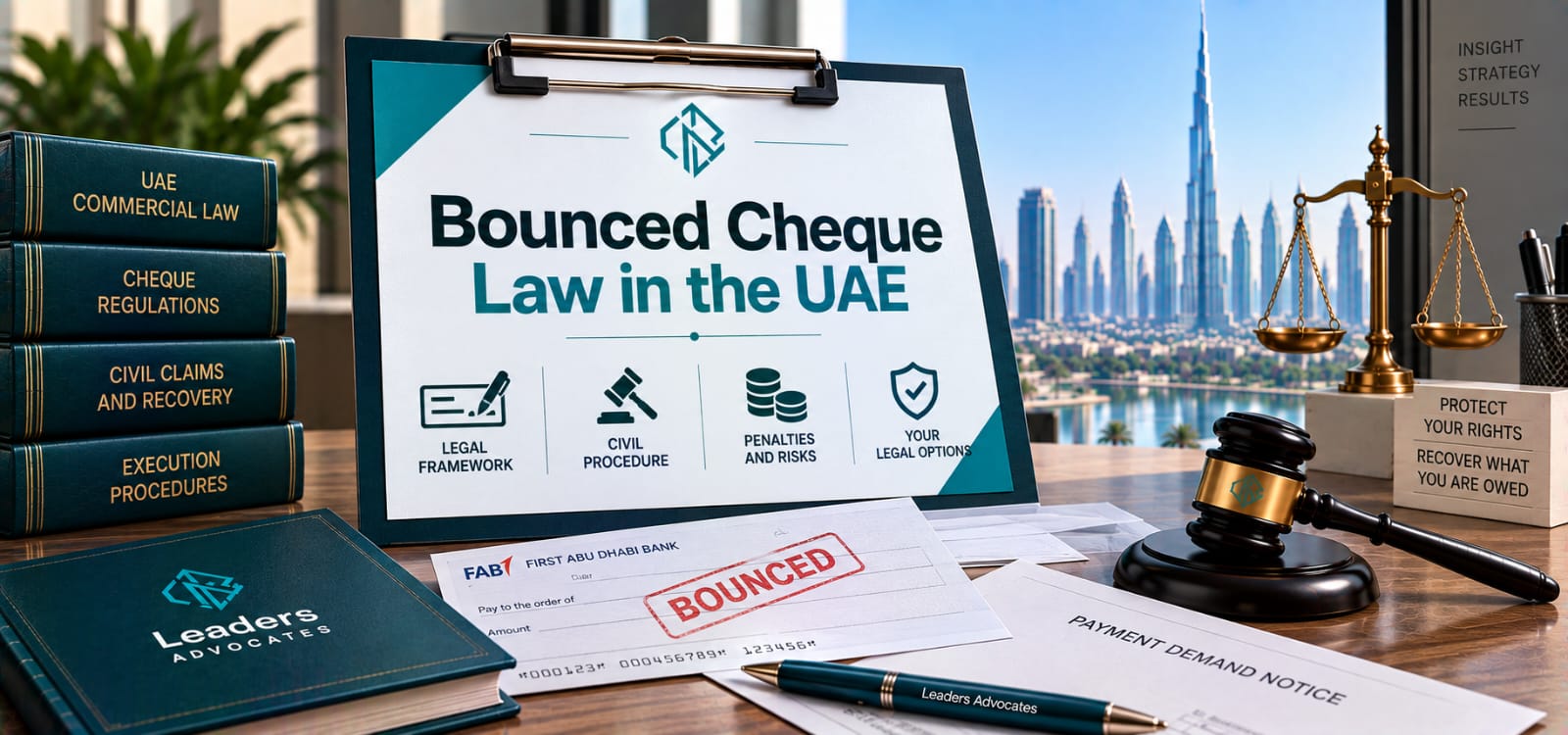
Bounced Cheque Law in UAE
Federal Decree-Law No. 14 of 2020 introduced major cheque reforms that took effect in January 2022. Federal Decree-Law No. 50 of 2022 now contains the current Commercial Transactions Law framework.
The law gives executive force to certain dishonored cheques. It also keeps criminal penalties for specific conduct defined in Articles 674 to 676.
The Bank Return Reason Matters
Ask the bank for the exact reason. No balance, insufficient balance, closed account, payment stop, mismatched signature, missing details, and suspected alteration can lead to different issues.
Do not rely only on an app notification. Article 663 addresses proof of dishonor through a dated statement from the drawee bank that records the presentation day on the cheque.
Keep every bank record. The return wording can determine whether Article 667 direct execution is available.
Not Sure What Your Bank Return Reason Means?
Send us the bank notation on WhatsApp and we’ll tell you whether direct execution applies to your cheque.
Article 667 Direct Execution
Article 667 states that a cheque marked by the bank for no or insufficient balance is an executive instrument. The holder may request compulsory execution for all or part of the amount.
The Civil Procedure Law governs the application and any challenge. The holder does not first need an ordinary civil judgment on the same qualifying instrument.
Execution still requires a proper filing. The court reviews the parties, original instrument, amount, bank notation, and procedural requirements.
The Original Cheque
Keep the original cheque secure. Avoid writing over the bank’s notation or attaching material that hides its terms.
A scan helps with internal review, but the original may be required for banking or court procedure. Record who holds it and every time it is submitted.
If the cheque is lost, do not create a replacement copy and treat it as the original. Obtain advice on the legal process for a lost instrument.
The Six Month Presentation Period
Article 649 provides a six-month period for presenting a cheque payable in the UAE. The period begins on the issue date written on the cheque.
Presentment through a bank or a legally recognized clearing method can count. Keep proof of the date and method.
Article 651 allows a bank to pay after the presentation period. That does not mean every recourse or limitation period is extended.
Partial Payment
Article 648 addresses a cheque account with less than the full amount available. The bank must make partial payment unless the holder refuses it.
The bank records the partial payment on the original cheque. It provides a certificate and returns the instrument to the holder.
The holder may pursue the remaining amount. Every later demand or execution request must deduct what was already paid.
Time Bars Under Article 670
Article 670 contains separate periods after which certain cheque claims will not be heard. A bearer claim against the drawer, endorsers, and other obligors is generally linked to two years after the presentation period expires.
The article also contains a one-year period for recourse among obligors and a three-year period for a bearer claim against the drawee bank. Exceptions may apply in the circumstances stated by the law.
These periods are not interchangeable with every underlying debt claim. Review the instrument, parties, dates, and relief before relying on one deadline.
Worried You’ve Missed a Cheque Deadline?
Presentation, recourse, and claim periods are easy to get wrong. Message us on WhatsApp and we’ll review your dates today.
Civil Enforcement Is the Main Route for Insufficient Funds
A return for insufficient funds does not automatically create the former broad criminal case. The law directs the holder toward execution under Article 667.
The court may consider lawful enforcement measures after the application is accepted. Attachment, account inquiries, asset sale, or a travel restriction depend on the current rules and a judicial decision.
Do not promise a specific measure. Ask for relief supported by the facts and proportional to the unpaid amount.
Criminal Conduct Under Article 674
Article 674 addresses a person who endorses or delivers a bearer cheque while knowing there is no available balance or that the funds cannot be drawn.
The article provides a fine linked to the cheque value, subject to its statutory minimum and maximum. Repeat offending can increase the penalty.
The required knowledge matters. A bank return alone does not prove every element of the offense.
Criminal Conduct Under Article 675
Article 675 addresses defined acts intended to prevent payment. They include certain unjustified instructions to the bank not to honor the cheque.
It also covers closing the account, withdrawing its balance, knowing it was closed, intentionally freezing it, or deliberately signing the cheque in a way that prevents payment.
The article provides imprisonment and or a fine within statutory limits. The precise facts and timing must be proved.
Forgery Under Article 676
Article 676 covers forging or fabricating a cheque, knowingly using one, and other specified misuse. It also addresses certain tools or data used for cheque forgery.
Forgery is different from a routine signature mismatch. Expert review and the original instrument may be necessary.
Do not accuse a signatory of forgery based only on a return code. Preserve the cheque and obtain legal advice.
Facing a Criminal Cheque Allegation?
A bank return alone doesn’t prove intent. Talk to us on WhatsApp now before you respond to any complaint.
Payment Stop Instructions
The law permits objections to payment in limited settings, including loss or bankruptcy of the bearer under Article 651. Other unjustified payment-stop conduct can create Article 675 exposure.
Review the actual instruction, timing, reason, and person who gave it. A contractual dispute does not automatically justify stopping payment.
The civil debt and any criminal allegation should be analyzed separately.
Company Cheques
Identify the company named on the account and the authorized signatory. The company, manager, shareholder, and employee are distinct legal persons.
Personal liability does not arise merely because someone signed for a company. A separate legal or contractual basis is required.
Preserve the trade license, authority record, contract, invoices, and communications. They show the underlying transaction and the roles of each person.
Cheque and Underlying Debt
The cheque may secure an invoice, loan, settlement, or another obligation. Keep the records behind it.
A debtor may raise payment, setoff, invalidity, lack of authority, or another defense. The execution court can consider challenges under the applicable procedure.
Do not recover the same amount twice. Reconcile payments received through the cheque and the underlying claim.
Responding to an Execution Case
Read the execution file and notice. Confirm the cheque, amount, bank return, claimant, service, and requested measures.
Act within the applicable period. A challenge should identify a real legal or factual ground and include the supporting document.
If payment is admitted but immediate payment is difficult, seek advice on settlement or any lawful request available. Do not ignore the file.
Settlement
A settlement should state the balance, installments, dates, payment method, security, and default consequences. It should also address the execution file.
Record each payment and obtain receipts. The holder should not continue execution for an amount already paid.
Do not surrender the original cheque before the settlement terms require it. Define when the instrument will be returned or canceled.
Faris Raian on Bounced Cheques
Faris Raian, founder and partner at Leaders Advocates, has explained that holders and issuers often misunderstand how directly a qualifying dishonored cheque can be enforced.
Holders may move to execution faster than expected. Issuers facing genuine financial difficulty should respond early because court measures can escalate once execution begins.
Documents for the Holder
- Original cheque.
- Dated bank return statement.
- Presentation and deposit proof.
- Contract, invoice, loan, or settlement.
- Payment and partial-payment records.
- Drawer and company details.
- Written demands and responses.
- A calculation of the unpaid balance.
Scan the file, but preserve the originals.
Ready to Get Your Cheque Enforced?
Send your original cheque and bank return on WhatsApp. We’ll tell you the fastest legal route to get paid.
Related Success Story
Leaders Advocates publishes a Dubai debt recovery case involving successful loan recovery. The Leaders Advocates Success Stories page includes the available summary.
The facts and instrument differ in every matter. The result is not a guarantee, but the case shows the value of documents and an enforcement plan.
Common Mistakes
- Assuming every bounced cheque is automatically criminal.
- Filing without the original cheque or bank notation.
- Ignoring partial payment.
- Missing presentation or claim dates.
- Treating every return reason as Article 667 execution.
- Naming managers without a legal basis.
- Promising attachment or a travel restriction.
- Ignoring an execution notice.
Final Takeaway
Bounced cheque law now separates direct civil execution from defined criminal conduct. The bank return reason, original cheque, amount, and timeline determine the first analysis.
Act promptly and use the procedure supported by the actual facts. Keep civil recovery, defenses, settlement, and any criminal allegation distinct.
Relevant Legal Services
- Debt Recovery Lawyers in Dubai — for cheque demands, settlement, execution, and repayment strategy.
- Litigation Lawyer in Dubai — for execution filings, challenges, and related court disputes.
- Civil Lawyers in Dubai — for the underlying loan, invoice, contract, or payment claim.
Follow Leaders Advocates on LinkedIn or Leaders Advocates on Facebook for more UAE legal updates.
Frequently Asked Questions
Holding a Bounced Cheque or Facing an Execution Case?
Message Leaders Advocates on WhatsApp now for a fast, confidential read on your cheque and your fastest path to recovery.