


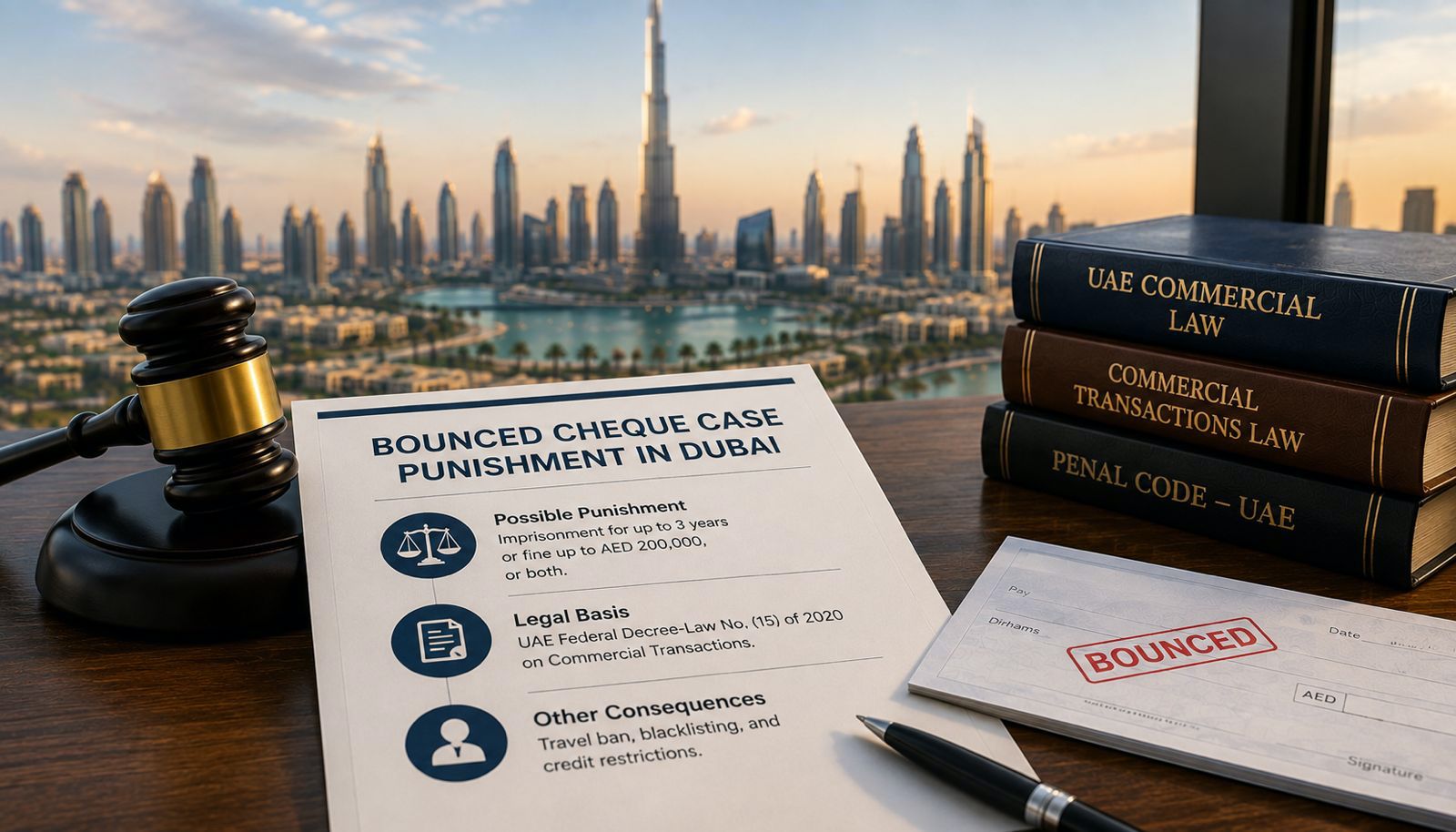

The punishment for a bounced cheque case in Dubai depends on why the bank refused payment. Insufficient funds and bad faith are treated differently.
An ordinary shortfall is mainly a civil enforcement issue. Fraud, deliberate misuse, or forgery can still create criminal exposure.
The distinction is not about how much the cheque was worth. It is about what the bank return memo says and what the surrounding conduct shows.
A cheque returned only for insufficient funds carries no criminal punishment under the current framework, though the payee can still enforce the debt through the Execution Court. Criminal exposure remains where bad faith or fraud is proved. Article 675 provides imprisonment from six months to two years, and a fine of at least 10% of the cheque value, with a minimum of AED 5,000 and a maximum of twice the cheque value. Article 676 punishes cheque forgery with at least one year in prison and a fine from AED 20,000 to AED 100,000. Certain simpler Dubai cases use fines of AED 2,000, AED 5,000, or AED 10,000. Early full payment can stop some criminal cases before execution begins.
Start With the Reason on the Bank Return Memo
In cases like this, it is worth speaking with debt recovery lawyer in dubai.
Do not begin with the cheque amount alone. Begin with the bank’s stated return reason and the surrounding conduct.
- Insufficient funds in an otherwise active account.
- Account closure.
- Stop-payment instruction.
- Signature or writing designed to prevent payment.
- Forgery, alteration, or fabricated cheque details.
- Funds withdrawn after the cheque was issued.
The return reason does not prove criminal intent by itself. It identifies the issue that must be investigated and explained.
Keep the original cheque, return memo, bank records, and communications. They show whether the case is civil, criminal, or both.
Punishment for a Bounced Cheque Case in Dubai: Main Categories
For help choosing the right professional, see our guide on who is the best cheque bounce lawyer in dubai.
Before 2022, a bounced cheque could become a criminal case almost automatically. That approach changed on 2 January 2022.
A genuine good-faith shortage of funds now leads mainly to civil enforcement. It does not create a criminal sentence by itself.
The payee can still seek payment through the Execution Court. No criminal punishment does not mean no financial consequence.
When a Bounced Cheque Becomes a Criminal Offence
You can read more about this in our guide on bounced cheque case in the UAE.
Criminal liability remains for specific deliberate conduct. The facts must show more than an ordinary payment failure.
- Drawing a cheque in bad faith without genuine intent to cover it.
- Withdrawing funds after issuing the cheque.
- Ordering the bank to stop payment without valid grounds.
- Writing or signing the cheque to make payment impossible.
- Closing the account to avoid payment.
- Forging, fabricating, altering, or knowingly using a false cheque.
The investigation focuses on conduct and intention. The bank memo, account history, instructions, and communications can all matter.
Article 675: The Main Bad-Faith Penalty
This connects closely with our guide on debt recovery in the UAE.
Article 675 of Federal Decree-Law No. 50 of 2022 on Commercial Transactions is the main bad-faith cheque provision.
The punishment is imprisonment from six months to two years and/or a fine linked to the cheque value.
- The fine is at least 10% of the cheque value.
- The minimum fine is AED 5,000.
- The maximum fine is twice the cheque value.
- The court may impose imprisonment, a fine, or both.
The final sentence depends on the proven facts. The cheque amount is only one part of the court’s assessment.
Article 676: Forgery Carries a Harsher Penalty
Forgery involves fabricating, altering, or knowingly using a false cheque. It is treated more severely than ordinary bad faith.
- Changing cheque details through addition or deletion.
- Fabricating a signature or cheque.
- Knowingly using a forged or altered cheque.
- Presenting false details as genuine.
| Point | Article 675, Bad Faith | Article 676, Forgery |
|---|---|---|
| Conduct Covered | Stop payment, account closure, withdrawing funds, deliberate signing defects | Fabricating, altering, or knowingly using a false cheque |
| Imprisonment | Six months to two years | At least one year |
| Fine | At least 10% of value, minimum AED 5,000, maximum twice the value | AED 20,000 to AED 100,000 |
| Linked to Cheque Value | Yes, the fine scales with the amount | No, the range is fixed |
| Effect of Payment | Early full payment can stop some cases | Payment may not answer the document offence |
The forgery offence is separate from the unpaid debt. Payment may not answer every allegation about a false document.
The Lower-Tier Fine Scale for Simpler Dubai Cases
Certain simpler cases use a streamlined Public Prosecution process. The fine depends on the cheque value.
| Cheque Value | Stated Fine | Note |
|---|---|---|
| Under AED 50,000 | AED 2,000 | No imprisonment once the fine is paid in this category |
| AED 50,000 to AED 100,000 | AED 5,000 | Streamlined treatment depends on the actual classification |
| AED 100,000 to AED 200,000 | AED 10,000 | More serious conduct may move beyond the simple fine route |
| Above AED 200,000 | Referred to criminal court | Full examination of the conduct and evidence |
Do not assume the value alone decides the case. Fraud, forgery, account closure, and other conduct can change the legal route entirely.
A cheque file should be classified before settlement or defence decisions are made. A criminal defence lawyer in Dubai can review the return reason, the evidence of intent, and any prosecution file already opened.
Facing a Criminal Cheque Allegation?
Bad faith and forgery allegations turn on evidence of intent, not on the cheque amount. Leaders Advocates can review the return reason, the account records, and the prosecution file before you respond.
Civil Consequences Are Not Criminal Punishment
A civil case can still be serious even when no criminal penalty applies. The unpaid amount remains enforceable.
- Direct enforcement through the Execution Court.
- Bank account freezing.
- Attachment of assets.
- A discretionary travel ban.
- Legal costs and payment orders.
- A continuing credit-record impact.
These measures aim to recover the debt. They are different from imprisonment or a criminal fine. Our debt recovery lawyers in Dubai handle the enforcement side, and our guide on how to clear a bounced cheque case in Dubai sets out the settlement and enforcement steps in full.
Paying Before Execution Can Stop Some Criminal Cases
Early full payment can stop several bad-faith criminal cases. Timing is critical.
The full cheque value must be paid before execution procedures begin for this stated route. Later payment may not have the same effect.
- Confirm the cheque amount and the exact criminal allegation.
- Obtain a traceable full-payment method.
- Document payment and creditor receipt.
- File the proof through the competent criminal process.
- Confirm whether execution procedures have already started.
- Obtain written confirmation of the case outcome.
A verbal settlement is not enough. Link the payment to the cheque and to every existing case reference.
Company Cheques and Management Liability
A company cheque does not make every director or manager automatically criminally liable. The individual’s role and knowledge must be proved.
Under Article 683, liability can depend on knowledge or personal benefit. A job title alone is not enough.
- Who controlled the account and cheque book.
- Who signed or ordered the cheque.
- Who knew about the available balance.
- Who gave any stop-payment instruction.
- Whether anyone received a personal or third-party benefit.
- What board, banking, and internal records show.
Keep company records that show decision-making and authority. They can separate management responsibility from automatic assumptions, and our corporate lawyers in Dubai can help assemble the authority trail.
How the Court Decides Between Fine and Imprisonment
Article 675 allows a fine, imprisonment, or both. The court considers the proved misconduct and the case circumstances.
No one can predict the final sentence from the cheque amount alone. Evidence about intent remains central.
- The stated bank return reason.
- Account activity before and after issue.
- Communications with the payee.
- Any stop-payment or closure instruction.
- Evidence of alteration or forgery.
- Timing and completeness of later payment.
A serious criminal allegation requires a file-specific defence. General online fine charts cannot decide it.
Documents to Collect
For the Drawer
- Cheque copy and bank return memo.
- Account statements around the issue and presentation dates.
- Contract, invoice, loan, or settlement documents.
- Messages showing payment discussions.
- Proof of partial or full payment.
- Company authority records, where relevant.
For the Payee
- Original cheque and official bank return record.
- Evidence of the underlying obligation.
- Demand letters and delivery proof.
- Correspondence about payment and account status.
- Evidence suggesting deliberate misconduct, if alleged.
- Civil execution and criminal complaint references.
Use the same cheque number, amount, and party names throughout. Inconsistent details can delay filing or settlement.
What to Do After Receiving a Police or Court Notice
Read the notice before contacting the other party. Identify whether it concerns police, prosecution, criminal court, or execution.
- Record the authority, case number, hearing date, and deadline.
- Collect the cheque, return memo, and underlying contract.
- Obtain current bank and payment records.
- Avoid deleting messages or altering documents.
- Review early settlement and defence options.
- Attend or respond through the required channel.
Do not assume one case number covers every track. Civil execution and criminal proceedings can have separate references.
Credit and Business Consequences
Settlement does not always remove the credit entry immediately. The financial record can continue after the debt is paid.
A company may also face banking and supplier concerns. Keep the settlement and case-closure records for later checks.
- Ask the bank how the account record will be updated.
- Keep the creditor’s no-liability or clearance letter.
- Retain the court or prosecution closure decision.
- Check the credit record after updates are expected.
- Correct any mismatch through the responsible institution.
Is a Company Cheque Being Traced Back to You?
A job title does not create criminal liability by itself. The evidence has to connect knowledge, authority, or personal benefit to the individual. We can build that record before the prosecution forms a view.
Civil and Criminal Examples
The same unpaid amount can produce different legal results depending on conduct. These examples help separate the categories.
Example 1: Genuine Cash-Flow Shortfall
The drawer expected funds but the account balance was insufficient on presentation. No separate act shows fraud or deliberate misuse.
This is mainly a civil recovery problem. The payee can enforce the cheque amount through the Execution Court.
Example 2: Account Closed Before Presentation
The bank returns the cheque because the account was closed. The reason and timing of closure require investigation.
If the closure was intended to avoid payment, criminal exposure may arise. Account records and instructions become important.
Example 3: Stop-Payment Instruction
The drawer ordered the bank not to pay. The court considers whether a valid ground existed for that instruction.
An unjustified stop-payment order can move the matter into criminal territory. Keep the instruction and the stated reason.
Example 4: Cheque Written to Prevent Payment
A deliberate signature mismatch or other writing defect can indicate an effort to make the cheque unpayable.
The evidence should show the defect was intentional. A simple clerical mistake is a different factual issue.
Example 5: Forged or Altered Cheque
A signature or cheque detail was fabricated or changed. Article 676 applies a separate and harsher penalty.
The document offence and the debt recovery may proceed through different issues. Preserve the original cheque for examination.
How to Read the Bank Return Reason
The bank return memo is the first objective record. It states why the bank refused payment on presentation.
- Insufficient funds.
- Account closed.
- Payment stopped.
- Signature mismatch.
- Technical or writing defect.
- Suspected alteration or other irregularity.
Do not rewrite the bank’s reason in stronger language. Use the exact wording and collect records that explain it.
The memo does not decide intention. Police, prosecution, and court review the bank evidence alongside the surrounding conduct.
Account Statements
Statements show the balance, deposits, withdrawals, and account status around issue and presentation. Keep the complete relevant period.
Bank Instructions
A stop-payment or closure instruction can show who acted and when. Preserve the request and the reason given to the bank.
Signature Records
Specimen signatures and authorised signatory records may matter in a mismatch or forgery allegation. Company mandates can also be relevant.
Separate Legal Tracks May Exist
One bounced cheque can create more than one reference. Each track answers a different legal question.
Execution Court
The execution file seeks recovery of the cheque amount. It may include asset attachment, account freezing, or a travel ban.
Police and Public Prosecution
The criminal file investigates alleged bad faith, fraud, forgery, or deliberate misuse. It focuses on conduct and liability.
Criminal Court
The court decides the criminal allegation and sentence when the case proceeds. Article 675 or Article 676 may become relevant.
Bank and Credit Records
The bank and credit record can continue after the legal file changes. Settlement documents may be needed for later updates.
Closing one track does not always close the others. Obtain a written outcome for every case number. Where more than one file is active, our litigation lawyers in Dubai can coordinate the civil and criminal positions together.
Immediate Actions for the Drawer
The drawer should act before enforcement measures increase. The goal is to understand the return reason and preserve every option.
- Obtain the bank return memo and cheque copy.
- Check the account balance and instructions around presentation.
- Identify every police, prosecution, court, and execution reference.
- Collect the contract and proof of any payment already made.
- Contact the payee with a realistic written proposal.
- Review whether full payment can occur before execution begins.
- Document settlement and file it in every active case.
Do not make false promises about immediate payment. A broken agreement can damage later negotiations and credibility.
If the Cheque Was a Company Cheque
Identify the authorised signatory, account controller, and the person giving banking instructions. Keep board or management records.
Do not assume the most senior title is automatically responsible. Article 683 requires evidence linked to the individual.
If Forgery Is Alleged
Preserve the original document, specimen signatures, and banking mandate. Avoid writing on or altering the cheque.
A forgery allegation needs careful evidence handling. The debt dispute and the document offense should not be confused.
Immediate Actions for the Payee
The payee should preserve the executive instrument and the evidence behind the debt. A complete file supports both settlement and enforcement.
- Keep the original cheque in a safe place.
- Obtain the official bank return memo.
- Collect the contract, invoice, or transaction record.
- Send a clear payment demand where appropriate.
- Record every response, admission, and partial payment.
- File for civil execution when settlement fails.
- Use a criminal complaint only when the facts support it.
Avoid overstating criminal allegations to force payment. The evidence should support the complaint category actually filed.
When the Drawer Offers Partial Payment
Record the amount paid and the balance remaining. State whether accepting payment changes any existing legal action.
A partial payment can acknowledge the debt. Keep the bank and written settlement records.
When the Drawer Offers Full Payment
Confirm the total amount, costs, and accepted method. State which cases will be closed after cleared funds are received.
Do not return original evidence before the payment and closure terms are complete. Keep copies of everything provided.
Settlement Before and After Execution
Before Execution Begins
Early settlement offers more control over payment and closure terms. It may also affect some criminal cases under the stated payment rule.
- Agree on the full cheque amount and costs.
- Use a traceable payment method.
- State the deadline for cleared funds.
- Identify each case to be withdrawn or closed.
- Record the effect on the original cheque.
After Execution Begins
The settlement should be filed in the execution case. Ask the court to record payment and address any active measures.
- Update the execution balance.
- Request release of attached assets where appropriate.
- Request account unfreezing where ordered.
- Address any travel ban formally.
- Obtain the written closure or suspension decision.
The specific early-payment rule may no longer apply in the same way after execution starts. Timing must be checked.
When a Criminal Case Already Exists
Submit payment evidence through the competent criminal file. A private receipt does not update the prosecution or court record automatically.
Ask for written confirmation of the criminal outcome. Keep it separate from the civil execution closure.
A Company Cheque Investigation File
Company cases often involve several people and approval levels. Build a record showing who did what at each stage.
- Corporate bank mandate and authorized signatories.
- Board or management approval for the transaction.
- Person who prepared and delivered the cheque.
- Person who monitored the account balance.
- Person who ordered closure or stop payment.
- Internal messages about funding and presentation.
- Evidence of any personal or third-party benefit.
This evidence helps test Article 683. It can show whether knowledge or benefit was connected to a particular manager.
A company may remain civilly liable even when one person lacks criminal responsibility. Keep the two questions separate.
How to Confirm the Case Is Closed
A case is not safely closed because the parties stopped communicating. Obtain documents from every authority involved.
- Creditor’s signed receipt and clearance.
- Execution Court balance and closure decision.
- Police or prosecution disposition.
- Criminal court judgment or case-ending order.
- Travel-ban cancellation where applicable.
- Release of attached assets or frozen accounts.
- Updated bank and credit information when available.
Compare the party names, cheque number, and case reference on each document. A closure for one cheque may not cover another.
Store the final file permanently. Banks, creditors, or authorities may later ask for proof of the outcome.
Common Misconceptions
Every bounced cheque means jail.
No. Ordinary insufficient funds have civil consequences, not automatic criminal punishment.
Paying a fine always avoids prison.
No. That may apply in the simpler fine-scale category. Article 675 still gives the court separate sentencing discretion.
Forgery is treated like an ordinary bounce.
No. Article 676 sets a higher prison minimum and a separate fine range.
A director is automatically liable.
No. Knowledge, conduct, authority, or personal benefit must be connected to the individual.
Payment never helps after filing.
No. Early full payment can stop some bad-faith cases before execution procedures begin.
Common Mistakes to Avoid
- Treating every bank return reason as the same offence.
- Ignoring a civil execution notice because no criminal case exists.
- Using the AED 2,000 to AED 10,000 scale for serious bad faith.
- Assuming a company title creates automatic personal liability.
- Making an undocumented payment without case closure terms.
- Waiting until execution starts before considering full payment.
- Losing the bank return memo or original cheque record.
Frequently Asked Questions
The legal exposure depends on the return reason, the intention behind it, the value, and the procedural stage the case has reached.
Those four factors rarely point the same way, which is why a file review is more useful than any general fine chart.
Need a Cheque Case Reviewed Properly?
Leaders Advocates acts in both civil enforcement and criminal cheque matters across Dubai, from classifying the return reason through to defending bad-faith and forgery allegations in court.

1 Comment