


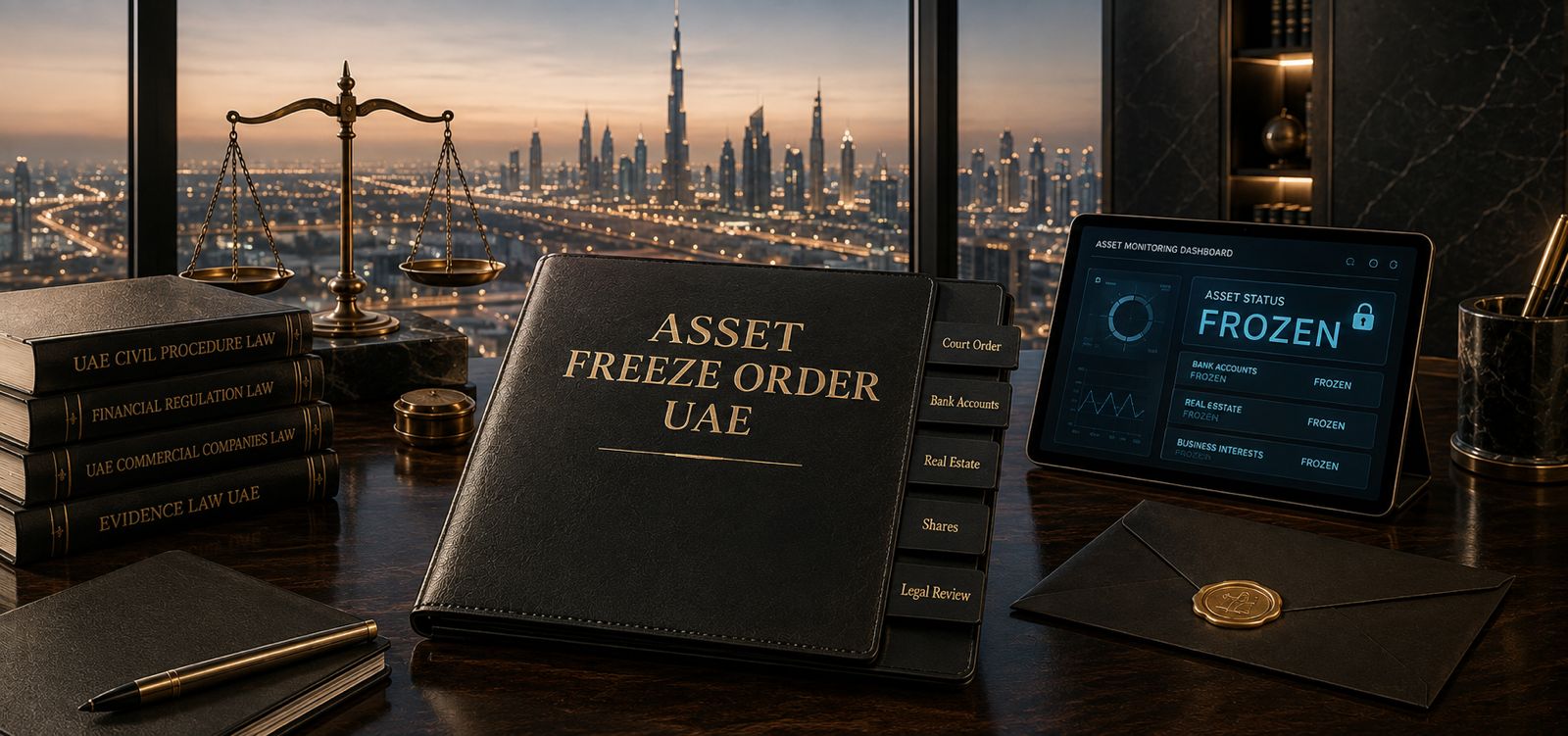

Asset freeze orders in the UAE can reach far beyond a bank account. Under the precautionary attachment framework, the order can cover property, vehicles, company shares, and other valuable assets.
A creditor may seek this protection before the main legal case is filed. The purpose is to stop assets being hidden, transferred, or dissipated before a judgment can be enforced.
Asset freeze orders in the UAE are formally handled as precautionary attachments under Articles 247 to 251 of the Civil Procedures Law, Federal Decree-Law No. 42 of 2022. The order can cover bank accounts, real estate, vehicles, company shares, furniture, office equipment, and other valuable property. A creditor may apply before filing the main substantive claim if there is sufficient evidence of a real, ascertainable debt and a genuine risk that assets may be hidden or transferred. In urgent cases, courts can grant the order within 24 to 48 hours. After the order, the claimant must file the substantive case within 8 days. If enforcement does not begin within 30 days of a final judgment, the attachment becomes void.
What Asset Freeze Orders in the UAE Can Cover
Working with criminal defense lawyer in dubai can help you avoid costly mistakes here.
The order is not limited to money held in a bank. Precautionary attachment can reach several asset types.
- Bank accounts.
- Real estate and other property.
- Vehicles.
- Company shares and stock.
- Furniture, office equipment, and other valuable movable property.
This wider scope matters when the debtor holds value in several forms. A creditor may be concerned about assets being moved before the main claim reaches judgment.
For disputes that may require an attachment application or a challenge to one, litigation lawyers in Dubai can review the procedural position and the underlying claim.
What a Creditor Must Show Before an Asset Freeze
For a closer look at this, see our guide on how to find the best family lawyers in dubai.
The creditor generally needs evidence of a real and ascertainable debt. The application also needs evidence of a genuine risk that the debtor may hide, transfer, or dissipate assets before judgment.
The two points work together. The application is not only about showing a debt. It also addresses why waiting until the end of the case may put recovery at risk.
Can the Order Be Requested Before the Main Case?
Our guide on new UAE visa rules explains this further.
Yes. A creditor can request precautionary attachment before filing the main substantive claim.
That does not remove the next filing requirement. Once the attachment order is granted, the substantive case must follow within the stated deadline.
Worried Assets Are Being Moved Before You Can Sue?
A freeze can be granted in 24 to 48 hours in urgent cases, but only with the right evidence of the debt and the risk. Our best advocates in Dubai can assess your position today and file before the assets are gone.
The Key Deadlines After a Precautionary Attachment
You can read more about this in our guide on penalties for forging drug tests in the UAE.
The attachment process includes strict timing points. Missing them can affect whether the freeze remains effective.
- The substantive claim must be filed within 8 days of the attachment order.
- If the substantive claim is not filed within that period, the freeze is automatically lifted.
- Enforcement proceedings must start within 30 days of a final judgment, or the attachment becomes void.
- In urgent cases, the court can grant an asset freeze within 24 to 48 hours.
Why the 8-Day Filing Requirement Matters
A creditor who obtains an early freeze still has to move the main dispute forward. Missing the 8-day filing deadline causes the freeze to lift automatically.
This makes the attachment and the substantive case closely connected. The freeze protects the position while the main claim is brought, rather than replacing that claim.
Where the attachment is connected to unpaid debt and enforcement, debt recovery lawyers in Dubai can assess the recovery route alongside the attachment issue.
Urgent Applications and the 24 to 48 Hour Window
Courts can grant an asset freeze within 24 to 48 hours in urgent cases. Emergency judges are also available outside normal court hours.
Urgency does not change what the creditor needs to show. The application still depends on evidence of the debt and the risk to the assets.
DIFC and ADGM as an Alternative Venue
DIFC and ADGM courts are alternative venues in complex or international matters. They apply common-law freezing order principles.
The onshore Dubai Courts route remains the equivalent precautionary attachment route set out above. The appropriate forum depends on the specific dispute and its connection to the available court system. The commercial framework behind these disputes is summarised in this overview of commercial law in the UAE.
How an Asset Freeze Can Be Challenged or Lifted
Three routes may lead to a challenge or release. Each depends on what has happened to the debt, the filing deadline, or the dispute itself.
- File a formal legal objection where the underlying claim is genuinely disputed.
- Rely on the automatic lifting of the freeze if the creditor misses the 8-day filing deadline.
- Settle the underlying debt, which generally leads directly to release of the freeze.
Where the dispute is primarily a civil claim rather than a debt collection matter, civil lawyers in Dubai can review the claim and the attachment affecting the parties.
Accounts Frozen and You Dispute the Debt?
Check the dates first. If the claimant missed the 8-day filing window, the freeze should already have lifted. Send us the order and we will tell you which route applies to your case.
Practical Steps for a Creditor Seeking an Asset Freeze
- Identify the debt and the assets that may be at risk of transfer or dissipation.
- Prepare the evidence supporting the real and ascertainable debt.
- Prepare the evidence showing the risk to the assets before judgment.
- If the attachment is granted, file the substantive claim within 8 days.
- After a final judgment, make sure enforcement begins within the 30-day period stated above.
Practical Steps if Your Assets Have Been Frozen
- Identify the order and the underlying claim connected to the attachment.
- Check whether the substantive case was filed within the 8-day period.
- If the underlying claim is disputed, consider a formal legal objection.
- If the debt is settled, address release of the attachment rather than assuming it will remain indefinitely.
Common Mistakes
- Assuming an asset freeze only affects bank accounts.
- Ignoring the 8-day deadline after obtaining the attachment order.
- Treating the attachment as a substitute for the main substantive case.
- Overlooking the 30-day enforcement requirement after a final judgment.
- Failing to consider DIFC or ADGM in a complex or international matter described above.
People Also Ask
Conclusion
Asset freeze orders in the UAE are broad protective measures with strict deadlines. They can affect many types of property and may be requested before the main case starts.
For both creditors and asset holders, the key issues are the evidence supporting the application, the risk to the assets, and the filing and enforcement deadlines that keep the attachment effective.
Every Day Counts on an Attachment File
Eight days to file, thirty days to enforce, and a freeze that lifts on its own if either is missed. Leaders Advocates acts for creditors seeking attachment and for asset holders challenging one, onshore and in the DIFC and ADGM.


6 Comments