


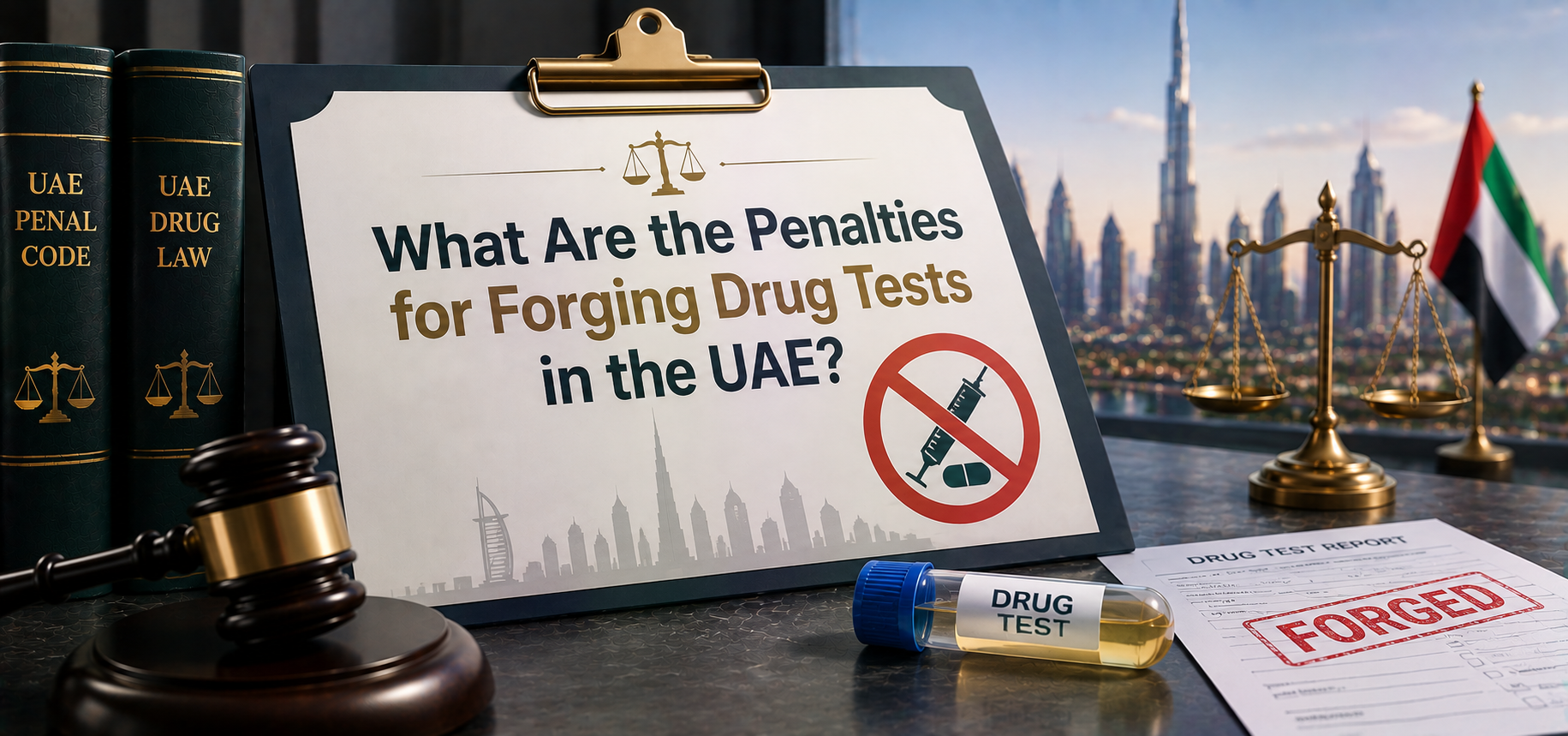

The penalties for forging drug tests in the UAE depend on the document, the method of falsification, and how the result was used. A person may face criminal liability for creating a false report, altering a genuine report, manipulating identifying details, or knowingly submitting a forged result to an employer, immigration authority, regulator, or court.
The Crimes and Penalties Law distinguishes official from unofficial documents. A criminal defense lawyer in Dubai can help assess the applicable charge, while how to choose best criminal lawyer for your case in Dubai depends on the nature and stage of the matter. Other UAE legal issues, including UAE law for car accidents and what does child maintenance cover in the UAE, should also be assessed according to the specific facts and applicable provisions. Article 252 provides imprisonment of up to 10 years for forging an official document, while forgery of an unofficial document is punishable by incarceration. Article 258 applies the corresponding forgery penalty to a person who knowingly uses the forged document.
Quick Answer
Forging a drug test in the UAE can amount to document forgery whether the person fabricates the result, alters a genuine report, changes an identity or value, or knowingly submits a false document.
Under Article 252, forgery of an official document is punishable by imprisonment for up to 10 years; forgery of an unofficial document is punishable by incarceration. The classification depends on the document’s issuer, legal function, and circumstances.
Article 258 provides that a person who knowingly uses a forged document faces the penalty prescribed for the corresponding forgery, even if someone else created it. Exposure may also extend to employment, immigration, licensing, or family proceedings when the result was submitted to influence a decision.
The original report, laboratory trail, device records, and submission history should be preserved immediately.
Faris Raian is the founder, Managing Partner, and Senior Legal Consultant at Leaders Advocates. He brings more than 15 years of experience across commercial, corporate, real estate, family, and criminal law in UAE courts, with experience relevant to document forgery allegations, medical and employment records, digital evidence, police and prosecution investigations, and criminal defense.
Why This Falls Under Forgery Law, Not Just Workplace Policy
A drug test result is a document, and altering it, fabricating one, or submitting someone else’s genuine result as your own falls within the UAE’s forgery framework.
This pushes the consequences beyond a workplace disciplinary issue because forgery can be dealt with through the criminal justice system, not only through an employer’s internal process.
Official vs Private Document Forgery
The distinction between official and unofficial documents is important.
A drug test connected to a government-mandated screening, visa medical, court-ordered test, or another official process may raise the question of whether it qualifies as an official document.
A test obtained from a private clinic for an employer’s internal purposes may be classified differently.
The classification should not be assumed merely because a document appears formal. The issuer, legal status, purpose, and way the document was used all matter.
Accused of Forging or Using a False Drug Test in the UAE?
The legal exposure can depend on whether the document is treated as official or unofficial, what was altered, who created it, and how it was used. Get the report, laboratory records, digital trail, and case stage reviewed before responding further.
Using a Forged Result Is Its Own Offence
Criminal exposure is not limited to the person who physically created or altered the drug test.
A person who knowingly submits a forged result to an employer, immigration authority, regulator, court, or another decision-maker may also face liability, even where someone else created the forgery.
Article 258 applies the corresponding forgery penalty to the knowing use of the forged document.
Where This Actually Comes Up
Workplace Screening
An employee may submit an altered or fabricated result in an attempt to satisfy an employer’s drug-testing requirement.
Immigration or Residency
A visa or residency applicant may submit a falsified medical document as part of an official process.
Family or Court Proceedings
A party may attempt to use a fabricated result to influence a custody, family, or other court matter.
Each context can create both criminal consequences and separate consequences within the process where the document was used.
What Conduct Can Amount to Forging a Drug Test
Forgery is broader than producing an entirely fictional report.
Article 251 addresses methods that can include changing writing, numbers, marks, or images; adding or altering a signature, seal, or fingerprint; creating a false document attributed to another person; filling a signed blank without authority; changing identity; and altering the truth in a document intended as proof.
In a drug-testing context, examples may include:
- Replacing the patient’s name.
- Changing an identity number.
- Altering the collection date.
- Changing a positive result to negative.
- Copying the layout of a genuine laboratory report.
- Altering a QR code or verification link.
- Using another person’s genuine result.
- Changing sample or reference numbers.
A technical mistake is not automatically a completed forgery offence. The circumstances should distinguish an innocent clerical error from an intentional alteration, fabrication, or knowing use.
Evidence That Should Be Preserved
Important material may include:
- The original test request.
- Sample collection records.
- The original laboratory report.
- The patient’s name and identity number.
- Test date and collection date.
- Sample or reference number.
- The result shown on each version.
- Any signature, stamp, QR code, barcode, or verification link.
- File metadata.
- Email or message history.
- Upload or submission records.
- The device used to receive, edit, or send the document.
- Information identifying who created, changed, received, or submitted each version.
Official and Unofficial Document Penalties Under Articles 252 and 253
Article 252
Article 252 sets the main distinction between official and unofficial documents.
Forgery of an official document is punishable by imprisonment for no more than 10 years.
Forgery of an unofficial document is punishable by incarceration.
The status of a medical report should be determined from its actual legal function and issuer rather than its appearance alone.
Article 253
Article 253 separately addresses forged copies of documents and the knowing use of those copies.
It provides imprisonment for up to five years where the forged copy is official and incarceration where the copy is unofficial.
The correct provision therefore depends on whether the alleged item is an original document, copy, or electronic record and on what the evidence actually shows.
Knowingly Using a Forged Result Is a Separate Route to Liability
A person cannot necessarily avoid liability simply by saying that somebody else edited the test.
Under Article 258, knowingly using a forged document can attract the penalty prescribed for the corresponding forgery.
The investigation may therefore consider:
- Who originally supplied the document.
- What the recipient knew about its authenticity.
- When that knowledge arose.
- Where the document was submitted.
- How it was submitted.
- What benefit or decision it was intended to influence.
- Whether the person corrected or disclosed the problem before the document was used.
The submission trail can be especially important. Emails, portal uploads, court filings, and physical submissions may all help establish how the document was used.
How Authenticity Can Be Tested
A forged-drug-test investigation may compare the disputed document with the issuing laboratory or medical facility’s own records.
Relevant questions can include:
- Does the sample number exist?
- Does the patient’s identity match?
- Does the collection date match?
- Was the named signatory authorized?
- Does the result appear in the laboratory’s system?
- Does the QR code or barcode verify correctly?
- Does the electronic file contain suspicious metadata?
- Does the document format differ from the genuine template?
The original digital file is often more useful than a printout or screenshot alone.
A reliable evidence file should preserve the original attachment, complete communication chain, device information, and any portal confirmation.
Did Someone Else Create the Fake Result, but You Submitted It?
Knowingly using a forged document can create separate criminal exposure even where another person made the alteration. Preserve the original file, messages, email trail, device data, and submission history before anything is deleted or changed.
Issues an Accused Person May Need to Address
Depending on the case, the disputed issues may include:
- Authorship.
- Knowledge.
- Intent.
- Whether the document was actually forged.
- Whether the document was official or unofficial.
- Whether the accused person submitted it.
- Whether they knew it was false at the time.
- Whether the alleged digital trail is accurate.
- Whether an innocent clerical or administrative error occurred.
These issues should be considered separately rather than assuming guilt from the document’s appearance alone.
Employment, Immigration, Licensing, and Family Case Consequences
A forgery allegation can create more than one legal or administrative process.
Employment
An employer may investigate misconduct, recruitment representations, or the basis on which employment was obtained or continued.
Immigration
An immigration authority may reconsider an application or status where the test was used in a visa or residency process.
Licensing
A regulator may review a licence or permit that depended on the document.
Family Proceedings
A family court may consider the reliability of a drug-test result submitted in custody or another personal-status dispute.
These proceedings should be tracked separately because they may involve different questions, deadlines, and evidentiary standards.
Immigration Consequences for Non-Citizens
A serious forgery conviction may also affect a non-citizen’s immigration position.
That consequence should not be assumed automatically from the document alone. The charge, sentence, use of the document, and any connected statutory consequence require a case-specific review.
What to Do If a Drug Test Is Disputed
Do not alter the disputed document further.
Do not delete the original file, email thread, messages, or device data.
Do not create a replacement explanation or new version after the dispute begins.
Instead:
- Preserve every version of the document.
- Keep the laboratory records available.
- Save complete messages and emails.
- Preserve device and upload information.
- Record when the document was received and submitted.
- Keep notices from the employer, police, immigration authority, court, or regulator.
- Obtain legal advice before giving inconsistent statements across different proceedings.
Facing an allegation involving a forged or manipulated drug test? Faris Raian and the team at Leaders Advocates can examine the document classification, original laboratory record, digital submission trail, employment or immigration context, and the criminal procedure already underway.
Common Mistakes
- Assuming a forged test result is only an employment issue rather than a potential criminal matter.
- Not realizing that knowingly using another person’s forgery can create separate criminal exposure.
- Underestimating the more serious penalty that can apply where the document is treated as official.
- Assuming every report issued by a private medical facility automatically qualifies as an official document.
- Deleting the original file, email, message thread, or device data after authenticity is disputed.
- Giving separate explanations to an employer, immigration authority, regulator, and police without considering whether the statements are consistent.
Relevant Legal Services
A Criminal Defense Lawyer in Dubai can address forgery charges and prosecution evidence. An Employment Lawyer in Dubai can assess a connected workplace investigation or dismissal. A Litigation Lawyer in Dubai can manage contested document and court issues.
People Also Ask
Conclusion
A forged drug test can create serious criminal and practical consequences in the UAE.
The correct assessment turns on what was changed, whether the document was official or unofficial, who knew about the falsification, how the document was used, and what the laboratory and digital records prove.
Facing Employment, Immigration, or Court Consequences From a Drug Test Dispute?
A forged-result allegation can affect more than the criminal case. Faris Raian and the team at Leaders Advocates can review the document classification, laboratory trail, employer or authority submissions, and connected proceedings as one coordinated legal strategy.
1 Comment