


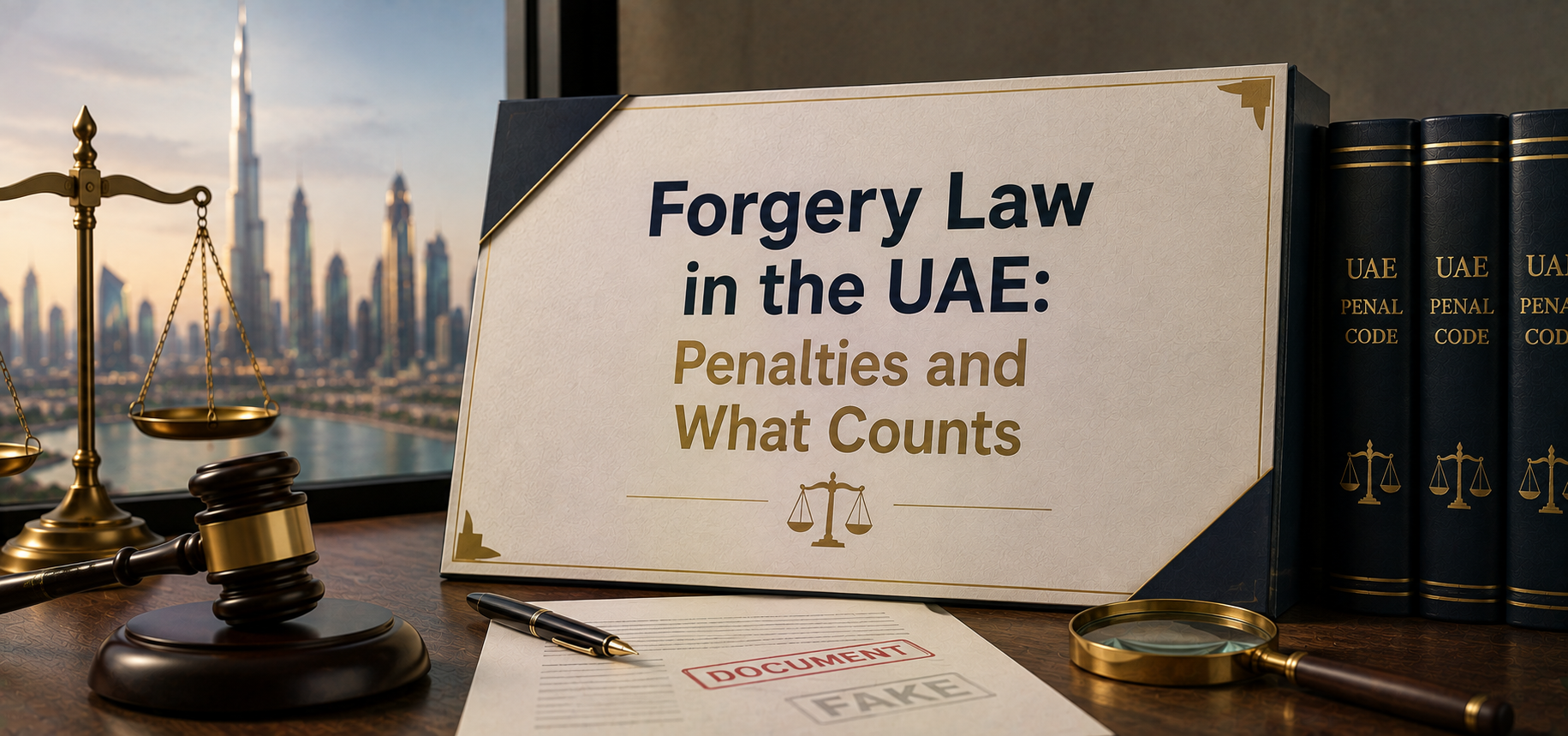

Forgery sounds like something that only happens in dramatic, deliberate schemes, a criminal ring producing fake passports. In practice, most UAE forgery cases look far more ordinary: a fabricated degree certificate on a job application, an altered sick note, or a signature on a contract that was never actually given. A criminal defense lawyer in Dubai can help assess the circumstances, including what is tampering in UAE and what is the punishment for perjury in the UAE. If forgery is involved, who is the best forgery lawyer in the UAE depends on the facts and stage of the case.
So is forgery actually illegal in the UAE, and what actually counts?
Yes, forgery is illegal in the UAE, and it’s defined broadly under Article 251 of Federal Decree-Law No. 31 of 2021, covering any alteration of a genuine document intended to make a false version pass as real. This reaches situations most people wouldn’t immediately think of as forgery, presenting a fabricated degree certificate to an employer, altering a medical certificate, or signing someone else’s name on a contract, cheque, or power of attorney without their genuine authorisation. Article 252 sets the penalty structure: forging an official document, one issued by a government body or carrying official status, carries temporary imprisonment of up to 10 years, while forging a non-official, private document carries a lesser detention-level sentence. Article 253 extends liability to forging or knowingly using a forged copy of an official document specifically, carrying up to five years.
About Faris Raian
Faris Raian is the founder, managing partner, and senior legal consultant at Leaders Advocates. He brings more than 15 years of experience across commercial, corporate, real estate, family, and criminal law in UAE courts, with experience relevant to forgery allegations, fraud-related criminal files, document evidence, and UAE court procedure.
Situation 1: The Fabricated Degree Certificate
Presenting a fake or altered educational qualification to an employer, an authority, or an institution is a genuinely common forgery scenario, and it’s treated as a real criminal matter, not simply grounds for dismissal. This applies whether someone created the fake certificate themselves or asked another party to produce it for them, both can carry criminal exposure.
Situation 2: The Altered Medical Certificate
Changing the dates, details, or diagnosis on a medical certificate, to extend sick leave or justify an absence, falls squarely within the same forgery framework. It doesn’t matter that the underlying document, a genuine medical note, existed at some point, altering it to misrepresent its actual content is what makes it forgery.
Situation 3: A Signature That Was Never Actually Given
Signing someone else’s name on a contract, a cheque, or a power of attorney, without their genuine authorization, is one of the specific methods the law names directly. This includes forging a signature outright, and obtaining a real signature through deception where the signer didn’t understand or agree to what they were actually signing.
Situation 4: Filling In a Blank, Pre-Signed Document
Where someone has signed, sealed, or stamped a blank page in advance, filling it in later with terms that person never actually approved is treated as forgery too. This comes up in commercial contexts more often than people expect, particularly with pre-signed blank cheques or authorization forms.
Situation 5: Property and Real Estate Documents
A forged sale agreement, a falsified title deed, or any altered document used to support a property transfer carries the same exposure, and given the value typically involved, these cases are pursued seriously. Beyond imprisonment, a court can order restitution and a fine tied to the value of the property or proceeds involved.
Handed a Document You Didn’t Know Was False?
Knowing use carries the same exposure as creating the forgery, so not being the author is not automatically a defence. What you knew, and when, is the whole question. Speak to us before you make any statement.
Why Official Documents Carry a Harsher Penalty
The law draws a real distinction based on what’s actually being forged. An official document, one issued by or connected to a government authority, carries a considerably harsher penalty, up to 10 years, than a private document between individuals, reflecting the greater public trust and reliance placed on official paperwork.
Using a Forged Document Is Its Own Offence
Someone who didn’t create a forgery but knowingly uses one, submitting a forged certificate someone else produced, for example, faces genuine criminal exposure too, separately from whoever actually fabricated it.
Facing a forgery allegation, or need to understand your exposure in a specific situation? A UAE criminal lawyer from our team can assess your circumstances.
Worried a Forgery Case Could Affect Your Visa?
A conviction can carry deportation risk for expatriates on top of the prison term and fine. The earlier a defence is built around the actual document and the actual allegation, the more options stay open.
Common Mistakes
Relevant Legal Services
A Criminal Defense Lawyer in Dubai can assess the allegation and criminal exposure. A Litigation Lawyer in Dubai can manage document-heavy proceedings. A Civil Lawyer in Dubai can address related private claims and compensation issues.
People Also Ask
So, is forgery illegal in the UAE? Yes, and the definition covers far more everyday situations than most people expect. A UAE criminal lawyer from our team can assess your specific circumstances.
Facing a Forgery Allegation in the UAE?
Whether the case involves a cheque, a contract, an identification document, or an official record, the exposure changes with the document and the conduct alleged. Leaders Advocates reviews the document trail and the knowledge evidence from the outset.
3 Comments