

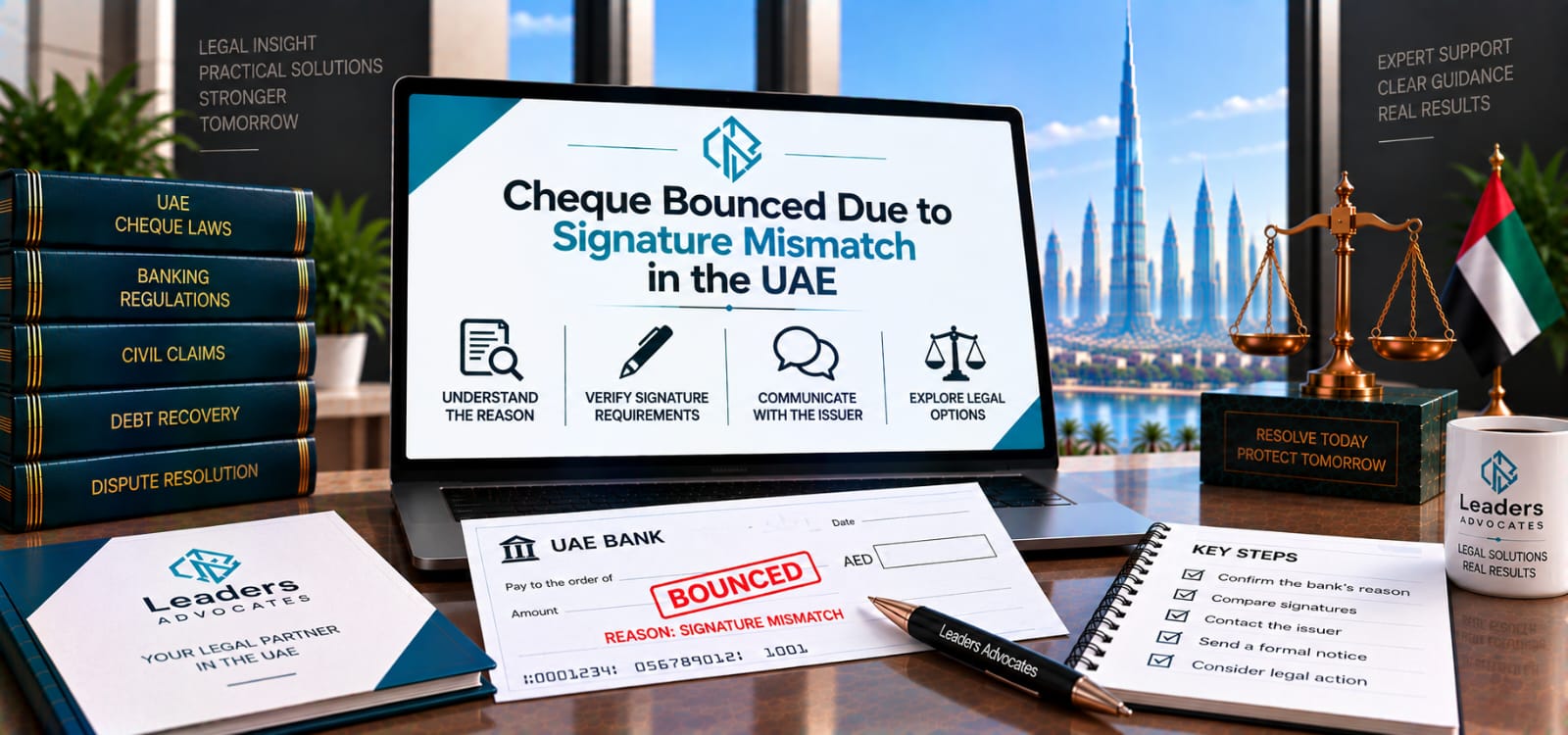

The holder has a cheque, but the bank refuses payment because the signature does not match its records. The drawer may say it was a simple mistake or may refuse to replace the cheque.
The holder still needs payment. The challenge is choosing a recovery route that fits the bank’s actual reason.
Quick Answer
A cheque returned for signature mismatch is different from one returned for no or insufficient funds. Article 667 of Federal Decree-Law No. 50 of 2022 gives executive force to the latter category, so a signature return usually needs another recovery route.
Ask the drawer to correct or replace the cheque and pay by a clear deadline. Keep the original cheque, bank return memo, contract, invoices, messages, and proof that the amount is due.
If the mismatch was deliberate, Article 675 may apply. It provides imprisonment from six months to two years and/or a fine within the limits stated by the law. An honest signature error is normally handled through correction, a payment order, or a civil claim.
Obtain the formal bank return memo and keep the original cheque. Ask for correction or payment in writing and preserve the underlying contract and account records.
Then separate civil recovery from any criminal allegation. A signature mismatch is not automatically proof of bad faith.
Cheque Bounced Due to Signature Mismatch UAE
Banks compare the cheque signature with the specimen held for the account. A difference can arise from error, a changed signature, an old cheque book, or deliberate conduct.
The bank’s memo is the starting point. It should state the return reason clearly.
Do not rewrite, annotate, or alter the cheque. Keep it flat and secure because the original may be needed.
Why Article 667 Is Not the Natural Route
Article 667 of the Commercial Transactions Law gives executive force to a cheque marked unpaid for lack of or insufficient funds. It allows the holder to seek compulsory execution without first obtaining an ordinary judgment on the debt.
A signature mismatch is a different return reason. The bank has not certified that funds were missing.
The holder may therefore need a payment order or an ordinary civil claim based on the underlying transaction. The exact route depends on the documents and the debtor’s response.
Insufficient Funds and Signature Mismatch Are Different
For insufficient funds, the cheque itself may support direct execution under Article 667. Lack of funds is not automatically a criminal offense under the reformed framework.
For a signature mismatch, direct execution is generally not the natural fit. Criminal exposure arises only when the evidence supports deliberate obstructive signing under Article 675 or another offense.
Do not file an insufficient-funds execution case using a signature return without advice. The instrument and return wording must support the selected route.
Not Sure Which Route Fits Your Cheque?
Send us your bank return memo on WhatsApp and we’ll tell you within minutes whether Article 667, a payment order, or a civil claim applies.
Honest Error or Deliberate Conduct
An innocent mismatch can happen when a person signs quickly, changes their usual signature, or uses an old cheque book after updating the bank specimen. Prompt correction supports that explanation.
Article 675(1)(c) addresses intentionally writing or signing a cheque in a way that prevents payment. Intent is a factual question for the competent authority or court.
Evidence may include repeated mismatches, refusal to correct after notice, contradictory explanations, or a pattern of unusable cheques. No single fact proves intent automatically.
First Step: Get the Bank Return Memo
Ask the bank for the formal record showing the cheque, presentation, and return reason. Keep any deposit slip, app notice, email, or SMS as supporting material.
Confirm whether the return relates only to the signature. A cheque may have more than one issue.
If the memo is unclear, request clarification through the bank’s proper channel. Do not rely on an oral explanation alone.
Second Step: Send a Written Correction Request
Notify the drawer promptly. Identify the cheque, amount, bank return date, and the reason stated by the bank.
Ask for a corrected cheque, bank transfer, or another reliable payment by a specific date. Keep proof that the drawer received the request.
Do not return the original cheque before receiving cleared funds or a properly documented replacement arrangement. If a replacement is issued, record what happens to the first cheque.
Third Step: Build the Underlying Debt File
The cheque is not the only evidence. Keep the contract, invoice, loan record, settlement, delivery proof, and account statement that explain why payment is due.
Reconcile the balance. Deduct every payment, credit, or agreed adjustment.
Identify the correct debtor. A company cheque does not automatically make the shareholder, manager, or signatory personally liable.
Building Your Debt Recovery File?
Message us on WhatsApp with your documents and we’ll tell you exactly what’s missing before you file anything.
Payment Order Procedure
If the debt is fixed, due, and supported by written or electronic evidence, a payment order may be available under Articles 143 to 150 of Federal Decree-Law No. 42 of 2022.
The creditor should give at least five days’ written notice before using that procedure. The documents and current procedural requirements must be checked.
A disputed performance claim may not fit the same route. An ordinary case may be needed if the court must examine extensive evidence or expert issues.
Ordinary Civil Claim
The holder can rely on the underlying transaction when the cheque cannot use the Article 667 route. The claim should explain the agreement, performance, due date, cheque, bank return, notice, and unpaid balance.
Check the forum clause. The contract may select UAE courts, arbitration, or another competent forum.
Plan service and translation early. Missing documents can delay an otherwise clear monetary claim.
When a Criminal Complaint May Be Relevant
A criminal complaint should be considered only when the facts support deliberate conduct. Article 675 provides imprisonment from six months to two years and/or a fine of at least 10% of the cheque value.
The fine is no less than AED 5,000 and no more than twice the cheque value. Repeat-offense penalties can be doubled.
Do not use a criminal allegation to pressure payment when the evidence shows an honest error. Civil recovery should proceed on its own legal basis.
Forgery Is a Separate Issue
If another person signed the account holder’s name, the issue may involve forgery rather than a mismatch by the drawer. The facts, handwriting evidence, account authority, and related Penal Code provisions need separate review.
Preserve the original cheque and all bank records. Do not ask witnesses to recreate signatures for comparison.
Report suspected forgery through the proper authority. Avoid public accusations while the facts are being investigated.
Suspect Forgery or Deliberate Non-Payment?
These cases need careful evidence handling from day one. Talk to us on WhatsApp before you file a complaint or make an accusation.
If You Are the Drawer
Act quickly. Contact the holder, explain the error, and make payment or issue a proper replacement.
Update the specimen signature with the bank if necessary. Keep proof of the correction and communication.
Delay after notice can make an innocent explanation harder to understand. It can also increase recovery costs and damage the commercial relationship.
Settlement Options
A practical settlement may use a bank transfer, cashier’s cheque, secured installment plan, or another reliable method. The right option depends on the amount and trust between the parties.
Write the payment dates, account details, default consequences, security, and treatment of the original cheque. State when any release takes effect.
Do not surrender the original instrument before the settlement is performed, unless counsel confirms a protected arrangement.
Documents to Keep
- Original cheque.
- Formal bank return memo.
- Deposit and presentation proof.
- Contract, invoice, loan, or settlement.
- Account statement and balance calculation.
- Written correction request.
- Drawer responses and payment promises.
- Company and signatory information.
Create a chronology. Record issue, presentation, return, notice, response, and every later payment.
Related Success Story
Leaders Advocates publishes a debt recovery case involving successful loan recovery in Dubai. Review the Leaders Advocates Success Stories page for the available summary.
The result arose from different facts and does not guarantee another recovery. It shows why proof of the debt, debtor identity, and enforcement planning matter.
Common Mistakes
- Treating a signature return as an insufficient-funds case.
- Filing a criminal complaint without evidence of intent.
- Returning the original cheque before payment.
- Ignoring the contract behind the cheque.
- Claiming an incorrect balance.
- Failing to notify the drawer in writing.
- Waiting without tracking legal deadlines.
- Assuming a signatory is personally liable for company debt.
Final Takeaway
A signature-mismatch cheque requires a route built around the return reason and the underlying debt. Prompt correction is the simplest outcome when the problem is genuine.
If correction fails, assess a payment order or civil claim. Reserve criminal action for evidence that supports deliberate obstructive conduct.
Relevant Legal Services
- Debt Recovery Lawyers in Dubai – for demands, settlement, payment claims, and recovery strategy.
- Litigation Lawyer in Dubai – for payment orders, civil claims, procedural disputes, and enforcement.
- Civil Lawyers in Dubai – for the underlying loan, invoice, contract, or monetary obligation.
Follow Leaders Advocates on LinkedIn or Leaders Advocates on Facebook for more UAE legal updates.
Frequently Asked Questions
Holding a Bounced Cheque and Not Sure What’s Next?
Message Leaders Advocates on WhatsApp now. We’ll review your return memo and tell you the fastest legal route to get paid.