


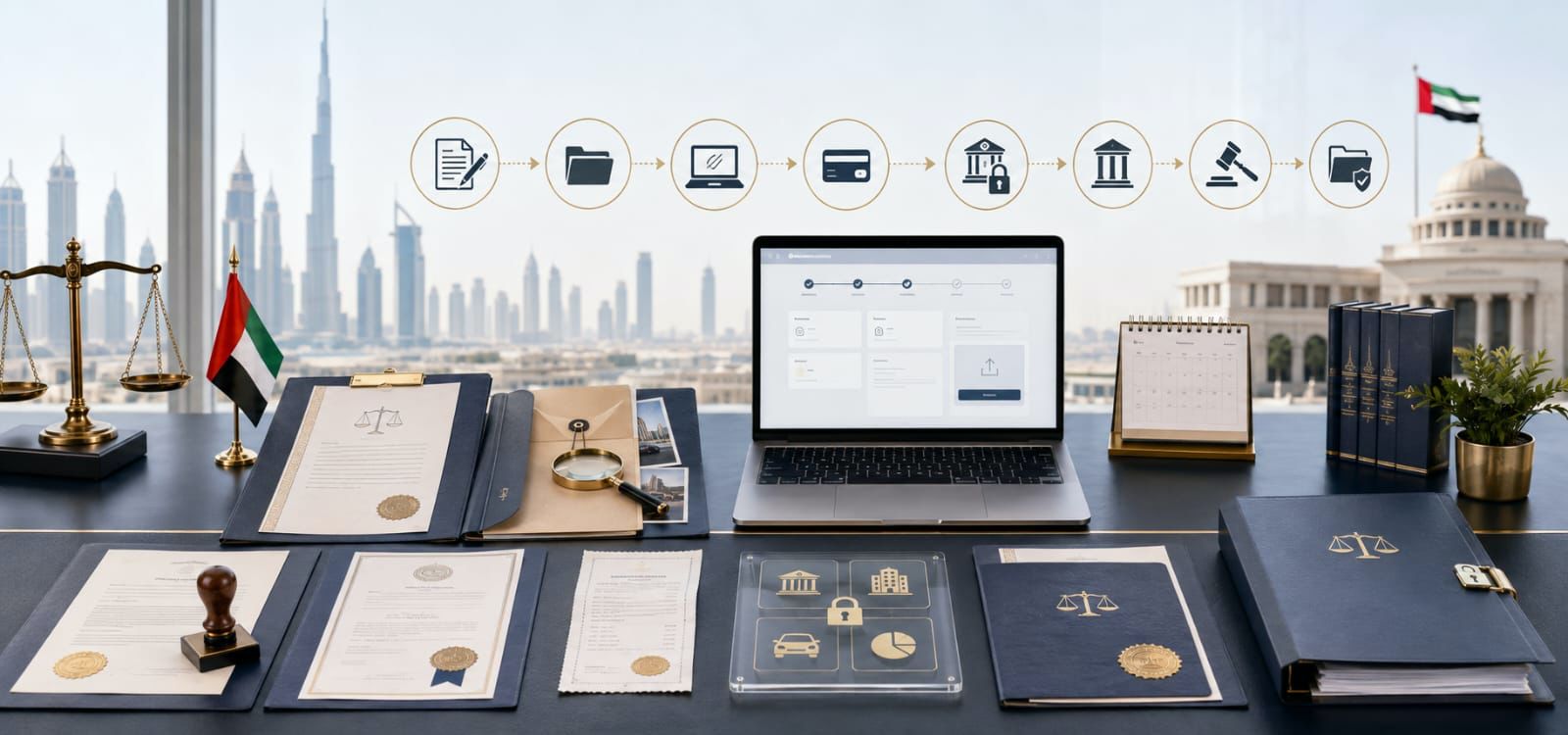

How to File a Civil Case in Dubai starts with preparing the statement of claim correctly. The source draft treats this as the most important document because it sets out the facts, the legal basis, and the exact remedy being requested.
The case is then filed through the Dubai Courts e-services portal with supporting evidence and the applicable fee. If there is a real risk that assets may be hidden or transferred, the source also identifies precautionary attachment as a step that can be considered before or alongside the main filing.
How to File a Civil Case in Dubai begins with a statement of claim in Arabic that clearly sets out the facts, the legal basis, and the specific remedy sought. Submit it through the Dubai Courts e-services portal with the supporting evidence and pay the applicable filing fee, which the source states is generally calculated as a percentage of the claim value. If there is genuine evidence that the other party may hide or transfer assets, a precautionary attachment can be requested before or alongside the main case under Articles 247 to 251 of the Civil Procedures Law. The matter then moves through hearings and judgment. If you win and the other party does not comply, a separate execution case must be filed with the Execution Department to enforce the judgment.
Step 1: Prepare the Statement of Claim
This connects closely with our guide on court of cassation in dubai.
The statement of claim is the starting point of the case. The source says it must be in Arabic and should clearly state the facts, the specific legal basis, and the exact remedy you want the court to grant.
Vague drafting can create problems later because the claim defines what the case is about. The source specifically warns that errors at this stage can be difficult and costly to fix once the proceedings are underway.
A civil lawyer in Dubai can review the claim structure and supporting material before submission through the Dubai Courts portal.
What the Statement of Claim Needs to Do
The document should tell the court what happened, why the claimant says there is a legal basis for the claim, and what outcome is being requested. These three parts need to work together rather than appearing as disconnected information.
- Set out the relevant facts clearly.
- State the specific legal basis relied on in the claim.
- Identify the exact remedy being requested.
- Keep the claim consistent with the evidence that will be filed with it.
Worried One Mistake Could Sink Your Case?
A vague or poorly drafted statement of claim is hard and costly to fix once the case is underway. Leaders Advocates can check the facts, the legal basis, and the exact remedy before anything is filed.
Step 2: Gather the Supporting Evidence
Our related guide on how long does litigation take in the UAE goes into this further.
The source lists contracts, agreements, correspondence, proof of loss or damage, financial records, receipts, and expert assessments as examples of supporting evidence. Which documents matter most depends on the dispute described in the statement of claim.
Any evidence that is not already in Arabic should have a certified Arabic translation before it is relied on. This preparation should happen before filing so the case begins with the strongest documentary record available.
- Contracts and agreements connected to the claim.
- Correspondence relevant to the dispute.
- Financial records, receipts, or other proof of loss or damage.
- Expert assessments where they are relevant to the issue.
- Certified Arabic translations for evidence that is not already in Arabic.
Many disputes reaching this stage sit within the wider field of commercial law in the UAE, which shapes how contracts and agreements are treated as evidence.
Step 3: Submit Through the Dubai Courts Portal
The filing is made through the Dubai Courts e-services portal. The statement of claim and supporting evidence are submitted together, and the applicable filing fee is paid as part of the process.
The source states that the filing fee is generally calculated as a percentage of the claim value. It does not provide one fixed fee for every civil case, so the amount depends on the claim being filed.
For a contested dispute that is likely to proceed through hearings, a litigation lawyer in Dubai can assist with the filing strategy and later court stages.
Step 4: Consider a Precautionary Attachment
A precautionary attachment is an additional protective step described in the source. It can be requested where there is genuine evidence that the other party may hide or transfer assets before judgment.
The source says the application may be made before or alongside the main civil case under Articles 247 to 251 of the Civil Procedures Law. The assets identified include bank accounts, property, vehicles, and company shares.
When Attachment Becomes Relevant
The source does not present precautionary attachment as a standard step in every civil case. It connects the remedy to a real risk of asset dissipation.
That means the claimant should separate the main dispute from the urgent question of whether assets may disappear before judgment. Where that risk exists, waiting until the end of the case can undermine the practical value of winning.
Think the Other Side Might Move Their Assets?
Waiting until judgment can mean there is nothing left to collect. Where the risk is genuine, a precautionary attachment can freeze bank accounts, property, vehicles, or company shares before it is too late.
Step 5: Hearings and Judgment
After filing, the matter moves through the standard court hearing process. Both sides present their evidence and arguments before judgment is issued.
The source does not give a fixed number of hearings or a universal timeline. The important point for this article is that the filing stage is followed by an adversarial court process before the judgment is reached.
Step 6: File a Separate Execution Case if Needed
Winning the civil case does not automatically enforce the judgment. The source states that a separate execution case must be filed with the Execution Department if the judgment needs to be enforced.
The enforcement tools identified in the source include bank account freezing, salary garnishment, and asset seizure against a non-compliant party.
Where the judgment concerns an unpaid financial obligation, debt recovery lawyers in Dubai can assist with the recovery and enforcement stages after the main case.
A Practical Filing Checklist
- Prepare the Arabic statement of claim with the facts, legal basis, and exact remedy sought.
- Collect the contracts, correspondence, financial records, receipts, expert material, and other evidence relevant to the claim.
- Arrange certified Arabic translations for documents that are not already in Arabic.
- Submit the claim and evidence through the Dubai Courts e-services portal.
- Pay the applicable filing fee.
- Consider precautionary attachment where there is genuine evidence of asset dissipation risk.
- Attend the hearings and present the case through the court process.
- If judgment is not complied with, file the separate execution case needed for enforcement.
Common Mistakes to Avoid
- Filing a vague or poorly structured statement of claim.
- Leaving important evidence until after the case is already underway.
- Submitting non-Arabic evidence without the certified Arabic translation identified in the source.
- Ignoring a genuine risk of asset dissipation until it is too late to consider precautionary attachment early.
- Assuming the court judgment will enforce itself automatically.
- Failing to plan for the separate execution process after winning.
People Also Ask
Conclusion
How to File a Civil Case in Dubai is a sequence that starts with a precise Arabic statement of claim and organised evidence. The quality of that first filing affects the rest of the process.
From submission through hearings, precautionary attachment where justified, and later enforcement, each stage has a different purpose. Planning for the full sequence helps avoid the common mistake of treating the initial filing or even the judgment as the end of the case.
Won Your Case and Still Not Paid?
A judgment is not the end of the process if the other side will not comply. Leaders Advocates handles the full sequence, from the first filing through precautionary attachment to the separate execution case that actually recovers what you are owed.


7 Comments