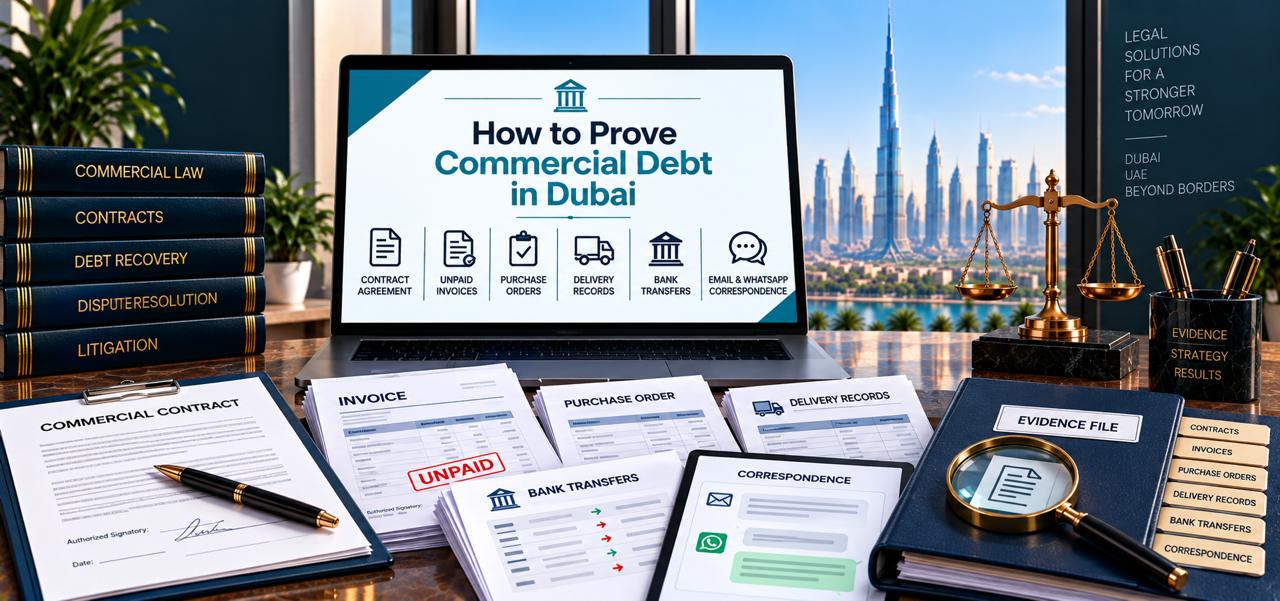

A customer denies an unpaid balance, disputes delivery, or says the invoices do not match the agreed price. The creditor may have many records but no clear evidence chain.
The legal issue is proof. The court must see the relationship, performance, correct amount, maturity, and continued nonpayment.
Quick Answer
To understand how to prove commercial debt Dubai, build a document chain. Connect the contract or purchase order to performance, each invoice, the statement of account, and the outstanding balance.
Federal Decree-Law No. 35 of 2022 recognizes electronic evidence in Articles 53 to 57. Emails, messages, electronic invoices, and acknowledgments can help when authenticity and relevance are established. Commercial books may also support a merchant’s claim.
Complex accounts often lead to a court expert. A clear reconciliation is essential. The result depends on the documents, entity, defenses, accounting records, and expert findings. Missing delivery evidence can materially weaken the claim.
Build an Evidence Matrix Before Filing
Create one row for each invoice. Link it to the order, delivery or completion record, agreed price, credit note, payment, and remaining amount.
Then classify each row as admitted, disputed, partially paid, unsupported, or time-sensitive. This exercise often reveals problems before the court expert sees them.
- Confirm that every document names the correct legal entity.
- Match quantities and prices across orders, deliveries, and invoices.
- Explain gaps between invoiced and received amounts.
- Separate principal from interest, fees, or damages.
- Identify written acknowledgment of each disputed balance.
- Remove duplicate entries and explain credit adjustments.
A clean evidence matrix is not a substitute for the original records. It is a guide that helps the judge, expert, and opposing party trace the claim.
Struggling to Prove an Unpaid Commercial Debt?
Send us your contract, invoices, and any messages on WhatsApp — we’ll tell you fast whether your evidence chain is strong enough to file.
Proving Delivery, Completion, and Acceptance
Delivery is often the decisive issue in a trading claim. Signed delivery notes, gate passes, warehouse receipts, tracking data, and acceptance emails may show receipt.
For services, preserve the scope, work product, submission history, access logs, meeting records, approval messages, and evidence that the client used the result.
Construction and project claims may require progress certificates, variation instructions, measurement records, handover documents, and correspondence about defects or delay.
If a formal acceptance document is missing, later conduct may still matter. Payment of earlier invoices, resale, use, or a request to correct work can support performance.
Handling Electronic Evidence Correctly
Preserve complete conversations instead of selected screenshots. Include the number or account, date, participants, attachments, and messages before and after the admission.
Keep the original device, account, or export when possible. Do not edit images or remove metadata that may help establish authenticity.
Explain why the account belongs to the company representative. Prior communications, email signatures, payment instructions, and consistent business conduct may provide that link.
A message saying “we will pay” may acknowledge liability, but the amount and transaction should still be identified. Ambiguous messages should not carry the whole claim.
Got Messages or Emails That Could Prove Your Case?
Don’t rely on a cropped screenshot. WhatsApp us the full conversation and we’ll assess whether it holds up as evidence.
Prepare for the Accounting Expert
Give the expert a short case summary, transaction chronology, indexed documents, and a reconciled account. State clearly what the opposing party disputes.
Answer every expert request on time. If a document is unavailable, explain why and identify any alternative evidence.
Review the report for incorrect opening balances, missing credits, duplicated invoices, unsupported interest, wrong entity names, or conclusions outside the expert’s mandate.
Object with documents and calculations, not general disagreement. The court may consider the report persuasive, but it remains free to assess the evidence.
Evidence Problems That Require Caution
- Invoices were created internally but never sent or accepted.
- Delivery notes contain no name, stamp, signature, or receiving record.
- The contract belongs to another entity in the group.
- The price changed without written approval.
- The statement of account excludes credits or partial payments.
- Messages are cropped and the sender cannot be identified.
- Accounting books conflict with bank or tax records.
A weak item should be explained, supported, narrowed, or removed. Filing every available paper can hide the documents that actually prove the claim.
How Legal Counsel Can Strengthen the Proof
Counsel can identify the legal elements, test jurisdiction, prepare the demand, and decide whether the evidence supports a payment order or ordinary claim.
A lawyer can also prepare the expert submission, challenge incorrect calculations, preserve electronic material, and avoid allegations that exceed the available evidence.
No legal team can replace missing performance or fabricate an acknowledgment. The result remains dependent on authentic records and the debtor’s defenses.
Final Pre-Filing Checklist
- Correct licensed debtor identified.
- Contractual forum and arbitration clause reviewed.
- Every invoice matched to performance.
- Complete electronic records preserved.
- Statement of account reconciled to bank records.
- Demand amount matches the proposed claim.
- Arabic translations prepared where required.
- Limitation and procedural deadlines recorded.
Ready to File But Not Sure Your File Is Complete?
Run through your checklist with a lawyer on WhatsApp before you file — catch the gaps now, not after the hearing.
Distinguish the Principal Claim From Additional Amounts
State the principal debt separately from contractual interest, delay charges, legal costs, and damages. Each additional amount needs its own contractual or legal basis.
If interest is claimed, identify the agreed rate, calculation period, and relevant documents. Avoid adding a percentage that does not appear in the contract or applicable law.
Damages require proof of loss and causation. They should not be used simply to increase the value of an unpaid invoice claim.
Admissions, Partial Payments, and Account Confirmations
A signed balance confirmation may narrow the dispute significantly. Check who signed it, their authority, the date, the covered transactions, and any reservations.
Partial payment can support the existence of the relationship, but the debtor may still dispute the remaining amount. Link the payment to a specific invoice or account period.
A request for more time may amount to useful evidence. Preserve the exact wording and avoid summarizing it more broadly than the message allows.
The Correct Defendant Matters to the Evidence
A group may use one email domain, shared offices, and a common brand. Those facts do not automatically make every company responsible for the debt.
Compare the contracting name, purchase order, license, invoice recipient, delivery recipient, bank account, and signatory authority. Explain any mismatch before filing.
If a guarantee exists, analyze it separately. A manager or shareholder is not personally liable merely because they negotiated the transaction.
Arabic Translation and Document Presentation
Material foreign-language documents generally require certified Arabic translation for onshore proceedings. Translate complete relevant clauses, not fragments that remove context.
Check names, numbers, dates, currencies, technical terms, and accounting descriptions after translation. One incorrect digit can affect an entire reconciliation.
Use consistent document numbering across the claim, chronology, reconciliation, and expert submission. Clear presentation reduces the risk that decisive evidence is overlooked.
Limitation and Preservation
Commercial claims between merchants are generally subject to a five-year period when the debtor denies the obligation. The starting point and any interruption require legal review.
Do not wait for the final months to organize the file. Former employees may leave, messages may be lost, systems may change, and counterparties may dispose of assets.
Issue an internal preservation instruction for relevant email, messaging accounts, accounting data, delivery systems, devices, and paper files.
How the Claim Changes When the Debt Is Disputed
If the debtor admits the relationship but disputes quantity or quality, focus the file on inspection, complaints, rejection notices, remedial work, and accepted portions.
If the debtor disputes price, identify the signed quotation, price list, purchase order, variation, or established course of dealing.
If the debtor claims set-off, require details of the counter-obligation and supporting documents. Do not treat an unparticularized allegation as an accounting credit.
If the debtor denies authority, trace the representative’s position, prior transactions, company communications, and any ratification of the transaction.
What the Final Document Bundle Should Show
The bundle should allow a new reader to understand the complete claim without oral explanation. Start with the chronology, contract, and reconciliation.
Place performance evidence beside the related invoice. Place acknowledgments and payment promises after the account documents they concern.
Remove irrelevant duplicates while keeping original source records available. A concise, complete bundle is usually more persuasive than an unstructured archive.
Relevant Legal Services
The appropriate service depends on the claim, the contract, the forum, and the enforcement position.
- commercial debt recovery lawyers in Dubai
- commercial litigation lawyers in Dubai
- corporate lawyers in Dubai
Relevant Success Story
See our debt recovery success stories for an example of how documented recovery work may progress.
Past results do not guarantee a similar outcome. Every matter depends on its own facts, documents, assets, and legal circumstances.
Follow Leaders Advocates on LinkedIn or Leaders Advocates on Facebook for more UAE legal updates.
Frequently Asked Questions
Final Takeaway
Prove the relationship, performance, amount, maturity, and nonpayment through a connected evidence chain. A clear reconciliation often decides whether the claim is understandable.
Review the complete file before filing. The safest next step depends on the documents, defenses, accounting records, and likely expert issues.
Owed Money by a Business in Dubai?
Message Leaders Advocates on WhatsApp now — we’ll review your documents and tell you the fastest realistic route to getting paid.