


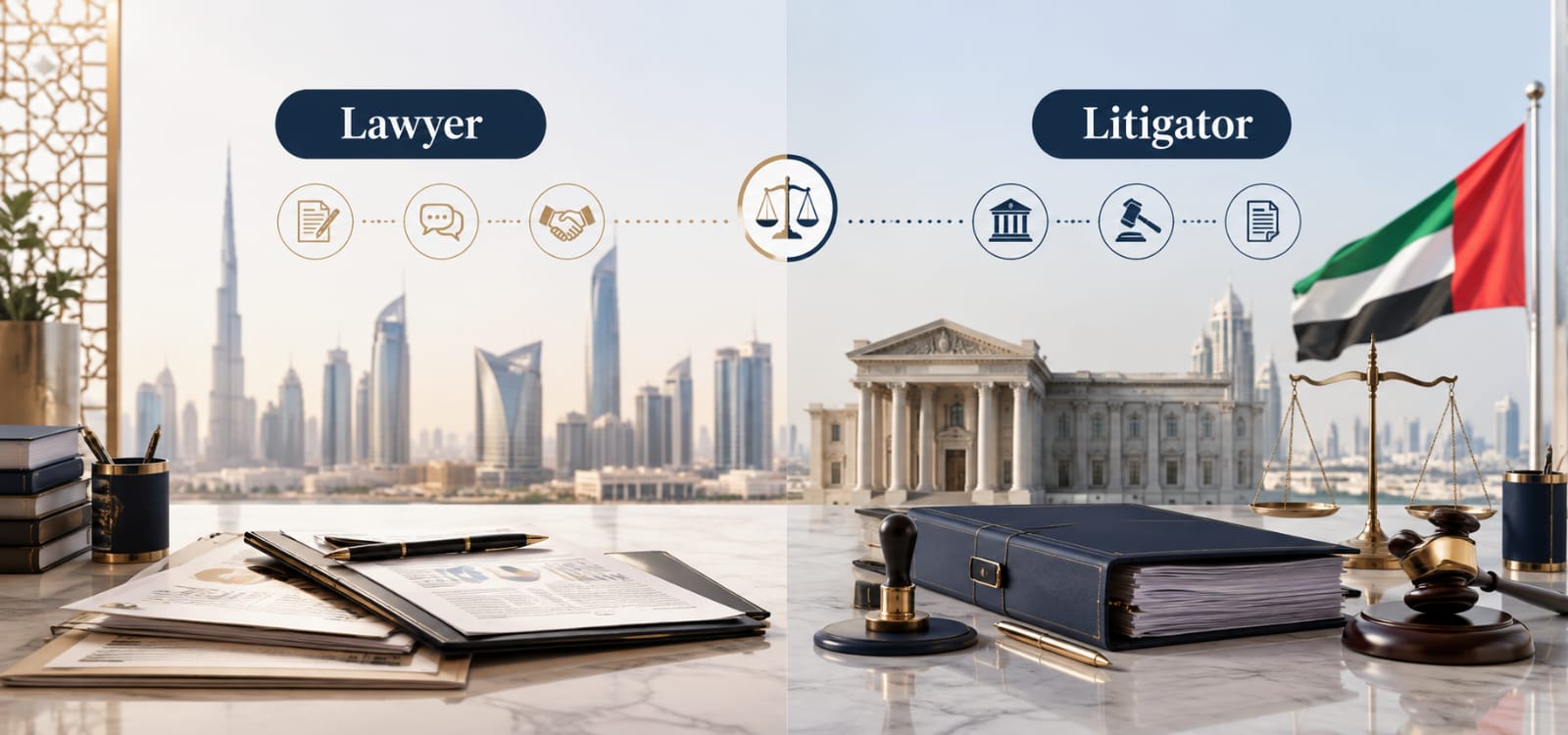

Litigator vs. lawyer in the UAE is not only a difference in job description. The source draft explains that “lawyer” is the broad term, while “litigator” describes a lawyer whose work centres on court proceedings and actual courtroom representation.
The distinction also connects to licensing. The source says a registered advocate on the Ministry of Justice roll can personally plead a case in court, while a legal consultant can advise, draft, and negotiate but cannot personally argue a case before a mainland judge.
Litigator vs. lawyer in the UAE comes down to the type of legal work and the right to appear in court. A lawyer is the broad category covering professionals who may advise clients, draft contracts, negotiate settlements, or handle disputes. A litigator is a lawyer whose work focuses specifically on court proceedings and arguing cases before a judge. The source says this maps onto a UAE licensing distinction: a registered advocate on the Ministry of Justice roll can personally plead a case in court, while a legal consultant can advise, draft, and negotiate but cannot personally argue before a mainland judge. Every litigator is a lawyer, but not every lawyer is a litigator. Many firms combine both roles, with consultants handling strategy and drafting and registered advocates handling courtroom appearances.
What “Lawyer” Means in This Context
Our guide on how much does a civil litigation lawyer cost in UAE explains this further.
The source uses lawyer as the broad professional description. It can cover people whose work includes legal advice, contract drafting, negotiation, dispute strategy, or court-related work.
That means the title alone does not tell you whether the person will personally appear before a mainland judge. The practical question is the individual role and licensing status.
What Does “Litigator” Mean?
You can read more about this in our guide on how to check if you have a civil case in the UAE.
A litigator is described in the source as a lawyer whose practice centres on court proceedings. The defining feature is the courtroom role: handling litigation and arguing cases before a judge.
In the UAE framework described by the draft, this court-facing role maps onto the registered advocate status. That is the role the source connects directly with personal pleading rights before the court.
For a dispute that is already heading to court, a litigation lawyer in Dubai can help clarify the representation structure and courtroom role from the start.
Registered Advocate: The Court-Facing Role
The source states that a registered advocate appears on the Ministry of Justice roll and can personally plead cases in court. This is the role it identifies as functioning as a litigator in the UAE.
For a client, the key question is therefore not only whether someone is generally described as a lawyer. It is whether that person has the registered advocate status required for the courtroom role described in the source.
Not Sure Who Will Actually Stand Up in Court for You?
It is a fair question to ask before you sign anything, and you should get a straight answer. Our Best Advocates in Dubai will tell you exactly who handles your advice, who pleads your case, and where the line sits between them.
Legal Consultant: Advice, Drafting and Negotiation
The source describes a legal consultant as someone who can advise, draft, and negotiate. It also states that a legal consultant cannot personally argue a case before a mainland judge.
This does not mean the consultant has no role in a dispute. The source specifically notes that many firms pair legal consultants with registered advocates so strategy and drafting can be handled alongside courtroom representation.
Why Many Legal Teams Use Both Roles
The draft describes a common team structure in which the legal consultant handles strategy, drafting, and negotiation while the registered advocate takes the courtroom side once the matter reaches a judge.
This division can make sense because litigation is more than the hearing itself. The preparation and advisory work can be handled by one professional while the court appearance is carried out by the advocate authorised to plead.
Why the Distinction Matters Before You Hire
If there is a realistic chance that the matter may end up in court, the source recommends confirming the representation structure before engagement. A client should know whether the person advising them is also the litigator or whether a registered advocate will handle the court appearances.
The point is clarity, not that one role is automatically better than the other. The right arrangement depends on whether the matter is advisory, transactional, negotiated, or likely to require courtroom representation.
For civil claims and private disputes, civil lawyers in Dubai can advise on the claim while the team structure for any court stage is made clear. The wider question of how to assess a firm before engaging it is covered in this guide on how to find the best lawyers in Dubai.
When a General Legal Adviser May Be Enough
The source includes advice, drafting, and negotiation within the broader lawyer role. A matter that remains at those stages may not require the client to choose a professional based only on courtroom work.
The distinction becomes more important when the dispute is likely to proceed before a mainland judge. At that point, the source says the registered advocate role matters directly.
When Contract Work and Litigation Can Overlap
A contract matter may begin as drafting or advice and later become a dispute. The source uses contract drafting and negotiation as examples of lawyer work outside the narrow courtroom role.
If a disagreement later moves into litigation, the team may need both the advisory work and the registered advocate role identified in the draft.
Where the issue begins with drafting, review, or interpretation of an agreement, contract lawyers in Dubai can handle the contract side before any court-facing role becomes necessary. The broader scope of that work is set out in this overview of what commercial law covers.
Questions to Ask Before Engaging a Lawyer
- Is the person advising me a registered advocate or a legal consultant?
- If the matter reaches court, who will personally appear before the judge?
- Will the same person handle strategy, drafting, negotiation, and court appearances, or will the work be divided?
- If a legal consultant is leading the matter, which registered advocate will handle the courtroom stage?
- Does my matter actually require litigation now, or is it still at the advice, drafting, or negotiation stage?
Already Been Advised, but No One Has Mentioned Court?
If your matter is drifting towards a hearing, the time to confirm who can plead it is now, not at the first court date. Send us the details and we will tell you what your case actually needs.
Common Mistakes
- Assuming every person described as a lawyer can personally represent a client in court.
- Treating litigator as only a marketing title rather than the court-facing role described in the source.
- Failing to ask whether the adviser is a registered advocate or a legal consultant.
- Waiting until the first court stage to ask who will actually plead the case.
- Assuming a legal consultant has no useful role simply because the consultant cannot personally argue before a mainland judge.
- Confusing strong advisory or drafting skills with the separate courtroom function of litigation.
People Also Ask
Conclusion
Litigator vs. lawyer in the UAE is best understood as a broad profession versus a specific court-facing role. A lawyer covers many types of legal work, while a litigator describes the professional focused on court proceedings.
The licensing distinction in the source makes the issue practical for clients. If a matter may reach court, confirm whether the person handling it is a registered advocate or works alongside one, and understand who will take responsibility for each stage.
Get Advice and Courtroom Cover From One Team
Leaders Advocates pairs legal consultants with registered advocates, so the strategy, the drafting, and the pleading all sit under one roof. You will know from day one who takes your case into court.


1 Comment