


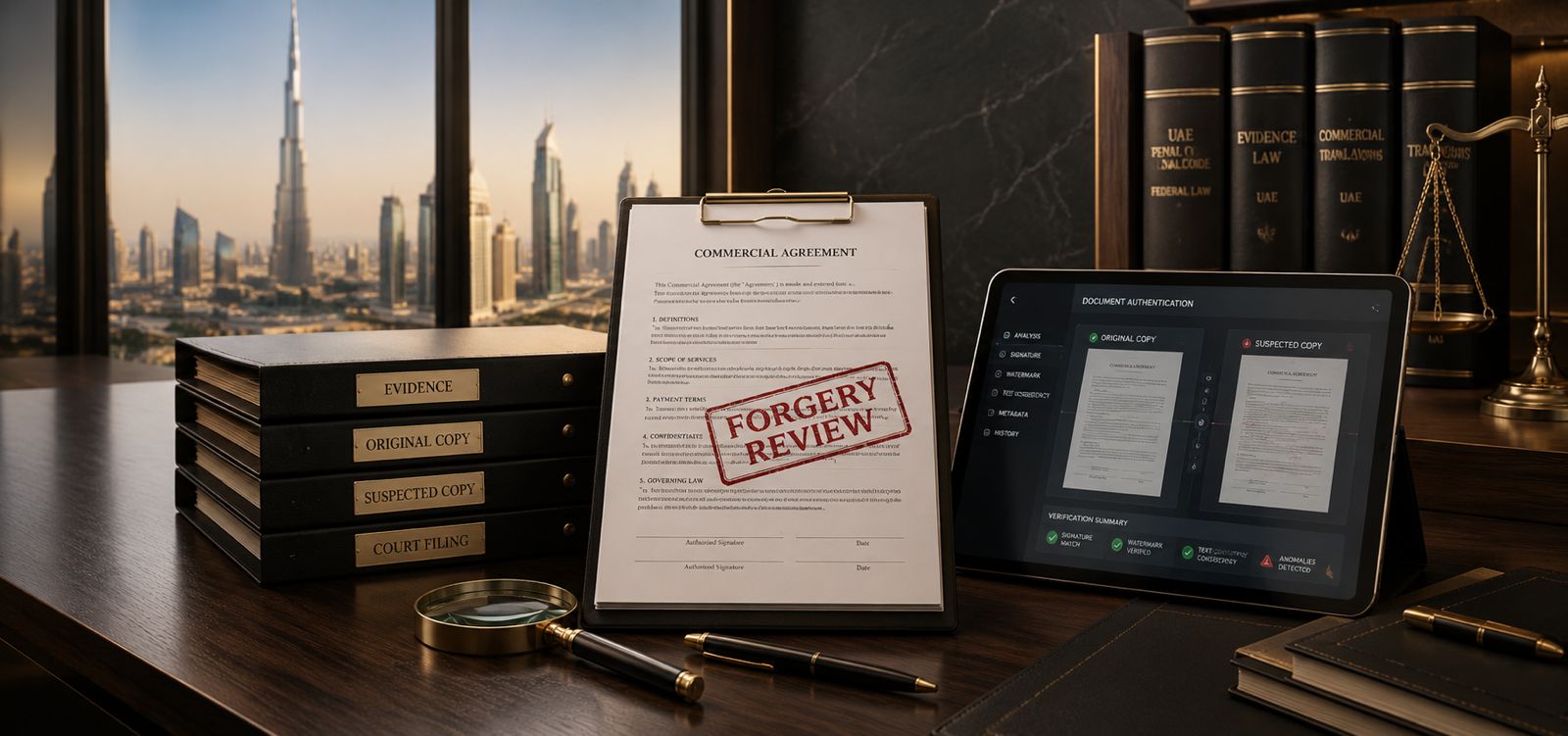

Forgery law in the UAE covers more than a fake signature. The source article identifies altering, fabricating, or knowingly using a falsified official or private document, including a cheque, contract, or identification document, as conduct that can fall within forgery.
The article also draws a clear distinction between forgery and ordinary fraud. It describes forgery as the more serious offence, with cheque forgery carrying a specific minimum prison term and fine range, while official-document forgery is treated as an aggravated circumstance.
Forgery law in the UAE covers altering, fabricating, or knowingly using a falsified official or private document with the intention to deceive. The source article includes cheques, contracts, and identification documents within that scope. For cheque forgery specifically, Article 676 of the current Penal Code sets a minimum of one year’s imprisonment and a fine of not less than AED 20,000 and not exceeding AED 100,000. The article contrasts this with ordinary fraud under Article 399, which it states carries a base penalty capped at two years’ imprisonment and AED 20,000. It also states that forgery involving official government documents or public officials is treated as an aggravated circumstance and can carry penalties beyond the base minimum.
What Forgery Law in the UAE Actually Covers
In cases like this, it is worth speaking with criminal defense lawyer in dubai.
For a closer look at this, see our guide on is tampering with evidence a felony in UAE.
The core issue is whether the truth in a document has been altered or a false document has been created or used. The article does not limit forgery to signatures or handwritten changes.
- Altering a genuine document through addition, deletion, or amendment with intent to deceive.
- Fabricating a document entirely so that a false instrument is made to appear genuine.
- Knowingly using a forged document even if the person using it did not create the forgery.
The documents identified in the source include official and private documents, cheques, contracts, and identification documents. This makes the factual question of what document is involved central to understanding the allegation.
Altering a Genuine Document
Forgery can arise even where the document itself began as genuine. The source specifically includes addition, deletion, or amendment carried out with intent to deceive.
That means the issue is not only whether a document was created from nothing. A genuine document that has been changed in a deceptive way can fall within the same overall forgery analysis described in the article.
Fabricating a Document Entirely
The article also includes the complete creation of a false document. In that situation, the document is fabricated so that it appears to be a genuine instrument.
This distinction is useful because it separates two different factual patterns: changing something that was originally genuine and creating a false document from the start.
Knowingly Using a Forged Document
A person does not need to be the individual who physically created the forgery for the conduct identified in the article to be relevant. Knowingly using a forged document is itself included within the scope described by the source.
The word knowingly matters to the way the article frames this category. The focus is not only on who produced the document but also on whether another person used it while aware that it was forged.
Where a forgery allegation has already become a criminal matter, criminal defense lawyers in Dubai can review the allegation, the document involved, and the position being taken against the accused.
Accused Over a Document You Did Not Create?
Knowing use is treated as forgery in its own right, so being handed the document is not automatically a defence. What you knew, and when, is the whole case. Speak to us before you give any statement.
Cheque Forgery and the Penalty Stated in the Source
Our related guide on who is the best forgery lawyer in the UAE can help you make that decision.
The source gives a specific penalty for cheque forgery. Under Article 676 of the current Penal Code, it states that the minimum penalty is one year’s imprisonment, together with a fine of not less than AED 20,000 and not exceeding AED 100,000.
The article presents this as a distinctly harsher standard than the general fraud provision under Article 399, which it states is capped at two years’ imprisonment and a fine of up to AED 20,000.
The separate penalty framework for a dishonoured cheque is covered in our guide to the punishment for a bounced cheque case in Dubai.
Forgery Compared With Ordinary Fraud
The article treats forgery and ordinary fraud as related but separate offences. Its main comparison is the difference in the penalty structure, particularly where a cheque is forged.
Forgery is described as carrying a harsher minimum sentence and a higher fine range in the cheque context. The article therefore warns against assuming that a forgery allegation has the same exposure as an ordinary fraud allegation.
Where the allegation also sits within a wider financial-crime dispute, financial crimes and public funds legal services in Dubai may be relevant to the wider criminal context. Related conduct carried out through electronic means is addressed under the UAE cybercrime law.
Official Documents and Aggravated Forgery
Forgery involving official government documents or public officials is treated more seriously in the source. The article describes this as an aggravated circumstance because of the added harm to public trust and institutional processes.
The source does not give one single penalty range for every aggravated official-document scenario. It states instead that the penalties can extend considerably beyond the base minimum.
Why the Type of Document Matters
The article covers both private and official documents, but it does not treat them as identical in seriousness. Official government documents and conduct involving public officials are singled out as aggravated.
For that reason, one of the first practical questions in reviewing an allegation is whether the document is private, official, a cheque, a contract, or identification. The category affects how the source frames the seriousness of the conduct.
For matters involving forged seals, marks, or stamps specifically, the firm’s forgery and counterfeiting legal service is a directly related service page. Other conduct that carries unexpected criminal exposure in the UAE is illustrated by this guide on the legal risks of prank calling in the UAE.
Is an Official Document Involved in Your Case?
Once a government document or public official is part of the allegation, the exposure moves well beyond the base minimum. This is not a matter to approach without representation. Send us the details today.
What to Review in a Forgery Allegation
- Identify the exact document involved and whether it is official or private.
- Identify whether the allegation concerns alteration of a genuine document, fabrication of a false document, or knowing use.
- If a cheque is involved, separate the cheque-forgery allegation from the ordinary fraud comparison made in the source.
- If an official document or public official is involved, recognise that the source treats the matter as aggravated.
- Keep the original document, copies, and any material that shows what was changed or how the document was used.
Where the underlying cheque case also needs resolving, see our guide on how to clear a bounced cheque case in Dubai.
Common Mistakes
- Assuming forgery only means faking a signature.
- Assuming a private document cannot be the subject of forgery.
- Treating the creation of a forged document and the knowing use of one as completely unrelated conduct.
- Assuming cheque forgery carries the same penalty range as ordinary fraud.
- Ignoring the more serious treatment described for official government documents or public officials.
- Failing to separate the factual question of what happened to the document from the later question of what penalty may apply.
People Also Ask
Conclusion
Forgery law in the UAE covers a wider range of conduct than simply creating a fake signature. The source includes alteration, fabrication, and knowing use across official and private documents, including cheques, contracts, and identification.
The article also makes clear that document type and conduct matter. Cheque forgery carries the specific penalty stated under Article 676, while official-document forgery is treated as aggravated. The safest way to assess any allegation is to begin with the exact document and the exact act said to have occurred.
Facing a Forgery Allegation in the UAE?
A forgery charge carries a minimum prison term where a cheque is involved and more where an official document is. Leaders Advocates examines the document, the alleged act, and the evidence of intent from the first day of the case.

2 Comments