



Quick Answer
To resolve a debt collection dispute in Dubai, first define what is contested. Reconcile the contract, invoices, payments, interest, and fees before making a demand or response.
Try a written settlement supported by a clear statement of account. Where Dubai’s conciliation rules apply, the dispute may need to go through the Centre for Amicable Settlement of Disputes before court filing.
A fixed, due, documented debt may use the payment order process under Articles 143 to 150 of the Civil Procedure Law. A genuinely disputed claim may require ordinary litigation or arbitration. Any judgment or enforceable settlement then moves to execution if payment still does not follow.
A collection dispute may start with an invoice, loan, settlement, cheque, or judgment. The parties often argue about several stages at once.
The creditor wants payment. The debtor may challenge the balance, liability, fees, performance, limitation, or collection method.
Map the dispute by stage. Identify the legal relationship, amount accepted, amount contested, evidence, forum, and next deadline.
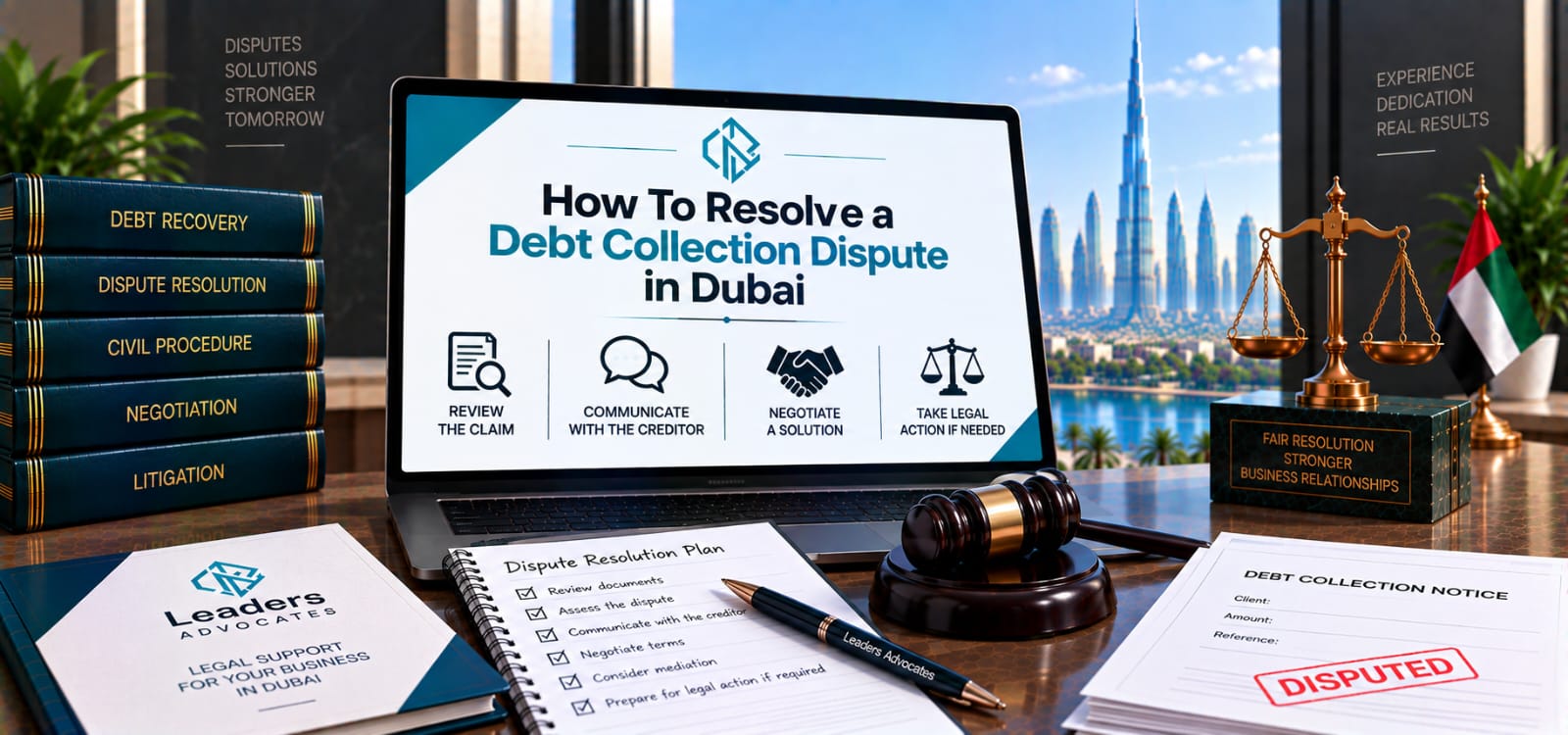
Move through written demand, negotiation, conciliation, claim, and execution only as needed. Each stage should use the work completed before it.
How To Resolve Debt Collection Dispute in Dubai
The process starts before court. A reliable statement and evidence file often reveal whether the case is suitable for settlement or requires a decision.
Do not select a remedy from the claim value alone. Jurisdiction, documentation, dispute clause, and the nature of the debt all matter.
Define the Debt and the Parties
Identify the creditor, debtor, contract, due date, and source of the obligation. Confirm the exact legal names and addresses.
Separate the principal from interest, fees, costs, and payments. State one current balance with a calculation date.
If a company is involved, do not confuse the company with its manager or shareholder. Personal liability needs a separate basis.
Define What Is Actually Contested
Ask whether the debtor denies the whole relationship or only the amount. The dispute may concern payment, delivery, defects, guarantee, authority, limitation, or identity misuse.
Record every accepted fact. Narrowing the dispute can make settlement or a focused claim easier.
If part is admitted, consider payment of that part without prejudice to the remaining issues. Document the purpose of the transfer.
Build the Core Evidence File
Collect the contract, guarantee, invoices, delivery records, account statements, payment proof, notices, and acknowledgments. Include the full communication chain.
Prepare a chronology and document index. Link each disputed issue to a small number of strong records.
Preserve originals and electronic metadata. Use copies for correspondence and court working files.
Not Sure What Evidence You Actually Need?
Send us your documents on WhatsApp and we’ll tell you what’s strong, what’s missing, and what to do next.
Reconcile the Account
Create a line-by-line schedule from the opening balance to the current amount. Show invoices, credits, payments, interest, and fees separately.
This schedule helps both sides. The creditor avoids overclaiming, and the debtor can identify the exact error.
If expert accounting may be needed, keep the source records organized by date and transaction.
Send or Answer a Written Demand
A demand should state the basis, amount, due date, evidence, and deadline. It should explain the next proposed step without unsupported threats.
A response should identify the accepted and disputed amounts. It should list each objection and attach focused supporting documents.
Use the contract’s notice channel where applicable. Keep delivery proof and the complete final version.
Negotiate From a Defined Position
Settlement discussions work better after the balance and dispute are clear. The parties can discuss discount, timing, security, and costs instead of repeating accusations.
Make a specific offer. Include the first payment date, later dates, treatment of interest, and what happens after default.
Do not allow negotiations to hide a court deadline. Protect the procedural position while talks continue.
Draft a Complete Settlement
Identify the original transaction and the agreed replacement obligation. State whether the earlier debt is released immediately or only after full payment.
Address security cheques, guarantees, court files, costs, confidentiality, and the final clearance. State which party must complete each withdrawal step.
Confirm signing authority. A company settlement signed by the wrong person can create another dispute.
Ready to Send a Formal Demand?
Most debts get paid once a proper legal letter arrives. Message us on WhatsApp and we’ll draft it today.
Dubai Conciliation
The Centre for Amicable Settlement of Disputes handles matters within its jurisdiction. Dubai Law No. 18 of 2021 was amended by Dubai Law No. 9 of 2025.
Current rules require certain disputes to complete the applicable conciliation route before court registration. Resolution No. 4 of 2025 also identifies matters within the Centre’s jurisdiction.
A settlement reached through the proper process can receive enforceable status. That can avoid a full lawsuit while preserving a direct response to later default.
Check Whether Conciliation Is Mandatory
The answer depends on the claim type, value, exclusions, and current jurisdiction instruments. Do not assume every debt dispute follows the same route.
Confirm the contract and forum first. An arbitration agreement or specialized forum may affect the path.
Keep proof that any required preliminary step was completed. The court may require it at filing.
Payment Order Procedure
Articles 143 to 150 of Federal Decree-Law No. 42 of 2022 provide the payment order framework. It applies when the statutory requirements are met.
The debt generally needs to be fixed, due, and documented in writing or electronically. A prior demand giving at least five days to pay is required.
The debtor can challenge the order. A creditor should prepare for that possibility instead of treating the order as the end of the dispute.
Ordinary Court Claim
An ordinary claim may be needed when liability, performance, amount, or facts are genuinely disputed. The parties can present fuller pleadings and evidence.
The court may use an expert for accounting or technical questions. A clear chronology and reconciliation help the expert focus on the real issues.
The claim should also address jurisdiction, service, Arabic translation, interest basis, and limitation.
Arbitration and Other Forums
Read the dispute clause before using Dubai Courts. A valid arbitration agreement may require the dispute to proceed before a tribunal.
The DIFC Courts or another jurisdiction may be relevant when the legal requirements are satisfied. Forum selection should follow jurisdiction, not convenience alone.
Specialized forums can apply to rent, employment, property, or other subject areas. Classify the debt correctly.
Which Route Fits Your Case — Payment Order, Claim, or Arbitration?
Message us on WhatsApp now and get a fast, practical answer on the right forum for your debt.
Cheques and Executive Instruments
A cheque returned for no or insufficient funds may be enforced under Article 667 of the Commercial Transactions Law. Keep the original and formal bank return record.
An enforceable settlement or judgment may also move to execution. The instrument should state a clear amount and obligation.
Reconcile partial payments before filing. Execution must target the actual unpaid balance.
Execution After a Decision
The execution judge handles enforcement of judgments and qualifying instruments. The debtor receives notice through the required procedure.
Available measures depend on legal conditions and the debtor’s assets. Bank attachment, asset seizure, and travel restrictions are not automatic.
The creditor should plan asset-focused enforcement. A judgment alone does not guarantee payment.
Debtor Rights During Collection
A debtor can request the account, dispute unsupported amounts, raise payment, challenge liability, and use the available court procedures.
Ordinary inability to pay is generally civil. Criminal allegations require facts that meet a separate offense.
If the collector represents a licensed bank or finance company, use the institution’s complaint process. An eligible unresolved complaint may be taken to Sanadak.
Limitation and Delay
Commercial claims between merchants are generally not heard after five years from the due date when the debtor denies the claim. Other claims may follow different periods.
Record acknowledgments, part payments, settlements, and procedural steps. They can affect the analysis.
Do not allow informal promises to replace deadline management. Review limitation when the file is opened.
Weigh Cost and Proportionality
The strongest legal route is not always the best commercial route. Compare the debt value, evidence, expected defense, filing cost, and likelihood of finding assets.
A short settlement may be sensible when it produces reliable payment. A weak discount may be inappropriate when a clear instrument and reachable assets support recovery.
Set a staged budget for notice, conciliation, claim, expert work, appeal, and execution. Review the strategy after each stage instead of committing to every possible step at the start.
Owed Money and Not Sure Where to Start?
Leaders Advocates can review your file and outline the fastest realistic path to payment.
Related Success Story
Leaders Advocates publishes a debt recovery case involving successful loan recovery in Dubai. The Leaders Advocates Success Stories page provides the available summary.
That result reflects its own documents, parties, and enforcement facts. It is not a guarantee, but it illustrates the value of a complete file.
Common Mistakes
- Demanding a balance before reconciling the account.
- Ignoring the contract’s notice or arbitration clause.
- Filing before a mandatory conciliation step.
- Using a payment order for a genuinely disputed claim.
- Agreeing a verbal settlement without enforceable terms.
- Ignoring a court or execution notice.
- Treating attachment or a travel restriction as automatic.
- Waiting without checking limitation.
Final Takeaway
How To Resolve Debt Collection Dispute in Dubai begins with a defined balance, organized evidence, and the correct forum. The parties should know what is accepted and what requires a decision.
Use negotiation and conciliation where they can produce a reliable settlement. When they cannot, select the payment order, litigation, arbitration, or execution route that fits the file.
Relevant Legal Services
- Debt Recovery Lawyers in Dubai – for account review, demands, negotiation, payment orders, claims, and enforcement.
- Civil Lawyers in Dubai – for payment, liability, settlement, limitation, and procedural disputes.
- Litigation Lawyer in Dubai – for conciliation planning, court claims, challenges, appeals, and execution.
Follow Leaders Advocates on LinkedIn or Leaders Advocates on Facebook for more UAE legal updates.
Frequently Asked Questions
Ready to Start Recovering What You’re Owed?
Message Leaders Advocates on WhatsApp now for a fast, practical read on your debt collection dispute.