


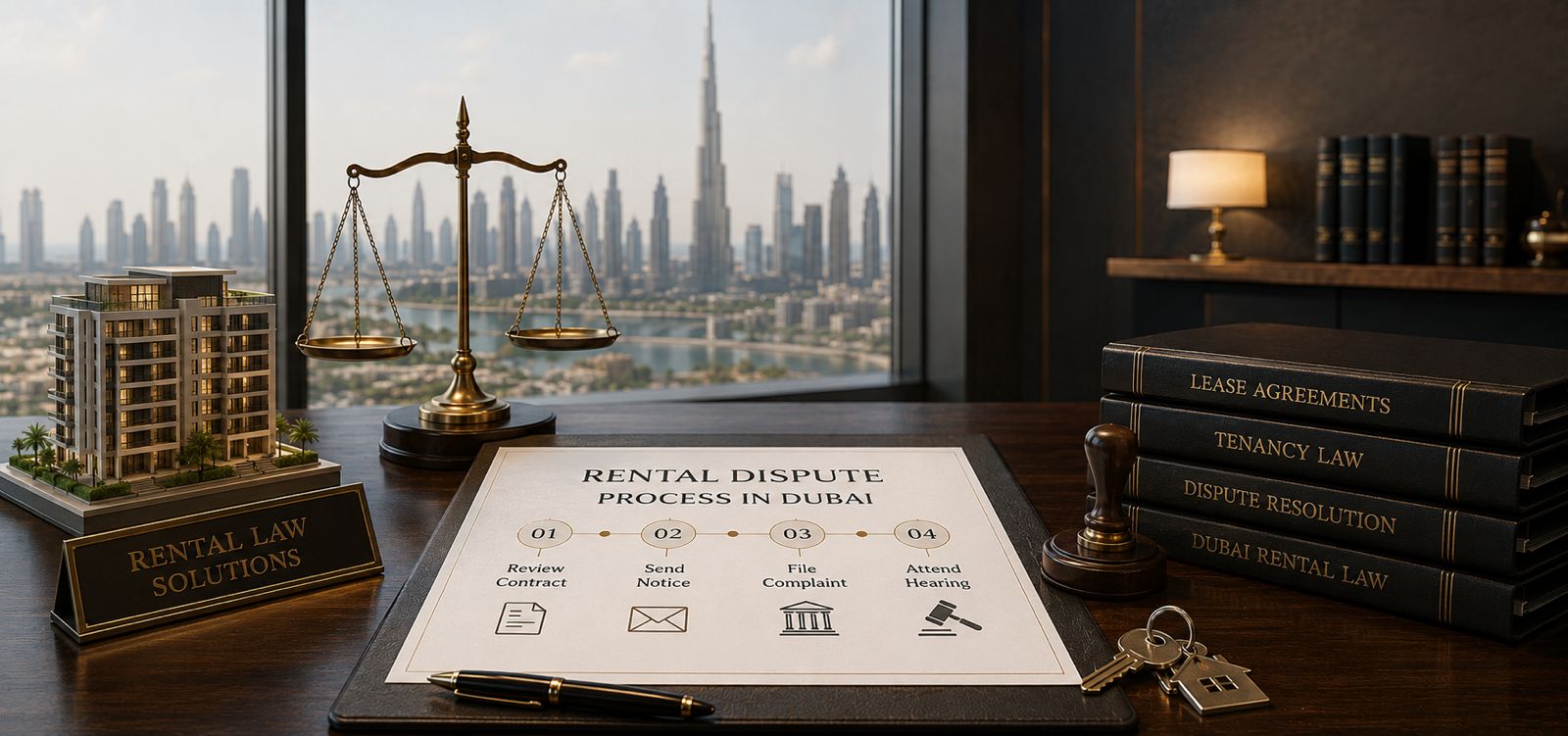

How to Solve a Rental Dispute in Dubai usually begins outside the hearing room. Identify the legal issue, check the tenancy contract and Ejari record, calculate the amount or remedy, send a clear written proposal, and preserve the proof. If direct resolution fails, the Dubai Rental Disputes Center, commonly called the RDC, provides conciliation, first-instance proceedings, appeals in eligible cases, and enforcement.
The correct route depends on the dispute. A rent increase challenge, unpaid rent claim, deposit deduction, maintenance failure, eviction notice, and refusal to accept rent do not use identical evidence or notices. Filing the wrong request can cost time even when the underlying complaint is reasonable. This guide separates the common issues and explains how to build a file the RDC can use.
Read the tenancy contract and obtain the latest Ejari, payment records, notices, messages, inspection evidence, and identification documents. Check the Dubai Land Department Rental Index for any proposed increase and verify whether the required notice was given. Send a factual written settlement proposal.
If the issue remains unresolved, choose RDC conciliation or the correct first-instance service, upload legally translated Arabic documents where required, pay the applicable fee, and attend the remote session. A conciliation agreement approved by the supervising judge is enforceable. If the matter proceeds to judgment, check the 15-day appeal period and the special rules for claims below AED 100,000, then open enforcement if the losing party does not comply.
How to Solve a Rental Dispute in Dubai in 7 Steps
You can read more about this in our guide on family mediation for parents and adult children.
- Define the exact breach, amount, legal remedy, and date on which the problem started.
- Review the tenancy contract, Ejari, addenda, notices, and the current official Rental Index where rent is disputed.
- Collect payment, communication, inspection, maintenance, move-in, and move-out evidence in chronological order.
- Send a clear written proposal or the legally required notice through the correct delivery method.
- Choose the appropriate RDC service, prepare Arabic documents or legal translations, and submit the claim or conciliation request.
- Attend conciliation and, if needed, the first-instance hearing with a specific remedy supported by organized evidence.
- Review the judgment immediately for appeal eligibility and deadlines, then use RDC enforcement if voluntary compliance does not follow.
Direct negotiation and conciliation can resolve many disputes, but neither party should allow an important notice period or appeal deadline to expire while discussions continue. Put proposals in writing, state that rights are reserved where appropriate, and understand which procedural step must still be taken to protect the claim.
The Laws and Authorities That Govern Dubai Rental Disputes
This connects closely with our guide on how long does a rental dispute take in dubai.
Law No. 26 of 2007 Regulating the Relationship between Landlords and Tenants in the Emirate of Dubai, as amended by Law No. 33 of 2008, provides the core tenancy rules. It deals with rent, renewal, maintenance, use of the property, notices, eviction grounds, deposits, and other landlord-tenant obligations.
Decree No. 26 of 2013 established the Rental Disputes Center. The RDC handles many disputes arising between landlords and tenants in Dubai through specialized conciliation, first-instance, appellate, and enforcement functions. Jurisdiction should still be checked because some properties, free-zone arrangements, hotel or serviced-apartment structures, and disputes based on a sale or development contract may follow another route.
The Dubai Land Department maintains the Rental Index and Dubai REST services. The RDC maintains its own electronic services for amicable settlement, first-instance lawsuits, appeals, provisional requests, offers and deposits, and enforcement. A complaint to a property manager or DLD customer service is not automatically the same as an RDC lawsuit.
Step 1: Identify the Dispute and the Remedy
A claim should ask for a legally available result, not simply describe unfair conduct. State whether you seek payment, a refund of a security deposit, repair, a rent reduction, renewal, termination, eviction, rejection of an increase, compensation, validation of a rent deposit, or enforcement of a prior settlement or judgment. Several remedies may arise from one tenancy, but each must be supported.
- Rent increase dispute: compare the notice date and official Rental Index result with the renewal date and current annual rent.
- Unpaid rent: calculate each due amount, payment date, check, partial payment, and any legally served notice.
- Security deposit: compare the move-in and move-out condition, contractual deductions, invoices, and proof of return of keys.
- Maintenance: identify the defect, responsibility under the contract and law, reports, repair requests, access offered, and resulting loss.
- Eviction: identify whether the request is during the term or at expiry, the statutory ground, notice period, and method of service.
- Refusal to accept rent: preserve the tender attempt and consider the RDC Offer and Deposit procedure instead of simply withholding payment.
- Early termination: check whether the contract contains a break clause and whether a legal or agreed termination ground exists.
Do not rely on a label alone. A message saying “eviction notice” may not satisfy the statutory requirements, and a document headed “final settlement” may not cover a claim that was not actually released. The RDC considers the contract, law, service records, and conduct, not only the title chosen by one party.
Step 2: Review the Tenancy Contract and Ejari
If your situation involves this, it helps to speak with tenancy lawyer in dubai.
Obtain the signed tenancy contract, every addendum, the latest Ejari certificate, renewal correspondence, and property-management appointment if relevant. Compare names, dates, property details, rent, payment schedule, maintenance clauses, notice addresses, permitted use, occupants, and any early-termination or subletting terms. Inconsistency should be identified before filing.
Ejari is a central record, and the RDC service pages list a copy of the latest lease or Ejari among the required documents. A missing, expired, or inaccurate registration can complicate filing and proof, but it should not be guessed at. Obtain the available record and evidence of the actual relationship, then confirm what the RDC requires for the intended service.
Check who the legal parties are. A broker, property manager, relative, or maintenance company may communicate for a landlord without becoming the party against whom the main tenancy remedy should be claimed. Obtain the title deed or authority documents available to you and use the correct legal name and service details.
Not Sure Who You Should Actually Be Claiming Against?
Filing against the broker or the management company instead of the landlord can cost you the case before the merits are heard. Send us the contract and the Ejari, and we will confirm the correct party and remedy.
Step 3: Check the Rental Index and Notice Timing
The Dubai Land Department Rental Index service calculates the permitted increase and market information from the relevant property data. Since 2025, the Smart Residential Rent Index has used building classification and market information for residential properties. Use the official result for the correct contract end date and property rather than a broker’s estimate or a general listing price.
Article 14 of the amended tenancy law generally requires a party seeking to change contract terms to notify the other at least 90 days before expiry unless the parties agreed otherwise. A rent increase also needs support from the official index. The index result and the notice rule are separate checks. An increase can fail if the index does not permit it or if timely notice was not given.
Save the index result, the data entered, the date checked, and the notice itself. If the building, unit, bedroom count, use, or contract date is wrong, the result may not address the real property. Raise any discrepancy in writing and propose the figure that follows the official data.
Step 4: Gather and Organize Evidence
The RDC decides from the record filed and the statements made in the case. Good evidence is not merely a large folder. It is an organized set showing the contract, event, breach, notice, loss, and remedy. Create a chronology and number each exhibit. Use the same names and dates throughout the pleading and supporting documents.
- Latest Ejari and signed tenancy contract, including addenda and renewal documents.
- Passport, Emirates ID, trade license, authority, or power of attorney documents for the relevant party.
- Bank statements, transfer records, cheque copies, receipts, and a schedule of rent or other amounts.
- Notarized notices, registered-post receipts, notification reports, emails, and messages showing delivery.
- Move-in and move-out reports, dated photographs, videos, key handover records, and inventory lists.
- Maintenance requests, contractor reports, quotations, invoices, access records, and Dubai Municipality material where relevant.
- Rental Index result and the data used to generate it for a rent increase or reduction dispute.
- Title, management, or ownership records available to establish the correct landlord or representative.
- A calculation of every amount claimed, with the source document for each line.
- Legal Arabic translations for documents that the RDC requires to be submitted in Arabic.
Keep original electronic files and full conversations. A screenshot of one message may exclude a reply that changes its meaning. Export the conversation where possible, retain the phone or account, and show the date and participants. For photographs, keep the original metadata and explain when, where, and by whom each image was taken.
Step 5: Try Direct Settlement Properly
A settlement proposal should be short enough to read and specific enough to accept. Identify the tenancy, state the problem and supporting clause or rule, attach the key proof, propose a defined remedy, and give a reasonable response date. Avoid threats, personal attacks, and accusations that are unnecessary to the tenancy issue.
For example, a deposit proposal can list the deposit paid, admitted deductions, disputed deductions, supporting inspection evidence, and the exact balance requested. A rent increase response can attach the official index result and notice date. A maintenance proposal can identify the defect, earlier access offered, required work, and reasonable deadline.
If an agreement is reached, record every term: amount, payment date, keys, access, repairs, Ejari action, release language, fees, and what happens if a party defaults. A private settlement is a contract, while an RDC conciliation agreement approved by the supervising judge has the force of an execution instrument. The appropriate form depends on the risk and the stage of the dispute.
Step 6: Choose the Correct RDC Service
Amicable Settlement
The RDC’s Dispute Lawsuit for Amicable Settlement service allows parties to seek conciliation within a legal framework. The official service requires the latest lease or Ejari, identification, an IBAN letter or bank statement for the claimant, any required eviction notice material, and supporting documents. All documents must be submitted in Arabic or legally translated into Arabic.
Under Decree No. 26 of 2013, the Mediation and Conciliation Directorate seeks to settle the dispute within 15 days from the parties’ appearance, subject to extension by the supervising judge. If settlement is reached, it is signed, approved, and enforceable. The official RDC service states that half of the court fee paid for basic claims is refunded when conciliation succeeds.
First-Instance Rental Lawsuit
The first-instance service is used for a formal lawsuit between landlord and tenant. Its official document and translation requirements are similar to those of conciliation. After electronic verification and fee payment, the parties attend through the tele-litigation system and receive the judgment through the website. Select the defendant and remedy carefully because the tribunal decides the filed claim.
Urgent, Provisional, Deposit, and Enforcement Services
Not every problem should wait for ordinary conciliation. The RDC offers provisional and summary orders, an offer and deposit procedure, payment-writ services, appeals, and enforcement. A tenant whose landlord refuses rent may need an offer and deposit to protect the payment position. A party with an existing judgment needs enforcement, not a second lawsuit asking for the same result.
Choosing the service is a legal and factual decision. Tenancy lawyers in Dubai can help distinguish a conciliation request, first-instance claim, urgent petition, rent deposit, or enforcement file and prepare the evidence for the correct route.
RDC Fees and Filing Costs
The official RDC service pages currently state a fee of 3.5 percent of the annual rent or lease value for cases such as eviction, renewal, rent claims, termination of a lease in force, and return to premises after certain eviction, with a minimum of AED 500 and maximum of AED 20,000. For monetary claims, the fee is 3.5 percent of the claimed amount, with a minimum of AED 500 and a maximum of AED 15,000.
Additional official charges may include process service, knowledge and innovation fees, power-of-attorney registration, legal translation, expert fees, and service-trustee charges where applicable. A combined case may be costed differently from a single monetary claim. Always use the fee shown by the current RDC service and electronic verification rather than relying only on an old article or informal estimate.
The claimant should also consider recoverability and proportionality. Winning a small claim after spending more on translation, experts, and representation may still be justified if a continuing tenancy or important legal issue is involved, but the decision should be informed. A settlement proposal can account for time, fees, risk, and enforceability without giving up a strong claim for nothing.
What Happens at Conciliation
Conciliation is structured negotiation supervised within the RDC framework. The conciliator reviews the claim, response, documents, and practical settlement options. Attend with authority to settle, a clear minimum position, and draftable terms. A representative who cannot approve anything may waste the session and the opportunity for an enforceable agreement.
The strongest presentation is not the loudest. Explain the issue in a few minutes, identify the key documents, state the remedy, and show the calculation. A landlord may agree to return part of a deposit against a complete handover, while a tenant may agree to a payment plan combined with a fixed move-out date. The final terms should be precise enough to enforce.
If settlement is not reached, preserve the points that were clarified and prepare for the next stage. Do not assume that a proposal made in conciliation automatically proves liability. The formal claim must still be supported by admissible documents and a clear legal basis.
What Happens at the First-Instance Stage
At first instance, the tribunal considers the pleadings, evidence, notices, calculations, and defenses. Sessions may be conducted electronically. Each party should monitor the portal, attend on time, and respond to directions. Missing a session or upload deadline can affect the ability to present the case even when the party believes the documents were previously emailed to a manager or conciliator.
The tribunal may appoint an expert where technical or accounting issues require it. A maintenance case may need evidence about the defect and responsibility; a complex rent account may need reconciliation of payments and cheques. Cooperate with the expert, provide indexed material, and challenge factual errors through the permitted process rather than waiting until judgment.
Decree No. 26 of 2013 directs first-instance tribunals to determine referred claims within 30 days, with a possible extension for the same period under the applicable rules. This statutory framework does not guarantee that every matter finishes in exactly 30 days. Service, experts, amendments, connected claims, and procedural events can affect the practical timeline.
Appeals and the 15-Day Deadline
The appeal period is 15 days from the day after the hearing at which judgment was issued. If the losing party did not attend any hearing and filed no defense, the period starts from service of the judgment. The calculation is important and should be checked immediately. Settlement discussions do not automatically extend the deadline.
As a general rule, rent claim judgments below AED 100,000 are final, but the decree lists exceptions. These include eviction judgments and certain jurisdiction, service, representation, relief, falsified evidence, or concealed-document issues. Appeal eligibility should therefore not be decided from the amount alone.
For appeals involving financial claims, the decree requires the appellant against whom judgment was issued to deposit half the judgment amount with the RDC until the appeal is determined. The exact filing requirements and any application concerning the deposit should be reviewed against the current service. A late or procedurally defective appeal may not reach the merits.
Judgment Went Against You?
The appeal window is 15 days, and it does not pause while you negotiate. Send us the judgment today and we will confirm whether it can be appealed and what has to be filed.
Enforcing an RDC Settlement or Judgment
A favorable judgment or approved conciliation agreement does not always produce voluntary payment or possession. The successful party may need to open an RDC execution file, identify the enforceable instrument, serve the debtor, pay the execution fees, and request lawful measures. Use the execution service rather than continuing informal demands indefinitely.
For a money award, provide the correct IBAN and track payments and outstanding balances. For possession, keys, access, or another non-monetary obligation, the execution request must match the wording of the order. If the judgment does not grant a remedy, enforcement cannot normally add it. This is one reason to draft the original claim precisely.
The debtor may make payment, seek an installment or deadline decision through the available procedure, or raise an execution issue. The creditor should respond through the file and keep an updated calculation. Enforcement strategy may involve separate assets, guarantors, or cheques depending on the documents and the order.
Resolving Common Rental Disputes
Rent Increase Disputes
Check the 90-day notice, any contractual variation, the official Rental Index result, and the correct renewal date. Listings and verbal market opinions do not replace the DLD index. Respond before expiry, state the lawful renewal position, and preserve proof that the response was sent.
Security Deposit Deductions
Compare the move-in condition, ordinary wear, tenant-caused damage, cleaning or repair clause, invoices, and move-out inspection. The tenant should document handover and give bank details. The landlord should itemize actual deductions rather than retain the entire deposit without explanation. Article 20 requires return of the deposit or the remainder upon expiry of the lease.
Maintenance and Uninhabitable Conditions
Article 16 generally places maintenance and repair of defects affecting intended use on the landlord unless the parties agreed otherwise. The contract may allocate minor maintenance. The tenant should notify the defect, offer access, preserve reports and loss, and avoid unauthorized structural work. Urgent safety issues may require authorities beyond an ordinary money claim.
Eviction for Non-Payment or Breach
Article 25 distinguishes eviction during the term from eviction at expiry. Non-payment generally requires 30 days after notice unless the parties agreed otherwise, and certain other breaches have their own conditions. The notice must be served through the legally accepted method. Filing an eviction claim does not suspend the tenant’s rent obligation while the claim is pending.
Eviction at the End of the Tenancy
For sale, personal use, qualifying use by a first-degree relative, demolition, or comprehensive restoration, the landlord must satisfy the specific statutory ground. The amended law generally requires 12 months’ notice through a notary public or registered post. A generic renewal refusal or informal message is not the same as a compliant statutory notice.
Landlord Refuses to Accept Rent
A tenant should not simply keep the money and assume that attempted payment is enough. Preserve the rejected transfer, cheque, or communication, and consider the RDC Offer and Deposit motion. The DLD FAQ explains that the tenant is treated as having paid from the date the judge accepts the motion, subject to the applicable procedure.
Mistakes That Weaken a Rental Case
- Filing against the broker or manager without checking the correct contractual party and authority.
- Using a general complaint channel when an RDC lawsuit, deposit motion, urgent order, or enforcement file is required.
- Submitting untranslated documents or incomplete screenshots instead of the required Arabic record.
- Claiming a total amount without a line-by-line calculation and supporting payment proof.
- Relying on a phone call for a notice that the law requires through a notary public or registered post.
- Ignoring the 90-day term-change notice or the separate 12-month eviction notice rules.
- Assuming every judgment below AED 100,000 is unappealable without checking the statutory exceptions.
- Missing the 15-day appeal period while negotiating privately.
- Stopping rent because a maintenance or eviction dispute is pending.
- Winning a judgment but failing to open the correct execution file.
When a Lawyer Adds Value
A straightforward deposit or rent calculation may be manageable without representation if the documents and parties are clear. Legal help becomes more valuable where eviction, significant arrears, a commercial lease, disputed authority, foreign ownership, multiple contracts, expert evidence, urgent relief, an appeal, or enforcement is involved.
A lawyer can identify the correct defendant and remedy, test notice validity, calculate the claim, arrange legal translation, draft the Arabic filing, represent the party in conciliation and hearings, and preserve appeal rights. Real Estate Lawyers in Dubai may also help where the dispute overlaps with title, sale, management, development, or property-ownership issues outside a simple tenancy claim.
The key is proportionality. The legal strategy should match the amount, urgency, ongoing relationship, evidence, and chance of voluntary compliance. Good advice may support filing, settlement, a narrower claim, or a different authority. It should not force every disagreement into the same template.
People Also Ask
Build the File Before You Escalate
The practical answer to How to Solve a Rental Dispute in Dubai is to match the remedy to the evidence and the RDC service. Start with the contract, Ejari, official index, notices, payments, and a written proposal. Escalate before a deadline expires, not simply when communication becomes frustrating.
Where the dispute reaches a hearing, appeal, or execution stage, a Litigation Lawyer in Dubai can help keep the pleading, evidence, deadlines, and enforcement requests aligned. The best result is not always a judgment. It is a clear, lawful, and enforceable resolution that closes the tenancy issue.
Rental Dispute Going Nowhere?
Leaders Advocates prepares the file, files through the correct RDC service, represents you at conciliation and hearings, and enforces the outcome when the other side will not comply.

1 Comment