
You have a judgment, settlement, award, or returned cheque, but the company still refuses to pay. The real question is no longer whether money is owed.
Recovery now depends on the enforceable instrument, the correct legal entity, reachable assets, guarantors, and any insolvency process.
Quick Answer
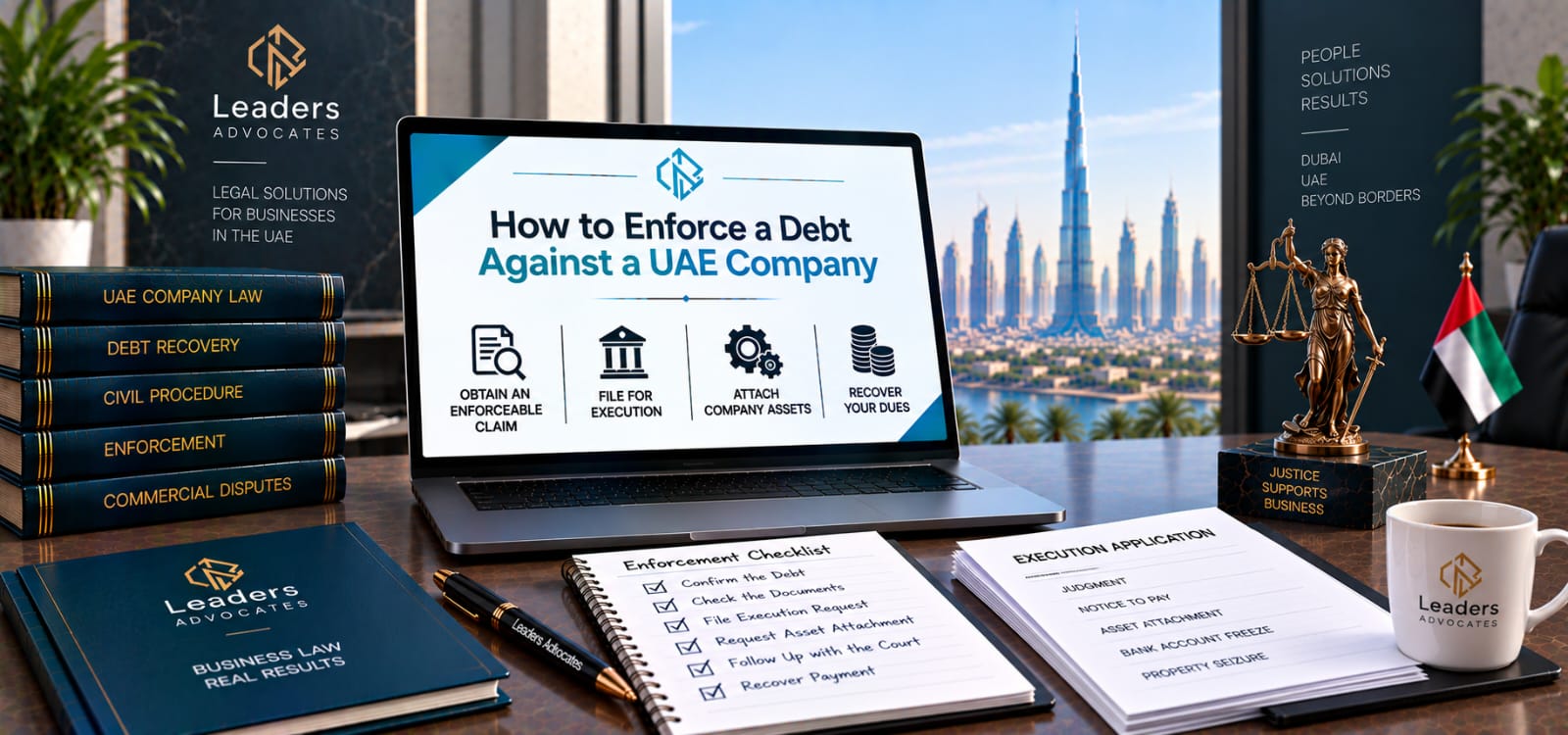
To enforce debt against a UAE company, start with an enforceable instrument. This may be a judgment, enforceable settlement, recognized arbitral award, or qualifying cheque under Article 667 of Federal Decree-Law No. 50 of 2022.
Open an execution file and request lawful measures against the company’s bank accounts, real estate, vehicles, shares, equipment, and receivables owed by third parties. A company itself cannot receive a travel ban. A qualifying individual guarantor may face separate measures.
Check insolvency status before acting. Federal Decree-Law No. 51 of 2023 may stay individual enforcement. Results depend on the instrument, entity structure, defenses, and available assets.
How to Enforce Debt Against a UAE Company
First confirm the debtor’s exact licensed name, legal form, license number, authority, and registered address. A brand or trade name may not identify the liable entity.
Then confirm what document permits execution. A final judgment, enforceable settlement, recognized award, or qualifying cheque may support an execution file.
The execution court generally notifies the debtor and allows the legal payment period. If payment does not follow, the creditor may request authorized measures.
Assets That May Be Reached
- Bank accounts identified or located through court-directed inquiries.
- Real estate registered in the company’s name.
- Vehicles, machinery, or equipment that can be identified.
- Shares or ownership interests, subject to applicable procedures.
- Receivables owed to the company by customers or other third parties.
- Sale proceeds or other money held for the company.
Third-party attachment can be effective for an operating business. The third party must respond to the court and must not simply redirect attached funds.
Asset value, ownership, priority rights, and existing security all affect recovery. An attachment does not ensure that sale proceeds will cover every creditor.
Judgment in Hand but Still Not Paid?
Send us your judgment or cheque details on WhatsApp now and we’ll tell you what assets can actually be pursued.
Guarantors, Managers, and Shareholders
A valid personal or corporate guarantee can create a separate enforcement target. Liability depends on the guarantee’s language, scope, and legal validity.
Managers and shareholders are not automatically liable for company debt. Personal liability requires a legal basis, such as a guarantee or actionable misconduct.
Travel-ban procedures concern natural persons, not companies. Articles 324 to 327 and the AED 10,000 threshold remain subject to all statutory conditions.
Insolvency and Cross-Border Assets
If restructuring or bankruptcy proceedings begin, individual execution may be stayed. Creditors must follow the claims process and applicable court directions.
DIFC and ADGM entities may follow their own insolvency and court regimes. The license and incorporation records should be checked before filing.
Foreign assets may require recognition and enforcement in another country. A foreign judgment against a UAE company must satisfy Articles 222 to 225 and other applicable rules.
Legal Framework for Company Debt Enforcement
The governing legal framework
Federal Decree-Law No. 42 of 2022 governs civil procedure in the federal framework. Local court systems and financial free zones may apply separate procedural rules.
Articles 143 to 150 regulate payment orders for certain fixed, due, and documented debts. The creditor must first demand payment and allow at least five days.
Federal Decree-Law No. 50 of 2022 governs commercial transactions. Article 667 treats a qualifying returned cheque as an executive instrument.
A cheque route depends on the return reason and supporting bank record. A signature dispute or other defense may require a different legal route.
Federal Decree-Law No. 51 of 2023 governs financial restructuring and bankruptcy. Once qualifying proceedings begin, individual enforcement may be stayed or controlled.
Commercial claims between merchants are generally subject to a five-year period when the debtor denies the claim. The starting point and interruptions require file-specific review.
Articles 324 to 327 of the Civil Procedure Law regulate travel-ban applications in qualifying debt matters. The debt threshold is AED 10,000, alongside other legal conditions.
A travel ban is not automatic. It requires a court application, supporting evidence, and satisfaction of the statutory conditions.
Practical Steps
Start with a legal and commercial assessment. Confirm the amount, the due date, the parties, the forum, and the debtor’s ability to pay.
- Reconcile the account and remove calculation errors.
- Confirm the debtor’s exact legal identity and current address.
- Review dispute-resolution, notice, and governing-law clauses.
- Send a focused written demand with a clear deadline.
- Choose negotiation, a payment order, cheque execution, arbitration, or an ordinary claim.
- Plan enforcement before spending heavily on litigation.
Settlement can be practical when it produces secured and realistic payments. Record the amount, schedule, default consequences, releases, and treatment of pending proceedings.
If litigation is required, file in the competent forum. Respond promptly to court directions, expert requests, translations, and service issues.
After judgment, open or continue execution without delay. Request asset measures based on reliable information and monitor the file actively.
Not Sure Which Recovery Route Fits Your File?
Payment order, cheque execution, or a full claim — get a fast, free WhatsApp read on the fastest route to your money.
Evidence and Documents Needed
A strong recovery file connects the legal obligation, performance, maturity, default, and amount. Each document should support one part of that chain.
- Signed contract, purchase order, facility agreement, or accepted terms.
- Invoices and a current statement of account.
- Delivery notes, completion certificates, or service records.
- Emails, messages, and written acknowledgments of the balance.
- Payment records, returned cheques, guarantees, and security documents.
- The debtor’s correct legal name, license details, address, and known assets.
Foreign-language documents usually need certified Arabic translation for onshore court use. Foreign documents may also require legalization or other authentication.
Keep originals when they exist. Preserve electronic records in their native form, including dates, sender details, attachments, and complete message threads.
Common Mistakes and Risks
- Using the wrong legal name or suing only a trade name.
- Waiting while limitation or appeal periods continue to run.
- Relying on invoices without proof of delivery or acceptance.
- Sending an unclear demand that does not support the intended procedure.
- Assuming a judgment automatically produces payment.
- Ignoring arbitration, DIFC, ADGM, or other jurisdiction clauses.
- Accepting a payment plan without security, default terms, or written acknowledgment.
A procedural shortcut can waste time if its legal conditions are missing. The correct route should follow the evidence, not the creditor’s preferred timetable.
How a Lawyer Can Help
A debt recovery lawyer can test the evidence, identify the correct defendant, and select the procedure that fits the documents.
Counsel can draft the demand, calculate the claim, address jurisdiction, and prepare Arabic court filings. Counsel can also respond to defenses and expert questions.
During enforcement, a lawyer can request lawful asset measures, follow third-party responses, address objections, and evaluate settlement against the expected recovery.
Legal advice cannot guarantee collection. Its value is reducing avoidable procedural risk and aligning the strategy with reachable assets.
Costs, Court Fees, and Commercial Decisions
A legally valid claim may still be commercially unattractive. The creditor should compare the debt, likely fees, court charges, translation costs, expert costs, and expected enforcement return.
Court fees differ by forum, claim value, and procedure. Current fees should be confirmed with the competent court before filing.
A debtor may also have secured creditors or earlier attachments. Priority and available equity can affect whether a successful claim produces a meaningful payment.
For a portfolio, use written authority levels for settlement discounts, installment terms, and litigation spending. This prevents inconsistent decisions and unnecessary delay.
Settlement should be measured against realistic net recovery, not only the face value of the claim. Consider timing, security, enforcement risk, and the debtor’s continuing business value.
Jurisdiction and Forum Checks
Before any filing, review the jurisdiction clause, arbitration agreement, place of performance, debtor address, and licensing authority. These details can determine the competent forum.
Mainland courts, DIFC Courts, ADGM Courts, arbitral tribunals, and specialized committees follow different rules. A filing in the wrong forum can lose time and cost.
Where several forums appear possible, obtain a reasoned jurisdiction assessment. The focus keyword or commercial preference cannot replace the contract and procedural law.
Debtor Has Assets in Another Country?
Message us on WhatsApp and we’ll map out the UAE and cross-border steps needed to reach those assets.
A Practical Asset Map
Build an asset map before and during execution. List known banks, property, vehicles, equipment, customers, projects, subsidiaries, shareholdings, and guarantees.
Separate confirmed information from assumptions. Court applications should rely on accurate identifiers and legally relevant evidence.
Review public and contractual records for changes in ownership, management, address, license status, or business activity. Sudden changes may require closer legal analysis.
Do not assume that money entering an operating company remains available. Payroll, secured lending, taxes, and earlier creditors may affect practical recovery.
Update the map as third parties respond. Enforcement works best as an active process supported by new, reliable information.
Record each request, response, attachment, objection, and follow-up date. This execution log helps identify stalled measures and decide whether another application is justified.
Relevant Legal Services
The appropriate service depends on the claim, the contract, the forum, and the enforcement position.
Relevant Success Story
See our debt recovery success stories for an example of how documented recovery work may progress.
Past results do not guarantee a similar outcome. Every matter depends on its own facts, documents, assets, and legal circumstances.
Follow Leaders Advocates on LinkedIn or Leaders Advocates on Facebook for more UAE legal updates. Read more on Debt Recovery in the UAE and Who Is the Best Debt Lawyer in Dubai on Mondaq.
Frequently Asked Questions
Final Takeaway
Company enforcement requires a valid instrument and a targeted asset plan. Focus on the licensed entity, its receivables, its property, and any valid guarantees.
Review the execution file and insolvency status promptly. The safest strategy depends on the documents, corporate structure, and reachable assets.
Ready to Start Enforcing Your Debt?
Don’t let another month pass without action. WhatsApp us your case details now and get a clear next step today.
Leaders Advocates | UAE Legal Information