


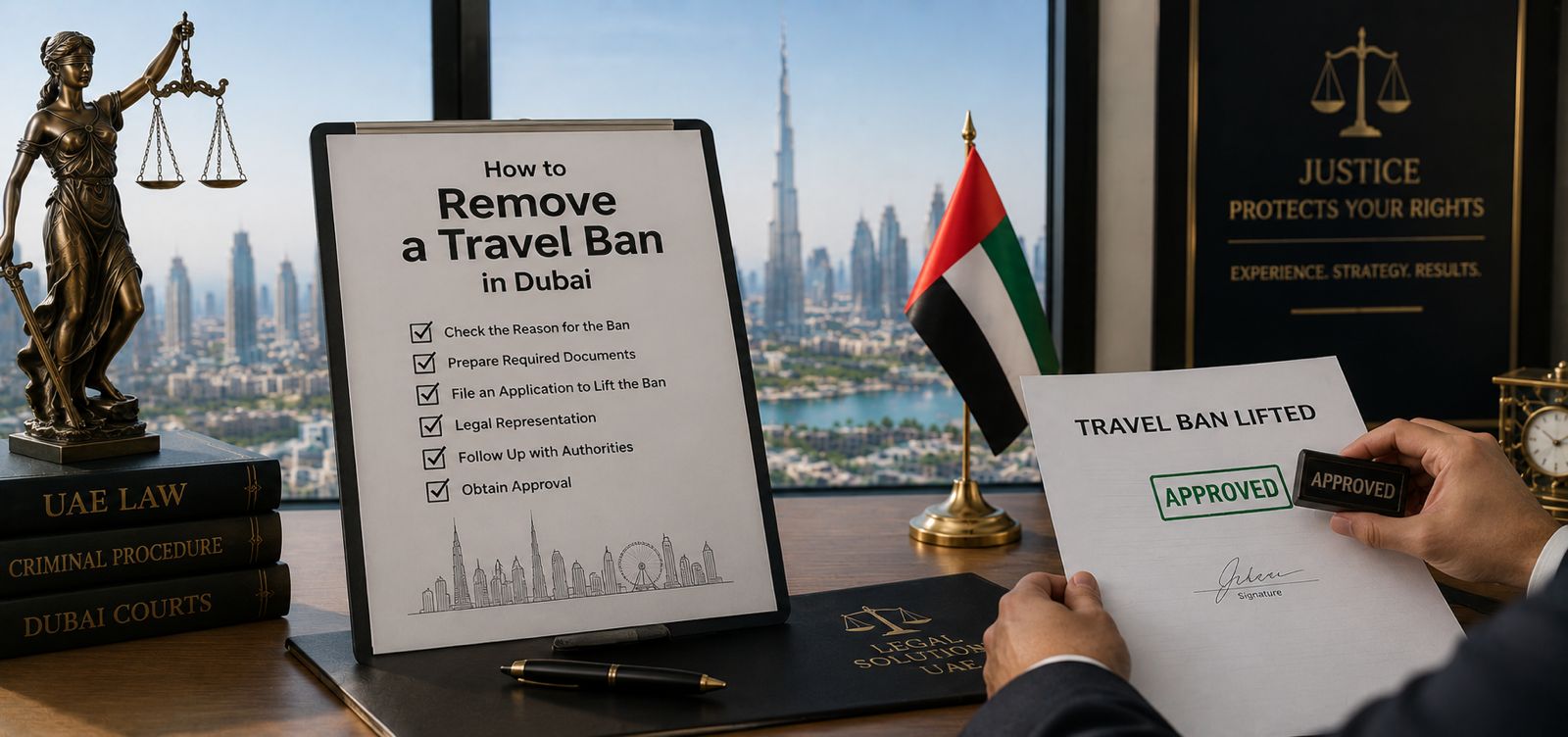

Most travel bans in Dubai relate to unpaid debt, bounced cheques, unpaid loans, or unresolved commercial disputes. They are rarely permanent.
How to remove a travel ban in Dubai depends on the ban type and the available legal route. This guide focuses on civil debt-related travel bans.
Five options exist, and the fastest one is not the same in every file. It depends on funds, documents, and whether the creditor will cooperate.
Civil debt-related travel bans are governed by Articles 324 to 326 of Federal Decree-Law No. 42 of 2022. Five legal options may lift a ban: full payment, accepted security, a court deposit, written creditor consent, or a successful challenge. A challenge may apply where the debt is below AED 10,000, genuinely disputed, supported by weak flight-risk evidence, or based on defective documents. A formal objection must be filed within seven days of a precautionary order. The ban may also be cancelled after a missed eight-day or 30-day deadline. Confirm the updated file status before any journey.
Confirm the Ban Before Taking Action
In cases like this, it is worth speaking with criminal defense lawyer in dubai.
Start with the case number, issuing court, and current status. The Dubai Police financial cases service can provide a preliminary check.
The correct route depends on which authority issued the ban. Do not assume every restriction is a civil debt ban.
Ask for the order or file reference before making any payment. The reference connects each receipt or settlement to the correct case.
A preliminary online result may not explain every restriction. Confirm the file directly through the relevant court or execution record, and see our guide on the UAE travel ban check for every channel worth using.
Types of Travel Bans in Dubai
Our guide on immigration bans in the UAE explains this further.
Civil Debt-Related Travel Ban
This type may arise from unpaid loans, bounced cheques, rent, or commercial disputes. The civil court or execution process controls its removal.
The underlying debt and the travel restriction are connected. However, each still needs the correct filing and supporting proof.
Criminal Travel Ban
A criminal restriction relates to an active investigation or prosecution. It follows the criminal procedure process rather than the civil debt route.
Paying a civil balance will not resolve a separate criminal file. The authority handling that file must address the restriction, which is why criminal defence lawyers in Dubai should review any file with a prosecution reference.
Immigration or Administrative Ban
This restriction may relate to visa, residency, or administrative status. It requires a separate administrative procedure with the issuing body.
The case source matters more than the label used in conversation. The official record determines the correct next step.
The Legal Basis for Civil Travel Bans
Civil debt-related bans are governed by the Civil Procedure Law, Federal Decree-Law No. 42 of 2022. Articles 324 to 326 address debtor travel bans linked to execution proceedings.
The debt normally must be at least AED 10,000. Common triggers include loans, credit card debt, bounced cheques, unpaid rent, supplier disputes, and personal guarantees.
The threshold is one part of the court’s review. The creditor’s documents and the stated flight risk also matter. Where the ban follows a dishonoured cheque, our guide on how to clear a bounced cheque case in Dubai covers the underlying enforcement file.
How to Remove a Travel Ban in Dubai: 5 Legal Options
For a closer look at this, see our guide on how to remove an absconding case in dubai.
| Option | Best When | What the Court Needs |
|---|---|---|
| Pay in Full | The balance can be settled and proved | Traceable payment, receipts, creditor clearance |
| Bank Guarantee or Surety | Immediate payment is not possible | Complete guarantee or solvent surety documents |
| Court Deposit | Funds exist but the creditor will not cooperate | Official deposit receipt linked to the execution file |
| Creditor Consent | A written settlement is realistic | Signed consent identifying parties, debt, and case |
| Challenge the Order | A required legal condition was missing | Chronology of dates plus proof of the defect |
Option 1: Pay the Debt in Full
Full payment is usually the most direct route when funds are available. Submit clear proof to the execution court and request release of the ban.
Use traceable payments and keep every receipt. Informal payment can create a second dispute about whether the balance was settled.
The payment should appear in the correct file. Confirm the court has recorded the settlement before planning travel.
Option 2: Provide a Bank Guarantee or Solvent Surety
An accepted bank guarantee or solvent surety can secure the debt. This route may help when immediate payment is not possible.
The execution judge must accept the proposed security. Prepare complete bank or surety documents before submitting the request.
Security does not erase the underlying claim. It addresses the court’s concern while the debt remains secured.
Option 3: Deposit the Full Debt With the Court
A court deposit places the full debt amount with the court for the creditor. It can help when funds are available but cooperation is missing.
Keep the official deposit receipt and link it to the execution file. Then request the required action on the travel restriction.
Option 4: Obtain Written Creditor Consent
The creditor may give written consent after a settlement or payment arrangement. The consent should identify the parties, debt, and relevant case.
A verbal promise is not enough for a reliable filing. Record the agreement and submit the consent through the court process.
Settlement terms should also address any remaining payments. Clear wording reduces later disagreement about the ban and the debt, which is why our contract lawyers in Dubai draft these agreements to cover both.
Option 5: Challenge the Travel Ban
A ban can sometimes be cancelled without paying or securing the debt. This applies when the original request missed a legal requirement.
- The debt is below the AED 10,000 threshold.
- The debt is genuinely disputed and is not a clear amount.
- There is no credible evidence of flight risk.
- The creditor’s documents were procedurally defective.
A debtor has seven days from the precautionary order to file a formal objection. Missing that period can reduce the available options.
Only Seven Days to Object?
The objection period after a precautionary order is short, and missing it narrows what remains available. Send us the order and we will tell you today whether a challenge is realistic.
How to Prepare a Strong Removal Request
A strong request connects the legal option to clear evidence. The court should be able to follow the file without guessing.
Organise the documents in date order and label each item. Use the case number on every settlement, receipt, or supporting letter.
- Identify the exact order that must be lifted.
- State the selected removal option clearly.
- Attach proof that directly supports that option.
- Show the payment date and amount, where relevant.
- Include written creditor consent, where available.
- Attach security or court deposit documents, where relevant.
- List the procedural dates when filing a challenge.
- Request written confirmation of the decision.
Preparing a Payment or Settlement File
Match every payment to the debt and execution case. A bank transfer alone may not explain the agreed settlement terms.
Include the signed agreement, receipts, and creditor clearance. The documents should show whether the balance is fully settled.
Preparing a Security or Court Deposit File
Prepare the guarantee, surety papers, or official deposit receipt. Check that the amount and parties match the court record.
Explain why the security answers the existing restriction. Incomplete supporting papers can delay the court’s review.
Preparing a Challenge File
Build a short chronology of the order, service, lawsuit, judgment, and enforcement steps. Dates are central to a deadline argument.
Place the strongest challenge ground first. Then attach the document that proves each factual point.
Important Deadlines That May Cancel the Ban
The law sets deadlines to prevent a creditor from keeping a ban without pursuing the case. Review the court record rather than relying on memory.
| Period | What It Applies To | Effect |
|---|---|---|
| 7 Days | Debtor’s formal objection to a precautionary order | Missing it narrows the options available |
| 8 Days | Creditor filing the main lawsuit | The ban is cancelled if the lawsuit is not filed |
| 30 Days | Enforcement starting after a final judgment | The ban can be lifted if enforcement has not begun |
Check the filing dates, judgment status, and enforcement activity. A complete timeline can reveal a missed procedural deadline.
Not sure which option fits your file? Our debt recovery lawyers in Dubai can review the order, the challenge grounds, and the settlement documents together.
Arrest for Unpaid Debt Is No Longer Automatic
Decisions of the Dubai Court of Cassation General Assembly have raised the bar for civil arrest. They concern arrest after judgment, not the travel ban itself.
A creditor must prove that the debtor is solvent and wilfully refusing to pay. The rule also covers fraudulent concealment or transfer of assets.
- Arrest can still apply when assets are concealed to harm creditors.
- It can apply when instalment payments stop without a valid reason.
- It can apply when the debtor gave guarantees for another party’s debt before the court.
- The position applies to Dubai Courts, not the courts of other emirates.
The distinction matters in practice. Losing the risk of arrest is not the same as regaining the ability to travel.
Step-by-Step Travel Ban Removal Process
- Confirm the ban, case number, issuing authority, and current balance.
- Obtain the order and review the legal reason for the restriction.
- Choose payment, security, court deposit, creditor consent, or a challenge.
- Collect the documents required for the selected route.
- Submit the request through the correct court or execution file.
- Obtain written confirmation of the court’s decision.
- Check the case status again before attempting to travel.
Keep a dated copy of every submission. A clear file history helps when the status has not updated as expected.
Documents You May Need
- Passport and Emirates ID copies.
- Travel ban order and complete case reference.
- Signed settlement agreement.
- Payment receipts and creditor clearance letter.
- Complaint withdrawal confirmation, where relevant.
- Updated court or execution case record.
- Bank no-liability certificate, where relevant.
- Bank guarantee, surety papers, or court deposit receipt.
For a challenge, add the documents supporting the objection. These may include the debt record, disputed correspondence, and the procedural dates.
How Long Does Travel Ban Removal Take?
There is no single timeline for every file. Timing depends on the issuing authority, legal route, documents, and creditor response.
A complete payment file may move faster than a contested challenge. Missing documents or unclear settlements can extend the process.
Do not treat a payment date as the ban removal date. Confirm the updated restriction status through the proper file.
Choosing the Most Practical Legal Option
The fastest option is not identical in every case. It depends on available funds, documents, security, and creditor cooperation.
- Choose payment when the balance can be closed and proved.
- Choose creditor consent when a written settlement is realistic.
- Consider security when immediate payment is not possible.
- Consider a court deposit when the creditor is not cooperating.
- Challenge the order when a required condition was missing.
Do not combine several options without a clear reason. A focused request is easier to support with matching evidence, and our civil lawyers in Dubai can identify which route the file actually supports.
Cannot Pay the Full Amount Right Now?
Payment is not the only route. A bank guarantee, a court deposit, or written creditor consent can lift a ban without settling the balance immediately. We can tell you which one your file supports.
What to Do After the Court Approves Removal
Obtain a written copy of the decision and keep it with the case papers. Check that the request relates to the correct restriction.
Review the electronic status before booking travel. A court decision and a system update may not appear at the same moment.
- Keep the removal order and submission receipt.
- Check the case status using the correct reference.
- Confirm that no separate restriction remains.
- Retain settlement and payment records.
- Avoid relying only on a verbal confirmation.
If the restriction still appears, use the written decision to follow up. Do not start a second settlement for the same file. Where more than one case is involved, our litigation lawyers in Dubai can trace each file to its issuing authority.
Common Mistakes to Avoid
- Assuming the ban ended without checking the case status.
- Paying informally without recording the settlement in the case file.
- Missing the seven-day objection period.
- Ignoring the AED 10,000 threshold.
- Assuming the Dubai arrest position applies in other emirates.
- Waiting instead of considering security or a court deposit.
- Booking travel before receiving reliable status confirmation.
Frequently Asked Questions
A civil travel ban can end through payment, security, a court deposit, creditor consent, or a successful challenge. Which one fits depends on the file, not on preference.
Whichever route applies, the ban ends when the court records it, not when the money leaves your account.
Need a Travel Ban Lifted?
Leaders Advocates handles civil travel ban removal across payment, security, court deposits, creditor settlements, and formal challenges, then confirms the restriction has actually cleared before you travel.


6 Comments