


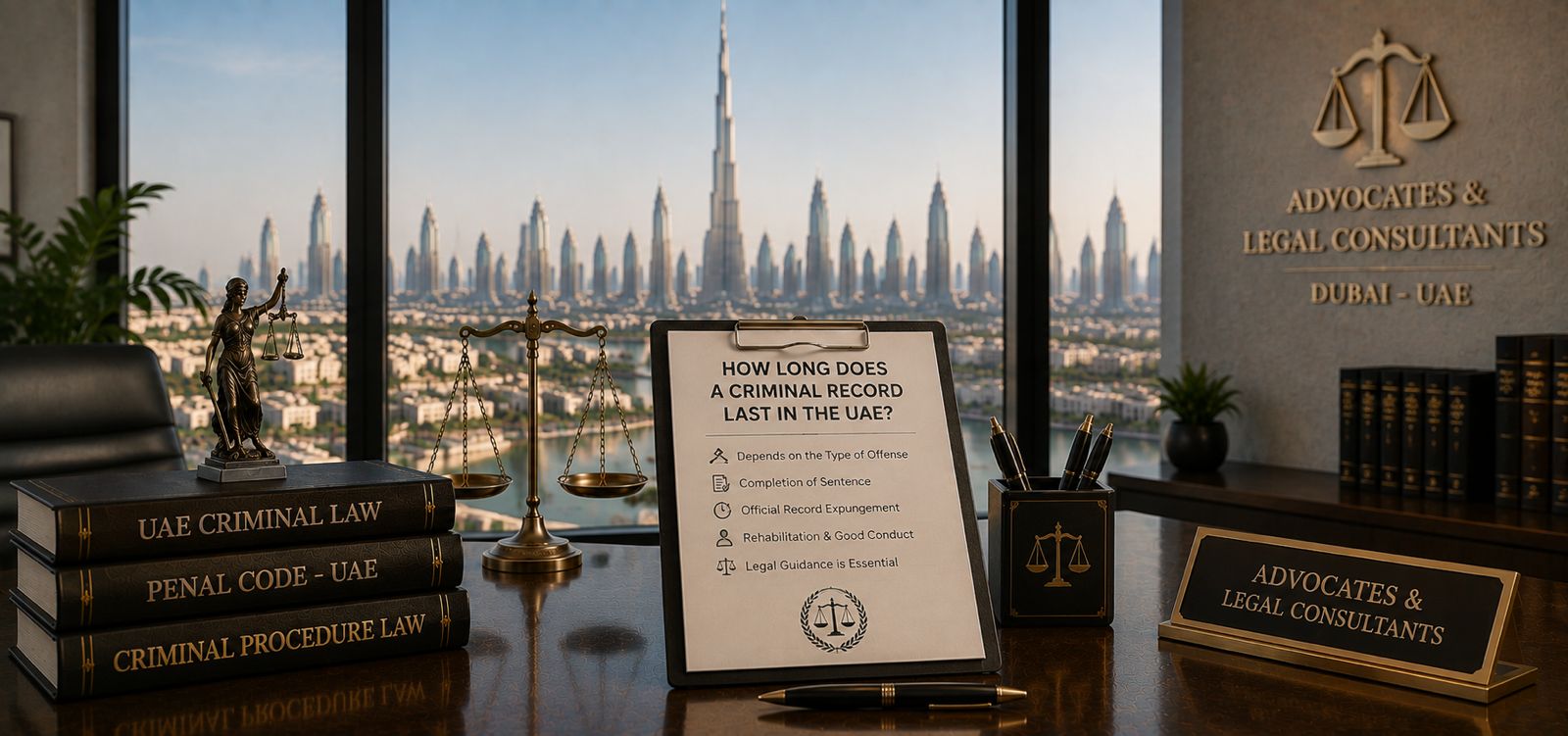

Unlike some jurisdictions where minor convictions automatically fall off a record after a set number of years, a UAE criminal record generally does not expire on its own timeline. It remains on file indefinitely unless a specific clearing process is successfully pursued.
This is a genuine point of confusion for many expatriates. A person may assume that a minor, old conviction has disappeared simply because several years have passed, only to find that it remains relevant to a background check, visa application, employment screening, or future entry question.
This guide explains the indefinite default position, what can change a record’s practical status, how to prepare for a clearance review, and how to avoid mistakes when a previous conviction becomes relevant again. A criminal defense lawyer in Dubai can advise on how to remove a travel ban in Dubai and how to remove an absconding case in Dubai.
Quick Answer
A UAE criminal record generally has no automatic expiry date. It stays on file indefinitely by default, whether the underlying offence was a minor misdemeanor or a serious felony.
The only way a record’s practical status genuinely changes is through the formal rehabilitation or clearance process, available in limited circumstances, generally for lesser offences after the sentence is fully completed and a defined period passes without reoffending.
Where clearing is not pursued, or is not available given the offence’s severity, the record continues to exist and can surface in future background checks, visa applications, or employment screening indefinitely.
Why UAE Criminal Records Do Not Expire Automatically
Some legal systems use an automatic timetable. A conviction may become spent or stop appearing in certain checks after a fixed period. The UAE’s default framework is different: the passage of time alone does not automatically remove the record.
This means the useful question is not simply, “How old is the case?” The person should also ask what the final outcome was, whether the sentence was completed, whether any later offence occurred, and whether a formal rehabilitation or clearance process was ever completed.
If the person is not sure whether the matter ended as a complaint, prosecution, conviction, or another outcome, a Dubai criminal case check may help identify the file and current status before any further step.
What “Criminal Record” Can Refer To
The phrase is used broadly. It may refer to the conviction itself, the criminal case history, information appearing in a background check, or the practical consequences of a past judgment.
Not Sure If Your UAE Criminal Record Can Be Cleared?
The answer depends on the final judgment, the offence classification, whether the sentence was fully completed, and whether the required period has passed. Our criminal defense lawyers in Dubai can review your case before you start the clearance process.
These questions should be separated:
• Was there a final conviction or only an allegation?
• Was the sentence completed?
• Does a formal rehabilitation or clearance route apply?
• What does the requesting employer, authority, or embassy actually ask?
• Is the issue a UAE background check, a foreign visa application, or re-entry to the UAE?
A person should obtain the final case documents instead of answering from memory or from an informal description used years earlier.
What Actually Changes a Record’s Status
The genuine mechanism for changing a record’s practical status is the formal rehabilitation or clearance application. It is available in limited circumstances for lesser offences.
The process is not based only on how much time has passed. The sentence generally needs to be fully completed, and a defined period must pass without reoffending. The seriousness and type of the original offence can also affect whether the process is available.
A person should not announce that a record has been cleared before receiving the formal result. Completing a sentence, paying a fine, leaving the UAE, or receiving a new visa does not by itself prove that a rehabilitation or clearance decision was issued.
First Confirm the Original Case Outcome
Complaint or Investigation
Not every police report ends in a conviction. Obtain the official file result and avoid describing a complaint as a criminal record without confirming the outcome.
Court Judgment
If there was a conviction, collect the final judgment and any appeal result. The offence classification and sentence matter when assessing the practical consequences and possible clearing route.
Sentence Completion
Keep proof that imprisonment, a fine, or another ordered measure was completed. A clearance review should be based on the official completion record, not an estimate.
Later Conduct
Because the formal process is generally linked to a defined period without reoffending, any later criminal case must be identified accurately.
Practical Consequences of an Indefinite Record
Employment Screening
An employer may request a background check or Police Clearance Certificate, especially for regulated, trusted, financial, security, education, healthcare, or government-related roles. The request should be read carefully because different employers ask different questions.
Visa and Immigration Applications
A visa form may ask whether the person has ever been convicted. The word “ever” creates a historical question, not merely a question about the last few years. Never assume that age alone makes the conviction irrelevant.
Re-Entering the UAE
A past conviction can affect a later attempt to enter or reside in the UAE, depending on the original matter and any connected immigration consequence. A background record, immigration restriction, and travel ban are separate issues and should not be confused.
Professional Licensing
Some professions and regulated activities require character, conduct, or clearance documents. The authority may need the formal outcome of the old case and any clearance decision.
Documents to Collect Before Seeking Clearance
• Passport and Emirates ID copies.
• Old passports used during the original case.
• Police, Public Prosecution, and court file numbers.
• Final judgment and appeal result.
• Proof that the sentence was fully completed.
• Fine and payment receipts.
• Release or case-completion documents.
• Current residence and contact information.
• Evidence of conduct and stability after the case.
• Employment or licensing request that made the record relevant again.
• Copies of any earlier rehabilitation or clearance application.
If the case involved a specific offence, such as a theft case in Dubai, use the actual judgment rather than assuming the classification from the incident description.
How to Prepare for a Rehabilitation or Clearance Review
Step 1: Reconstruct the Case Chronology
List the complaint, judgment, appeal, sentence, payment, release, and any later application in date order. Mark which points are supported by official documents.
Step 2: Confirm the Sentence Was Completed
Collect the formal evidence. If an amount remains unpaid or a required measure was not completed, resolve the gap before treating the record as ready for review.
Step 3: Check Whether the Offence Is Eligible
The process is available only in limited circumstances and is generally associated with lesser offences. The severity and classification should be assessed from the final judgment.
Step 4: Confirm the Required Period Has Passed
Do not guess. Confirm the relevant period and when it began. The date of the offence, judgment, sentence completion, and release are not interchangeable.
Step 5: Check for Later Cases
A new offence can affect the application. Obtain current case information and disclose the relevant history accurately.
Step 6: Submit the Formal Application
Use the correct authority and provide a complete, consistent document file. Keep the reference number and every official response.
Step 7: Obtain the Final Result
Do not rely on a verbal statement. Keep the formal rehabilitation or clearance result and use it when applying for any updated certificate or explaining the record to another authority.
Police Clearance and Disclosure Questions
A Police Clearance Certificate is a practical document requested for employment, immigration, licensing, study, or other purposes. The applicant should confirm the issuing authority, purpose, destination country, and whether fingerprints, attestation, or translation are required.
A PCC request and a historical disclosure question are not always the same. A foreign form asking whether someone has ever been convicted may still require an accurate historical answer even if the person believes the matter is old.
When in doubt, criminal defense lawyers in Dubai can review the actual judgment and the wording of the form instead of giving a general answer based only on the age of the case.
Does Time Make an Old Conviction Less Important?
Time can change the context. A person may have stable employment, a clean later history, and completed every part of the original sentence. Those facts can matter to a clearance review or to an authority assessing the person’s current situation.
However, time by itself does not automatically erase the UAE record. The formal process remains the key distinction between an old record that still exists by default and a record whose practical status has been changed successfully.
If an Employer or Embassy Asks Before Clearance Is Complete
Read the request carefully and note the deadline. Determine whether it asks for a Police Clearance Certificate, a copy of the judgment, a statement about any conviction, or proof that a sentence was completed.
Do not submit an application based on guesswork. If the formal clearance review is still pending, distinguish between the existing case documents and the application that has not yet been decided.
Keep a copy of exactly what was submitted. This helps prevent a later form from containing a different date, offence description, or outcome.
Worried an Old Conviction Could Affect Your Visa or Job?
Do not assume an old UAE conviction has disappeared just because years have passed. Get the case status checked before submitting a background check, visa application, or employment disclosure.
Working With Very Old Case Files
Older cases may be connected to an expired passport, previous visa, former address, or different English spelling of the person’s name. Include those identifiers when requesting records.
If a document cannot be found, make a list of what is missing and which authority may hold it. Reconstruct the chronology from official references rather than social media messages, memory, or an unofficial agent’s summary.
The goal is one reliable file containing identity, judgment, sentence completion, payment, and any later clearance result. That file can then support future employment, licensing, visa, or background-check requests.
Common Mistakes
• Assuming a minor conviction disappeared after a few years.
• Confusing the end of the sentence with clearance of the record.
• Forgetting an old passport or name spelling connected to the case.
• Applying without the final judgment or sentence-completion proof.
• Treating a police report as a conviction without confirming the outcome.
• Failing to disclose a past conviction when a form expressly asks for it.
• Assuming a new visa proves the old record was cleared.
• Ignoring a later offence that may affect eligibility.
• Waiting until an employment or visa deadline is urgent.
• Relying on an unofficial agent’s promise that the record is gone.
People Also Ask
Conclusion
A UAE criminal record generally lasts indefinitely by default and does not expire automatically after a standard number of years. The practical status can change only through the formal rehabilitation or clearance process where it is available.
The safest approach is to obtain the final case outcome, prove the sentence was completed, review eligibility and the required period, disclose the history accurately where required, and keep the formal result of any successful application.
Have a Visa, Job, or Licensing Deadline Coming Up?
Old case files can take time to reconstruct. If a previous conviction is about to become relevant again, our criminal defense lawyers in Dubai can help review the judgment, sentence completion records, and possible clearance route before the deadline becomes urgent.

1 Comment