

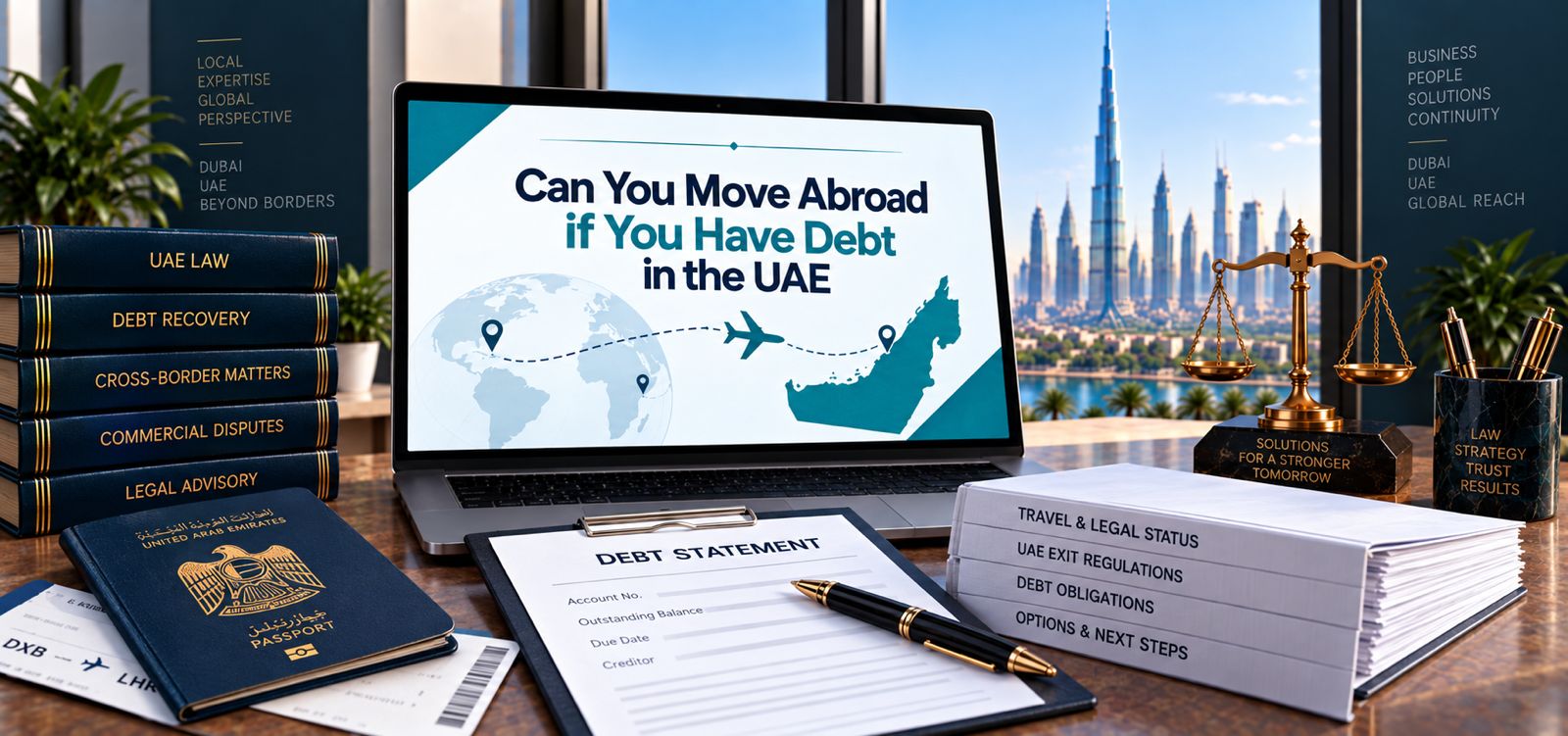

Job offers abroad, family needs or a simple wish to go home often collide with an outstanding loan or credit card balance. The question of whether you can move abroad if you have debt in the UAE has a legal answer and a practical one. Legally, the key issue is whether a travel ban or pending case exists. Practically, it is what happens to the debt once you are gone.
Quick Answer
Generally, you can move abroad with debt in the UAE if no travel ban or other legal restriction applies. Leaving the UAE does not cancel the debt, and creditors may continue recovery action after your departure.
Before leaving, check your case and travel status, address any outstanding cheques, and arrange repayment where appropriate. Confirming your position before departure can help you understand any restrictions or unresolved debt issues.
Treat travel status and debt repayment as separate checks. Establish whether any restriction applies, then review each loan, credit card balance, and outstanding cheque. Put repayment arrangements in writing and keep the records accessible after relocation so you can respond to creditor contact and legal notices.
Legal Framework
You can usually move abroad if you have debt in the UAE, as long as no travel ban or other restriction is in place. A civil travel ban for debt in the UAE requires a court order. Under Articles 324 to 327 of Federal Decree-Law No. 42 of 2022, a creditor can request one where the debt is at least AED 10,000 and there are grounds to believe the debtor may leave. Criminal cases can also lead to travel restrictions.
Leaving does not extinguish the debt. Creditors may pursue a UAE claim, enforce against assets left behind, or seek recognition of a UAE judgment abroad where that country allows it. Closing a bank account or emptying it while cheques are outstanding can fall within Article 675 of the Commercial Transactions Law. The safest route is to check your status and deal with the debt before departure.
When You Cannot Leave
Where there is no case and no ban, travel is generally unrestricted, although the debt remains. A pending civil claim without a ban does not automatically restrict travel.
A civil travel ban ordered by a court prevents departure until it is lifted, usually through payment, settlement, or security. A criminal case or public prosecution restriction may affect travel under criminal procedure.
How to Check Travel Ban Status in the UAE
Official channels let residents check their status. Dubai Police offers an inquiry service for circulars and travel bans, and Abu Dhabi’s judicial department provides the Estafser service for Abu Dhabi matters. Coverage differs by emirate, so someone with history in more than one emirate may need to check more than once. A lawyer can also search court records for pending cases.
Review the history behind the status check
Prepare a list of the creditors involved and the emirates connected with your borrowing or any known dispute. Keep case references, earlier notices, and relevant correspondence available. This gives the person reviewing your position a clearer starting point than a general question about whether you are free to travel. Explain any previous settlement and whether you have written confirmation of what happened afterward.
Record which official inquiry you used and retain the result for your records. Because coverage differs, avoid assuming that a result relating to one emirate answers every question about a matter elsewhere. If a creditor refers to a case you do not recognize, collect the details for review. Do not rely solely on an informal assurance that there is nothing to check.
Give your lawyer the departure date and explain whether you intend a short trip or a permanent move. The underlying legal assessment still depends on the actual cases and restrictions, but a clear timetable helps organize the work. Leaders Advocates’ civil lawyers in Dubai can assess the civil debt issues and the records relevant to your circumstances.
What Happens to the Debt After You Leave
• The debt continues: moving countries does not cancel a contractual obligation.
• Claims can proceed: creditors may file in the UAE and serve you abroad under the Civil Procedure Law.
• Assets in the UAE: bank accounts, property or end-of-service benefits may be attached through the courts.
• Enforcement abroad: a UAE judgment may be enforceable in another country if that country’s rules allow it.
• Future return: an unresolved case or ban may affect you if you come back to the UAE.
Interpol Red Notices are designed for criminal matters, and a Red Notice is not an extradition order. Ordinary civil debt is generally a matter for civil courts, not criminal cooperation channels.
Keep communication workable after relocation
Make a practical plan for receiving correspondence once you are abroad. Tell the relevant contacts how to reach you and keep copies of the details you provide. Store agreements, statements, and settlement communications in a place you can access from the new country. Moving creates enough administrative disruption without also losing the records needed to answer a creditor’s question.
If the creditor contacts you after departure, ask for a clear account of the balance and any case details being relied on. Compare those details with your own file before responding substantively. A demand, an existing court claim, and an enforcement step raise different questions. Keep the distinction clear when you seek advice rather than assuming every collection message describes the same legal position.
Where proceedings are involved, Leaders Advocates’ litigation services in Dubai can help assess the UAE dispute. Questions about recognition or a fresh claim in another country also depend on that country’s rules, so the destination matters when evaluating the position.
Leaving the UAE with Loans Steps to Take First
• List all debts and check whether any case or ban exists.
• Contact lenders and propose a settlement or repayment plan in writing.
• Retrieve or deal with any security cheques held by creditors.
• Keep your UAE bank account open while cheques remain outstanding.
• Obtain clearance letters for debts you settle.
• Keep contact details updated so you receive notices.
Flying Soon? Don’t Wait Until You Reach the Airport
If you have unpaid loans, credit cards, a pending debt case, or concerns about a travel ban, review your legal position before your departure date.
Build one record of the debts and proposed payments
For each account, note the creditor, current balance shown in your records, payment dates, and any dispute about the amount. Add the relevant agreement and recent correspondence. Keep settled accounts separate from those still being negotiated. This helps you avoid overlooking a smaller balance while concentrating on the largest loan, and makes discussions with advisers more focused.
Work out a repayment proposal against the income and expenses you expect after moving. Include the practical costs of relocation in your own planning so you do not offer payments that immediately become difficult to maintain. Present the proposal clearly and keep the creditor’s response. A proposed schedule should not be described as an agreed arrangement until the correspondence supports that description.
When a payment is made, save the transfer record and reconcile it with the account. If there is a difference between your calculation and the creditor’s statement, identify the entry causing it. Keep the written settlement and clearance letters for debts you settle. Those records are particularly useful when responsibility for the account passes to a different person after you leave.
Deal with outstanding cheques before closing accounts
List the cheques still held by creditors and connect each one with the obligation it was intended to address. Note the cheque details available to you and any correspondence about its return or replacement. Do not assume that paying an installment or discussing a settlement resolves every outstanding cheque. Raise the cheque position expressly when arranging repayment and retain the resulting records.
Before making account changes, discuss the outstanding cheques with your lawyer and the relevant creditor. Keep your UAE bank account open while cheques remain outstanding, as set out above. The important practical task is to understand the position of each cheque before acting, rather than discovering a problem after the account has been closed and you are overseas.
Actions That Increase Risk
Some steps before departure turn a civil problem into a criminal one. Article 675 of the Commercial Transactions Law penalizes closing an account or withdrawing the balance before outstanding cheques are presented, and giving the bank baseless instructions not to pay. The penalty is imprisonment of six months to two years and/or a fine of at least 10% of the cheque value, with a minimum of AED 5,000 and a maximum of twice the value. Deception in obtaining credit can also raise fraud issues under Article 451 of the Penal Code.
Give your adviser an accurate account of any steps already taken. If an account has been closed, funds withdrawn, or payment instructions changed, provide the dates and relevant bank correspondence. Do not describe the matter simply as an unpaid loan while omitting conduct involving the cheques. That information is necessary to assess the concerns identified in Article 675 without assuming that every debt dispute has the same consequences.
If Debts Are Unmanageable
Individuals who are not traders can consider Federal Decree-Law No. 19 of 2019 on Insolvency, a court-supervised route for settling financial liabilities. It needs engagement and full disclosure, and it is generally better pursued while you are still in the UAE.
Prepare a realistic account of what you owe and what you can pay before discussing a court-supervised route. Include the documents showing the debts and the payment difficulties, and identify any pending proceedings. Full disclosure is central to the approach described above. Leaving the issue until the final days before travel makes it harder to organize the information and consider the available options carefully.
For a review of repayment discussions and the outstanding obligations, Leaders Advocates’ debt recovery legal services provide a relevant starting point. Explain that the request concerns your position as a debtor and your proposed relocation, so the discussion addresses the actual problem.
Moving Abroad With UAE Debt? Know Your Position First
A move abroad does not make UAE debt disappear. Leaders Advocates can review your debt, travel-ban concerns, pending cases, outstanding cheques, and repayment options before you leave.
Common Mistakes
• Assuming a debt disappears once you leave.
• Closing a bank account with cheques still outstanding.
• Ignoring creditor contact after relocating.
• Not checking for a travel ban before booking travel.
• Assuming a pending civil case always blocks travel.
Another mistake is treating a conversation with a lender as a complete resolution. Check what was actually agreed, what remains unpaid, and whether any restriction or proceeding still needs attention. Keep the travel inquiry, the repayment arrangement, and the evidence of payment as separate records. Each answers a different practical question, and having one does not explain the status of all the others.
Faris Raian and the team at Leaders Advocates can assess your specific situation.
Frequently Asked Questions:
Worried Your UAE Debt Could Stop You From Leaving?
Before making travel plans, get clarity on any debt cases, travel restrictions, outstanding cheques, and repayment issues that could affect your departure.