


Quick Answer
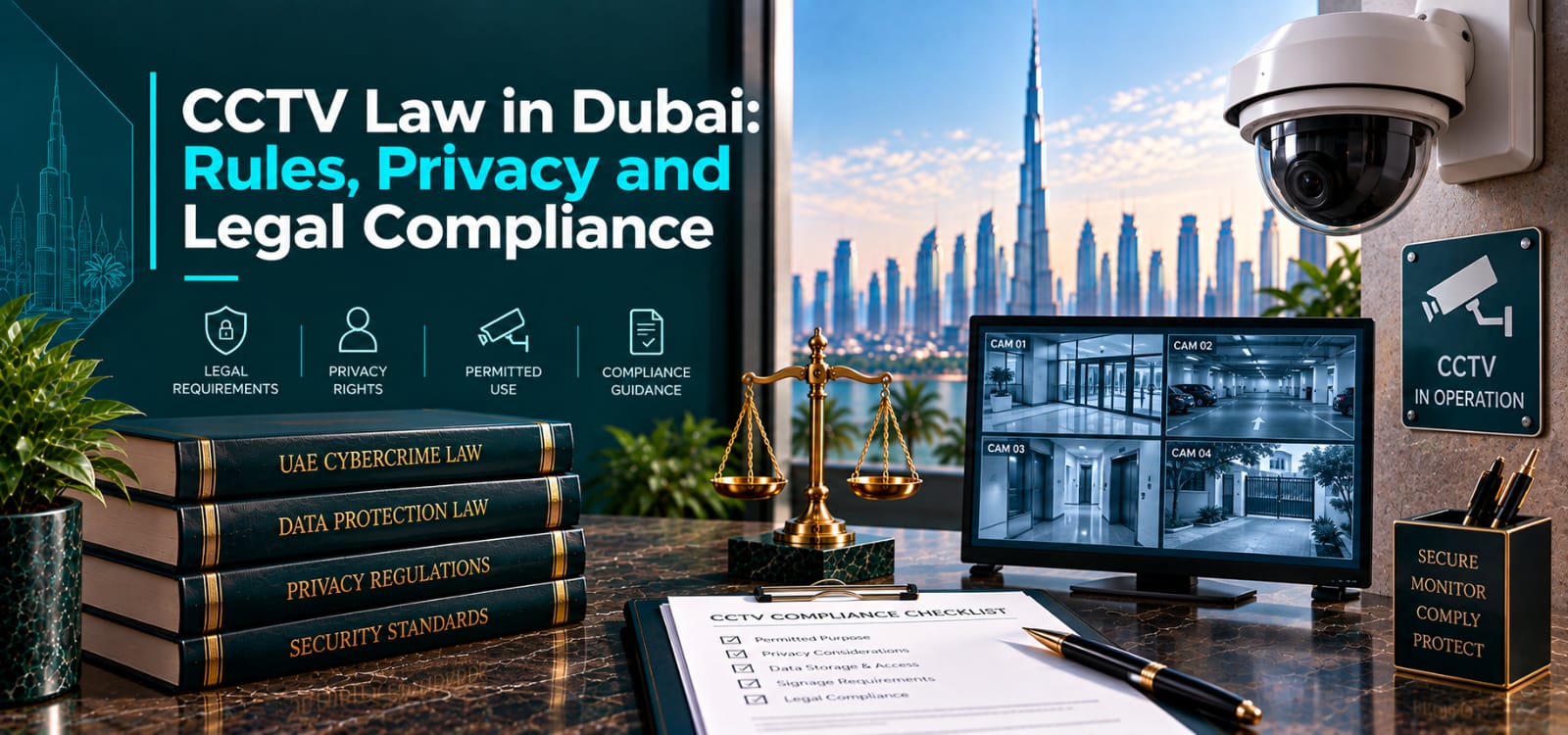
CCTV law in Dubai has two separate tracks. SIRA regulates security-industry requirements and technical standards for specified premises. Federal law governs privacy, electronic misuse, data protection, and the handling of footage.
Do not assume every building has the same installation duty. Confirm the current SIRA category, approval, installer, camera placement, retention, and technical requirements for the particular premises.
Article 431 of Federal Decree-Law No. 31 of 2021 addresses unauthorized recording of private conversations or scenes. Article 44 of the Cybercrime Law can apply when technology is used to invade privacy.
Use visible, purpose-limited cameras, restrict access, protect recordings, and control disclosure. Hidden cameras in private spaces and public posting can create serious legal exposure.
Businesses and building managers often ask one question: may we install cameras? The complete answer requires two different legal tracks.
Dubai security regulation may require or control installation for a category of premises. Federal law separately controls privacy, technology misuse, personal data, and disclosure.
Classify the premises first. Confirm current SIRA requirements and use the approved technical route where applicable.
Then complete a privacy and governance review. Define camera purpose, placement, notice, access, retention, incident response, export, and deletion.
CCTV Law in Dubai Has Two Separate Tracks
The first track concerns Dubai security regulation. The Security Industry Regulatory Agency oversees security-industry requirements and technical standards for covered premises.
The second track concerns federal law. A technically compliant camera can still be misused if it records a private area or footage is disclosed unlawfully.
Do not merge the two tracks into one approval. Installation compliance does not replace privacy compliance.
Confirm Whether SIRA Requirements Apply
Requirements can vary by premises type and security classification. A hotel, bank, warehouse, retail site, residential building, and office may not have identical duties.
Check the current category directly with SIRA or an authorized professional. Confirm required approvals, camera locations, system specifications, retention, monitoring, and maintenance.
Do not rely on an old fit-out checklist. Technical standards and covered categories can change.
Not Sure If Your CCTV System Is Compliant?
Message us on WhatsApp with your premises type and we’ll walk you through what SIRA and privacy law actually require.
Use Authorized Security Providers
Where the regulated security framework applies, installation and maintenance may need appropriately licensed providers.
Verify the provider’s current authorization and the scope of its work. Keep contracts, drawings, approvals, commissioning reports, and maintenance records.
The contract should allocate responsibilities for faults, access, password control, exports, and compliance updates.
Camera Placement
Place cameras only where the security purpose requires them. Entrances, exits, cash areas, access points, and common spaces may present a clearer purpose.
Bedrooms, bathrooms, changing rooms, prayer facilities, medical areas, and other intimate spaces create severe privacy concerns.
Check sight lines before activation. A camera aimed at a neighboring home or private office may capture more than the stated purpose requires.
Visible CCTV and Notice
Visible cameras and clear notices support transparency. Notice should identify CCTV use without creating a misleading promise about who can access footage.
Employees, visitors, tenants, and contractors may need tailored communication. A small generic sign does not solve every employment or data issue.
Keep evidence of the approved purpose and notice design. Review notice whenever the system or monitoring purpose changes.
Article 431 and Private Recording
Article 431 of Federal Decree-Law No. 31 of 2021 protects private life. It addresses unauthorized recording or transmission of private conversations and scenes.
CCTV should not be used to capture private conversations or intimate areas without a lawful basis. Audio recording creates an additional risk beyond ordinary video monitoring.
The fact that an organization owns the premises does not eliminate personal privacy interests.
Worried a Camera Might Cross a Privacy Line?
Send us your camera plan on WhatsApp before you install. A quick review now can prevent a serious complaint later.
Article 44 of the Cybercrime Law
Article 44 of Federal Decree-Law No. 34 of 2021 addresses invasion of privacy through information technology. Covered conduct can include recording, transmitting, keeping, or publishing private material.
The provision carries imprisonment of at least six months and a fine from AED 150,000 to AED 500,000 for covered violations.
That penalty does not apply to every CCTV issue. It belongs to the specific cybercrime provision and depends on the alleged conduct.
Data Protection Considerations
CCTV footage may contain identifiable images, movements, vehicle plates, access patterns, or other personal data. Federal Decree-Law No. 45 of 2021 can become relevant, subject to its scope and exemptions.
Define the controller, purpose, lawful basis, retention, security, access, and disclosure. Avoid collecting more footage than the security purpose needs.
Special contexts may follow additional sector or free-zone rules. Do not assume one data policy fits every operator.
Purpose Limitation
State why each camera exists. Security, access control, safety, and incident investigation are different purposes.
Do not quietly repurpose footage for employee entertainment, marketing, social media, or unrelated performance monitoring.
If a new use is proposed, assess it before access or export. Record the approval and legal basis.
Retention and Deletion
Retain footage for the period required by the applicable security standard and legitimate purpose. Longer storage increases access and breach risk.
Confirm SIRA or sector-specific periods for the premises. Do not invent a universal retention period for every Dubai camera system.
Suspend routine deletion when a relevant incident occurs. A legal hold should identify the precise cameras and time window.
Access Controls
Limit live viewing and recorded access to authorized roles. Use individual accounts, strong passwords, and logs rather than shared credentials.
Separate system administration from routine review where practical. Disable access promptly when staff leave or change roles.
Review logs after unusual exports or remote access. A compliant installation can still fail through weak account control.
Received a Police or Court Request for Footage?
Do not export or edit anything yet. Message us on WhatsApp and we’ll guide you through the chain-of-custody process.
Exporting and Sharing Footage
Create an export process. Record the requester, purpose, authority, time range, camera, approver, and recipient.
Do not send footage through personal messaging accounts. Use secure transfer and preserve the original export package.
Public posting can expose bystanders, children, victims, and employees. A security incident does not automatically authorize online publication.
Requests From Police or Courts
Verify the request and preserve the identified footage immediately. Follow the lawful instruction on format, transfer, and confidentiality.
Keep a chain-of-custody log. Note who exported the file, the system used, and the date of delivery.
Do not edit the evidentiary original. If redaction is required for another purpose, work on a separate copy.
Requests From Individuals
A customer, resident, employee, or accident victim may ask for footage. The recording may also contain other people’s data.
Do not promise immediate release. Confirm identity, authority, purpose, third-party impact, and the applicable process.
Preservation can be separated from disclosure. Save the relevant file while legal review determines whether and how it can be provided.
Workplace CCTV
Workplace cameras need a clear and proportionate purpose. Monitoring should not extend into intimate areas or become constant hidden observation without legal review.
Notify staff through appropriate policies and notices. Explain access, incident use, retention, and complaint channels.
Audio capture deserves additional caution. Disable unused microphones where the security purpose does not require sound.
Residential Buildings and Doorbell Cameras
Building cameras can protect common entrances, elevators, parking, and access points. Placement should avoid unnecessary views into private units.
Residents should not treat corridor or doorbell footage as material for neighborhood groups or social media.
Management should define how incident requests are handled. A consistent process reduces selective disclosure and conflict.
Retail, Hospitality, and Public-Facing Sites
These sites can involve high visitor volumes and multiple cameras. Map each camera to the security objective and applicable technical standard.
Control access to cash-point footage, guest areas, back offices, and loading zones. Vendors should receive only the access needed for maintenance.
Review analytics such as facial recognition separately. Advanced identification can raise additional proportionality and data concerns.
Hidden and Covert Cameras
Covert monitoring presents much higher risk, especially in a private location. Do not use hidden cameras as a routine management tool.
Suspected theft or misconduct does not automatically authorize covert recording. Obtain legal and regulatory advice before any exceptional measure.
Never install a hidden camera in an intimate space. Serious criminal, privacy, employment, and reputational consequences can follow.
System Security
Change default passwords and update firmware. Restrict remote access and expose no recorder directly to the public internet without appropriate controls.
Encrypt storage and transfers where supported. Backups and cloud services should follow the same access and retention rules.
Document security incidents. If footage is copied or leaked, preserve logs and obtain immediate cyber and legal advice.
A Practical Compliance File
- Premises classification and current SIRA confirmation.
- Provider licenses and installation approvals.
- Camera map and approved purposes.
- Technical and commissioning records.
- Privacy notices and employee policies.
- Retention and deletion schedule.
- Access list and audit logs.
- Export and disclosure register.
- Maintenance and incident records.
- Legal-hold and authority-request procedure.
Keep the file current. Compliance should be demonstrable before an incident, not reconstructed afterward.
Related Success Story
Leaders Advocates handled a contested case where electronic evidence and unauthorized email use were central issues. Read the Successful Child Custody and Divorce Case in Dubai. It illustrates evidence sensitivity, but every CCTV dispute requires its own analysis.
Common Mistakes to Avoid
- Assuming every building follows the same SIRA rule.
- Treating installation approval as privacy approval.
- Recording audio without a clear lawful basis.
- Pointing cameras toward private spaces.
- Using shared administrator passwords.
- Keeping footage without a defined period.
- Sending exports through personal accounts.
- Publishing clips online after an incident.
- Ignoring free-zone or sector-specific requirements.
Final Takeaway
CCTV law in Dubai requires both security compliance and responsible data handling. Confirm the premises-specific SIRA rules instead of relying on a general checklist.
Design privacy into the system. Clear purpose, careful placement, access control, retention, and lawful disclosure protect both the organization and the people recorded.
Relevant Legal Services
- Cybercrime Lawyer in Dubai — for privacy, unauthorized access, leaks, and technology misuse.
- Criminal Defense Lawyers in Dubai — for recording complaints, investigations, and potential penalties.
- Corporate Lawyers in Dubai — for policies, vendor contracts, governance, and regulatory compliance.
Follow Leaders Advocates on LinkedIn or Leaders Advocates on Facebook for more UAE legal updates.
Frequently Asked Questions
Get Your CCTV System Reviewed Before It Becomes a Problem
Leaders Advocates can check your installation, placement, notices, and disclosure process against SIRA and federal privacy law.