
Quick Answer
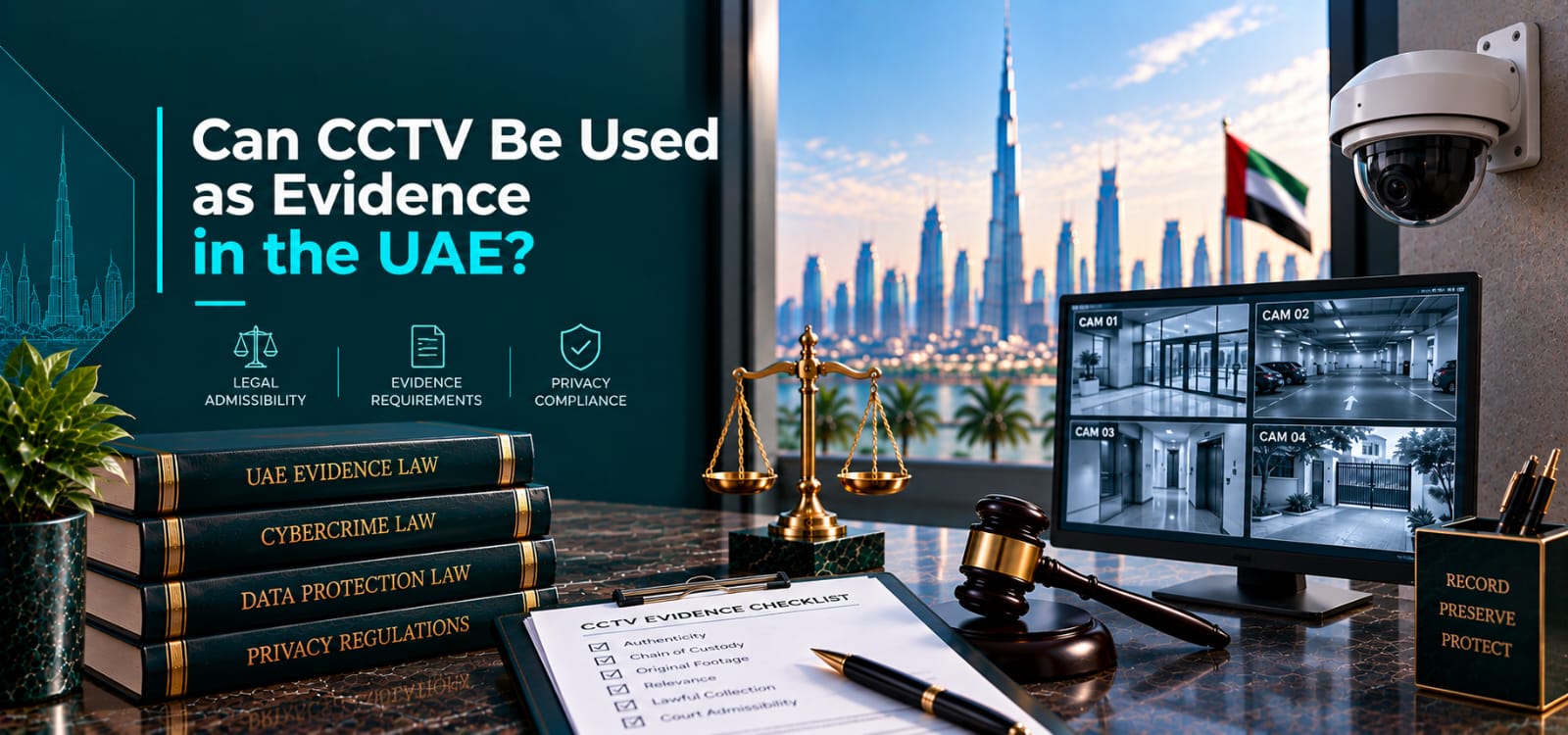
CCTV footage can be important evidence in the UAE, but the applicable rules depend on the proceeding. Federal Decree-Law No. 35 of 2022 expressly addresses electronic evidence in civil and commercial matters.
A court can examine the footage’s source, authenticity, integrity, relevance, and lawful origin. Original exported files and system records are usually more useful than a phone video of a monitor.
Criminal cases follow separate criminal procedure and evidence rules. Police or prosecutors may obtain footage, preserve devices, and request technical examination.
Act quickly because systems overwrite files. Send a focused preservation request, keep chain-of-custody records, and avoid editing or posting footage. Hidden cameras or recordings in private areas can create serious privacy issues.
CCTV may capture an accident, assault, theft, workplace event, contract delivery, or family incident. The recording can disappear quickly because many systems overwrite old footage.
Obtaining a copy is not the end of the problem. The court may need proof of source, date, integrity, relevance, and lawful collection.
Identify the exact camera, location, time window, and system owner. Send a narrow preservation request before the retention period expires.
Collect the footage through an authorized route. Preserve the original export, player software, audit records, and a chain-of-custody note.
Can CCTV Be Used as Evidence UAE? The Correct Scope
Yes, CCTV can have evidentiary value. The governing route depends on whether the dispute is civil, commercial, criminal, family, employment, or regulatory.
Federal Decree-Law No. 35 of 2022 is the Law of Evidence in Civil and Commercial Transactions. It expressly addresses electronic evidence.
Do not present that law as the complete rule for a criminal prosecution. Criminal proceedings follow separate procedural provisions and investigative powers.
Electronic Evidence Under Articles 53 and 54
Article 53 defines electronic evidence broadly through electronically created, issued, sent, received, stored, or communicated data or information.
Article 54 lists forms that include electronic records, instruments, correspondence, and modern communication means. CCTV can fit within the electronic evidence analysis.
The label does not make footage automatically decisive. The court can examine whether the file is reliable and connected to the pleaded issue.
Criminal Proceedings Use a Separate Route
In a criminal matter, the police and Public Prosecution may secure footage during investigation. They can request recordings, examine systems, and use technical expertise.
A private party should preserve details and report promptly. Do not trespass, hack a system, or pressure an operator to hand over restricted footage.
The criminal court assesses the full evidentiary record under the applicable procedure. A civil evidence article should not be treated as the only test.
Lawful Collection Matters
Footage from a disclosed security system in a common area presents different facts from a covert camera in a private room.
Privacy, data protection, sector rules, employment policies, and property rights may all affect collection and disclosure.
An evidentiary purpose does not automatically cure unlawful surveillance. Obtain the recording through the owner, police, court, insurer, or another authorized channel.
Need to Preserve CCTV Before It’s Overwritten?
Send us the camera location and incident time on WhatsApp now — we’ll tell you how to request and preserve it correctly.
Identify the Original Source
Record the building, business, camera number, direction, and system operator. Note whether the displayed time was accurate.
Ask who installed and maintained the system. Identify the recorder model and whether the export requires proprietary player software.
The source statement should explain who made the export, when it was made, and which time period it covers.
Preserve Authenticity and Integrity
Keep the native export. Some systems produce several data files, a player, and verification information. Preserve the complete package.
Do not convert the only copy to another format. Conversion can remove metadata or change quality.
Create a separate viewing copy and document the process. If a hash value is available, record it to help demonstrate that the file remained unchanged.
Chain of Custody
Chain of custody is the record of possession and handling. It helps answer who collected, copied, transferred, stored, and reviewed the footage.
Use a simple log with dates, names, devices, filenames, and transfer methods. Restrict access to people who need the file.
If police collect the footage, follow their instructions. Avoid creating unnecessary copies after official preservation begins.
Not Sure How to Build a Proper Chain of Custody?
Message us on WhatsApp and we’ll walk you through exactly what to log, keep, and avoid.
Relevance and the Correct Time Window
More footage is not always better. A focused clip should still include enough time before and after the event to show context.
Write down why that time window matters before requesting or exporting any file from the system.
Match the recording to the disputed fact. An entrance camera may prove arrival, but it may not prove what happened inside a room.
Preserve surrounding camera angles when possible. A single view can miss an obstruction, reflection, or second participant.
Timestamps and System Clock Errors
CCTV clocks can drift or use a different time zone. A visible timestamp should not be assumed accurate without checking the system.
Compare the time with access-control logs, receipts, calls, vehicle data, or another camera. Record any known offset.
Do not edit the displayed time. Explain the discrepancy and preserve the system information that supports the correction.
Image Quality and Identification
Low resolution, darkness, glare, distance, or compression can limit identification. Enhancement should be performed transparently on a copy.
The original must remain available. An expert should explain any enhancement method and its limitations.
Do not claim that a blurred person is definitively identified without supporting evidence. Clothing, route, access records, and witnesses may provide corroboration.
Expert and Forensic Review
Technical review may address authenticity, editing, file structure, timestamps, camera settings, or object identification.
An expert cannot recover detail that the camera never recorded. The report should separate observation, enhancement, and opinion.
Engage an appropriate expert early when the other party disputes the footage. Late conversion or repeated copying can weaken the available analysis.
Civil and Commercial Examples
CCTV can support a premises-liability claim, delivery dispute, property damage case, access dispute, or workplace event.
The recording should connect to the legal elements being proved. Footage of damage does not automatically prove who had a contractual duty to prevent it.
Combine the video with contracts, notices, maintenance logs, photographs, invoices, and witness evidence.
Criminal Examples
Footage may capture violence, theft, fraud-related access, vehicle movement, or the disposal of evidence. Report the event promptly.
Give authorities the precise time, location, camera owner, and overwrite risk. Preserve your request and the response.
Do not confront a suspect using the footage. That can create safety risks or encourage destruction of other evidence.
Footage Caught a Crime on Camera?
Don’t confront anyone or post the clip. Message us on WhatsApp and we’ll guide your next step, fast.
Family and Domestic Disputes
Home cameras, doorbell systems, and building CCTV can become relevant to contact, threats, entry, or child handover.
Private-space recording raises heightened concerns. Do not install hidden cameras in bedrooms, bathrooms, or other intimate areas.
If safety is involved, contact the police or competent authority. Use lawful evidence routes and protect children’s identities.
Requesting Footage From a Third Party
Send a specific preservation request. Identify the date, time range, location, incident, and cameras without demanding unrelated recordings.
The controller may not be free to provide footage directly because other people appear in it. Police or a court order may be the proper route.
Keep proof of the request. If the system overwrites automatically, the timing of your request may become important.
What to Do When Footage Is Used Against You
Request the original source and complete time window. Ask for system information, export details, and chain-of-custody records.
Check time accuracy, missing intervals, edits, compression, camera angle, and whether the footage actually shows the alleged conduct.
Raise privacy or collection concerns through the correct procedure. Do not edit or publish the opposing party’s copy.
Missing or Deleted Footage
An absence of footage does not prove that a camera was working or that a file was deliberately destroyed. Request maintenance, storage, and incident logs.
Record when the operator learned about the dispute and when preservation was requested. The system’s ordinary overwrite schedule may explain why a file no longer exists.
Do not accuse a party of evidence destruction without a factual basis. Ask the court or authority for the appropriate disclosure or technical step.
Prepare the Footage for a Lawyer
Provide the original export, a viewing copy, the player, the camera map, the requested time window, and a short chronology.
List every person who handled the file. Identify any conversion, enhancement, screenshot, or social-media copy separately from the original.
This package allows a faster decision on preservation, expert review, disclosure, and the correct court or investigative route.
A Practical Preservation Checklist
- Identify every relevant camera and owner.
- Confirm the likely overwrite period.
- Send a dated preservation request.
- Obtain the native export where authorized.
- Preserve player files and system information.
- Record the exporter and transfer method.
- Keep the original unchanged.
- Create a separate viewing copy.
- Preserve related logs and documents.
- Obtain expert review when authenticity is disputed.
Related Success Story
Leaders Advocates handled a contested family case involving disputed electronic evidence and unauthorized email use. Read the Successful Child Custody and Divorce Case in Dubai. The case shows why authenticity and lawful collection matter, but it does not predict another outcome.
Common Mistakes to Avoid
- Waiting until the system overwrites the footage.
- Filming a monitor instead of obtaining an export.
- Editing the only copy.
- Ignoring timestamp errors.
- Requesting unrelated footage.
- Publishing clips online.
- Treating a civil evidence rule as the complete criminal procedure.
- Installing a hidden camera in a private area.
Final Takeaway
The answer to can CCTV be used as evidence UAE is yes, when the footage is preserved and presented through the correct legal route.
Lawful origin, source, integrity, context, and relevance matter. Act early, keep the original, and avoid turning useful evidence into a privacy or authenticity dispute.
Relevant Legal Services
- Litigation Lawyer in Dubai — for electronic evidence, preservation, and civil court strategy.
- Criminal Defense Lawyers in Dubai — for investigations, prosecution evidence, and defense challenges.
- Cybercrime Lawyer in Dubai — for privacy, digital systems, and unlawful disclosure issues.
Follow Leaders Advocates on LinkedIn or Leaders Advocates on Facebook for more UAE legal updates.
Frequently Asked Questions
Have CCTV Footage You Need to Use — or Fight?
Message Leaders Advocates on WhatsApp now for prompt advice on preservation, authenticity, and the correct court route.