


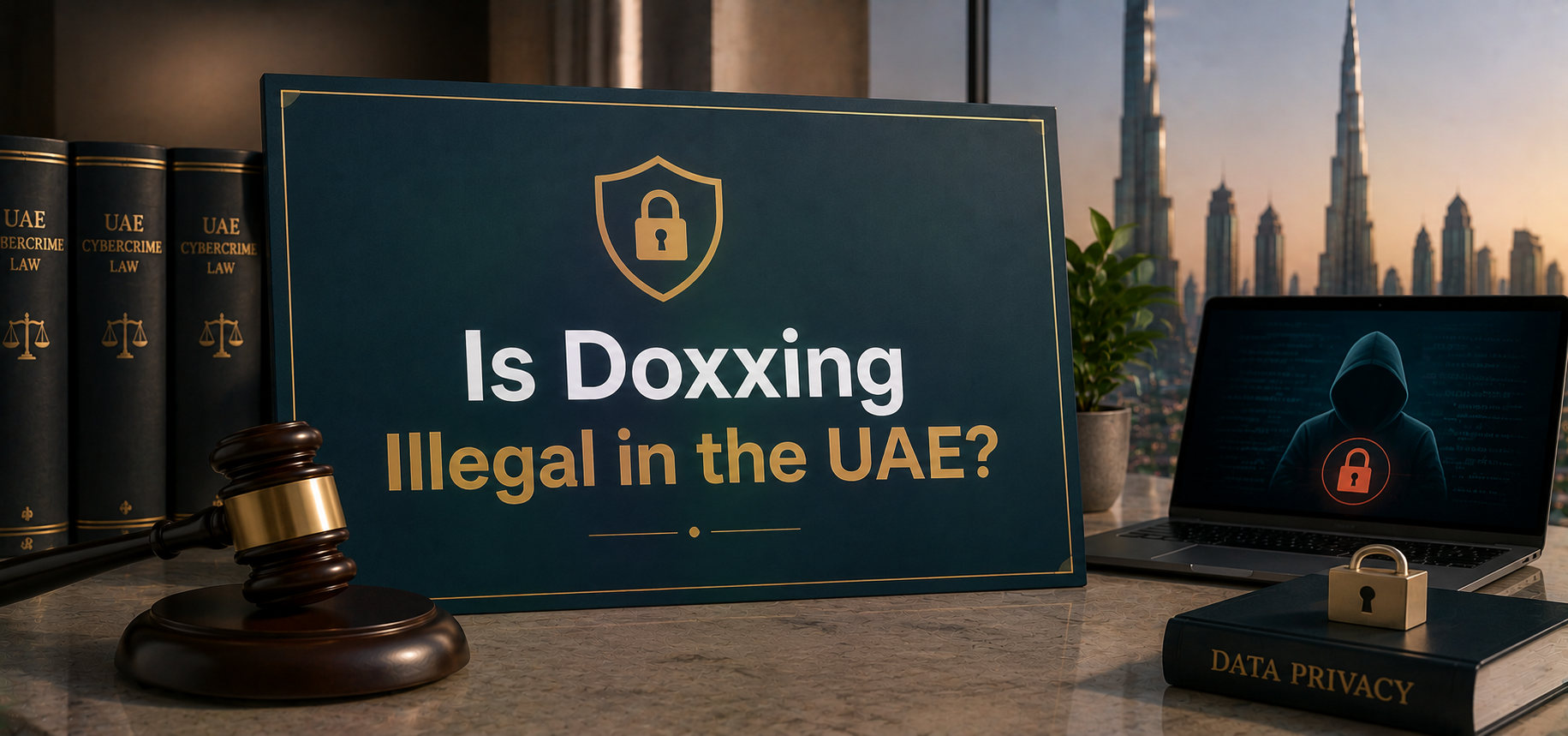
Is doxxing illegal in the UAE? Yes, when information technology is used to publish or misuse a person’s private information, images, or communications without consent in breach of Article 44 of the Cybercrime Law.
UAE privacy rules differ from many other systems because truth is not a defence to unauthorized disclosure and there is no broad public-place exception for photographing and posting a specific person. A cybercrime lawyer in Dubai can advise on who is the best defamation lawyer in Dubai, what is doxxing in the UAE, and defamation and insult under the UAE crimes and penalties law publicity method and aggravating circumstances.
Article 44 of Federal Decree-Law No. 34 of 2021 on Combatting Cybercrimes prohibits using information technology to breach privacy or family life. It covers eavesdropping, interception, recording conversations, unauthorized photography, and publishing private information or images without consent. A standard violation carries imprisonment and a fine of AED 150,000 to AED 500,000. If material is altered or edited with intent to damage or abuse the person, the penalty rises to a minimum of one year’s imprisonment and a fine of AED 250,000 to AED 500,000. Truth is not a defence because the offence concerns unauthorized disclosure rather than whether the information is false. The UAE also has no broad public-place exception, so photographing a specific person in a mall, restaurant, or street and posting the image can still lead to prosecution.
Why Is Doxxing Illegal in the UAE?
Article 44 protects a person’s privacy and family life from technology-based intrusion and unauthorized disclosure.
What Article 44 Prohibits
- Eavesdropping, intercepting, or recording private conversations or communications without the consent of those involved.
- Taking, storing, or sharing photographs of a person without permission, including in public places.
- Publishing private information even where it is accurate if the disclosure violates the person’s privacy.
- Sharing unauthorized images or videos of injured, deceased, casualty, or accident victims.
Why Truth Is Not a Defence
Defamation generally concerns false statements that damage reputation. An Article 44 privacy violation concerns unauthorized disclosure itself, regardless of whether the information is accurate.
Sharing genuine private messages, photographs, or personal details without consent, specifically to embarrass or harm the person, can therefore be prosecuted even when every disclosed fact is true.
No General Public-Place Exception
UAE law does not adopt the broad public-place exception used in many other jurisdictions. The test focuses on whether an image or recording captures and targets a specific individual’s private moments, even in a mall, restaurant, or public street.
Photographing women, children, or families without consent is treated with particular seriousness.
Already Posted a Photo Taken in a Public Place?
There is no blanket public-place exception in the UAE, so a photo that felt harmless to post can still lead to a police complaint. Leaders Advocates can review what was shared and how exposed it leaves you.
Penalties for Privacy and Data Violations
- Standard Article 44 privacy breach: imprisonment and a fine from AED 150,000 to AED 500,000.
- Altered or edited material intended to damage or abuse a person: a minimum of one year’s imprisonment and a fine from AED 250,000 to AED 500,000.
- Unauthorized access to or misuse of personal data under Article 6: imprisonment of at least 6 months or a fine from AED 20,000 to AED 100,000, with the penalty doubled for medical, banking, or payment data.
Confidential Workplace Information Under Article 45
Article 45 separately addresses an employee who shares confidential information accessed through employment without authorization. The offence carries 6 months’ imprisonment or a fine from AED 200,000 to AED 1,000,000.
The penalty is treated as aggravated where the disclosure was made for personal benefit.
What to Do If You Are Targeted
- Preserve screenshots, links, messages, and every available record of the disclosure immediately.
- Report through the Dubai Police e-Crime portal or the equivalent reporting channel in the relevant emirate.
- Do not engage directly with the person threatening to disclose, or already disclosing, the information, particularly where blackmail is involved.
Targeted by doxxing or facing a privacy complaint? A UAE cybercrime lawyer from Leaders Advocates can assess the disclosure, preserve the evidence, and advise on the police, prosecution, or defence process.
Been Accused of Sharing Something You Shouldn’t Have?
Truth is not a defence under Article 44, so denying the facts will not help. What matters now is how the disclosure happened and whether consent genuinely existed. Talk to us before you respond to any summons.
Common Mistakes
- Assuming true information can be shared freely when truth is not a defence under Article 44.
- Assuming a photograph taken in public is automatically lawful to publish in the UAE.
- Treating privacy violations and defamation as the same offence even though they use different legal tests.
Relevant Legal Services
A Cybercrime Lawyer in Dubai can advise a victim or accused person. A Criminal Defense Lawyer in Dubai can assist during investigation and prosecution, while a Civil Lawyer in Dubai can assess a related compensation claim.
People Also Ask
Doxxing is illegal in the UAE under Article 44 where private information, images, or communications are disclosed without consent through information technology. Accuracy and a public location do not create automatic defences.
Dealing With a Doxxing or Privacy Complaint?
Whether you are the person targeted or the one accused, Article 44 cases move quickly and truth alone will not resolve them. Leaders Advocates advises both victims and defendants through the police, prosecution, and court process.


3 Comments