


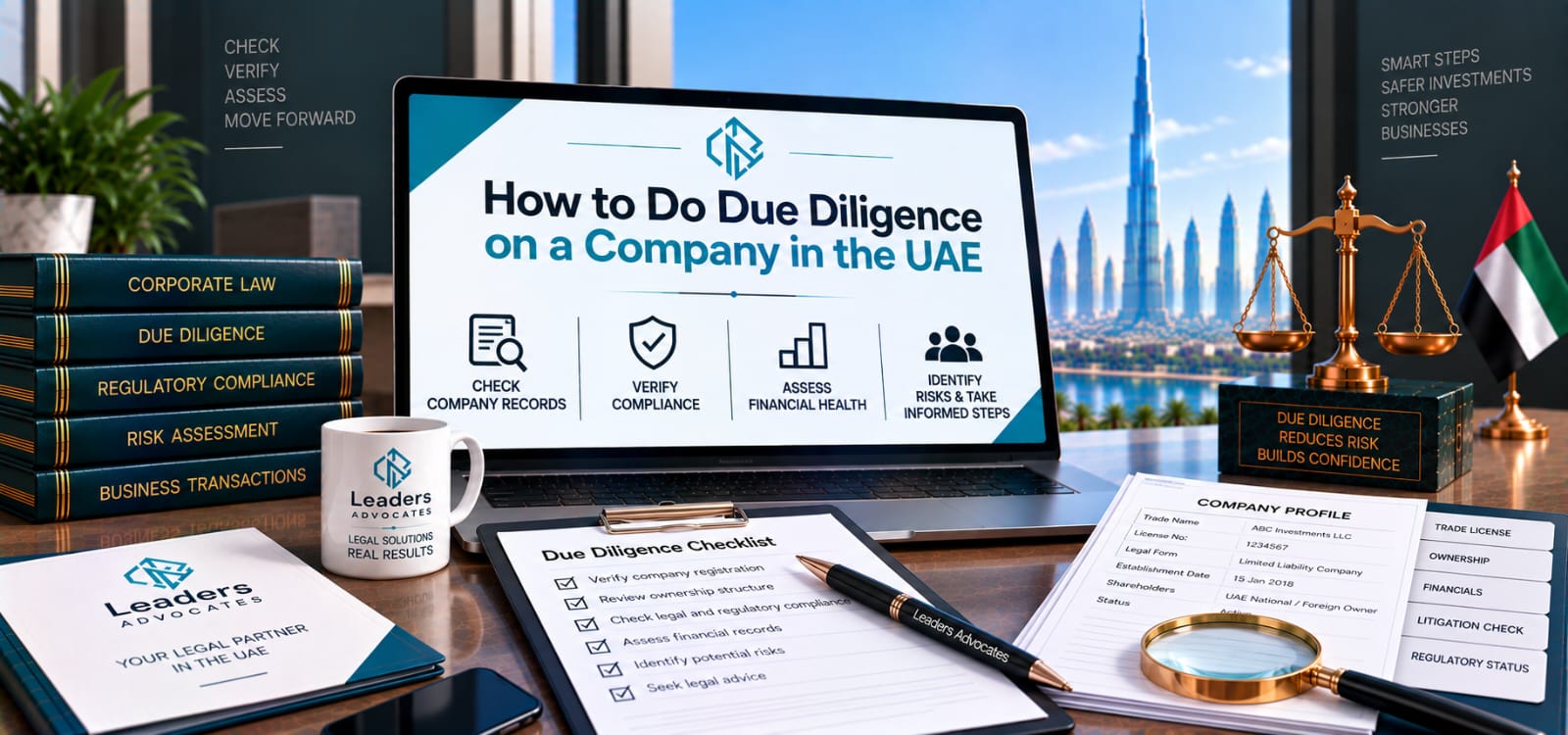

A company may have a polished website and an impressive office but still be the wrong legal entity for the deal. It may also hold a license that does not cover the service it offers.
The risk increases when the payment recipient, contracting party, and operating business are different names. A good review identifies those gaps before money or control changes hands.
Quick Answer
To conduct company due diligence in the UAE, first identify the correct licensing authority. A mainland company, free zone entity, DIFC company, and ADGM company may appear in different registers.
Verify the exact legal name, license number, legal form, activities, status, ownership documents, and authorized signatories. Then review financial statements, major liabilities, security, litigation, regulatory approvals, sanctions exposure, and material contracts.
Scale the review to the transaction. A supplier check can be narrower than an acquisition, joint venture, or investment. Record every source, note missing information, and convert important findings into warranties, conditions, security, and termination rights in the final agreement.
Start with the official register that applies to the company. Confirm identity, license, legal form, current status, owners, and signing authority.
Then test financial strength, disputes, compliance, assets, liabilities, and major contracts. The final agreement should address every material risk found in the review.
How to Do a Due Diligence on a Company in UAE
Due diligence is a structured verification process. It should not be a collection of documents accepted without testing.
Create a request list, a source log, and a red-flag tracker. Record what was checked, who provided it, when it was current, and what remains missing.
The depth should match the transaction. A one-time supply order does not need the same review as buying shares in a company.
Step 1: Identify the Correct Register
The UAE has several registration systems. First identify where the company is licensed.
- Mainland companies are checked through the relevant emirate’s economic department and the National Economic Register.
- Free zone companies are checked through the relevant free zone authority.
- DIFC companies appear in the DIFC public register.
- ADGM companies appear in the ADGM public register.
Match the exact legal name and license number. A trade name or brand may not identify the contracting entity.
Step 2: Verify the Trade License
Confirm the license is valid and current. Check the legal form, registered address, manager, listed activities, issue date, and expiry date.
The activity must match the proposed deal. A trading license may not cover consultancy, and a normal commercial license does not replace a financial-services approval.
Save a dated copy or screenshot from the official source. A license may change after the first review.
Not Sure Which Register or License Applies?
Send us the company name on WhatsApp and we’ll tell you which register and license checks actually apply.
Step 3: Check Regulated Activities
Some businesses need approval beyond the trade license. Financial services may require authorization from the Central Bank, the Capital Market Authority, the DFSA in the DIFC, or the FSRA in ADGM.
The Capital Market Authority replaced the Securities and Commodities Authority on January 1, 2026. Check the current regulator and the exact approved activity.
Do not treat a regulator’s logo as proof. Match the legal entity, license number, website, and service offered to the official register.
Step 4: Establish Ownership and Control
Request the memorandum or articles of association, shareholder register, resolutions, and amendments. Federal Decree-Law No. 32 of 2021 on Commercial Companies, as amended, is relevant to mainland companies.
Cabinet Decision No. 109 of 2023 requires covered entities to keep beneficial ownership records. Those records are not generally open to a full public search.
Ask the counterparty for a beneficial ownership declaration and supporting evidence. Follow the chain until the natural persons who ultimately own or control the company are identified.
Step 5: Confirm Signing Authority
A real company can still be bound by the wrong person. Check who can sign the contract, borrow, guarantee, sell assets, appoint advisers, or operate accounts.
Review manager and director appointments in the constitutional documents. If a person relies on a power of attorney, verify that it is current, properly notarized where required, and wide enough for the transaction.
For a major deal, request a board or shareholder resolution. The resolution should approve the actual transaction, not a vague future possibility.
Step 6: Review Financial Information
Request recent audited financial statements where available. Compare revenue, cash, debt, receivables, related-party balances, and contingent liabilities.
Ask for management accounts when the audited period is old. Reconcile major figures to bank or operational records when the risk justifies it.
Look for sudden revenue growth, large unexplained receivables, overdue taxes or fees, and dependence on one customer. A valid license does not prove financial strength.
Reviewing Financial Statements Before a Deal?
Share the numbers on WhatsApp and get a fast read on what’s worth investigating further.
Step 7: Identify Loans, Guarantees, and Security
List bank facilities, shareholder loans, guarantees, pledges, mortgages, and security over assets. Ask who benefits from each obligation and whether a default has occurred.
If the transaction involves shares or assets, confirm whether a lender’s consent is needed. A transfer made in breach of financing terms can create immediate problems.
Do not rely on a simple statement that the company has no debt. Request documents appropriate to the size of the deal.
Step 8: Review Litigation and Claims
Ask for a schedule of current, threatened, and recent cases. Review the relevant court systems and available official sources where lawful and practical.
Include arbitration, regulatory investigations, employment claims, unpaid judgments, and enforcement proceedings. A small claim may reveal a wider operational problem.
Check whether the company has complied with important judgments or settlements. The existence of a case matters, but the underlying facts matter more.
Step 9: Review Material Contracts
Identify the agreements the business needs to operate. These may include leases, licenses, customer contracts, supplier agreements, distribution rights, financing, insurance, and intellectual property licenses.
Look for termination rights, change-of-control clauses, exclusivity, minimum purchases, automatic renewal, and unusual penalties. A profitable relationship may end after ownership changes.
Record which contracts need consent. Make those consents conditions to completion when appropriate.
Step 10: Check Assets and Property
Confirm ownership of material assets. If real estate forms part of the deal, review title and registered interests through the relevant land authority.
For movable assets, request purchase records, serial numbers, insurance, and security information. Separate company assets from items owned by shareholders or related parties.
Intellectual property also needs verification. A brand used by the business may be registered in another person’s name.
Found a Gap in the Company’s Records?
Missing title deeds, unclear ownership, or an undisclosed contract? Message us now before you move forward.
Step 11: Review Compliance Exposure
The UAE anti-money laundering framework includes Federal Decree-Law No. 10 of 2025 and Cabinet Resolution No. 134 of 2025. Regulated businesses may have specific customer due diligence and reporting duties.
Screen the company and relevant people against applicable sanctions lists. Consider politically exposed person risk where the facts require it.
Review internal policies, training, complaints, regulatory correspondence, and any past breach. A written policy is useful only if the company actually follows it.
Step 12: Protect Personal Data
Due diligence can involve passports, addresses, ownership information, and employee records. Handle personal data lawfully and securely.
Federal Decree-Law No. 45 of 2021 on the Protection of Personal Data may apply. Limit collection to what the review needs and control access.
Use a secure data room for sensitive deals. Record who uploaded, viewed, downloaded, or changed key documents.
Check the Payment Path
The contract party, invoice issuer, and bank beneficiary should make sense together. A request to pay a personal account or an unrelated company is a serious red flag.
If another entity collects payment, ask for the legal basis. Confirm agency, assignment, group structure, and tax or accounting treatment.
Test a changed bank instruction through an independent contact. Email compromise and invoice fraud can occur even when the company itself is legitimate.
Red Flags That Need an Answer
- An expired license or missing activity.
- A legal name that differs across documents.
- Refusal to provide constitutional records.
- A signatory with no clear authority.
- Payment to a personal or unrelated account.
- Unexplained owners or related-party transactions.
- Major litigation omitted from disclosure.
- Pressure to sign before questions are answered.
- Important contracts that cannot be produced.
A red flag does not always end the deal. It should change the price, structure, conditions, security, or decision.
Convert Findings Into Contract Protection
Due diligence is wasted if the agreement ignores the findings. Use accurate representations, warranties, indemnities, conditions precedent, security, and termination rights.
Identify who bears each known risk. Do not use a general warranty where a specific disclosure, retention, escrow, or guarantee is needed.
Set document-delivery deadlines. State what happens if a license, consent, or key contract is missing at completion.
Keep the Review Current
Due diligence is dated. A license, lawsuit, bank account, owner, or regulator status can change between signing and completion.
Repeat critical checks before money is released. For a long-term relationship, refresh the review at sensible intervals or after a trigger event.
Keep a final file showing the information relied on. That record helps if a later dispute concerns disclosure or authority.
Related Success Story
Leaders Advocates publishes a case in which corporate lawyers recovered AED 17 million in a shareholder dispute. Review the Leaders Advocates Success Stories page for the available summary.
The result depended on its own documents and parties. It still illustrates why ownership records, corporate authority, and enforceable agreements deserve careful review.
Common Mistakes
- Searching the wrong register.
- Relying on a website or brochure.
- Checking the license but not the activity.
- Skipping the signatory authority review.
- Treating license validity as proof of solvency.
- Ignoring related-party contracts.
- Collecting personal data without controls.
- Failing to update checks before completion.
Final Takeaway
Company due diligence in the UAE begins with the correct register and ends with contract protection. Every important fact should be verified, documented, and reflected in the deal.
Scale the work to the risk. A focused review can prevent payment to the wrong entity, signature by the wrong person, or investment in a business with hidden liabilities.
Relevant Legal Services
- Corporate Lawyers in Dubai – for ownership, governance, investment, acquisition, and corporate-record reviews.
- Contract Drafting and Review – for warranties, conditions, security, disclosures, and risk allocation.
- Litigation Lawyer in Dubai – for court-record checks, dispute exposure, and enforcement risk.
Follow Leaders Advocates on LinkedIn or Leaders Advocates on Facebook for more UAE legal updates.
Frequently Asked Questions
Ready to Verify a Company Before You Commit?
Message Leaders Advocates on WhatsApp now for a fast, confidential due diligence review before you sign or pay.