
Quick Answer
To recover debt from a company in Dubai, confirm the company’s registered name, license status, address, and legal form. Then identify the contract, invoices, delivery proof, admissions, and exact unpaid balance.
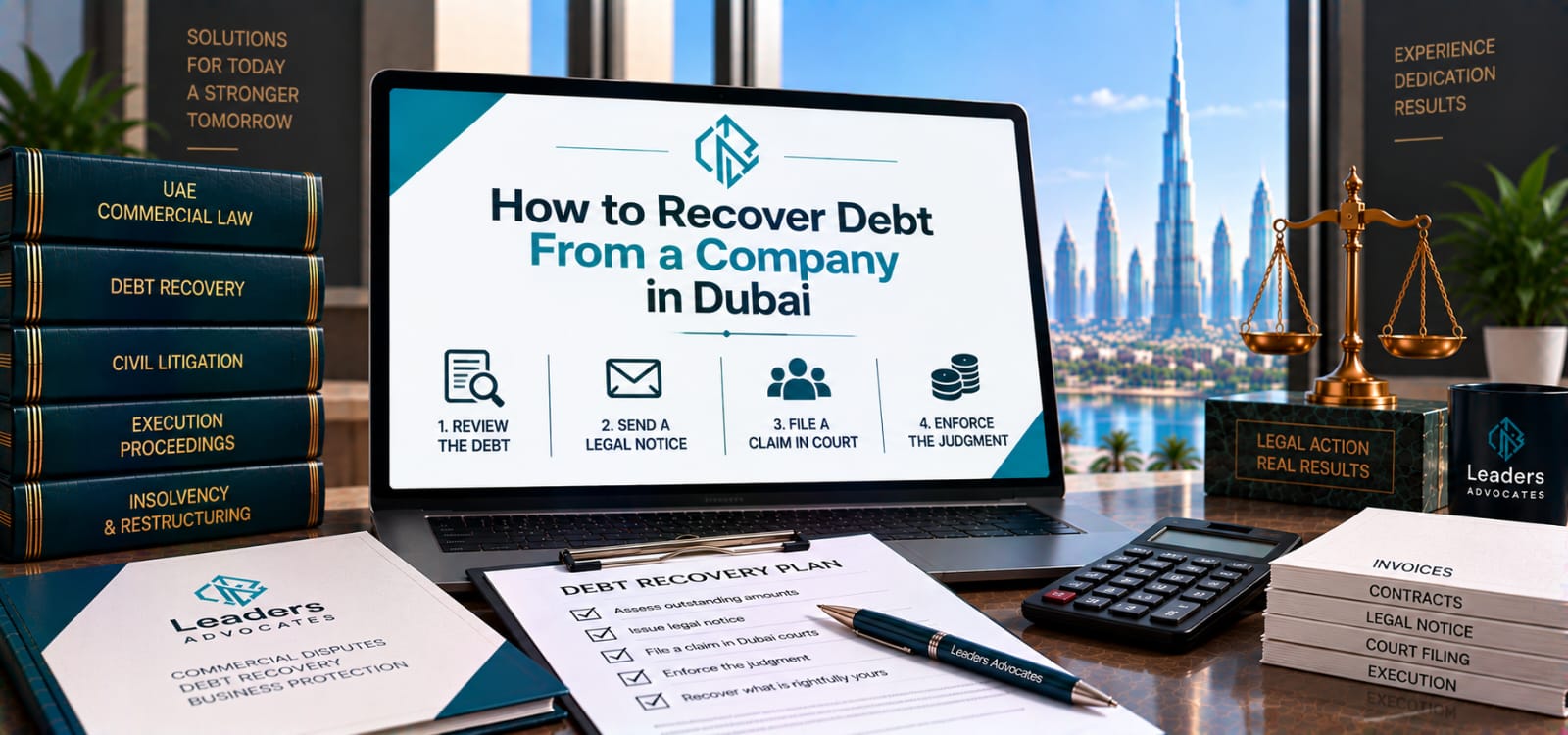
Send a focused written demand and assess whether settlement is realistic. If payment does not follow, the route may be a payment order, ordinary civil or commercial claim, arbitration, or cheque execution.
The correct procedure depends on the evidence, jurisdiction clause, and whether the debt is fixed, due, and documented. Court and arbitration requirements should be checked before filing.
A judgment is only part of recovery. The creditor should also assess bank accounts, receivables, assets, liquidation, and insolvency because enforcement depends on what can legally be reached.
A company has not paid, but the creditor may only have invoices and emails. The trade name on the invoice may also differ from the registered legal entity.
Build the claim before sending pressure. Confirm the legal debtor, the amount, the due date, the forum, and the evidence proving performance.
Then choose the procedure that fits the documents. Plan enforcement at the same time so a successful judgment can lead to actual payment.
How to Recover Debt From Company in Dubai
Start with identity, not the demand letter. Obtain the company’s registered name, license number, legal form, current status, and official address.
Match that entity to the contract, purchase order, invoices, delivery records, and payments. Resolve any mismatch before filing.
Next, calculate the principal, agreed interest or charges, credits, and partial payments. The final amount must be clear and supported.
Confirm the Correct Legal Entity
A brand, branch, trade name, and limited liability company may not be interchangeable. The entity that ordered the goods is not always the entity that signed the contract.
Check the issuing licensing authority or free-zone registrar. Obtain current records rather than relying on an old invoice header.
If a group has several companies, identify which one accepted the obligation. Avoid naming every related company without evidence.
Check Whether the Company Is Active
A dormant or expired license does not automatically erase the debt.
Look for current premises, employees, known customers, contracts, vehicles, equipment, and receivables. Use only lawful sources.
If liquidation or insolvency has started, obtain the appointment document and claim instructions. Ordinary collection activity may need to change.
Not Sure If the Company Is Even Still Active?
Send us the company name on WhatsApp and we’ll help you confirm its status before you spend on a claim.
Build the Evidence File
- The signed contract and amendments.
- Purchase orders and accepted quotations.
- Invoices and account statements.
- Delivery notes and completion certificates.
- Emails or messages confirming receipt.
- Records of defects or complaints.
- Payment promises and acknowledgments.
- Cheques, guarantees, or security documents.
- A schedule of payments and the unpaid balance.
Number the documents and create a chronology. A clear file makes the legal basis and missing evidence easier to identify.
Prove That Your Side Performed
The company may admit the invoice but argue that the goods were late, incomplete, or defective. Keep evidence showing what was supplied and when.
For services, preserve reports, approvals, timesheets, access records, or client sign-offs. For goods, keep delivery notes, transport records, and acceptance communications.
Address genuine complaints in the claim analysis. Ignoring them can make the demand look unreliable and increase the dispute.
Calculate the Debt Accurately
Start with the contractual price and each issued invoice. Deduct credit notes, returns, discounts, setoffs, and payments already received.
Separate principal from interest, penalties, tax, and costs. Confirm the contractual and legal basis for every added amount.
Use one reconciliation schedule that matches the supporting records. A changing figure gives the debtor an easy objection.
Review the Contractual Forum
Read the governing-law, jurisdiction, arbitration, notice, and dispute-resolution clauses. They may control where and how the claim begins.
A Dubai address does not always mean the Dubai onshore courts are the correct forum. The contract may point to arbitration, the DIFC Courts, or another agreed process.
Check whether mandatory pre-filing steps apply. Complete any notice, negotiation, mediation, or certification requirement before filing.
Ready to Send a Legal Demand?
Share your contract and invoices on WhatsApp — we’ll tell you if a demand letter is enough or if you need to file now.
Send a Focused Legal Demand
The demand should identify the parties, contract, invoices, services or goods, amount, due date, and payment method. Attach a concise account statement.
Set a realistic deadline and state the next intended step. Avoid threats that are not supported by the contract or law.
Serve the notice through a method that creates evidence. Follow any address and delivery clause in the contract.
Negotiate a Documented Settlement
Settlement may preserve a commercial relationship and reduce cost. It should still be precise and enforceable.
State the admitted balance, installment dates, payment account, default event, and consequence of a missed payment. Address interest, costs, security, and existing proceedings.
Do not release the debt on the first installment unless that is intended. Confirm when any waiver becomes effective.
Consider the Payment Order Route
A payment order may be available when the statutory conditions are satisfied. The debt generally needs to be established in writing, due, and for a specified amount.
The evidence must fit the procedure. A heavily disputed performance claim may require ordinary proceedings instead.
Review notice and filing requirements before relying on this route. A rejected application can add delay if the claim was not suited to it.
Ordinary Civil or Commercial Proceedings
An ordinary claim may be needed when liability, performance, valuation, or setoff is disputed. The pleading should explain the contract and the breach clearly.
Prepare Arabic translations where required. Court proceedings before the onshore Dubai courts are conducted in Arabic.
Expert evidence may be needed for accounts, construction, technology, or another technical issue. Organize the file so the expert can trace each amount.
Arbitration Claims
If the contract contains a valid arbitration agreement, court filing may be challenged. Review the clause before taking substantive steps.
Arbitration has its own filing rules, fees, tribunal process, and award-enforcement stage. The claim value and asset position should justify the chosen route.
Do not assume arbitration is always faster. Complexity, service, evidence, and tribunal availability affect the timeline.
Court, Arbitration, or Cheque Execution — Not Sure Which Route Fits?
Message us your documents on WhatsApp now and get a clear recommendation on the fastest route to payment.
Where a Cheque Backs the Debt
A dishonored cheque may support direct execution when the bank return meets Article 667 of the Commercial Transactions Law. The original cheque and dated bank statement are important.
Execution on the cheque and a claim on the underlying contract should be coordinated. Avoid double recovery or inconsistent amounts.
Record partial payments and any replacement instrument. The current outstanding balance must remain accurate.
Precautionary Measures
A creditor may consider precautionary attachment when the legal conditions are met. The court decides whether the evidence and risk justify the measure.
The applicant may need to show an apparent right and a real concern about recovery. Security or follow-up filing requirements can apply.
Do not promise an account freeze before the court acts. A request is different from an issued order.
Judgment and Enforcement
After a final or enforceable judgment, the creditor can start the appropriate execution process. The court may inquire about and attach assets allowed by law.
Bank accounts, receivables, vehicles, or property interests may be relevant. Ownership and exemptions must be checked.
Keep a live balance showing judgment amounts, costs, interest, and payments. Update the court when money is received.
Locate Commercial Assets and Receivables
Company recovery often depends on receivables rather than cash on hand. Identify major customers, active projects, payment processors, and contractual income where lawfully known.
Equipment in the company’s premises may be leased, financed, or owned by another group entity. Possession alone does not prove ownership.
Provide counsel with verified leads, not speculation. The execution authority controls formal asset inquiries and attachment.
Directors and Shareholders Are Not Automatically Liable
A company has a legal identity separate from its owners and managers. Unpaid corporate debt does not automatically become a shareholder’s personal debt.
Personal liability may arise only when a separate legal basis exists. Examples can involve a personal guarantee, direct undertaking, or legally proven misconduct.
Review the documents before naming individuals. Unsupported claims can increase cost and distract from the true debtor.
Liquidation and Insolvency
If liquidation has begun, identify the liquidator and the claim deadline. Submit the proof of debt through the required process.
Insolvency proceedings may stay or coordinate individual enforcement. The creditor’s rights can depend on security, priority, and the approved procedure.
Do not wait for informal updates from former staff. Obtain the official proceeding details and preserve proof of submission.
Cross Border Company Issues
The debtor may be registered in Dubai but hold assets abroad, or the opposite may be true. Recovery then requires a jurisdiction and enforcement map.
Check where the judgment or award must ultimately be used. Recognition depends on the destination country’s law and any applicable treaty.
Plan translations, finality documents, and asset evidence early. A judgment that cannot reach assets may have limited commercial value.
Related Success Story
Leaders Advocates publishes a Debt Recovery Case in Dubai involving successful loan recovery. The available summary appears on the Leaders Advocates Success Stories page.
The prior outcome does not guarantee another result. Corporate recovery depends on the contract, evidence, forum, debtor status, and reachable assets.
Common Mistakes to Avoid
- Suing a trade name instead of the legal entity.
- Sending demands before reconciling the account.
- Ignoring the arbitration or notice clause.
- Claiming unsupported interest or penalties.
- Treating directors as automatic guarantors.
- Obtaining a judgment without an asset plan.
- Missing a liquidation proof-of-debt deadline.
- Waiting until records or staff disappear.
Final Takeaway
Corporate debt recovery starts with the correct debtor and a complete evidence file. It does not start with a generic threat.
Choose the demand, settlement, payment order, lawsuit, arbitration, or cheque route that fits the documents. Prepare for enforcement before filing.
The best strategy connects liability, procedure, cost, and collectability. Each part matters if the goal is payment rather than only a judgment.
Relevant Legal Services
- Debt Recovery Lawyers in Dubai – for unpaid invoices, business debt collection, settlements, and enforcement.
- Litigation Lawyer in Dubai – for commercial claims, payment orders, court proceedings, and execution.
- Corporate Lawyers in Dubai – for company identity, contractual liability, guarantees, and insolvency coordination.
Follow Leaders Advocates on LinkedIn or Leaders Advocates on Facebook for more UAE legal updates.
Frequently Asked Questions
Owed Money by a Company in Dubai?
Don’t let the debt sit. Message Leaders Advocates on WhatsApp now and get a clear recovery plan today.