


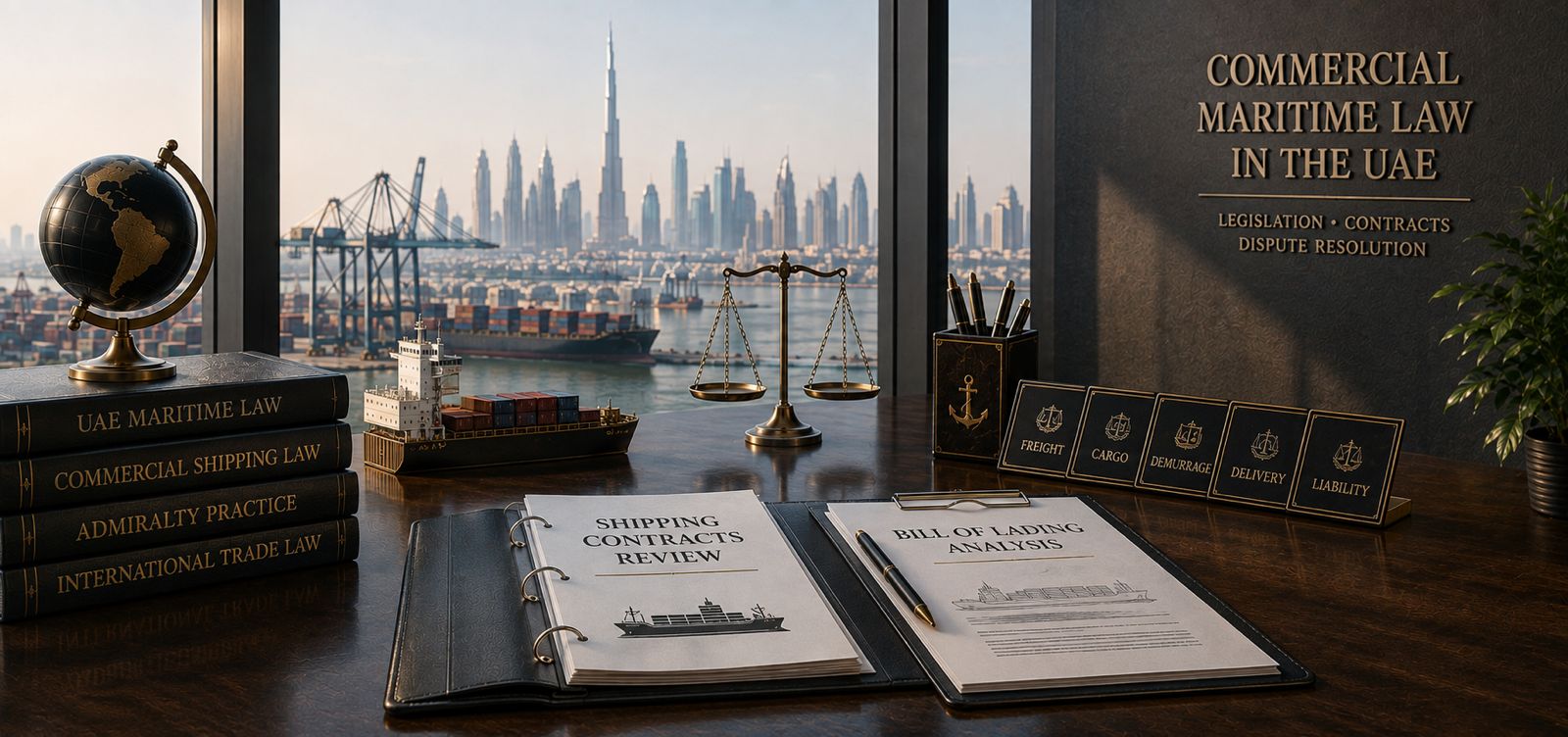

Commercial Maritime Law in the UAE underwent a major statutory change when Federal Decree-Law No. 43 of 2023 concerning Maritime Law took effect on 29 March 2024. It replaced Federal Law No. 26 of 1981 and created the current federal framework for ships, navigation, registration, maritime contracts, marine casualties, arrest, liability, and insurance.
The change was more than a renumbering exercise. It modernised a framework written decades before electronic registration, contemporary shipping finance, protection and indemnity arrangements, and today’s cross-border maritime operations. However, the legal effect on a particular claim still depends on the event date, contract, vessel, forum, and transitional position.
Commercial maritime law in the UAE is now principally governed by Federal Decree-Law No. 43 of 2023, effective 29 March 2024. The law broadened and modernised rules concerning maritime structures, ship registration, construction and chartering records, mortgages, arrest, release security, limitation of liability, carriage, charter parties, towage, pilotage, collisions, salvage, general average, insurance, and limitation periods. It also supports electronic procedures and reflects current international shipping practice more closely than the former 1981 law. The practical priority is not merely identifying the new statute. Owners, charterers, cargo interests, insurers, lenders, ports, and service providers must identify the correct claim, preserve documents, check the applicable time bar, and choose the competent UAE court or agreed dispute forum before taking action.
What the Current Maritime Law Covers
If your situation involves this, it helps to speak with maritime lawyer in dubai.
The law regulates vessels and other maritime means used for navigation and marine transport and includes provisions relevant to offshore platforms and floating structures. Its chapters address the legal status of a ship, nationality and registration, ownership, co-ownership, construction, mortgages, and maritime liens.
It also regulates the commercial and operational relationships surrounding a voyage. These include shipowners and operators, masters and crews, chartering, carriage of goods and passengers, towage, pilotage, agents, freight forwarders, cargo handling, marine insurance, accidents, salvage, general average, and maritime claims.
The Core 2024 Change: A New Federal Statute
For a closer look at this, see our guide on what is a bill of lading under UAE law.
The 1981 Commercial Maritime Law is no longer the starting statute for events governed by the new law. Contracts, notices, pleadings, guarantees, and legal opinions should therefore be checked for obsolete citations. An old clause may remain contractually relevant, but its statutory reference may no longer describe the current provision. The full text is published on the UAE Legislation portal.
The effective date matters. A casualty, contract, arrest, payment default, or limitation period that began before 29 March 2024 may raise transitional questions. It is unsafe to assume either that every older dispute automatically falls under the new law or that a continuing relationship remains governed entirely by the former law.
Vessel Registration and the Ship Register
The current framework places the ship register and registration procedures at the centre of vessel status. Registration affects nationality, flag entitlement, ownership records, mortgages, attachments, and dealings with third parties. The legislation also addresses registration connected to ships under construction and certain chartering arrangements, subject to statutory conditions.
Parties should verify the exact record rather than rely only on a certificate held in a transaction file. Ownership changes, mortgages, enforcement attachments, restrictions, and deregistration steps may require entry in the relevant register before they have the intended effect against third parties.
Ship Construction and Ownership Records
A shipbuilding project creates legal questions before the vessel is completed. The new framework addresses registration-related treatment of ships under construction and the recording of shipbuilding arrangements. Builders, buyers, lenders, and insurers should align the construction contract, title milestones, payment schedule, risk allocation, and register entries.
Disputes often arise because the contract describes ownership and risk differently from the registry or finance documents. A careful review should identify when title passes, who carries casualty risk, which party insures the work, and what happens after delay, termination, or insolvency.
Ship Mortgages and Maritime Security
We cover this in more detail in our guide on demurrage and detention under UAE maritime law.
A ship mortgage depends on compliance with statutory and registration requirements. The law recognises modern methods for transactions involving ship mortgages, but documentation, authority, priority, and registration remain critical. A private promise to grant security may not create the same protection as a properly recorded mortgage.
Lenders should also review the relationship between registered mortgages, maritime liens, enforcement attachments, insurance proceeds, and a judicial sale. Priority cannot be inferred from the date of a commercial invoice alone.
Ship Arrest and Release
Ship arrest is a precautionary remedy intended to secure qualifying maritime claims. The claimant must identify a legally recognised maritime debt or claim, establish the connection to the ship or liable party, and follow the competent court’s procedural requirements. Arrest is not available simply because a claimant labels an ordinary invoice maritime.
The law modernised release security and expressly accommodates recognised forms of security used in international shipping practice, including appropriate protection and indemnity arrangements where the statutory and judicial requirements are met. The amount, wording, issuer, jurisdiction, and conditions of the security may still be disputed.
Vessel Sailing Before You Can Secure the Claim?
An arrest application only works while the ship is still in port, and the paperwork has to be right the first time. Leaders Advocates can assess the claim and move on the same day.
What an Arrest Applicant Should Prepare
- The contract, bill of lading, charterparty, invoice, protest, survey, or casualty record supporting the maritime claim.
- Evidence identifying the vessel, registered owner, operator, charterer, flag, IMO number, and UAE port call.
- A clear calculation of principal, interest, expenses, and the amount for which security is requested.
- Arabic translations and properly authenticated foreign documents where required.
- Evidence of urgency and the vessel’s expected movement.
- A plan for the substantive claim and every applicable filing deadline after arrest.
What an Owner Seeking Release Should Check
- Whether the claim legally qualifies for arrest and is connected to the vessel or liable party.
- Whether jurisdiction, service, evidence, and required security from the applicant are sufficient.
- The acceptable form and amount of release security.
- Whether a limitation right or limitation fund may affect exposure.
- Deadlines for grievance, challenge, substantive proceedings, and release applications.
Limitation of Liability and Limitation of Funds
The current law provides a structured framework under which qualifying shipowners or other entitled parties may limit liability for defined maritime claims, subject to exclusions and loss of limitation in the circumstances set by law. A limitation fund may allow claims to be channelled through a court-controlled amount.
Limitation is not a blanket cap on every loss. The party must identify the qualifying person, claim category, vessel tonnage, applicable calculation, excluded claims, and conduct that may defeat the right. Contractual limits, convention-based rules, and statutory limitations should be analysed separately.
Carriage of Goods and Bills of Lading
Cargo disputes can involve loading condition, description, quantity, seaworthiness, care of cargo, deviation, delivery, liens, notice of loss, package limits, and time bars. The bill of lading may operate as a receipt, evidence of the carriage contract, and document of title, but its precise effect depends on the parties and transaction.
Preserve the original electronic or paper transport documents, booking terms, mate’s receipts, surveys, temperature logs, seals, notices, delivery records, and subrogation documents. A cargo claimant should not wait for commercial negotiations to finish before checking the statutory deadline.
Charterparties, Freight, and Withdrawal
Voyage, time, and bareboat chartering allocate control, employment, costs, maintenance, freight or hire, and operational risk differently. The current law supplies rules, but the negotiated charterparty remains central. Standard forms should be read with riders and amendments, not in isolation.
Non-payment of hire, unsafe port allegations, off-hire, speed and consumption, redelivery, cargo exclusions, sanctions, and withdrawal can produce urgent disputes. Parties should follow contractual notice and cure requirements exactly and preserve operational evidence from the vessel and shore teams.
Collisions, Salvage, Towage, and General Average
Marine casualties require immediate evidence preservation. Voyage data, AIS, bridge records, logs, communications, weather, pilotage material, survey evidence, and crew accounts can change or disappear quickly. Regulatory reporting and safety actions should be coordinated with privilege and litigation strategy.
Collision, towage, salvage, and general average have distinct legal tests and limitation periods. A payment request labelled salvage or general average is not self-proving. Review the service rendered, danger, success, contractual arrangements, adjustment, security, and parties entitled to claim.
Casualty Overnight and Evidence Already Disappearing?
Voyage data overwrites, crews rotate, and the records that decide liability are gone within days. Get instructions to the vessel now and protect the position before anyone gives a statement.
Marine Insurance
The new law contains rules for marine insurance relationships, but policy wording remains decisive. Notice, disclosure, insured interest, covered peril, exclusions, warranties, causation, loss measurement, abandonment, subrogation, and claims cooperation require careful review.
Insured parties should notify promptly without making unsupported admissions. Insurers and brokers should preserve placement records, questionnaires, endorsements, surveys, and claims communications. A coverage dispute can proceed alongside cargo, casualty, or recovery proceedings.
Jurisdiction, Arbitration, and Evidence
A UAE maritime dispute may be heard by an onshore court or another agreed forum depending on jurisdiction rules and the contract. Arbitration clauses, foreign court clauses, bills of lading, incorporation terms, and multiple contracts must be assessed together. A clause in one document does not automatically govern every participant.
UAE court proceedings generally require Arabic pleadings and translations. Foreign judgments and awards may need recognition or enforcement. Before arresting a vessel or commencing proceedings, confirm the forum, merits, time bar, service route, security strategy, and enforceable assets.
Practical Compliance Checklist
- Replace obsolete 1981-law citations in templates while preserving an audit trail for older contracts.
- Record the event date and analyse the transitional application before citing a new article.
- Verify registry, ownership, mortgage, charter, and attachment information from authoritative records.
- Review notice provisions and statutory limitation periods at the start of every claim.
- Preserve vessel, cargo, port, survey, insurance, and electronic evidence immediately.
- Coordinate arrest, release security, limitation, substantive proceedings, and enforcement as one strategy.
- Check Arabic translation, legalisation, authority documents, and service requirements.
- Do not assume that international standard terms override mandatory UAE law.
Relevant Legal Services
Vessel arrest, cargo, charterparty, marine insurance, and casualty matters may require Maritime Lawyers in Dubai. A disputed maritime claim may also involve a Litigation Lawyer in Dubai, while drafting or updating charterparties and shipping agreements may require Contract Lawyers in Dubai.
People Also Ask
Final Takeaway
The 2024 reform gave the UAE a modern maritime statute, but the practical risk lies in details: dates, registry status, claim classification, security, forum, and time bars. Update documents, verify facts, and act before the vessel or deadline moves beyond reach.
Is Your Maritime Claim Running Out of Time?
Cargo, collision, towage, and salvage claims each carry different time bars, and one missed deadline ends an otherwise strong case. Leaders Advocates handles vessel arrest, release security, cargo recovery, and casualty work across UAE ports.

2 Comments