


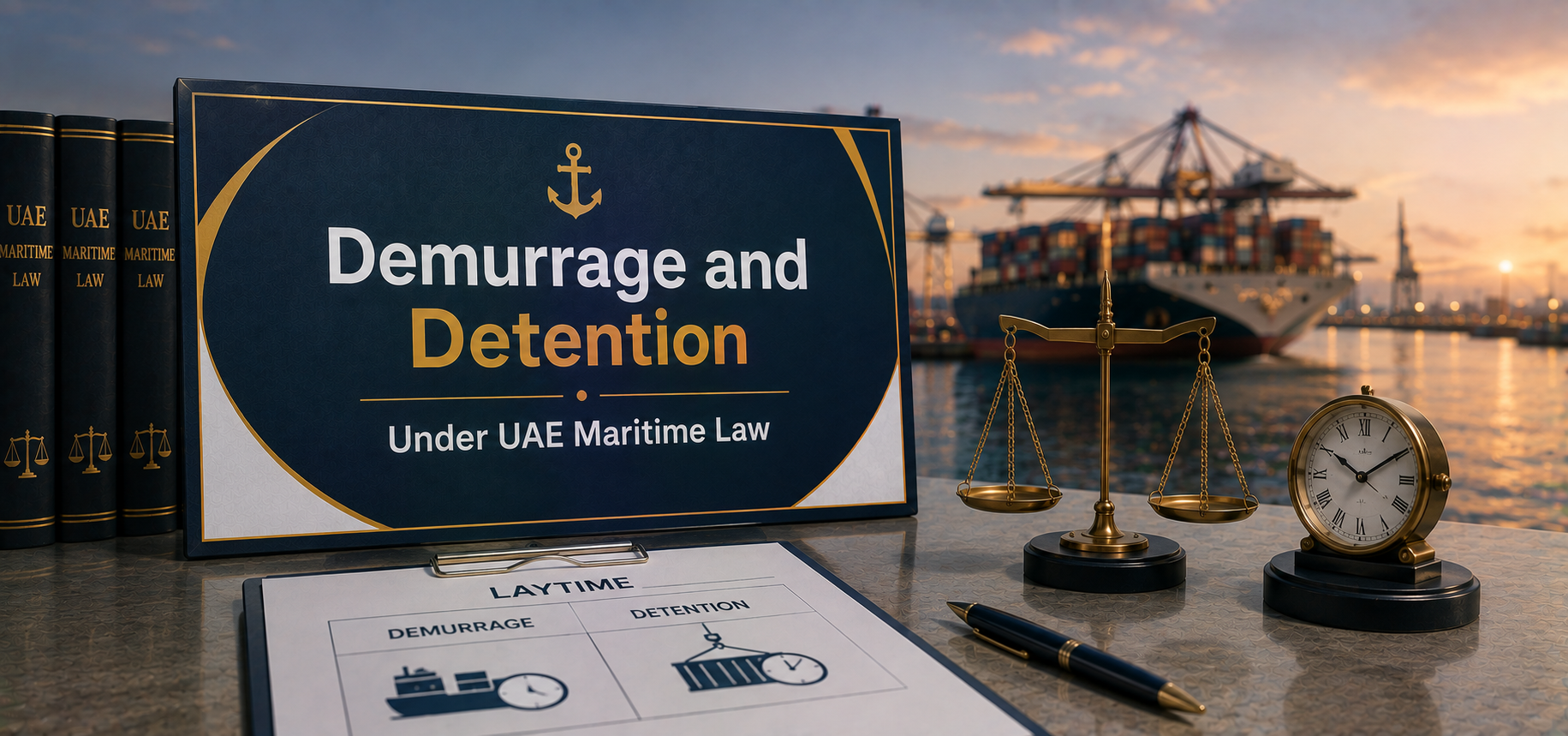

Demurrage and detention under UAE Maritime Law are industry charges rather than terms expressly defined in Federal Decree-Law No. 43 of 2023. The law addresses them indirectly through cargo delivery delay, charter-party obligations, and carrier liability.
Disputes are commercial claims within maritime jurisdiction and can be resolved through UAE courts or a contractually agreed arbitration centre. A maritime lawyer in Dubai can advise on how is demurrage calculated in the UAE and how to handle cargo claims in the UAE when such disputes arise.
Quick Answer
Federal Decree-Law No. 43 of 2023 does not expressly define demurrage or detention. Article 175 nevertheless provides a liability framework by presuming the carrier liable for damage or delay unless the carrier proves a recognized exception, commonly force majeure or the shipper’s negligence. Demurrage applies when a loaded container stays inside the port or terminal beyond free time, commonly 3 to 7 days for standard containers. Detention applies when the carrier’s container equipment is held outside the terminal beyond its contractual free period.
The party alleging delay or seeking compensation bears the burden of proof. In Dubai, documentation problems involving commercial invoices, packing lists, HS codes, and certificates of origin are a leading trigger. Dust storms or winter fog do not automatically stop the demurrage clock unless the contract says so.
About Faris Raian
Faris Raian is the Founder, Managing Partner, and Senior Legal Consultant at Leaders Advocates. He brings more than 15 years of experience across commercial, corporate, real estate, family, and criminal law in UAE courts, with experience relevant to commercial shipping contracts and maritime-adjacent disputes.
How Demurrage and Detention Under UAE Maritime Law Work
The charges apply to different stages of container use and are normally controlled by the carrier contract and the documented cause of delay.
Facing a Demurrage or Detention Dispute in the UAE?
Shipping charges can depend on the carrier contract, free-time terms, cause of delay, and supporting documentation. Our team can review the circumstances and assess the available court or arbitration route.
Demurrage
• Charged while a loaded container remains inside the port or terminal beyond the agreed free-time window.
• Commonly triggered by customs-clearance or documentation delays.
• Free time is commonly 3 to 7 days for standard containers.
Detention
• Charged for holding the carrier’s container equipment outside the terminal beyond free time.
• Commonly triggered by delayed unpacking, return, or repositioning of the container.
• Free-time terms are generally set by the specific carrier contract.
Article 175 and Presumed Carrier Liability
Article 175 presumes the carrier liable for damage or delay. The carrier must prove that a recognized exception applies, with force majeure and the shipper’s own negligence among the most commonly raised exceptions.
The presumption supports the party alleging the delay, provided that party can document what occurred. The party seeking compensation still carries the burden of proving the alleged delay and loss.
What Triggers Demurrage at UAE Ports
• Documentation delays: especially commercial invoices, packing lists, HS codes, certificates of origin, and VAT and duty calculations that should be validated before the vessel berths.
• Weather disruptions: such as dust storms and winter fog, which can suspend marine traffic but do not automatically pause charges unless the contract provides for it.
• Peak congestion: during festival seasons or periods of global trade surge, which can tighten clearance windows.
How Disputes Are Resolved
• Through UAE courts or the arbitration centre selected in the parties’ contract.
• Subject to limitation-of-liability provisions under the Maritime Law where those limits apply.
• Through liquidated damages for breach relating to cargo delivery delay where the contract provides for them.
Reducing Exposure in Practice
Pre-clearance filing through Dubai Customs before the vessel berths can reduce container idle time. Real-time shipment visibility and tracking tools allow the shipper to respond before charges accumulate for several days.
Facing a demurrage or detention dispute? Faris Raian and the team at Leaders Advocates can assess the carrier contract, evidence, delay cause, Article 175 position, and available court or arbitration route.
Disputing Demurrage or Detention Charges?
Demurrage and detention apply at different stages and may involve separate free-time periods, contractual terms, and evidence of delay. Get your carrier terms, invoices, shipping records, and delay evidence reviewed before deciding how to respond.
Common Mistakes
• Assuming weather delays automatically pause demurrage when a contractual provision is generally required.
• Failing to document the delay promptly even though the party alleging it carries the burden of proof.
• Treating demurrage and detention as interchangeable despite applying inside and outside the terminal respectively.
Relevant Legal Services
A Maritime Lawyer in Dubai can assess the shipping claim. A Contract Lawyer in Dubai can review free-time and liability wording, while a Litigation Lawyer in Dubai can manage court or arbitration proceedings.
People Also Ask
Conclusion
Demurrage and detention under UAE Maritime Law have enforceable legal grounding through contract and Article 175 even though the statute does not define the industry terms expressly.
Need to Challenge a Shipping Delay Claim?
The outcome of a delay dispute can turn on the contract, documentation, cause of delay, and the evidence available to each party. Faris Raian and the team at Leaders Advocates can assess your position under UAE Maritime Law and the relevant contractual terms.