


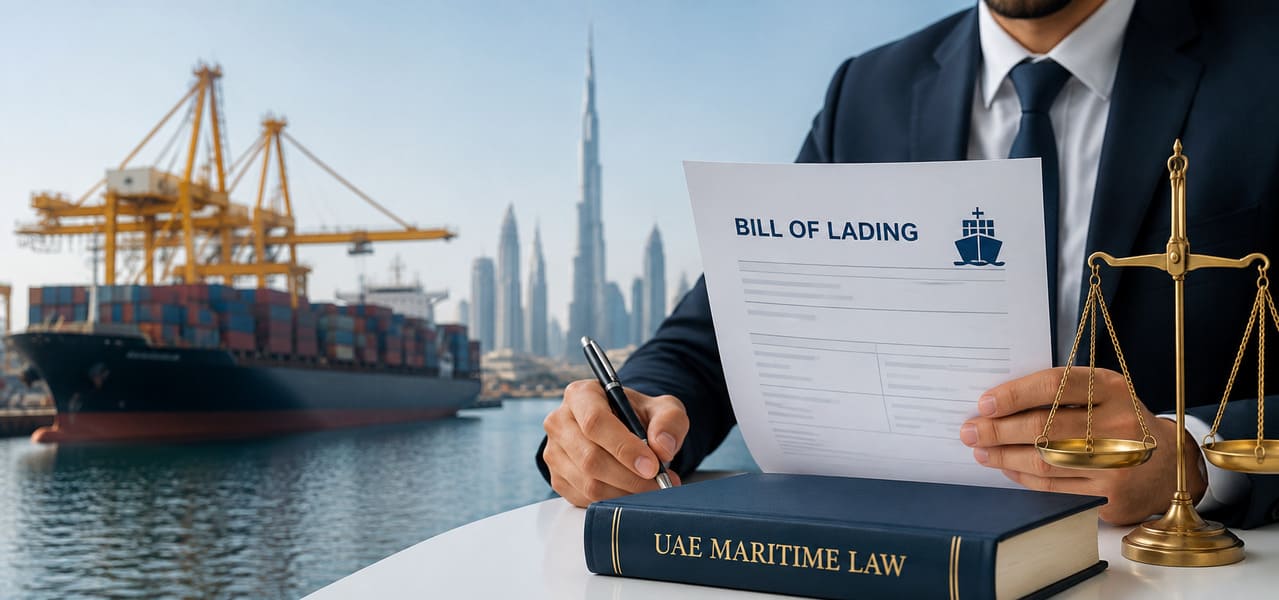

A bill of lading looks like a simple shipping receipt, but under UAE law it’s doing three genuinely different legal jobs at once, and which type you’re actually holding determines whether you can sell the goods while they’re still at sea.
So what is a bill of lading, exactly, under UAE law?
It’s the central document in any sea shipment, defined under Federal Decree-Law No. 43 of 2023, the New Maritime Law, as the document establishing the carriage contract and the carrier’s receipt of the cargo, with the carrier undertaking to deliver it against the document’s surrender. It operates simultaneously as a receipt for the cargo, evidence of the carriage contract, and, depending on how it’s drafted, a negotiable document of title, meaning ownership of the goods can actually change hands while they’re still in transit.
This guide covers the three functions a bill of lading actually performs, the three types that exist, and what changed with the New Maritime Law. Our detailed guide on handling cargo claims in the UAE covers what to do when something goes wrong with a shipment covered by one. A maritime lawyer in Dubai can also advise on how is demurrage calculated in the UAE and key issues under commercial maritime law in the UAE.
What Is a Bill of Lading Under UAE Law?
A bill of lading is defined under Federal Decree-Law No. 43 of 2023 as the document establishing the execution of the carriage contract and the carrier’s receipt or shipping of the cargo, with the carrier undertaking to deliver the cargo against recovery of the document itself.
It performs three distinct legal functions: it acts as a receipt confirming that the carrier took possession of the cargo in the condition described, provides evidence of the terms of the carriage contract between shipper and carrier, and, depending on how it is drafted, can function as a negotiable document of title.
Three types exist: a nominate or straight bill names a specific consignee and is non-negotiable; an order bill can be transferred by endorsement; and a bearer bill can be transferred by simple delivery, allowing the legitimate holder to claim the cargo.
The New Maritime Law also addresses electronic bills of lading. Claims arising from a bill of lading or the underlying carriage contract are subject to the applicable one-year filing deadline governing cargo claims.
The Three Functions, in Practice
- A receipt for the cargo, confirming the carrier actually took possession, and generally recording the goods’ apparent condition and quantity at that point.
- Evidence of the carriage contract, setting out the terms between shipper and carrier, generally treated as strong, often near-conclusive, evidence of what’s actually written on it.
- A negotiable document of title, where the bill is drafted to allow it, meaning legal ownership of the goods can transfer simply by transferring the document, even while the cargo is still at sea.Understanding what is a bill of lading under UAE law starts with separating its role as a cargo receipt, evidence of the carriage contract, and, where applicable, a document of title.
The Three Types of Bill of Lading
Another important point when considering what is a bill of lading under UAE law is that the legal effect of the document can differ depending on whether it is a straight, order, or bearer bill.
- Nominate (straight) bill of lading: Names a specific consignee; non-negotiable, only that named party can claim the goods
- Order bill of lading: Negotiable by endorsement, ownership can be transferred from one party to another
- Bearer bill of lading: Negotiable by simple delivery, no endorsement required, whoever holds it can claim the cargo
Need Help With a Bill of Lading?
Get legal guidance on shipping documents, carrier obligations, and bill of lading terms under UAE law.
Why the Document-of-Title Function Matters Commercially
This is the function that actually makes international trade finance work. An exporter typically retains title to the goods until the bill of lading itself is transferred, using it as security for payment through a letter of credit. An importer generally must present the original, or a properly negotiated, bill of lading to actually take delivery of the cargo, failing to do so can mean demurrage fees or the shipment being held or rejected entirely.
Electronic Bills of Lading: A Genuine Modernization
Unlike the 1981 law it replaced, the current Maritime Law specifically addresses electronic bills of lading, reflecting how much shipping documentation has moved on since the previous framework was written. Any modification to a bill, electronic or paper, needs to be properly documented, and may require re-legalization for customs purposes, with all parties needing to agree to the change.
What Happens If the Cargo Doesn’t Match the Bill
Misdeclaration under the current law carries real consequences, a carrier can offload the goods or charge the highest applicable freight rate where the cargo doesn’t match what’s declared, with the shipper liable for any resulting damages. Getting the bill’s description accurate at the outset genuinely matters, not just as good practice, but as a real point of legal exposure.
Drafting, reviewing, or disputing a bill of lading? The team at Leaders Advocates brings commercial and maritime-adjacent experience to this kind of shipping documentation and can review your specific position.
Why One Document Can Perform Three Different Jobs
The easiest way to understand a bill of lading is to separate its three functions and then see how they operate together. First, it records that the carrier received or shipped the cargo. Second, it provides evidence of the carriage contract and its terms. Third, where the document is drafted to be negotiable, it can represent title to the goods and allow that title to move while the cargo is still in transit.
Those functions overlap in a single commercial document, which is why a bill of lading can become central to disputes involving delivery, payment, ownership, cargo condition, and shipping instructions. Treating it as only a receipt misses the parts of the document that can matter most commercially.
The Type of Bill Determines What the Holder Can Do
The distinction between nominate, order, and bearer bills of lading is not merely descriptive. It determines whether the document is negotiable and, if so, how rights in the goods can be transferred. A nominate or straight bill identifies a specific consignee and is non-negotiable. An order bill can be transferred by endorsement, while a bearer bill can be transferred by delivery of the document itself.
This is particularly important where goods are sold while still at sea or where documentary finance is being used. Before relying on the bill to transfer title or support a payment structure, the parties need to know which type they are actually dealing with.
How the Bill Supports Trade Finance
The document-of-title function is what connects shipping documentation with payment security. As the article explains, an exporter can retain title until the bill itself is transferred and can use that position within a letter-of-credit transaction. The importer, in turn, generally needs the original or a properly negotiated bill in order to take delivery.
That creates a direct link between the accuracy and handling of the document and the commercial flow of the transaction. If the document is not transferred correctly, or if the party expecting delivery cannot produce the required bill, the consequences can include delay, demurrage, or the cargo being held or rejected.
Why the Cargo Description Is Legally Important
The description of the goods should not be treated as routine paperwork. The article states that where the cargo does not match what has been declared, the carrier can offload the goods or charge the highest applicable freight rate, while the shipper can be liable for resulting damages.
That means quantity, nature, and description should be checked carefully before the bill is finalized. An inaccurate description can create problems not only for logistics and customs handling but also for the legal and financial allocation of responsibility between shipper and carrier.
Electronic Bills of Lading and the Modern UAE Framework
The recognition of electronic documents is also relevant when explaining what is a bill of lading under UAE law under the current maritime framework.
The New Maritime Law specifically addresses electronic bills of lading, unlike the 1981 framework it replaced. Commercially, that reflects the move away from shipping processes that depend entirely on physical paper moving between several parties and locations.
The legal function of the document remains important whether it is electronic or paper. The article also notes that modifications need to be properly documented and may require re-legalization for customs purposes, with the parties agreeing to the change. In other words, using an electronic format does not make document control less important.
The Bill of Lading as Evidence in a Cargo Dispute
When cargo is lost, damaged, delayed, or delivered in a way that creates a dispute, the bill of lading becomes one of the core documents used to reconstruct the carriage arrangement. It identifies the shipment, records the contractual relationship, and can provide evidence about the cargo as received by the carrier.
That is why the related cargo-claims guide begins with preserving the bill of lading or equivalent shipping documentation. A dispute may involve many other documents, including carrier correspondence, survey reports, and photographs, but the bill remains a central reference point for understanding what the carriage contract required.
Why Negotiability Should Be Checked Before the Transaction Relies on It
One of the common mistakes identified above is assuming that every bill of lading is negotiable. That assumption can create serious commercial confusion where a transaction is structured on the belief that the document can transfer rights in the goods but the bill is actually a nominate or straight bill.
The safer approach is to identify the type at the start of the transaction and make sure it matches the intended commercial use. If the document is meant to move through a chain of buyers, sellers, banks, or other holders, the transfer mechanism needs to be consistent with the form of bill that has actually been issued.
Reviewing a Shipping Contract?
Our legal team can review the bill of lading, carriage terms, and related shipping documentation before a dispute develops.
Document Control Matters From Issue to Delivery
Because the bill can operate as a receipt, contract evidence, and document of title, control over the document matters throughout the shipment. Parties should know who is holding it, whether it has been endorsed where required, whether any changes have been agreed and documented, and what version will be presented for delivery.
Understanding what is a bill of lading under UAE law is particularly important when controlling original documents throughout the shipment and delivery process.
This is especially important in transactions where the cargo may arrive before the paperwork has been properly transferred. The article already notes the risk of demurrage, holding, or rejection where the importer cannot present the required original or properly negotiated bill.
The One-Year Cargo-Claim Deadline Still Matters
A bill of lading can also become the foundation of a later claim, but the document itself does not remove the need to act within the applicable time limit. The article states that claims arising from the bill of lading or the underlying carriage contract fall under the same one-year filing deadline that governs cargo claims generally.
For that reason, a party dealing with a disputed shipment should preserve the bill immediately and use it alongside the other evidence rather than allowing document review to delay the claim. The commercial value of a carefully drafted bill is strongest when the parties also manage the dispute timeline correctly.
Common Mistakes
Knowing what is a bill of lading under UAE law also helps parties identify the correct document type, control its transfer, and preserve it if a cargo dispute later arises.
- Assuming any bill of lading is automatically negotiable, when a nominate bill specifically isn’t.
- Not confirming which type of bill actually governs a specific shipment before relying on it for a letter of credit.
- Treating a bill’s cargo description as a formality, when misdeclaration carries real, specific consequences under current law.
Relevant Legal Services
A Maritime Lawyer in Dubai can assess shipping documents, carrier obligations, and maritime claims. A Contract Lawyer in Dubai can review the governing contract, bill of lading, or related terms, while a Litigation Lawyer in Dubai can assist if the matter develops into formal court proceedings.
People Also Ask
So, what is a bill of lading under UAE law? A single document doing three genuinely different legal jobs, and the specific type in your hands determines what you can actually do with it. The team at Leaders Advocates can review or draft your shipping documentation properly.
Facing a Cargo or Bill of Lading Dispute?
Leaders Advocates can assess your shipping documents, contractual position, and available legal options in the UAE.

2 Comments