


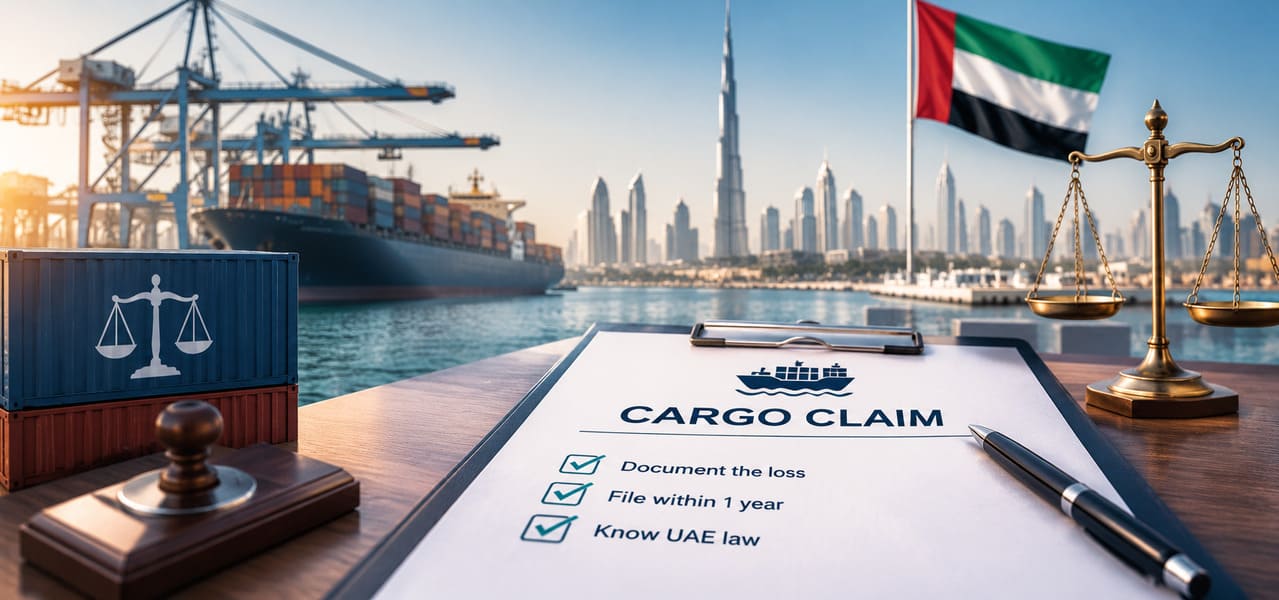

Handling cargo claims in the UAE depends on the mode of transport, the shipping documents, the available evidence, and the applicable filing deadline. Maritime cargo claims are primarily governed by Federal Decree-Law No. 43 of 2023.
Cargo claims in the UAE run on a genuinely strict clock, and international shippers who assume their bill of lading’s Hague-Visby terms will simply be honored here are frequently caught out. Handling a claim properly means understanding both the deadline and this specific, non-obvious feature of UAE cargo law from the outset.
Understanding how to handle cargo claims in the UAE requires careful attention to the applicable law, evidence, and filing deadlines.
So how do you actually handle a cargo claim in the UAE?
Act immediately to document the damage, loss, or delay, gather your shipping documentation, and file your claim well within one year of delivery, or the date delivery should have occurred, since Article 187 of the New Maritime Law bars UAE courts from hearing a claim filed late without a legally admissible excuse. Which specific law applies, and what liability caps you can actually claim, depends on the mode of transport and a genuine quirk in UAE ratification of international conventions.
This guide covers the actual steps to handle a cargo claim properly, the deadline that governs it, and the convention gap that catches many international operators off guard. A maritime lawyer in Dubai can advise on commercial maritime law in the UAE and disputes involving demurrage and detention under UAE maritime law.
Cargo claims involving a maritime leg are governed by Federal Decree-Law No. 43 of 2023, the New Maritime Law, in force since 29 March 2024, which replaced the 1981 Maritime Code. Land carriage and domestic air cargo instead fall under the Commercial Transactions Law, Federal Decree-Law No. 50 of 2022.
Under Article 187, cargo claims must be filed within one year from the date of delivery, or the date delivery should have taken place. UAE courts will not hear a claim filed after that deadline without a legally admissible excuse. Recourse claims against a third party carry their own shorter deadline, generally 90 days from either filing the main case or the date of payment.
To handle the claim, gather the bill of lading or equivalent shipping documentation, correspondence with the carrier, and any surveyor report documenting the damage. The claimant needs sufficient evidence to establish the carrier’s liability.
Where multiple claims arise from a single incident, a carrier can apply under Article 85 to establish a limitation fund based on the ship’s gross tonnage and SDR values. Claims may proceed before the competent UAE maritime court or, where the contract or bill of lading provides for it, through arbitration such as DIAC.
How to Handle Cargo Claims in the UAE: Step 1: Confirm Which Law Actually Applies
The applicable law depends on the mode of transport. Sea freight, and any multimodal shipment including a maritime leg, falls under the New Maritime Law, Federal Decree-Law No. 43 of 2023. Land carriage and domestic air cargo fall under the Commercial Transactions Law, Federal Decree-Law No. 50 of 2022, which also applies as a fallback wherever the Maritime Law is silent.
A genuine surprise for international shippers: the UAE has not ratified the Hague Rules, the Hague-Visby Rules, the Hamburg Rules, or the Rotterdam Rules for maritime cargo specifically. UAE courts will disregard Hague-Visby limitation provisions even where they’re written directly into the bill of lading and apply domestic UAE liability caps instead. In practice, this often works in the cargo owner’s favor, the UAE domestic cap generally runs higher, around 835 SDR per package, compared to the Hague-Visby figure of 666.67 SDR, but it means your bill of lading’s chosen liability regime may simply not hold up in a UAE court.
Step 2: Document Everything Immediately
- The bill of lading or equivalent shipping documentation, establishing the actual contract of carriage.
- Correspondence with the carrier from the moment the issue is discovered.
- A surveyor report, documenting the specific nature and extent of the damage or loss.
- Photographic evidence of the cargo’s condition, taken as close to discovery as possible.
Step 3: File Well Within the One-Year Deadline
Article 187 sets a strict one-year deadline, running from the date of delivery, or the date delivery should have taken place. UAE courts will not hear a claim filed after this window without a legally admissible excuse, so treating this as a hard deadline, not a rough guideline, genuinely matters.
Dealing With a Cargo Claim in the UAE?
Our maritime legal team can assess the shipping documents, carrier liability, filing deadline, and available claim route.
Step 4: Establish Where the Claim Is Actually Heard
Check the jurisdiction clause in the bill of lading or carriage contract first, claims proceed before the competent UAE maritime court by default, but many contracts specify arbitration instead, with DIAC being a common choice for cargo and maritime disputes specifically.
Where International Conventions Do Apply
- International air cargo: The Montreal Convention 1999, ratified by the UAE and directly enforceable in UAE courts
- Maritime liability limitation generally: The LLMC 1976 and its 1996 Protocol, ratified by the UAE
- International road transport: The CMR Convention, acceded to via Federal Decree No. 98 of 2018, though its enforceability in UAE courts remains contested
- Maritime cargo specifically: No Hague, Hague-Visby, Hamburg, or Rotterdam Rules ratified, UAE domestic law applies instead
Handling a cargo claim, or want your shipping contracts structured around UAE’s actual convention gaps? A UAE maritime lawyer from our team can assess your specific claim or contract.
Why Cargo Claims Need to Be Managed as Evidence Cases From Day One
A cargo claim is not only about proving that goods were lost, damaged, or delayed. It is also about being able to connect the loss to the contract of carriage and to the carrier’s responsibility under the legal regime that applies. That is why the documentation listed above is central rather than optional background material.
The bill of lading or equivalent shipping document identifies the carriage relationship. Carrier correspondence helps establish when the problem was discovered and how it was reported. A surveyor report records the nature and extent of the loss, while photographs preserve the cargo’s condition close to the time of discovery. Together, those materials create the factual record that the claimant may later need to rely on.
The Mode of Transport Changes the Legal Starting Point
The first question is whether the shipment falls within the maritime regime or another carriage regime. The article distinguishes sea freight and multimodal shipments with a maritime leg from land carriage and domestic air cargo. That classification matters because it determines which statutory framework is the starting point for the claim.
For businesses handling international logistics, this can be easy to overlook when one commercial shipment moves through several stages. A cargo movement may look like a single transaction commercially, but the legal analysis still begins by identifying the relevant mode of transport and the rules that govern the particular claim.
Why the One-Year Deadline Should Drive the Claim Strategy
The one-year filing period under Article 187 is not a date to think about only after negotiations have failed. It should shape the claim strategy from the beginning. The article states that the period runs from delivery or the date on which delivery should have occurred, and that UAE courts will not hear a late claim without a legally admissible excuse.
That is why evidence gathering, claim valuation, correspondence with the carrier, and any settlement discussions should be organized with the filing deadline in view. A claimant may still want to negotiate, investigate, or obtain a survey, but those activities should not create a false sense that the statutory clock has stopped.
Recourse claims also need separate attention because the article identifies a shorter period, generally 90 days from filing the main case or from the date of payment. Where several parties are involved in the transport chain, this can make calendar management as important as the substantive liability analysis.
Understanding the Convention Gap
One of the most important features of UAE maritime cargo law in this article is the position on international cargo conventions. The UAE has not ratified the Hague Rules, Hague-Visby Rules, Hamburg Rules, or Rotterdam Rules for maritime cargo specifically. As a result, a bill of lading that refers to Hague-Visby limitation provisions does not necessarily produce the result an international shipper expects in a UAE court.
The article explains that UAE courts apply domestic liability caps instead and identifies the domestic figure as generally around 835 SDR per package, compared with the Hague-Visby figure of 666.67 SDR. The commercial lesson is not simply that one number is higher than another; it is that contractual wording should not be read in isolation from the UAE legal framework that the court will actually apply.
What to Preserve in the Claim File
A strong cargo-claim file should keep the core documents together from the earliest stage. The original shipping documentation should be preserved with carrier correspondence, survey material, and photographs. Copies should be organized in a way that allows the chronology to be reconstructed without relying on memory months later.
It is also useful to keep the practical history of the shipment clear: when delivery occurred or should have occurred, when the loss or damage was first discovered, when the carrier was contacted, when the survey took place, and what documents were exchanged. Those dates help the legal team understand both the evidence and the deadline position already described in the article.
Court Proceedings and Arbitration
The forum for the dispute should be identified early. The article states that claims proceed before the competent UAE maritime court by default, while many carriage contracts or bills of lading specify arbitration, with DIAC identified as a common choice. The jurisdiction or arbitration clause is therefore not boilerplate that should be checked only after a dispute has escalated.
Knowing the forum affects how the claim is prepared, how documents are organized, and how the filing timetable is managed. It also prevents a claimant from spending valuable time preparing for one route when the contract points to another.
Cargo Lost, Damaged, or Delayed?
A maritime lawyer can review your bill of lading, survey report, carrier correspondence, and other evidence before the applicable filing deadline expires.
Multiple Claims From the Same Incident
Where a single maritime incident produces several claims, the article notes that a carrier can apply under Article 85 to establish a limitation fund calculated by reference to the ship’s gross tonnage and SDR values. That mechanism can cap the carrier’s total exposure across the group of claims.
For a cargo owner, the practical significance is that a claim may not exist in isolation even if the cargo damage is assessed separately. A wider casualty can involve several claimants and a limitation process, which is another reason to identify the legal and procedural context early rather than treating the matter as a simple bilateral complaint.
A Practical Claim Workflow
The sequence in this guide can be treated as a practical workflow: identify the mode of transport and governing law, preserve the documents and physical evidence, calculate the relevant filing deadline, check the jurisdiction or arbitration clause, and then pursue the claim with the limitation and convention issues in view. Each step supports the next one.
The biggest avoidable errors usually come from reversing that sequence: negotiating first without securing evidence, assuming the bill of lading’s international terms will control without checking UAE law, or waiting until the one-year period is close to expiry before deciding where and how to file.
Common Mistakes
- Assuming Hague-Visby terms written into a bill of lading will be honored by a UAE court, when they generally won’t be.
- Waiting past the one-year deadline before filing, when UAE courts apply it strictly.
- Not gathering a surveyor report or proper documentation early enough to actually prove the carrier’s liability.
Relevant Legal Services
A Maritime Lawyer in Dubai can assess shipping documents, carrier obligations, and maritime claims. A Contract Lawyer in Dubai can review the governing contract, bill of lading, or related terms, while a Litigation Lawyer in Dubai can assist if the matter develops into formal court proceedings.
For businesses dealing with damaged, delayed, or missing shipments, knowing how to handle cargo claims in the UAE can help preserve evidence and avoid missing critical filing deadlines.
People Also Ask
So, how do you handle a cargo claim in the UAE? Document immediately, file well within the one-year deadline, and know that your bill of lading’s international liability terms may not actually govern here. A UAE maritime lawyer from our team can manage your claim properly.
Don’t Let a Cargo Claim Deadline Pass
Leaders Advocates can assess your cargo claim, determine the applicable UAE legal framework, and advise on court or arbitration proceedings.

2 Comments