


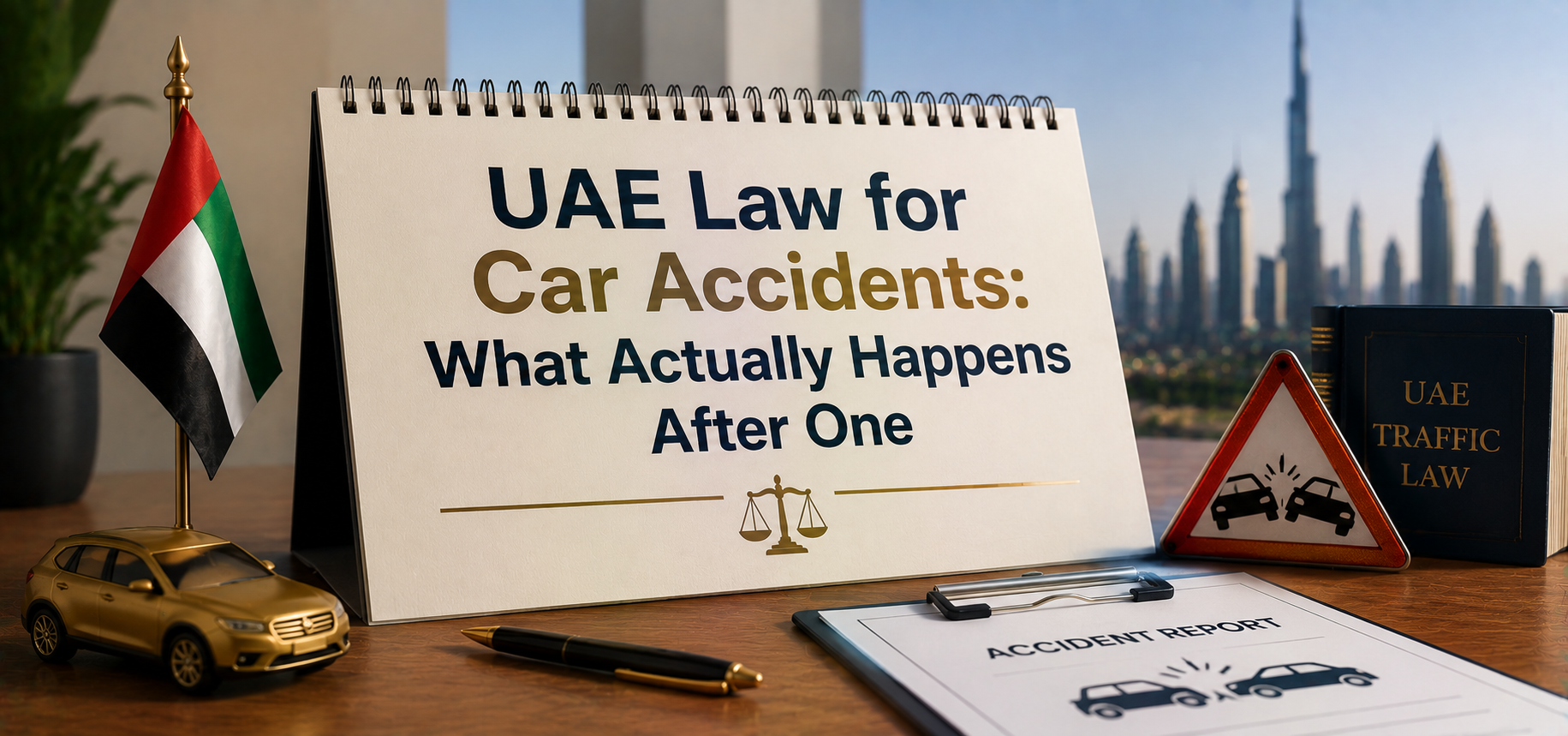

A collision can create several files at once: a police report, an insurer notification, repair or total-loss assessment, medical treatment, a possible Public Prosecution file, and a civil compensation claim. The police finding matters, but it does not by itself answer every question about medical causation, recoverable loss, insurance coverage, or criminal responsibility.
The first hours are particularly important. A civil lawyer in Dubai can help protect your legal position when an accident creates potential civil or compensation claims, while how to find the best family lawyers in Dubai may be a separate consideration where family-law issues are involved. Moving a vehicle at the wrong time, leaving without reporting, accepting an informal cash settlement, delaying treatment, or losing photographs and messages can make the legal and insurance position harder to prove. The correct procedure also depends on the emirate, the seriousness of the accident, and whether anyone was injured. Related legal questions, such as how to file adultery case in Dubai or how to get married in Dubai as foreigners, should likewise be addressed under the specific legal framework that applies.
Quick Answer
After a UAE car accident, stop safely, assist anyone injured, notify the competent police authority, and preserve the official report and evidence. Dubai’s reporting options are not identical to every emirate’s. Liability may involve the Traffic Regulation Law, insurance rules, criminal law, and the Civil Transactions Law, so injury, fault, coverage, and deadlines must be assessed separately.
Treat the accident as a sequence, not a single form. Protect people first, create the official record, notify the insurer, document medical and financial loss, and then separate the criminal, insurance, and civil issues before signing a release or accepting a final settlement.
Faris Raian is the founder, managing partner, and senior legal consultant at Leaders Advocates, with more than 15 years of UAE legal experience across criminal, civil, commercial, family, real-estate, and cyber-related matters. That combination is relevant after a serious road accident because one event can create a police file, public prosecution exposure, an insurance dispute, a personal-injury or property-damage claim, and urgent evidence questions. His role is to connect those tracks to the facts and deadlines of the case.
The Legal Framework Is a Combination of Rules
Federal Decree-Law No. 14 of 2024 on Traffic Regulation is the current federal traffic law. It has been in force since 29 March 2025 and addresses road duties, serious traffic offences, accident conduct, licensing, and penalties. Article 38 specifically addresses deliberate flight from an accident scene and failures connected with providing required information. Other provisions address driving under the influence and conduct that causes injury or death.
Civil compensation is now governed by Federal Decree-Law No. 25 of 2025 Promulgating the Civil Transactions Law, in force from 1 June 2026. The harmful-act chapter begins at Article 245 and runs through Article 272; Article 273 begins the following beneficial-act chapter. That distinction corrects the common but inaccurate statement that Articles 245 to 273 all govern harmful acts.
Accidents before the new Civil Transactions Law took effect may raise transitional and accrued-rights questions under the repealed Federal Law No. 5 of 1985. The accident date is important, but it should not be converted into a one-line answer without reading the promulgating and transitional provisions and identifying when the relevant right, liability, or proceeding arose.
What to Do at the Scene
Stop immediately in the safest practicable way. Check for injuries and call 999 where emergency assistance is required. If there is an injury or a dangerous scene, do not focus on taking perfect photographs while someone needs help. Follow police and emergency instructions, use hazard lights where safe, and avoid creating a second collision.
Injured in a UAE Car Accident and Unsure What to Do Next?
A serious road accident can create police, insurance, medical, criminal, and compensation issues at the same time. Our team can review the accident report, evidence, injuries, insurer position, and deadlines before important rights are lost.
For a minor collision with no injury, official UAE guidance may require vehicles to be moved to a safe place so they do not obstruct traffic. For an injury accident, vehicles and physical evidence may need to remain in place until the competent authority directs otherwise. The distinction is factual, so a driver should describe the situation accurately when contacting police rather than applying a social-media rule of thumb.
Exchange only the information needed for the official process and remain calm. Do not admit a legal conclusion, promise private payment, sign a release, or argue about fault at the roadside. A spontaneous apology or emotional statement can be misunderstood, while a deliberate false account can create separate problems. Give the authorities a truthful, chronological description of what you observed.
• Record the location, direction of travel, lane, signals, weather, time, and visible damage.
• Photograph the wider scene, vehicle positions, plates, impact points, debris, signs, and road markings where safe.
• Identify witnesses and preserve dashcam footage before it is overwritten.
• Keep the police reference, officer instructions, towing details, and insurer notification number.
Reporting the Accident and the Dubai Police Record
Every emirate has its own operational reporting channels. The UAE Government portal identifies Ministry of Interior, police, SAAED, Rafid, and emirate-specific digital services for eligible minor accidents. Use the competent authority for the place of the collision. A reporting method available in Dubai should not be assumed to work in Abu Dhabi, Sharjah, or another emirate.
In Dubai, a police accident report is central to the repair and insurance process. Drivers commonly describe reports as green for the party treated as not responsible, pink for the party treated as responsible, and white where responsibility is not allocated in the usual way or the cause cannot be attributed. The report is an important official record, but its precise wording and status should be reviewed rather than relying only on the colour label.
If the report contains a material factual error, act promptly through the available police or procedural channel. Gather objective material such as photographs, video, witness details, maps, vehicle data, and repair evidence. Do not edit images or reconstruct a scene. A disagreement about the report should be raised formally and respectfully, not through repeated confrontations with the other driver.
Insurance, Repairs, and Total-Loss Questions
Notify the insurer within the policy and regulatory process even when another driver appears responsible. Provide the police report, registration, driving licence, photographs, and any requested claim form. Do not authorise substantial repairs before inspection unless the insurer or emergency circumstances permit it. Keep every estimate, survey, towing invoice, storage charge, and communication.
Third-party liability and comprehensive cover answer different questions. The responsible vehicle’s policy may respond to covered third-party damage, while a comprehensive policy may provide a contractual route for the insured vehicle subject to terms, deductibles, exclusions, and recovery rights. Coverage is not decided only by who received a green report; the policy, driver status, use of the vehicle, notification, and accident facts also matter.
For a total-loss dispute, request the valuation basis and policy calculation in writing. Compare the insured value, market evidence, salvage treatment, depreciation method, and outstanding finance. Signing a discharge may settle more than the repair invoice, so read the scope carefully. If injury and property claims are both present, confirm that resolving one does not unintentionally release the other.
Personal Injury and Civil Compensation
A compensation claim requires proof of legally recognised harm and its connection to the accident. Medical records should begin as close to the incident as reasonably possible and continue consistently. Tell the treating provider how the injury occurred, follow referrals, keep prescriptions and imaging, and do not exaggerate or minimise symptoms. Gaps in care may later become a causation dispute.
Potential heads of loss can include treatment expenses, future medical needs, lost earnings or reduced earning capacity, property loss, and moral harm, depending on the facts and proof. A claimant should not assume that every expense will be reimbursed or use a foreign damages calculator. UAE courts assess the evidence, causation, legal framework, severity, and expert material applicable to the case.
The new Civil Transactions Law provides a knowledge-based period for harmful-act compensation claims and an ultimate fifteen-year period from the harmful act, with a specific rule where the claim arises from a crime and the criminal action remains admissible. Limitation analysis can be technical. The safest practice is to preserve the date of accident, date of knowledge, criminal-file status, and procedural steps and obtain advice early.
• Keep medical reports, receipts, sick leave, salary evidence, and proof of paid assistance.
• Record pre-existing conditions so the accident-related change can be assessed honestly.
• Preserve repair, replacement, rental, towing, and transport evidence.
• Do not post activities online that may be taken out of context during an injury dispute.
When a Collision Becomes a Criminal Matter
A routine property-damage accident is not the same as an investigation involving injury, death, alcohol, drugs, dangerous driving, deliberate flight, or false information. Serious cases can move from police to Public Prosecution and criminal court. Administrative traffic consequences, criminal punishment, civil compensation, and insurance rights can exist together but follow different legal questions.
Do not assume that paying a traffic fine closes every file. Likewise, a criminal acquittal, conviction, or reconciliation may affect but not automatically answer all insurance and compensation issues. Obtain the police and prosecution references, confirm any summons or travel-related measure, and understand whether expert reports, blood tests, vehicle examination, or witness interviews are pending.
If questioned, give accurate identifying information and obtain legal advice about the allegation and procedure. Do not delete messages, dashcam recordings, location data, or vehicle information. Do not contact an injured person to pressure a statement or settlement. Any lawful reconciliation should be documented through the correct process and should clearly state which rights it resolves.
Is the insurance offer too low, or is your claim being delayed?
Repair costs, total-loss valuation, medical expenses, lost income, and future losses should be assessed carefully before you sign a discharge. Get the policy, police report, medical evidence, and settlement wording reviewed first.
Involved in a UAE road accident? Leaders Advocates can review the police and prosecution status, insurance position, injury and property evidence, limitation questions, and settlement terms before important rights are released.
Common Mistakes
• Leaving an accident scene or delaying the official report because both drivers agreed privately.
• Assuming Dubai’s reporting colours and digital process apply identically in every emirate.
• Citing Article 273 as part of the new harmful-act chapter when that chapter ends at Article 272.
• Waiting weeks to document pain, treatment, lost work, or vehicle loss.
• Repairing, selling, or scrapping the vehicle before required inspection and evidence preservation.
• Signing an insurer or private release without checking whether it also settles injury or future-loss claims.
Relevant Legal Services
A Compensation Claims Lawyer in Dubai can assess injury, property damage, causation, evidence, valuation, and settlement scope. A Criminal Defense Lawyer in Dubai can advise where an accident involves injury, death, dangerous driving, intoxication, or Public Prosecution. A Litigation Lawyer in Dubai can coordinate disputed liability, insurance issues, civil proceedings, and enforcement strategy.
People Also Ask
Conclusion
A UAE car accident is handled through connected but distinct procedures. The strongest file starts with safety and official reporting, then preserves insurance, medical, technical, and financial evidence.
Current law must be identified by date and subject, and any settlement should be reviewed for the rights it actually releases.
Facing a Police or Public Prosecution Case After an Accident?
Accidents involving injury, death, dangerous driving, intoxication, or leaving the scene can move beyond insurance into criminal proceedings. Leaders Advocates can assess the police file, prosecution status, evidence, and connected civil exposure.

1 Comment