



Foreign couples can marry in Dubai, but there is no single checklist for everyone. The route depends on religion, residence, age, capacity, marital status, nationality documents, the chosen authority, and where the certificate must later be used. A checklist copied from another emirate or an old law can lead to rejected documents or an unusable certificate.
The marriage ceremony is only one step. A marriage lawyer in Dubai can help couples understand the required documents and procedures, while how to choose best criminal lawyer for your case in Dubai depends on the nature of any criminal matter. Questions such as is drinking alcohol legal in Dubai and is it legal to adopt a child in the UAE also require checking the applicable laws and individual circumstances. Passports, Emirates IDs, proof of status, medical screening, guardian requirements, prior-divorce or death records, translation, attestation, and home-country registration may need to be planned in the correct order. Couples should confirm the current service requirements before booking travel or a celebration.
Quick Answer
Foreigners can legally marry in Dubai through the applicable Muslim marriage process, Dubai’s civil-marriage service for eligible non-Muslims, or another recognised consular or religious route. Current Dubai civil marriage generally requires both parties to be non-Muslim, at least one Dubai resident, and both aged 21 or over. Documents, capacity, prior status, and foreign recognition must be checked.
Choose the legal route first, then build the document file around that authority’s current rules. Confirm eligibility, obtain and authenticate civil-status documents, complete any required medical screening, attend with the required participants, and plan UAE and foreign attestation after issuance.
Identify the Correct Marriage Route
The current general federal Personal Status Law is Federal Decree-Law No. 41 of 2024. It governs Muslim personal-status matters within its scope and sets the substantive elements and conditions of a marriage contract. Federal Decree-Law No. 41 of 2022 on Civil Personal Status and its executive regulation provide a civil framework for non-Muslims within their scope.
Dubai also operates a civil-marriage service for eligible non-Muslim couples. Current official UAE guidance states that both parties must be non-Muslim, at least one party must be a Dubai resident, and each party must be at least 21 years old. These conditions should be checked again at filing because service documentation and appointment steps can change.
Some foreigners may have access to a consular or recognised religious marriage, depending on nationality, religion, the institution’s authority, and UAE recognition requirements. A ceremony that is meaningful personally may not by itself create a civil-status record. Ask who legally issues the certificate, where it is registered, and how it will be authenticated.
Marriage Under the Muslim Personal Status Framework
For a marriage under the Muslim framework, the contract must satisfy the law’s substantive elements and be concluded through the competent official process. The current Personal Status Law identifies offer and acceptance by the spouses and, where the wife is Muslim, the guardian as elements of the contract. Capacity, prohibited degrees, consent, and other statutory conditions must also be checked.
Official UAE guidance states that a marriage contract cannot be registered under the Sharia route without a valid premarital medical certificate for both parties. Screening is arranged through the authorised health service. The certificate is not a formality to leave until the ceremony date; timing, identity records, validity, and any health-service counselling should be planned in advance.
Planning to Get Married in Dubai as a Foreign Couple?
The correct route depends on religion, residence, age, marital status, nationality documents, and where the marriage certificate will later be used. Our team can review eligibility and the required documents before you book travel or a ceremony.
Guardian and witness requirements should be confirmed for the couple’s exact circumstances and authority. If a guardian is abroad, unavailable, deceased, refuses, or cannot attend, do not substitute an informal letter. The competent court or marriage service may require a power of attorney, authenticated records, or a judicial step depending on the law and facts.
• Confirm the bride’s and groom’s religion, age, legal capacity, and current marital status.
• Complete the authorised premarital medical screening within the accepted validity period.
• Check guardian, witness, interpreter, and power-of-attorney requirements before the appointment.
• Ensure names and identity numbers match every passport, Emirates ID, and translated document.
Civil Marriage for Non-Muslims in Dubai
Dubai’s civil route is separate from a Muslim marriage contract. The official service checks non-Muslim status, age, residence eligibility, consent, legal capacity, and the absence of a prohibited relationship or existing marriage. The couple should use the current Dubai service checklist rather than assume that Abu Dhabi’s civil-marriage service has identical conditions.
A premarital medical certificate is not generally required for the civil marriage route according to current official UAE guidance, unlike registration under the Sharia route. That difference is useful, but it does not remove document or capacity checks. A party with a previous marriage must prove the final divorce or former spouse’s death in the form accepted by the authority.
The couple should decide whether the federal civil personal-status framework or another eligible route best meets their needs. Nationality, domicile, residence, future country of use, and any foreign-law consequences can affect the choice. The quickest local process is not always the simplest certificate to use abroad.
Documents Foreign Couples Commonly Need
The exact list comes from the chosen authority, but common documents include valid passports, Emirates IDs or residence proof where applicable, photographs or application data, and evidence of religion or non-Muslim status if requested. The authority may also require proof of address, entry status, or a declaration of capacity.
A never-married party may need a single-status, no-impediment, or capacity document from a home-country authority or embassy, depending on the route. A divorced party may need the final divorce judgment or certificate; a widow or widower may need the former spouse’s death certificate and prior marriage record. Names, dates, seals, and finality must be clear.
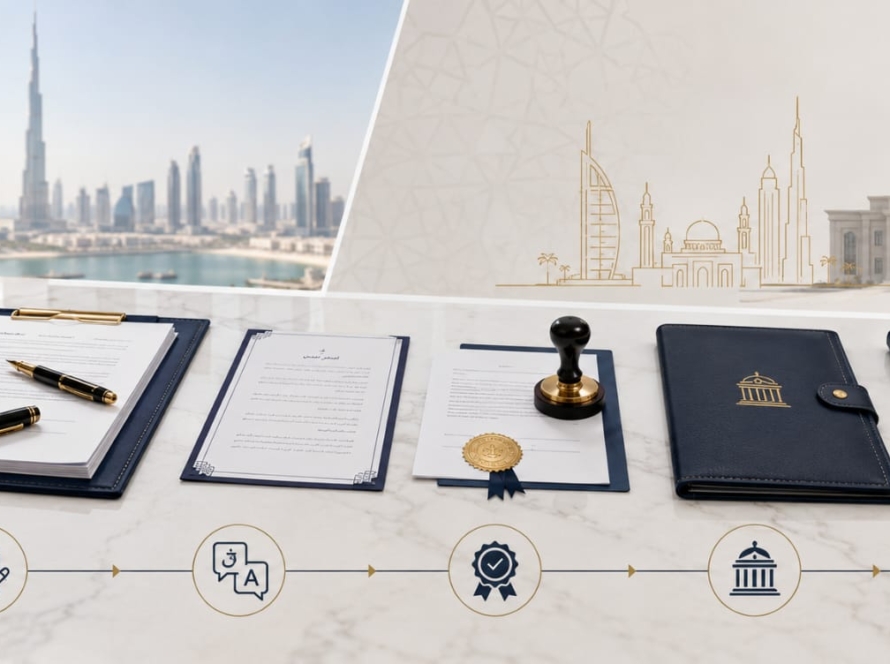
Foreign public documents may require legalisation or apostille where applicable, UAE embassy or consular authentication, Ministry of Foreign Affairs attestation, and certified Arabic translation. The sequence depends on the issuing country and document. Do not laminate, alter, or translate a copy before confirming what the accepting authority requires.
• Check passport validity and the spelling of every name in English and Arabic.
• Obtain final, not interim, divorce or civil-status records.
• Confirm whether original documents, electronic verification, or certified copies are accepted.
• Budget time for legalisation, courier delivery, translation, and correction of discrepancies.
A Practical Step-by-Step Process
Step 1: Select the Authority and Route
First, select the authority and route. Ask for the current eligibility and document list in writing or through the official portal.
Step 2: Map the Required Documents
Second, map each required document to the issuing country, legalisation chain, translation, expiry date, and responsible person. This prevents one missing seal from blocking the appointment.
Step 3: Complete Medical and Attendance Requirements
Third, complete medical screening if the Muslim route requires it and obtain any guardian, witness, interpreter, or power-of-attorney documentation.
Step 4: Submit the Marriage Application
Fourth, submit the application, pay the official fee, and attend as directed. Both parties should review the identity details and marital-status declarations before signing.
Step 5: Verify the Marriage Certificate
Fifth, obtain the official electronic or paper certificate and verify every name, date, nationality, identity number, and place of marriage immediately.
A minor spelling mismatch can become a major immigration, birth-registration, banking, or foreign-recognition problem. Use the authority’s correction process before beginning overseas attestation where possible.
Step 6: Authenticate and Register the Certificate
Finally, authenticate and register the certificate for its intended use. The UAE-issued certificate may require Ministry of Foreign Affairs attestation, destination-embassy or consular steps, translation, and registration with the couple’s home authorities.
The receiving country decides its own recognition requirements, so obtain destination-specific advice.
Interfaith, Previous Marriage, and Special Situations
Interfaith couples should not assume that the civil route automatically resolves every issue. Eligibility depends on the parties’ religions and the chosen framework. The current Personal Status Law also contains rules concerning marriages involving a Muslim party. Confirm the specific legal route before making declarations about religion or booking a ceremony.
If either party was previously married, obtain proof that the marriage legally ended and that any appeal or waiting requirement relevant to the chosen framework has been satisfied. A foreign divorce that is valid at home may still need authentication or recognition for use in Dubai. An informal separation or religious-only divorce may not be enough.
Couples involving minors, persons under guardianship, missing documents, disputed capacity, proxy attendance, or unusual nationality restrictions need individual advice. The standard online service is designed for straightforward applications. Trying to force a complex case through a simple checklist can produce a rejection or a certificate that is later challenged.
Unsure Which Dubai Marriage Route Applies to You?
Muslim marriage, Dubai civil marriage, and recognised consular or religious routes have different eligibility and document requirements. Get the correct authority, medical, guardian, prior-status, translation, and attestation steps mapped before filing.
Marriage Agreements and Cross-Border Planning
Marriage registration and financial planning are related but separate. A couple may wish to discuss ownership, existing assets, debts, gifts, business interests, housing, maintenance, and inheritance. Any marital agreement should be drafted for the applicable law and intended forum; copying a foreign prenuptial template does not guarantee UAE validity or overseas enforcement.
Non-Muslim couples using the civil framework should understand the default consequences that may apply and whether an agreement is permitted to address them. Muslim couples should consider the marriage contract terms available under the applicable law and whether separate estate or succession planning is needed. Each party should have a fair opportunity to understand the document and obtain independent advice where appropriate.
Cross-border couples should also plan for visas, surname use, birth registration, inheritance, tax residence, and property ownership. Marriage can affect these systems differently. A Dubai certificate proves the registered marriage, but it does not automatically complete every immigration, embassy, or home-country process.
Planning a foreign-couple marriage in Dubai? Leaders Advocates can identify the correct marriage route, review eligibility and documents, address guardian or prior-status issues, and plan attestation, agreements, and cross-border recognition.
Common Mistakes
• Assuming religion is the only factor when residence, age, capacity, nationality documents, and route also matter.
• Using an Abu Dhabi civil-marriage checklist for a Dubai application without checking current conditions.
• Booking travel or a ceremony before document legalisation and appointment confirmation.
• Treating a religious or celebratory ceremony as automatically creating a registered civil-status record.
• Submitting an interim divorce order, inconsistent name, expired record, or unauthenticated foreign document.
• Forgetting that the destination country controls recognition and may require additional attestation or registration.
Relevant Legal Services
A Marriage Lawyer in Dubai can identify the appropriate Muslim, civil, consular, or religious route and review the application. A Family Lawyer in Dubai can advise on personal-status consequences, prior marriages, interfaith issues, and cross-border family planning. A Civil Lawyer in Dubai can assist with document, capacity, recognition, agreement, and related civil-law questions.
People Also Ask
Conclusion
Foreigners can marry legally in Dubai, but success depends on choosing the correct route and preparing the right documents in the right order.
Current eligibility, medical and guardian requirements, prior marital status, certificate accuracy, attestation, and destination-country recognition should all be resolved before the celebration becomes the deadline.
Need Your Dubai Marriage Certificate Recognised Abroad?
A valid Dubai marriage certificate may still require attestation, translation, embassy steps, or home-country registration before it can be used overseas. Leaders Advocates can help plan the recognition process from the start.

2 Comments