


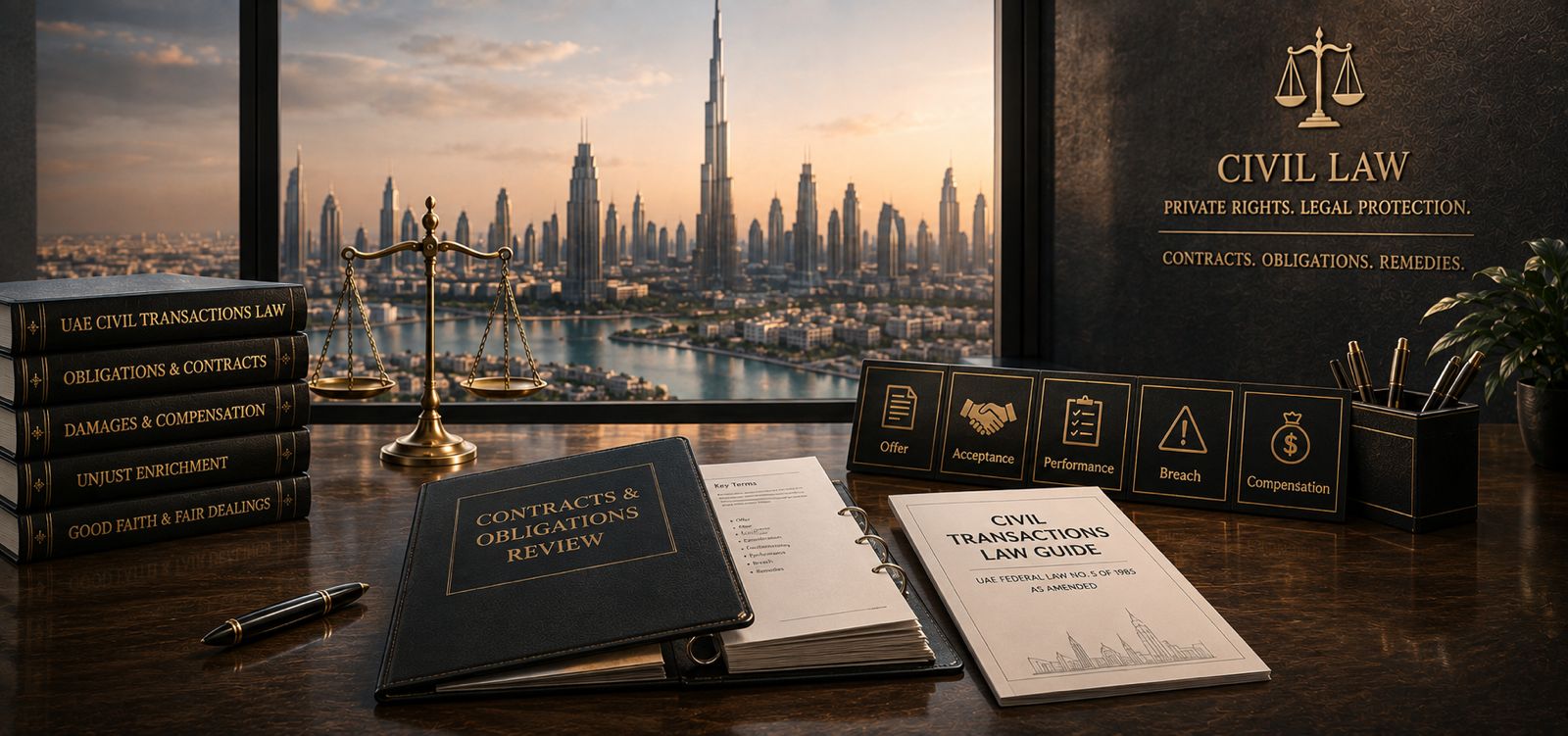

The UAE Civil Transactions Law A Complete Overview must now begin with Federal Decree-Law No. 25 of 2025, which entered into force on 1 June 2026. It replaced Federal Law No. 5 of 1985, the statute that had governed much of the UAE’s civil-law framework for four decades.
The new law addresses persons, property, obligations, contracts, civil liability, named contracts, ownership, and real rights. It modernises language and transactions, reorganises and renumbers provisions, and introduces substantive updates. It does not mean that every older contract or dispute can be analysed by simply replacing an old article number with a new one.
The UAE Civil Transactions Law A Complete Overview starts with Federal Decree-Law No. 25 of 2025, effective 1 June 2026. It is the main federal civil code for private-law relationships, covering legal capacity, property, formation and interpretation of contracts, performance, breach, termination, compensation, unjust enrichment, harmful acts, named contracts, ownership, security, and other real rights. The former Federal Law No. 5 of 1985 has been repealed, but transitional rules and the timing of contracts, acts, rights, and disputes remain critical. The new statute cannot be applied responsibly through a simple old-to-new article-number chart. Parties should identify the event date, contractual governing law, mandatory provision, forum, and any sector-specific law before relying on a current article.
What Is the Civil Transactions Law?
In cases like this, it is worth speaking with civil lawyer in dubai.
The Civil Transactions Law is the federal code that supplies general private-law rules when a relationship is not governed entirely by a more specific statute. It influences contracts, obligations, compensation, property, guarantees, leases, sales, construction arrangements, agency, loans, gifts, insurance-related civil questions, and many other dealings.
It must be read with specialised legislation. Commercial transactions, companies, labour, tenancy, real estate registration, consumer protection, insurance, maritime matters, electronic transactions, personal status, intellectual property, insolvency, and financial services can have their own rules. The civil code may fill gaps but does not automatically displace the specialist law.
The 2025 Law and Its Effective Date
This connects closely with our guide on is family mediation legally binding in the UAE.
Federal Decree-Law No. 25 of 2025 was issued as the replacement civil code and entered into force on 1 June 2026. References describing it as effective in 2025 are incorrect. The publication year and commencement date are different.
The replacement repealed the 1985 law subject to the new law’s provisions and transitional treatment. A document signed before June 2026, a breach occurring afterward, and proceedings commenced around the changeover can require a more careful temporal analysis. The scope of the reform is summarised in this client update on the new civil law in the UAE.
Why Renumbering Is a Practical Risk
Our related guide on new arbitration law UAE goes into this further.
The old law’s article numbers appeared in contracts, legal opinions, judgments, templates, and online articles. Because the new code reorganises the subject matter, the same number may now address a different issue or the former rule may be divided, qualified, or restated.
Do not update a template with automated number substitution. Compare the complete old and new provisions, definitions, exceptions, related articles, and commencement rules. Historical judgments can still be valuable, but their reasoning must be tested against the new text.
Are Your Contracts Still Citing the 1985 Code?
Swapping article numbers across a template is the fastest way to end up citing a provision that now says something else entirely. Leaders Advocates reviews your agreements provision by provision against the new code.
Persons, Capacity, and Legal Acts
The code contains rules concerning natural and legal persons, capacity, domicile, representation, and the legal effects of acts. Capacity questions can affect whether an agreement is valid, void, voidable, suspended, or capable of ratification.
Companies act through authorised individuals and governing documents. Individuals may act personally, through a guardian, curator, attorney, or other representative. Authority should be verified at signature and performance, especially where assets, minors, estates, or foreign powers of attorney are involved.
Property and Classification of Rights
The law distinguishes property, things, benefits, movable and immovable property, and different rights. Classification affects transfer, registration, possession, security, limitation, and remedies. Digital or modern assets may also require sector-specific rules in addition to the civil code.
Ownership of real estate and certain rights depends on registration under the applicable emirate’s property system. A contract to transfer property is not always equivalent to a completed transfer against third parties.
Contract Formation
A valid contract generally requires compatible offer and acceptance, lawful subject matter and cause, capacity, and any form required by law. Electronic communications and signatures may be recognized under the relevant electronic-transactions framework, but identity, authority, integrity, and mandatory form still matter.
Negotiations, letters of intent, term sheets, purchase orders, click-through terms, and unsigned drafts can create disputes about whether a contract was concluded. The answer depends on wording, conduct, essential terms, reservations, and applicable law rather than document title alone.
Contract Interpretation and Good Faith
The code provides principles for interpreting clear and ambiguous terms and understanding the parties’ common intention, nature of the transaction, custom, and good faith. Good faith supports performance and interpretation, but it should not be used as a slogan to rewrite an agreed allocation of risk without legal basis.
Arabic and English versions of a private contract may contain a precedence clause. In court, certified Arabic translation and the statutory context can become important. Inconsistencies should be resolved before signature, not after a dispute.
Performance, Breach, and Remedies
Obligations should be performed in the agreed manner, place, and time. A breach may support specific performance, termination, withholding, damages, or another remedy depending on the contract and law. Notice and an opportunity to cure may be required.
The injured party must establish breach, loss, causation, and the legal basis of the requested remedy. It should also take reasonable steps relevant to mitigation and avoid increasing loss unnecessarily. A contractual penalty or agreed compensation clause is not always immune from judicial review.
Termination and Rescission
A contract does not disappear merely because one party sends a cancellation email. Termination may arise from agreement, an express contractual mechanism, law, or a court decision. The required notice, materiality, cure period, restitution, accrued rights, and dispute clause should be analysed.
Clauses describing automatic termination can have legal effect subject to their wording and mandatory rules. A party relying on termination should document its own performance and avoid conduct inconsistent with the alleged end date.
Force Majeure and Exceptional Circumstances
The civil code addresses impossibility and extraordinary circumstances, but they are different doctrines. Force majeure can concern an external event that makes performance impossible, while exceptional general circumstances may make performance excessively burdensome without making it impossible.
The event label does not decide the outcome. The party must prove the event, foreseeability, control, causation, contractual allocation, notice, mitigation, and effect on the specific obligation. Price increases or commercial difficulty are not automatically force majeure.
Civil Liability and Harmful Acts
Civil liability can arise outside contract when a harmful act causes damage. The claimant generally needs a legally attributable act, damage, and causation. Contractual and tortious theories may overlap but should not be pleaded as interchangeable without analysing the relationship and available remedies.
Damage may be material or moral where the law allows, and assessment depends on proof and judicial principles. Speculative loss and unsupported lump sums are vulnerable. Expert evidence may be needed for technical causation and quantum.
Unjust Enrichment and Payment Without Right
The code includes restitutionary concepts for benefit received without lawful basis and amounts paid when not due. These remedies are not substitutes for a valid contract claim merely because contractual proof is difficult. The claimant must establish the required enrichment, impoverishment or payment, absence of basis, and remedy.
Named Contracts
The law contains rules for commonly used contracts such as sale, gift, company-related civil arrangements, loan, settlement, lease, agency, deposit, construction or muqawala, guarantee, and other transactions. Contract-specific chapters can modify the general obligations rules.
A transaction should be classified by substance, not title. A management agreement may contain agency, service, lease, and construction elements. Each component may trigger different default and mandatory rules.
Sale and Property Transactions
Sale rules address the thing sold, price, delivery, defects, warranties, risk, and remedies. Real estate transactions also require compliance with the registration and regulatory rules of the relevant emirate. Off-plan sales, mortgages, jointly owned property, and brokerage have additional legislation and procedures.
Lease and Use of Property
The civil code contains general lease principles, but Dubai and other emirates may have specific tenancy laws and dispute centres. Residential, commercial, long-term, hotel, free-zone, and government leases can differ. Use the special tenancy framework first where it applies.
Muqawala and Construction
Muqawala governs agreements to make something or perform work. Construction disputes may involve design, variations, delay, defects, certification, payment, decennial liability, subcontracting, and termination. The civil code operates alongside contract terms, building rules, professional duties, and evidence law.
Guarantees, Security, and Assignment
Personal guarantees, assignments, set-off, subrogation, mortgages, pledges, and priority have formal and substantive requirements. A guarantee should identify the secured obligation, amount, term, and release conditions. Security over registered assets must comply with the applicable registration regime.
Facing a Dispute That Straddles 1 June 2026?
A contract signed under the old code and a breach that happened under the new one is exactly where cases are won or lost right now. Send us the dates and we will tell you which law governs your position.
Limitation Periods and Procedural Law
Substantive rights and limitation periods must be distinguished from court procedure. The Civil Procedure Law and Evidence Law govern filing and proof, while specialist statutes may set shorter claim periods. Do not assume one general limitation period applies to every civil dispute.
Acknowledgment, filing, enforcement, negotiation, or a contractual notice may have different effects on time. Record the earliest possible deadline and do not allow settlement discussions to expire the claim.
Which Law Applies to Free Zones and DIFC or ADGM Matters?
DIFC and ADGM have distinct legal and court systems for many matters within their jurisdiction. Other free zones may still apply federal UAE law with their own regulations. A party’s office location alone does not determine the governing law or forum.
Review the contract’s governing-law and jurisdiction clauses, place of performance, parties, mandatory UAE provisions, and forum rules. A chosen foreign law may not answer registration, public policy, insolvency, or enforcement questions in the UAE.
Transition Checklist for Existing Contracts
- Identify contracts, templates, opinions, and policies that cite Federal Law No. 5 of 1985.
- Record signature, performance, breach, renewal, and dispute dates.
- Map the legal issue, not merely the article number, to the 2025 code.
- Check definitions, exceptions, related provisions, and sector-specific legislation.
- Review governing law, jurisdiction, arbitration, notice, termination, force majeure, and compensation clauses.
- Update new templates without rewriting historical executed documents.
- Preserve prior versions and the reason for each change.
- Obtain case-specific advice for disputes crossing the 1 June 2026 commencement date.
Relevant Legal Services
General obligations and compensation disputes may require Civil Lawyers in Dubai. Drafting and updating agreements under the new code may require Contract Lawyers in Dubai. Contested court proceedings and enforcement may need a Litigation Lawyer in Dubai.
People Also Ask
Final Takeaway
The new civil code is now in force, but the hardest issue is not identifying its name. It is deciding how the new text, transitional rules, contract, sector law, and forum interact. Verify legal issues provision by provision and never rely on automated renumbering.
Do Not Let a Renumbered Article Cost You the Case
Four decades of contracts, templates, and legal opinions now point at a code that no longer exists. Leaders Advocates handles the transition work and the disputes that arise from it, from contract updates through to enforcement.

2 Comments