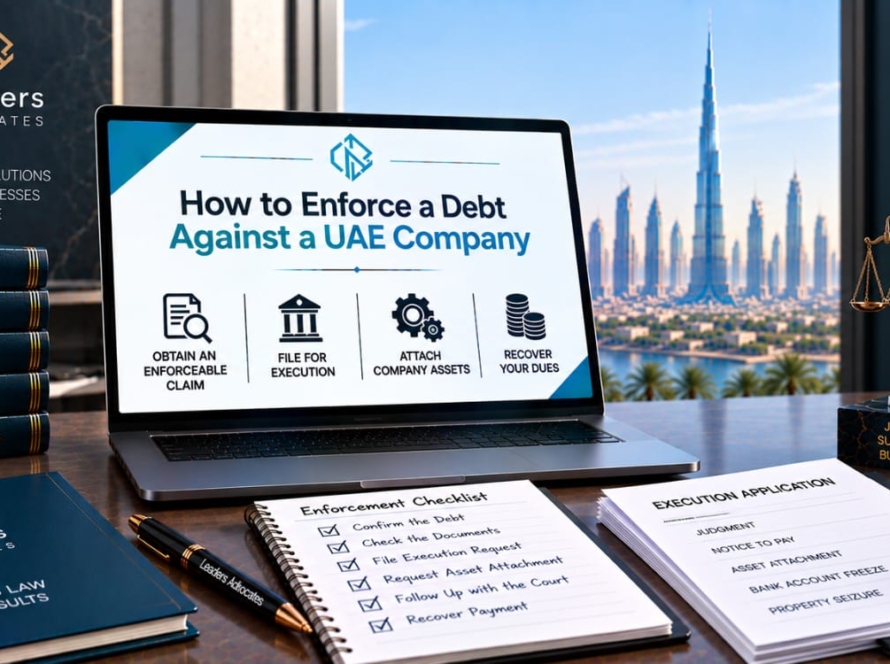



An individual lends money to a friend, relative, colleague, or business contact. Repayment does not arrive, and the paperwork may consist only of a transfer and messages.
How to Recover a Personal Debt in the UAE requires deciding whether the debt is provable, mature, and worth pursuing. The debtor’s location and assets also matter.
Unlawful pressure can create new problems. Public accusations, threats, or taking property without authority are not proper debt-recovery methods.
Quick Answer
How to Recover a Personal Debt in the UAE begins with proof of the payment, its loan purpose, the amount due, and the repayment date. Preserve transfers, messages, acknowledgments, partial payments, and any cheque. Federal Decree-Law No. 35 of 2022 recognizes electronic evidence and generally limits witness proof alone for civil transactions above AED 50,000, subject to exceptions. Send a written demand. A fixed, due, documented debt may qualify for a payment order under Articles 143 to 150 of Federal Decree-Law No. 42 of 2022 after at least five days. A qualifying returned cheque may support direct execution under Article 667 of Federal Decree-Law No. 50 of 2022. Recovery depends on the facts, documents, timing, defenses, forum, and assets.
Create a reconciled file before demanding payment. Confirm the principal, payments received, present balance, due date, debtor identity, and available written evidence.
Send a calm, provable demand. If the debtor responds, record any acknowledgment or settlement precisely. If payment does not follow, choose the procedure that matches the evidence.
Check recoverability before committing to major costs. A judgment establishes liability, but collection depends on assets, income, location, and competing claims.
How to Recover a Personal Debt in the UAE
Personal debt disputes usually fail for one of three reasons. The lender cannot prove a loan, cannot show that repayment is due, or cannot find assets after judgment.
Address those risks in that order. Strong emotion does not replace documents, and a court claim should not begin with an unreconciled figure.
The Civil Transactions Law is Federal Decree-Law No. 25 of 2025. It replaced Federal Law No. 5 of 1985 and took effect on 1 June 2026.
Older transactions may require transitional analysis. The transfer date, accrued rights, maturity, and procedural stage should be reviewed.
Lent Money to a Friend or Relative Who Won’t Pay?
Message Leaders Advocates on WhatsApp for a quick review of your transfers, messages, and options.
Step 1: Prove the Debt Exists
A bank statement shows that money moved. It does not automatically prove that the transfer created a repayable loan.
Look for evidence that repayment was expected:
- A signed loan note or acknowledgment.
- Messages requesting the loan or promising repayment.
- A repayment date or instalment schedule.
- A transfer reference stating “loan” or “advance.”
- Partial repayments made by the debtor.
- A cheque or guarantee issued as security.
- Messages asking for more time to repay.
Preserve the full context. A cropped message may look helpful but become misleading when earlier lines are produced.
For cash, collect withdrawal records, receipts, meeting messages, witnesses, and later acknowledgments. Proving receipt is the first additional challenge.
Step 2: Confirm the Amount and Maturity
Prepare a simple account showing the original advance, every repayment, agreed adjustments, and current principal. Do not add unsupported charges.
If the agreement has a fixed due date, show that it has passed. If repayment was on demand, obtain advice on the demand and reasonable performance period.
If instalments were agreed, separate overdue instalments from future ones. Acceleration of the full balance requires a contractual or legal basis.
Interest also requires careful analysis. A lender should not assume that an informal personal loan supports any rate later selected.
An admission of the principal does not necessarily admit every claimed charge. Present the calculation transparently.
Step 3: Preserve Electronic Evidence Correctly
Federal Decree-Law No. 35 of 2022 governs evidence in civil and commercial transactions. Articles 55 to 62 address electronic evidence.
Electronic messages, emails, and records can have probative value. Authenticity, completeness, source, and production method remain important.
Article 59 generally gives electronic evidence the probative value of informal instruments. Article 60 permits production in original electronic form or another electronic method.
Export complete conversations with dates and account details. Keep the original device and cloud account where practical.
Do not edit screenshots, rename participants to improve appearance, or delete unfavorable context. Those steps can undermine the entire file.
Written evidence matters especially when the transaction exceeds AED 50,000. The Evidence Law generally limits testimony alone, while Article 68 provides defined exceptions.
Step 4: Send a Proper Demand
The first written request should be factual. Identify the loan date, amount, payments received, balance, contractual basis, payment method, and deadline.
Follow the contract’s service method and preserve proof of delivery.
For a payment order, Article 143 of Federal Decree-Law No. 42 of 2022 requires a demand allowing at least five days to pay.
The demand should not threaten arrest for ordinary non-payment. It should not contact unrelated family members, employers, or customers to shame the debtor.
A response proposing instalments may create evidence and a settlement opportunity. Record the balance and default consequences in a signed agreement.
Step 5: Choose the Correct Procedure
Negotiated Settlement
Settlement is often proportionate for personal debts. It can reduce cost and preserve a practical route to payment.
State each payment date, amount, bank account, security, default consequence, and final release. Address any existing cheque and pending case expressly.
Avoid accepting a vague promise to pay “soon.” A settlement should be measurable and enforceable.
Payment Order
Articles 143 to 150 of the Civil Procedure Code create the payment-order procedure. It may suit a fixed, due debt established in writing.
The judge reviews whether the statutory conditions are met. A serious dispute over whether the transfer was a loan may require an ordinary claim.
Ordinary Civil Claim
Use an ordinary claim where the debtor disputes receipt, purpose, amount, due date, authenticity, or set-off. The court considers the evidence and defenses.
Onshore proceedings generally require Arabic pleadings and certified Arabic translations. Translate the complete relevant context, not selected phrases alone.
Cheque Execution
Article 667 of Federal Decree-Law No. 50 of 2022 treats specified returned cheques as executive instruments. The bank return reason controls the available route.
Keep the original cheque, bank return memo, and underlying loan evidence. A cheque dispute can still raise defenses about payment, settlement, or misuse.
Step 6: Assess Court and Emirate Jurisdiction
Jurisdiction may depend on the debtor’s domicile, place of performance, contractual clause, and other connecting facts. Do not assume Dubai Courts always have jurisdiction.
Check the forum before serving a final procedural demand. Starting in the wrong forum wastes time and may expose the lender to costs.
Step 7: Plan Enforcement Before Filing
A judgment becomes useful through execution. The creditor can request lawful measures against assets owned by the debtor.
Possible targets include bank accounts, vehicles, real estate, shares, salary within legal limits, and amounts owed by third parties.
Article 324 allows a travel-ban request for debt of at least AED 10,000 where the statutory conditions are satisfied. The creditor must show the required risk and evidence.
A travel ban is not automatic and is not a substitute for asset enforcement. The debtor can challenge the order.
Article 320 permits the execution judge to grant up to six months to pay. It also allows instalments over three years, subject to judicial assessment and safeguards.
Is the Claim Worth Pursuing?
Compare the principal with expected court fees, translation, service, expert costs, legal fees, time, and enforcement risk. A commercial decision can be sensible even with a strong case.
Check whether the debtor works, owns property, operates a business, holds vehicles, or receives identifiable third-party payments. Use lawful sources and procedures.
If the debtor has left the UAE, recognition and enforcement abroad may be required. That depends on treaties, local law, assets, and the judgment obtained.
Personal insolvency may affect strategy. Federal Decree-Law No. 19 of 2019 governs insolvency of natural persons outside trader bankruptcy in defined circumstances.
Practical Steps
- Reconcile the original payment and every repayment received.
- Export complete messages, emails, and transfer records.
- Confirm the debtor’s full legal name, address, and current location.
- Identify the due date and whether the balance is presently payable.
- Request a truthful written acknowledgment where none exists.
- Serve a provable demand that supports the selected procedure.
- Review likely assets and costs before filing.
Evidence and Documents Needed
- Signed loan agreements, notes, or acknowledgments.
- Bank transfers, cash receipts, and account statements.
- Complete messages and emails about the loan and repayment.
- Schedules and proof of partial repayments.
- Cheques, guarantees, and bank return memos.
- Identity and address information for both parties.
- Demand letters and delivery evidence.
- Documents concerning debtor assets or income, obtained lawfully.
Common Mistakes and Risks
- Relying only on a bank transfer without proving its purpose.
- Claiming future instalments without a valid acceleration right.
- Adding interest or penalties that were never agreed.
- Sending threats or public accusations to force payment.
- Returning original cheques before cleared funds arrive.
- Filing against a nickname, trade name, or wrong legal person.
- Spending heavily without assessing debtor assets.
- Stopping after judgment instead of opening execution.
Ordinary non-payment is a civil matter. Criminal allegations require separate evidence of specific criminal conduct and should not be used as leverage.
Not Sure If Your Evidence Is Enough?
Messages, transfers, and acknowledgments can all matter. Send us your details on WhatsApp and we’ll help you assess it.
How a Lawyer Can Help
A lawyer can test the proof, reconcile the debt, identify the forum, and select settlement, payment order, civil claim, cheque execution, or insolvency participation.
Counsel can also draft the demand, preserve electronic evidence, manage translation, and plan enforcement. The objective is collection, not simply obtaining a judgment.
Owed money personally and deciding what to do next? Faris Raian and the team at Leaders Advocates can assess the facts, documents, routes, and likely recoverability.
Relevant Legal Services
The closest services for this matter are debt recovery lawyer services in Dubai, civil lawyer services in Dubai, and litigation lawyer services in Dubai. The suitable service depends on the facts, documents, regulator, forum, procedural stage, and requested remedy.
Relevant Success Story
The firm publishes selected completed matter examples in its Success Stories archive. A prior result does not guarantee a similar outcome. Every matter depends on its facts, documents, evidence, procedure, and legal circumstances.
Ready to Send a Proper Demand?
Get your demand and procedure aligned before you act. Contact Leaders Advocates on WhatsApp.
FAQs
Final Takeaway
Personal debt recovery requires proof, maturity, a proper demand, the correct procedure, and a realistic enforcement plan. Avoid pressure tactics that create separate exposure.
The safest next step is a proportional review of the evidence and assets. The result depends on documents, electronic records, timing, defenses, jurisdiction, and recoverability.