


Quick Answer
To file a cheque execution case in Dubai, first confirm that the bank return supports direct execution. Article 667 covers a cheque marked for no or insufficient funds, while judicial unification also addressed closed accounts.
Keep the original cheque and the bank’s dated return statement. Confirm the unpaid balance, holder’s standing, drawer’s identity, address, and any partial payment before filing.
The execution request is submitted through the competent Dubai execution process. The Civil Procedure Law governs notification, objections, and enforcement measures.
Direct execution avoids a separate ordinary judgment on the instrument first. It does not make attachment, travel restrictions, or payment automatic, and a different return reason may require another claim.
A holder may have the cheque and a bank message but still lack the documents needed for execution. The name, amount, return reason, or unpaid balance may also be unclear.
Filing too early can lead to a correction request or a dispute. Filing too late can create avoidable limitation issues.
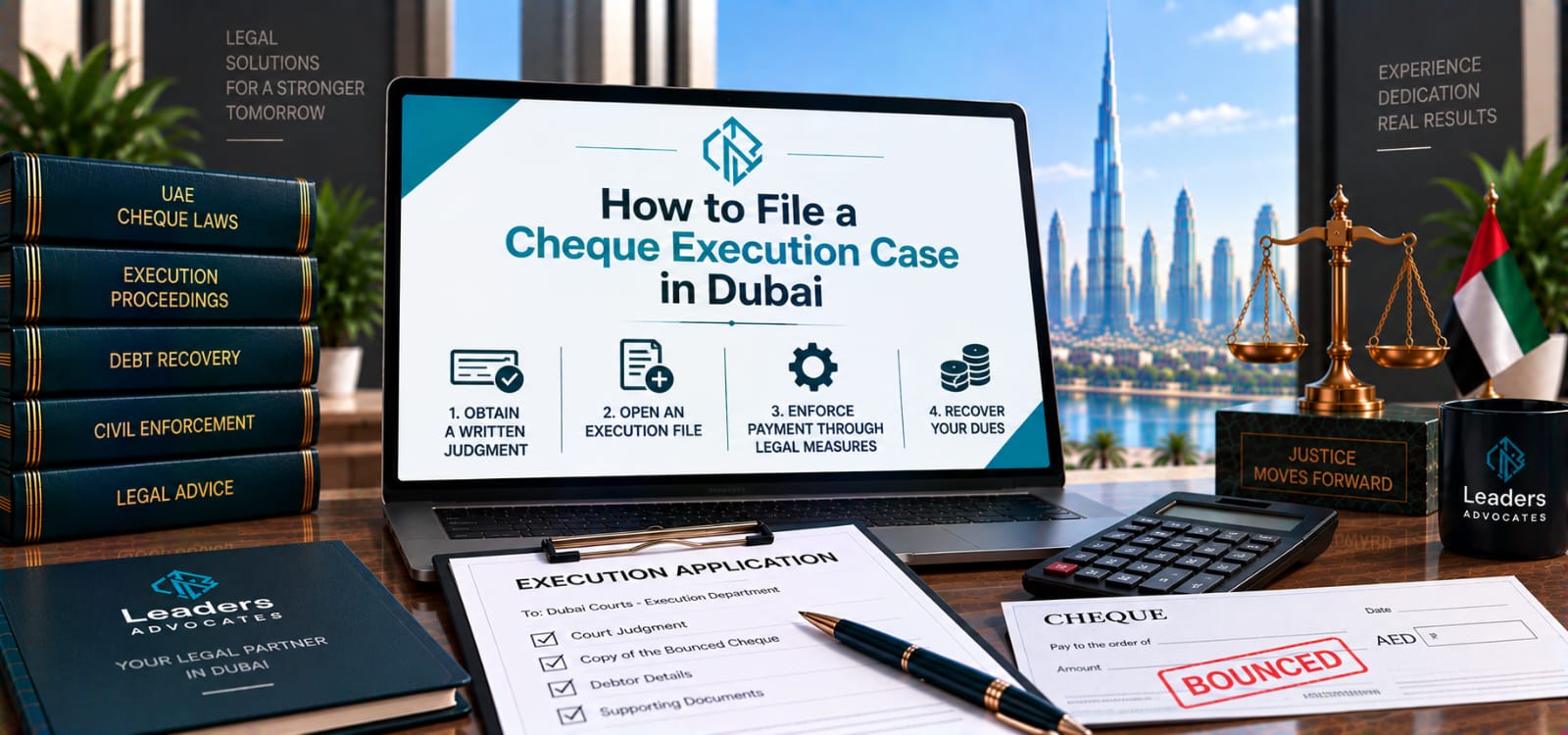
Prepare the execution file in a fixed order. Verify the instrument, bank statement, parties, balance, jurisdiction, and supporting transaction records.
Then submit through the competent Dubai execution channel. Track notification, any challenge, asset inquiries, payments, and closure of the file.
How to File Cheque Execution Case Dubai
Start with the wording written by the drawee bank. Article 667 of Federal Decree-Law No. 50 of 2022 applies when the bank states that there is no balance or an insufficient balance.
The bearer may request compulsory execution for the whole cheque or the unpaid part. Civil procedure rules control the request and any contention.
If the bank recorded another reason, direct execution may not be the correct starting point. Review the underlying debt and alternative claim before filing.
Not Sure If Your Cheque Qualifies for Direct Execution?
Send us the bank’s return reason on WhatsApp and we’ll tell you the correct route in minutes.
Confirm That the Cheque Qualifies
Read the bank endorsement carefully. Do not summarize the reason from memory.
No funds and insufficient funds fall within the express wording of Article 667. A 2023 judicial unification decision treated a closed-account return as an execution writ as well.
A signature problem, incomplete detail, suspected alteration, or technical rejection may require another legal route. The execution judge will examine the actual instrument.
Obtain the Dated Bank Statement
Article 663 allows the bank’s dated statement to prove dishonor instead of a protest. The statement should identify the presentation day and comply with the law.
Ask the bank for the original cheque with the required marking and any separate certificate. Keep deposit receipts and electronic notices as supporting records.
Do not rely on an undated screenshot alone. The formal bank record connects the instrument to the return event.
Preserve the Original Cheque
Execution is based on the cheque as an enforceable instrument. The original is therefore important.
Make color scans of both sides before filing. Store the cheque safely and avoid additional handwriting near the bank’s endorsement.
If the bank retained the original, ask what document or certified record it provides. Resolve that issue before opening the case.
Calculate the Correct Unpaid Balance
Check the face value against every payment already received. Include partial bank payment, transfers, cash receipts, credits, and agreed deductions.
Article 648 permits partial payment when some funds are available. The bank should mark the amount and return the original cheque with a certificate.
An execution request should claim only the amount still due. An incorrect balance can cause objection, delay, or cost exposure.
Not Sure What Your Correct Outstanding Balance Is?
Share your payment history on WhatsApp and we’ll help you calculate the exact amount you can claim.
Confirm the Holder’s Standing
Identify the current lawful holder. Review the named payee, endorsements, assignments, and any company succession affecting the claim.
The person filing must show the right to enforce the cheque. A collection agent, shareholder, or employee should not assume standing without authority.
For a company claimant, prepare current licensing and authorization documents. Confirm who may sign or instruct counsel.
Identify the Drawer Correctly
Use the name and details shown on the cheque and bank documents. Match them to Emirates ID, passport, company license, or other available records.
For a company cheque, distinguish the company from the individual signatory. A manager or shareholder is not automatically personally liable for the company’s payment obligation.
Provide a usable address, phone number, email, and company location where available. Accurate details support notification and asset inquiries.
Check Jurisdiction and the Competent Forum
Do not assume Dubai is competent only because the holder lives there. Review the bank, place of payment, parties, and any relevant procedural basis.
The underlying contract may also contain a jurisdiction or arbitration clause. Direct cheque execution and a substantive contract dispute can raise different questions.
If a DIFC or ADGM connection exists, obtain advice on the correct forum. Avoid opening overlapping cases without a coordinated strategy.
Prepare Supporting Documents
- The original cheque with the bank’s markings.
- The dated dishonor statement or certificate.
- Proof of the holder’s identity and authority.
- The drawer’s identity or company records.
- Evidence of partial or later payments.
- The contract, invoice, loan, or settlement.
- Communications admitting or disputing the debt.
- Certified Arabic translations where required.
Create a numbered index. Use the same document names in the application and the evidence folder.
File Through the Dubai Execution Process
The application should identify the enforceable instrument, claimant, debtor, and unpaid amount. It should attach the required bank and identity records.
Court filings and supporting documents may need Arabic or certified Arabic translation. Confirm the current digital filing requirements before submission.
Pay the applicable court fees and keep the filing receipt. Fees and required fields can change, so avoid relying on an old checklist.
Ready to File Your Execution Case?
Send your documents on WhatsApp now and our team will prepare your filing without delay.
What the Execution Judge Reviews
The judge checks whether the submitted cheque supports execution and whether the claimant has standing. The judge may also examine the amount and procedural completeness.
Direct execution does not decide every possible dispute about the underlying transaction. A debtor may raise an execution challenge or a substantive claim where legally available.
The holder should be ready to answer with the contract, payment history, and bank record. A complete file reduces unnecessary delay.
Notification of the Debtor
The debtor must be notified through the legally accepted process. An inaccurate address can slow the case.
Provide every verified contact point. If the debtor is a company, confirm its registered and operating addresses.
Track the notification status. Do not assume that filing alone completes service or starts every later enforcement step.
Requests for Enforcement Measures
The creditor may ask for measures available under civil procedure rules when the statutory conditions are met. These can include attachment of bank accounts, receivables, vehicles, or other assets.
A travel restriction may be requested in an appropriate case. The competent authority decides whether the requirements are satisfied.
Avoid describing any measure as automatic. The court order, debtor’s position, asset ownership, and exemptions affect what can be done.
Asset Information and Recovery Strategy
An execution file needs assets or payment capacity to produce recovery. List known banks, employers, customers, vehicles, property interests, and business receivables.
Use only information obtained lawfully. Do not access private accounts, devices, or databases without authority.
If assets are held by a company or third party, ownership must be proved. The debtor’s control of an asset does not always make it attachable.
Need Help Locating the Debtor’s Assets?
Message us on WhatsApp and we’ll build a lawful recovery strategy around what can actually be enforced.
Debtor Objections and Execution Disputes
The drawer may challenge the amount, payment history, standing, or enforceability. The response depends on the exact objection.
Keep evidence of the underlying obligation even when Article 667 allows direct filing. That evidence may be needed if the dispute becomes substantive.
Do not ignore a court notice or deadline. A prompt, focused response protects the execution position.
Company Cheques and Insolvency
Check whether the company remains active and whether liquidation or insolvency proceedings have started. Those facts can alter the recovery plan.
A creditor may need to lodge the claim in an existing proceeding. Separate enforcement can be restricted or coordinated under the applicable insolvency framework.
Do not pursue shareholders merely because the company lacks assets. Personal liability requires a separate legal ground.
Criminal Proceedings Are Separate
The execution file seeks payment. A criminal report addresses conduct that meets a defined offense.
Article 675 covers specified acts such as closing the account, withdrawing the entire balance, or intentionally causing a freeze in the stated circumstances. Article 676 covers cheque forgery and related use.
The facts and intent must be supported. A criminal allegation should not be added only to pressure the debtor.
Track Payments and Close the File Correctly
Record every amount recovered through the court or directly. Notify counsel and the execution court when a payment changes the outstanding balance.
Do not sign a full release for a partial payment unless that is the intended settlement. Read any closure or waiver document carefully.
When the amount is fully paid, complete the steps required to close the execution file and release measures that no longer apply.
Related Success Story
Leaders Advocates lists a Debt Recovery Case in Dubai involving successful loan recovery. The published summary appears on the Leaders Advocates Success Stories page.
That outcome is an example, not a forecast. Cheque enforcement depends on the instrument, return reason, debtor, assets, and defenses in the current file.
Common Mistakes to Avoid
- Filing with a copy instead of resolving the original-cheque requirement.
- Using a bank alert without the formal dated statement.
- Claiming the face value after receiving part payment.
- Naming the signatory instead of the legal debtor without a basis.
- Assuming every return reason qualifies under Article 667.
- Expecting attachment or a travel restriction automatically.
- Ignoring an execution objection or notice.
- Closing the file before all funds clear.
Final Takeaway
Cheque execution in Dubai begins with the right instrument and the right bank record. The return reason must support the chosen procedure.
Confirm the parties, unpaid balance, jurisdiction, translations, and supporting transaction evidence before filing. Then track service and enforcement actively.
Direct execution can save the ordinary judgment stage, but it is still a formal court process. Careful preparation protects both speed and accuracy.
Relevant Legal Services
- Debt Recovery Lawyers in Dubai – for cheque collection, settlement, asset review, and execution strategy.
- Litigation Lawyer in Dubai – for execution filings, objections, and related court disputes.
- Civil Lawyers in Dubai – for underlying debt claims when direct execution is unavailable or contested.
Follow Leaders Advocates on LinkedIn or Leaders Advocates on Facebook for more UAE legal updates.
Frequently Asked Questions
Holding an Unpaid Cheque in Dubai?
Don’t wait and risk limitation issues. Message Leaders Advocates on WhatsApp now and start your execution file today.