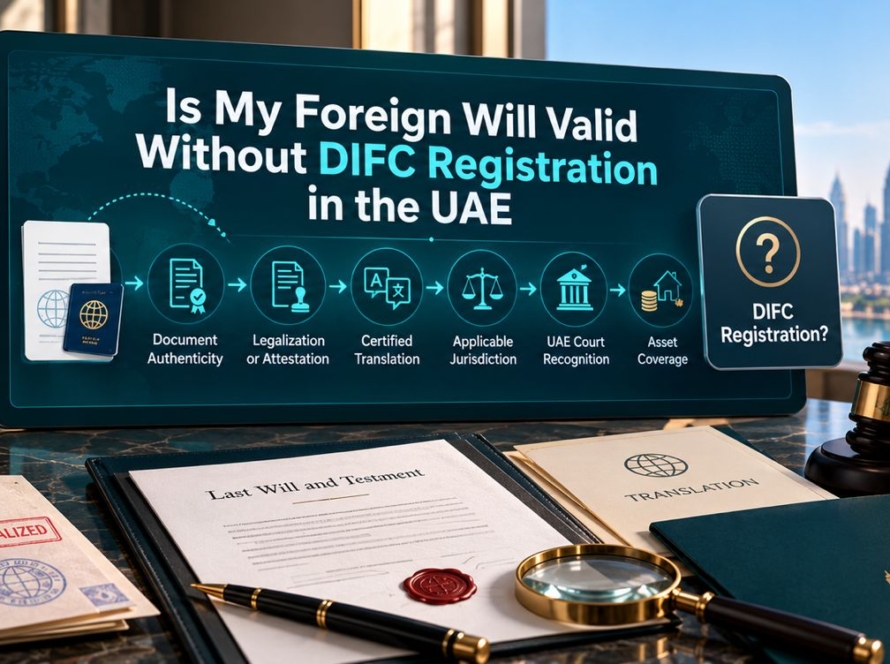

How to Ensure that Your Will is Legally Binding depends on capacity, governing law, permitted gifts, and the required formalities. Documentation or registration also helps establish the will’s existence.
Civil Transactions Law Article 17 governs the substance and form of wills. Article 17(5) applies UAE law to a foreigner’s will concerning UAE real estate. Personal Status Law Articles 173 and 184 govern Muslim bequest limits and gifts to heirs.
How To Ensure That Your Will Is Legally Binding
- Capacity: The testator must have full capacity. An interdicted person can make a will for charity only with the court’s permission (PSL Art 178).
- Governing law: The law the will names, or otherwise the nationality law at death. A foreigner’s will of UAE real estate follows UAE law (CTL Art 17(3), (5)).
- Form: The law the will names, the testator’s nationality law when it was made, or the law of the place where it was made (CTL Art 17(4)).
- Muslim limit: Within one third of the estate after funeral costs and debts. A will to an heir needs the other adult heirs’ consent or the court’s approval (PSL Arts 173, 184).
- Non-Muslim freedom: A person may leave a will of all his property in the State to whom he wishes (Civil law Art 11(1)).
- Proof: A will that is denied is heard only with two upright witnesses or their equivalent, so documenting it avoids this risk (PSL Art 176(2)).
- Changes: A documented will can be revoked or amended only in the same way (PSL Art 177(2)).
- Probate (DIFC): Probate is granted only for a will registered with the DIFC Courts Registry.
Validity disputes are discussed in challenging a will in the UAE.
Where To Register Or Document The Will
Choose the route that fits your religion and assets.
- Non-Muslims: the DIFC Courts Wills Service, for people who have never been Muslim, with UAE assets or minor children in Dubai or Ras Al Khaimah (DIFC Courts Wills FAQ).
- Non-Muslims: registration under the federal civil personal status law, including when the marriage is concluded (Federal Decree-Law 41/2022, Article 13).
- Muslims: document the will before the competent authority under the Personal Status Law, so it cannot be denied and can be changed only in the same way (Articles 176 and 177).
Keep wills in different countries consistent, so a later will does not revoke an earlier one by accident. A later will does not revoke an earlier one unless the testator says so (Personal Status Law, Article 180).
For drafting and registration considerations, see preparing a will without a lawyer.
Discuss Your Will And Registration Route
Share your will and an asset summary with Leaders Advocates to discuss the applicable requirements and documentation.
Common Reasons A Will Fails
A will can fail if it exceeds legal limits, lacks proof, or conflicts with applicable property rules.
- It gives a Muslim heir more than the Law allows without the other heirs’ consent.
- It exceeds the one-third limit for a Muslim testator.
- It cannot be proved because it was not documented.
- It contains a condition that breaks the Law, public order or morals, which is void, although the will stays valid (Article 172).
- It conflicts with the UAE law that governs UAE real estate.
After a death, the next steps are covered in starting an inheritance case in Dubai.
Frequently Asked Questions
Arrange A Will-Validity Review
For a will-validity review, share the will and an asset summary on WhatsApp.