

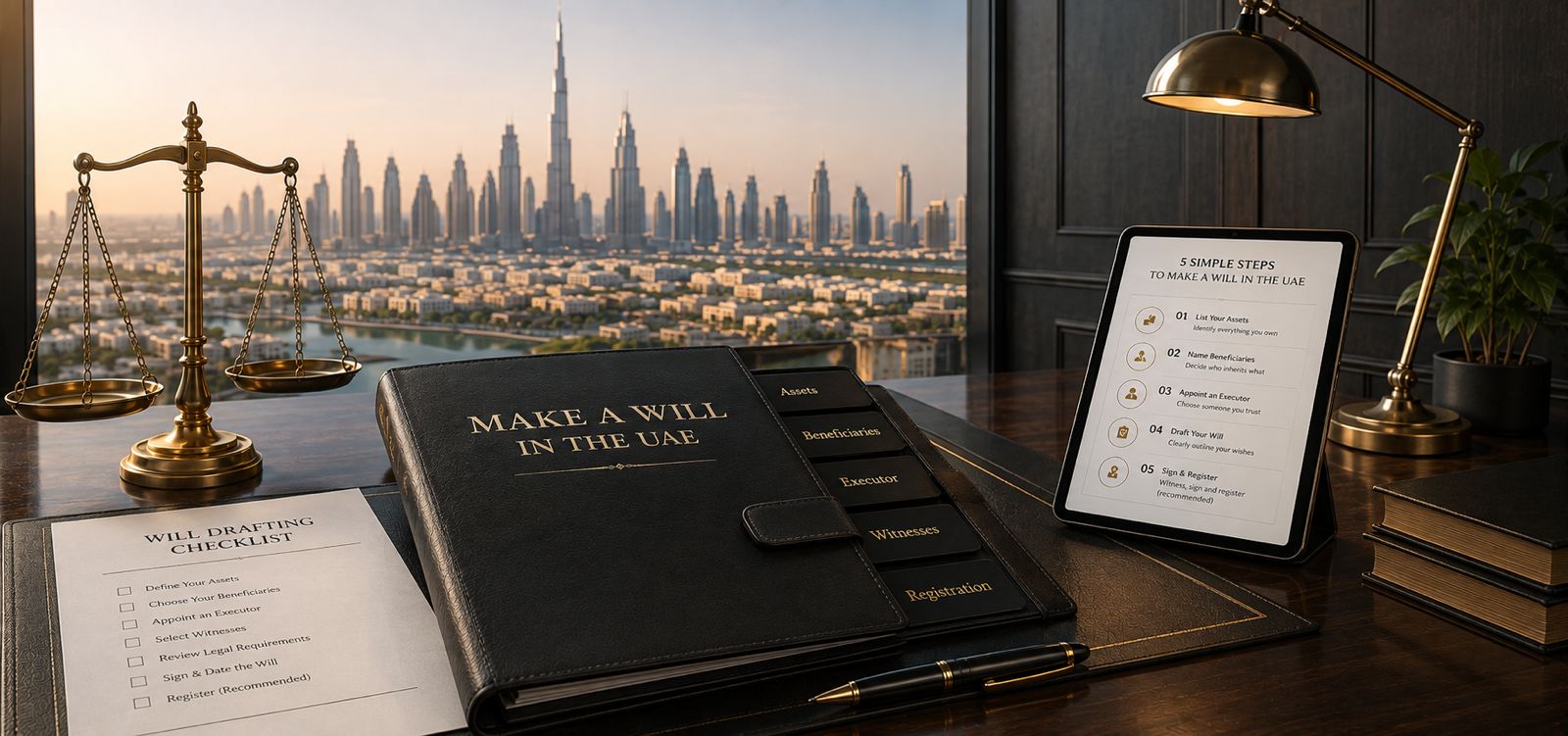
How to Make a Will Without a Lawyer in the UAE depends on the legal route you are eligible to use. A self-written document is not automatically valid merely because it is signed, notarized, or stored safely. Each registry or court framework has its own eligibility, language, content, witness, execution, and registration rules.
The DIFC Courts Wills Service expressly allows an eligible person to prepare a will personally or use an available online template. That is one recognized route, not a universal rule for every resident, religion, asset, or emirate. Before drafting, identify the framework that should govern the estate and the authority expected to administer it after death.
An eligible person can prepare a UAE will without hiring a lawyer, but the safe process is more than typing beneficiary names. First identify the correct regime, registry, and will type. List only assets and guardianship matters the chosen instrument can cover. Use the registry’s current mandatory provisions or approved template, appoint executors and substitute beneficiaries, address the residuary estate, debts, revocation, guardianship, and administrative powers, then check witness eligibility. For a DIFC court will, the official wills service confirms that an individual may self-draft, but the Will must meet minimum registration requirements and the Service does not provide legal advice. Registration or execution must follow the selected regime exactly. Review conflicts with foreign Wills, jointly owned assets, nominations, company documents, and marriage. Revisit the Will after major family, asset, residence, or legal changes.
How to Make a Will Without a Lawyer in the UAE: First Checks
If you need professional guidance, inheritance lawyer in dubai can help you understand your options.
Self-drafting is most suitable for a straightforward estate with clearly owned assets, adult beneficiaries, no conflict between jurisdictions, and no unusual trust, tax, company, debt, or family issue. It is not simply a cheaper version of professional estate planning. You personally assume responsibility for selecting the correct law and translating your wishes into operative language.
A template may reduce drafting errors but cannot decide whether an asset passes through the estate, is already controlled by joint ownership, a nomination, a shareholder agreement, a foundation, a trust, or another country’s succession law. Make the asset map before choosing the will type.
Step 2: Choose the Correct Will Regime
If you are trying to decide who to hire, our guide on who is the best inheritance lawyer in dubai explains what to look for.
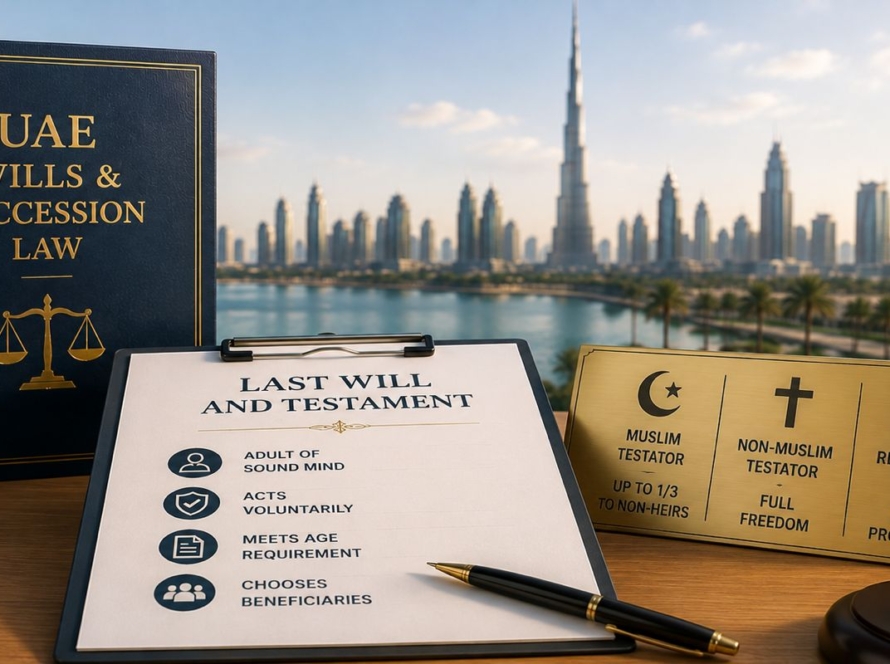
Non-Muslims may have more than one UAE option depending on residence, asset location, religion, language, and the intended court. These can include the DIFC Courts Wills Service and relevant local judicial or civil-will channels. Muslims are subject to different succession and testamentary rules, including limits on bequests and heirs, and should not use a non-Muslim Will template as though the regimes were interchangeable.
- Confirm religious and age eligibility for the selected registry.
- Check whether residence in a particular emirate is required or irrelevant.
- Identify which UAE and foreign assets the instrument is permitted to cover.
- Confirm the governing language and whether translation is accepted or required.
- Check which court will issue probate, succession, or guardianship orders after death.
- Read the current rules and fee schedule before relying on an old online article.
The registry itself is operated through the DIFC Courts Wills Service, and the wider succession position is summarised in this overview of inheritance law in the UAE.
Step 3: Select the Right Type of Will
We cover this in more detail in our guide on who can make a will in the UAE.
The DIFC Courts Wills Service currently offers several distinct Will types. A Full Will can address different categories of assets and may include guardianship provisions. A Guardianship Will is limited to guardianship. Property, Business Owners, and Financial Assets Wills cover specified categories and have limits. The available digital-assets option and template services should be checked on the official portal at the time of drafting.
A narrow Will may be easier to complete, but it may omit assets outside its permitted category. A Full Will may be more flexible, yet it still requires compliance with mandatory provisions. Do not choose by fee alone; choose by the estate the instrument must actually govern.
Not Sure Which Route Even Applies to You?
Picking the wrong regime is the one mistake a template cannot save you from, and it only surfaces once you are gone. A short review now confirms which framework governs your estate before you spend hours drafting.
Step 4: Build a Complete Asset and Liability Inventory
For a closer look at this, see our guide on will AI replace lawyers.
- Real estate, including title details, ownership shares, mortgages, and off-plan records.
- UAE and foreign bank, brokerage, investment, and digital-asset accounts.
- Company shares, partnership interests, shareholder restrictions, and free-zone records.
- Vehicles, valuable personal property, intellectual property, and receivables.
- Life insurance, end-of-service benefits, pensions, and existing nominations.
- Loans, guarantees, taxes, maintenance obligations, and other liabilities.
- Jointly owned property and assets that may pass outside the estate.
- Every existing UAE or foreign Will, codicil, trust, foundation, or succession document.
Use exact legal ownership, not family assumptions. You cannot give more than you own. A Will that describes the entire property when the testator owns only a share can create delay and conflict. Verify names, account identifiers, company numbers, and title details from current records.
Where UAE property is involved, our real estate lawyers in Dubai can confirm exactly how the title is held before it is described in a gift.
Step 5: Identify Beneficiaries and Substitute Beneficiaries
State each beneficiary’s full legal name and enough identifying information to avoid confusion. Define whether a gift is a fixed sum, a specific asset, a percentage, or part of the residue. Identify what happens if the beneficiary dies before you, disclaims the gift, or cannot be located.
Do not distribute only named assets and forget the residuary estate. Assets can be acquired after signing, sale proceeds can replace an asset, and a specific gift can fail. A residuary clause determines who receives what remains after debts, expenses, and specific gifts.
Step 6: Appoint Executors and Backups
The executor administers the estate, applies for the relevant grant, collects assets, pays liabilities, and distributes the balance. Choose a person or professional who is capable, willing, reachable, and able to deal with UAE institutions. Confirm whether the chosen route permits the appointment and whether practical residence or banking issues may affect administration.
Name at least one substitute where the rules allow it. An executor may die, refuse, lack capacity, or face a conflict. The Will should also grant the administrative powers required by the chosen regime rather than rely on a job title alone.
Step 7: Address Guardianship Carefully
A guardian nomination is important but does not privately remove the court’s responsibility for a child’s welfare. The chosen person should understand the intended role, residence implications, immigration requirements, schooling, finances, and the distinction between interim and permanent arrangements where relevant.
For a DIFC Courts Full or Guardianship Will, the child-related eligibility and geographic requirements must be checked. Also name substitutes and consider who can take immediate care while a formal order is obtained. A foreign guardian may need immigration and recognition planning.
Our guardianship lawyers in Dubai can confirm how a testamentary nomination interacts with the court’s own powers.
Step 8: Draft the Operative Clauses
- Identify the testator and declare testamentary intention and capacity.
- State the intended jurisdiction and scope without accidentally revoking another Will.
- Revoke prior instruments only to the extent actually intended.
- Appoint executors, substitutes, and any guardians permitted by the regime.
- Describe specific gifts and beneficiary substitutions precisely.
- Provide for the residuary estate and failed gifts.
- Address debts, expenses, taxes, administration, and executor powers.
- Use the mandatory execution and attestation wording required by the registry.
Avoid importing a Will from another country without review. The DIFC Wills Service warns that an existing Will drafted under another regime may not comply with its Rules and may need redrafting. Similarly, a later foreign Will can unintentionally revoke or conflict with a UAE Will if the revocation clauses are not coordinated.
Step 9: Check Witness Eligibility and Execution
Witness requirements are regime-specific. For the DIFC Wills Service, current official guidance says two witnesses are needed. They must be at least 18, hold valid photographic identification, and must not be beneficiaries or guardians, or spouses of beneficiaries or guardians. Eligible witnesses may attend virtually.
Do not sign early unless the selected process allows it. A Will may need to be executed during a registration appointment or through an electronic-signature procedure. Using the wrong witness, date, signature sequence, or version can defeat the purpose of careful drafting.
Step 10: Complete Registration or Formal Execution
- Create the official account and select the correct Will service or court route.
- Upload the final draft and requested identity or asset information.
- Complete any pre-registration compliance review and correct rejected provisions.
- Book the signing or registration appointment and arrange eligible witnesses.
- Pay the current official fee through the authorized channel.
- Sign only the approved final version in the required manner.
- Retain the registration confirmation and tell the executor how the record can be located.
The DIFC Courts Wills Service confirms that its electronic Will is treated as the original and that registration can be completed virtually. Other UAE routes may use different documentation, language, notarization, or court procedures. Do not assume that a PDF stored at home is equivalent to a registered instrument.
Cross-Border Wills and Revocation Risk
A person with assets in several countries may need coordinated local Wills. The objective is to avoid contradictory executor appointments, overlapping property definitions, incompatible tax planning, and a broad revocation clause in one country cancelling another instrument.
Foreign assets may be mentioned in some UAE Will forms, but enforcement abroad depends on the law where the asset is located. Obtain advice in every material jurisdiction before expanding the scope. A shorter UAE-only Will may sometimes be safer than an ambitious worldwide clause that cannot operate as intended.
Do You Already Hold a Will Abroad?
One broad revocation clause can quietly cancel the will covering your assets back home, and nobody finds out until the estate is being administered. We read both documents together before either one is signed.
Marriage, Divorce, Birth, and Later Changes
Review the Will after marriage, divorce, the birth or adoption of a child, the death of a beneficiary, a major asset purchase or sale, relocation, business restructuring, or a change in the law. Under the DIFC Rules, marriage can revoke a Will unless the required intention is clearly stated, while divorce affects gifts and appointments made to a former spouse.
DIFC modifications require a new modified Will rather than a codicil accepted by the Wills Service. Other regimes may differ. Do not handwrite a change on the registered copy or attach an informal page and assume it updates the official instrument.
The full replacement procedure is set out in our guide on how to revoke or cancel a will in the UAE.
When You Should Not Self-Draft
- You are unsure which religious or civil succession framework applies.
- The estate includes several countries, tax exposure, trusts, foundations, or private companies.
- There is a blended family, dependent adult, vulnerable beneficiary, or expected dispute.
- An heir may challenge capacity, pressure, ownership, or the authenticity of the instrument.
- You want unequal distributions, conditional gifts, lifetime arrangements, or complex executor powers.
- Your UAE Will must coordinate with another Will, prenuptial agreement, nomination, or shareholder agreement.
- You do not understand the English or Arabic legal text used by the selected route.
Digital Assets and Access Instructions
A Will can identify digital assets and the person who should administer them where the selected regime permits. The estate plan should distinguish transferable value, such as a digital-asset account, from a personal licence or account that ends on death. Check the service provider’s succession and access rules.
Do not place passwords, seed phrases, or live security codes in the Will. Probate documents may be shared during administration. Keep access instructions in a separate secure system and tell the executor how to locate it without exposing the credentials during your lifetime.
Nominations, Joint Ownership, and Assets Outside the Will
Some benefits may pass under a valid nomination, survivorship arrangement, policy term, pension rule, trust, foundation, or company document rather than under the Will. Verify the controlling instrument and update it separately. Naming the same asset differently in several records can create uncertainty instead of protection.
Joint ownership also needs precise analysis. The Will governs only the interest that forms part of the testator’s estate. It cannot privately rewrite another owner’s share or a bank’s secured rights. Record the ownership form, contribution history, finance terms, and intended result before drafting a gift.
Where company shares are involved, our corporate lawyers in Dubai can check whether a shareholder agreement overrides the Will.
Final Self-Audit Before Registration
- Every name and identity detail matches official documents.
- The chosen Will type covers every asset category and guardianship issue stated.
- Specific gifts, substitutions, and the residuary estate add up coherently.
- Executors and guardians are willing, eligible, and supported by substitutes.
- The revocation clause is coordinated with every foreign Will.
- Witnesses meet the selected regime’s restrictions and have valid identification.
- The final file matches the version submitted for registration and has not been signed early.
- The executor can identify the registry and locate the supporting estate records.
Inheritance Lawyer in Dubai can review succession and probate risks. Family Lawyers in Dubai can assess guardianship and family-status implications, while Marriage Lawyers in Dubai can check how marriage agreements or a planned marriage affect the Will.
Common Self-Drafting Mistakes
- Assuming notarization or a signature alone makes every UAE Will enforceable.
- Using a non-Muslim template for a Muslim estate or the wrong emirate’s route.
- Naming assets that the testator does not legally own.
- Omitting the residuary estate, substitutes, or backup executors.
- Using an ineligible witness or signing before the required appointment.
- Creating a broad revocation clause that conflicts with a foreign Will.
- Ignoring company documents, nominations, joint ownership, and secured debt.
- Failing to update the Will after marriage, divorce, birth, death, or relocation.
Frequently Asked Questions
Want a Second Pair of Eyes Before You Register?
You can draft it yourself. The risk is that a missing residuary clause, an ineligible witness, or an asset you do not fully own only shows up when your family is already dealing with a loss. Leaders Advocates will review the draft before it goes to the registry.

1 Comment