After a death in Dubai, families may find that bank accounts are frozen and property cannot be transferred. The court must first confirm who the heirs are. Knowing how to start an inheritance case in Dubai lets the family move from paperwork to distribution in the right order, instead of discovering each requirement as it blocks the next step.
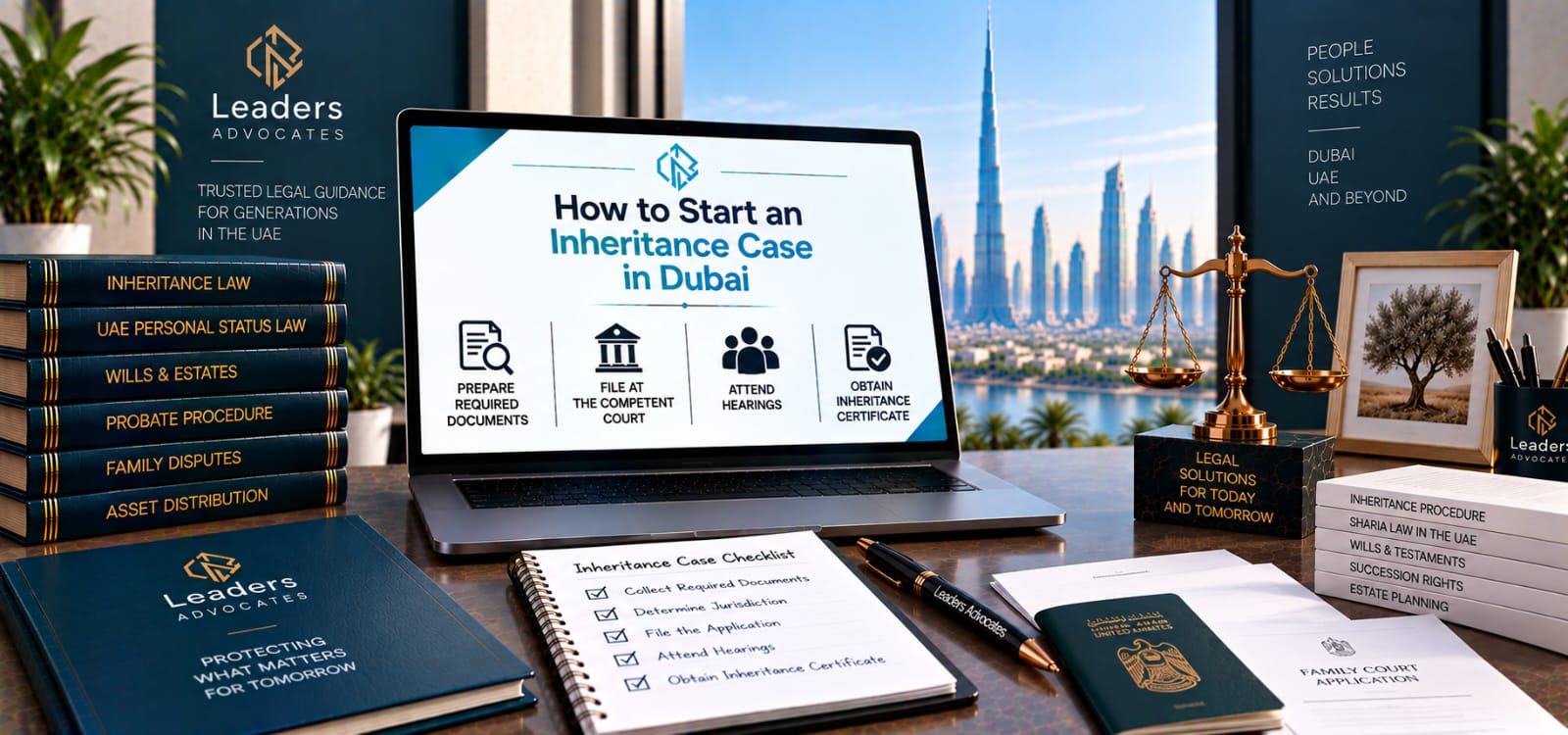
So how do you start an inheritance case in Dubai? Register the death and gather the family and asset documents. Open the estate application through Dubai Courts under the Probate Court framework, confirm the governing law, then seek distribution and asset transfers.
Quick Answer
To start an inheritance case in Dubai, obtain the official death certificate and check whether the relevant embassy or consulate requires notification or supporting records. Then open the estate application through Dubai Courts under the Probate Court framework. The application seeks a succession certificate identifying the legal heirs and requires documents about the deceased and the heirs. The applicable law then decides the shares. For Muslims, the rules of Federal Decree-Law No. 41 of 2024 (Articles 200 to 250) apply, with a will limited to one-third unless the heirs consent. For non-Muslims within its scope, Article 11 of Federal Decree-Law No. 41 of 2022 applies, with a registered will taking priority and a default split of half to the spouse and half to the children equally. Funeral costs, which Article 201 of the 2024 law addresses, and the deceased’s debts are settled before distribution.
Step 1: Register the Death
Obtain the official death certificate.
For expatriates, check whether the relevant embassy or consulate requires notification or supporting records.
Locate any will, including wills registered with the Dubai Courts or the DIFC Courts.
Make a list of known assets and debts.
Step 2: Open the Inheritance File
An heir or authorized representative opens the estate application through Dubai Courts under the Probate Court framework. The court reviews the documents and issues a succession certificate identifying the heirs. Typical documents include the death certificate, passports and identification of the deceased and the heirs, the marriage certificate and children’s birth certificates (attested and translated where required), any registered will, and powers of attorney for heirs who cannot attend.
Step 3: Identify the Applicable Law
Need to open an inheritance file in Dubai? Ekaterina Butseva and the team at Leaders Advocates can assess your specific situation.
Step 4: Settle Costs and Debts
Before heirs receive anything, the estate pays funeral costs, which Article 201 of the 2024 law addresses, and settles the deceased’s debts. For Muslim estates, unpaid deferred mahr is a debt owed to the wife, not part of her inheritance share, and is settled before distribution.
Step 5: Estate Distribution in Dubai
Once the heirs and shares are confirmed, the court issues orders enabling distribution. Banks release funds on those orders. Property is transferred through the Dubai Land Department on the court documents. Where heirs disagree over valuation or division, the court may need to resolve the dispute, and property that cannot be divided may have to be sold.
Heirs Living Abroad
Heirs outside the UAE can usually act through a lawyer under a power of attorney that is notarized, legalized for UAE use and translated where required. Arranging this early prevents delays when the court needs all heirs represented.
Common Mistakes
Delaying the file while assets remain frozen.
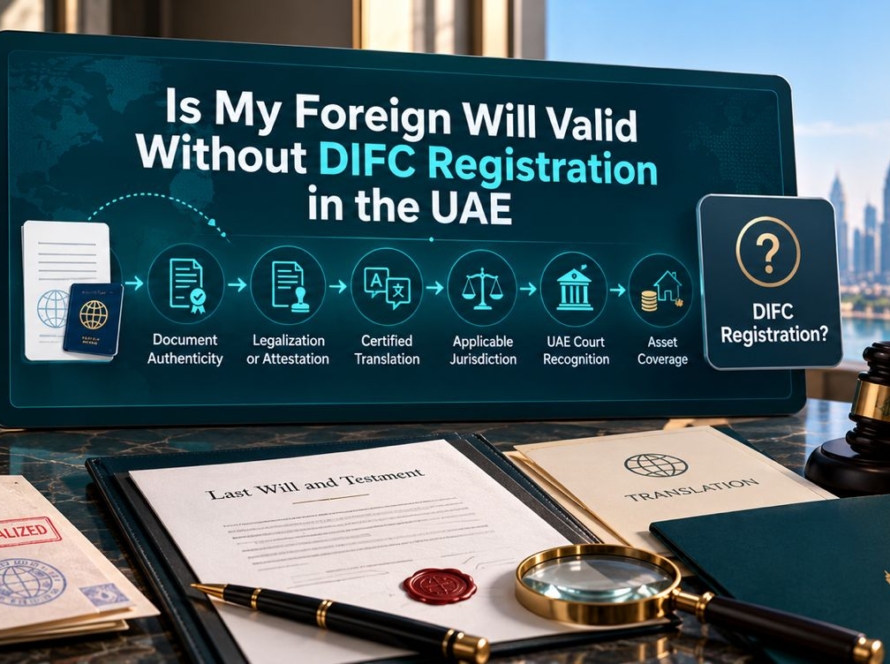
Assuming a foreign will automatically governs UAE assets.
Treating deferred mahr as part of the wife’s inheritance.
Confusing a legatee under a will with a legal heir.
Leaving overseas heirs without powers of attorney.
Ready to Open Your Inheritance File?
Frozen accounts and blocked transfers usually mean the succession certificate hasn’t been issued yet. Message Leaders Advocates on WhatsApp and we’ll walk you through what’s needed to open the file.
Practical Steps and Case Preparation
The first task is to secure the official death certificate and locate the deceased’s identity records. For an expatriate, the relevant embassy or consulate may also need notification. Do not distribute, sell, or transfer estate property before authority and entitlement are confirmed.
Search for every will before choosing the inheritance route. Check for a Dubai Courts will, DIFC Courts will, Abu Dhabi registration, home-country will, or later amendment. Two documents can conflict, and a foreign will may require authentication, translation, and a UAE recognition analysis.
Create a family tree supported by civil-status documents. Marriage certificates, divorce judgments, birth certificates, death certificates, and parentage records may affect who appears on the succession certificate. Resolve spelling differences and changed names before filing whenever possible.
Open the estate application through Dubai Courts under the Probate Court framework. The application normally seeks official identification of the heirs. The court may require the death certificate, identity documents, family records, any will, and authority documents for the person filing.
The succession certificate does not itself complete every asset transfer. It establishes the heirs for the estate process. Banks, companies, the Dubai Land Department, vehicle authorities, and other holders may require further court orders or institution-specific documents before releasing or registering property.
Prepare a complete asset inventory. Include bank accounts, real estate, vehicles, shares, company interests, end-of-service benefits, insurance, receivables, digital assets, and valuables. Record legal ownership, approximate value, location, account or title details, and the document supporting each entry.
Evidence and Documents Needed
Prepare a liability schedule separately. Include mortgages, personal loans, business debts, court judgments, taxes where applicable, funeral expenses, and unpaid deferred mahr. A claimed family loan should be supported by evidence. Distribution concerns the net estate after recognized prior obligations.
For a Muslim estate, Federal Decree-Law No. 41 of 2024 governs inheritance within its scope. Articles 200 to 250 address succession matters. A will is generally limited to one-third unless heirs consent, and estate costs and debts are addressed before distribution.
For a non-Muslim estate within Federal Decree-Law No. 41 of 2022, a registered will can control distribution. Without one, Article 11 provides the civil default. The spouse receives half, while the other half is divided equally among the children.
- Identity and civil-status documents relevant to the parties, deceased, heirs, or children.
- Court orders, notices, registration records, and proof of filing or service.
- Financial, medical, school, ownership, travel, or communication evidence relevant to the remedy.
- Certified translations, attestations, and powers of attorney where required.
Need Help Settling Estate Debts and Assets?
Debts, funeral costs, and a full asset inventory all have to be sorted before distribution. Send your situation to Leaders Advocates on WhatsApp for a structured review.
Common Risks and How a Lawyer Can Help
Heirs abroad should prepare powers of attorney early. The document may need notarization, legalization, UAE attestation, and Arabic translation. Its wording should cover the intended court, banking, property, settlement, and receipt powers without granting unnecessary authority.
Real estate needs a title-specific review. Confirm the registered owner, ownership share, mortgage, pending sale, usufruct, or disputed transfer. The Dubai Land Department will act on the accepted court documents, but an ownership dispute may need separate litigation before distribution.
Do not assume every account or jointly held asset passes automatically. The legal ownership record, account terms, contributions, and governing estate rules matter. Obtain the relevant statements and contracts instead of relying on how family members described the asset informally.
If heirs disagree, identify the actual dispute. They may contest heirship, a will, ownership, valuation, debt, lifetime gift, or proposed division. Each dispute requires different evidence. An indivisible asset may require valuation, buyout, agreed sale, or a court-directed sale.
An inheritance lawyer can coordinate the succession certificate, applicable-law analysis, asset inquiries, powers of attorney, debt review, and transfer orders. Counsel should also identify when a separate civil, real estate, company, or will dispute must be filed.
A lawyer can identify the governing framework, test the evidence, calculate deadlines, draft precise requests, and coordinate enforcement. Advice should always be based on the actual facts and documents.
Practical Review Before Filing
Secure estate records before access is lost. Download statements lawfully available to the family, preserve property and company documents, and identify recurring liabilities. Do not use the deceased’s online credentials without legal authority, even where relatives know the password.
Nominate one person to maintain the document index and communication log. Multiple heirs contacting the same bank or authority can produce inconsistent instructions. A coordinated record should show requests, responses, outstanding documents, deadlines, and the person responsible for each task.
Obtain valuations when division depends on value. Real estate, company shares, vehicles, jewelry, and valuable personal property may need different experts. Agreeing a valuation method early can reduce disputes about buyouts, equalization, or sale proceeds.
Check whether an asset is truly part of the estate. Property held in trust for another person, a valid lifetime transfer, jointly owned property, or an insurance benefit with a designated recipient may require separate analysis. Registration in the deceased’s name is important but may not resolve every beneficial-ownership claim.
Do not pay one creditor selectively without advice. The estate should identify valid liabilities and the order in which obligations are settled. A payment made too early may create difficulty if the estate later proves insufficient or another creditor disputes priority.
Before final distribution, prepare a closing statement. It should list estate receipts, expenses, debts, transfers, sales, and each heir’s entitlement. Written acknowledgment of the final distribution helps prevent later confusion, but it should not waive an unresolved claim unintentionally.
Relevant Legal Services
The appropriate service depends on the facts, the framework, and the procedural stage.
Relevant Success Story
For examples of how documented legal disputes are approached, review the firm’s Success Stories archive. It does not guarantee a similar result. Every matter depends on its facts, documents, evidence, and legal circumstances.
Ready to Move Your Inheritance Case Forward?
Frozen assets don’t resolve themselves. Contact Leaders Advocates on WhatsApp for a focused review of the succession certificate process and what your family needs next.
FAQs
Final Takeaway
An inheritance case should begin with proof of death, heirship, the governing law, and a complete estate inventory. The safest next step is a document review before requesting distribution, transferring assets, paying disputed debts, or signing releases.