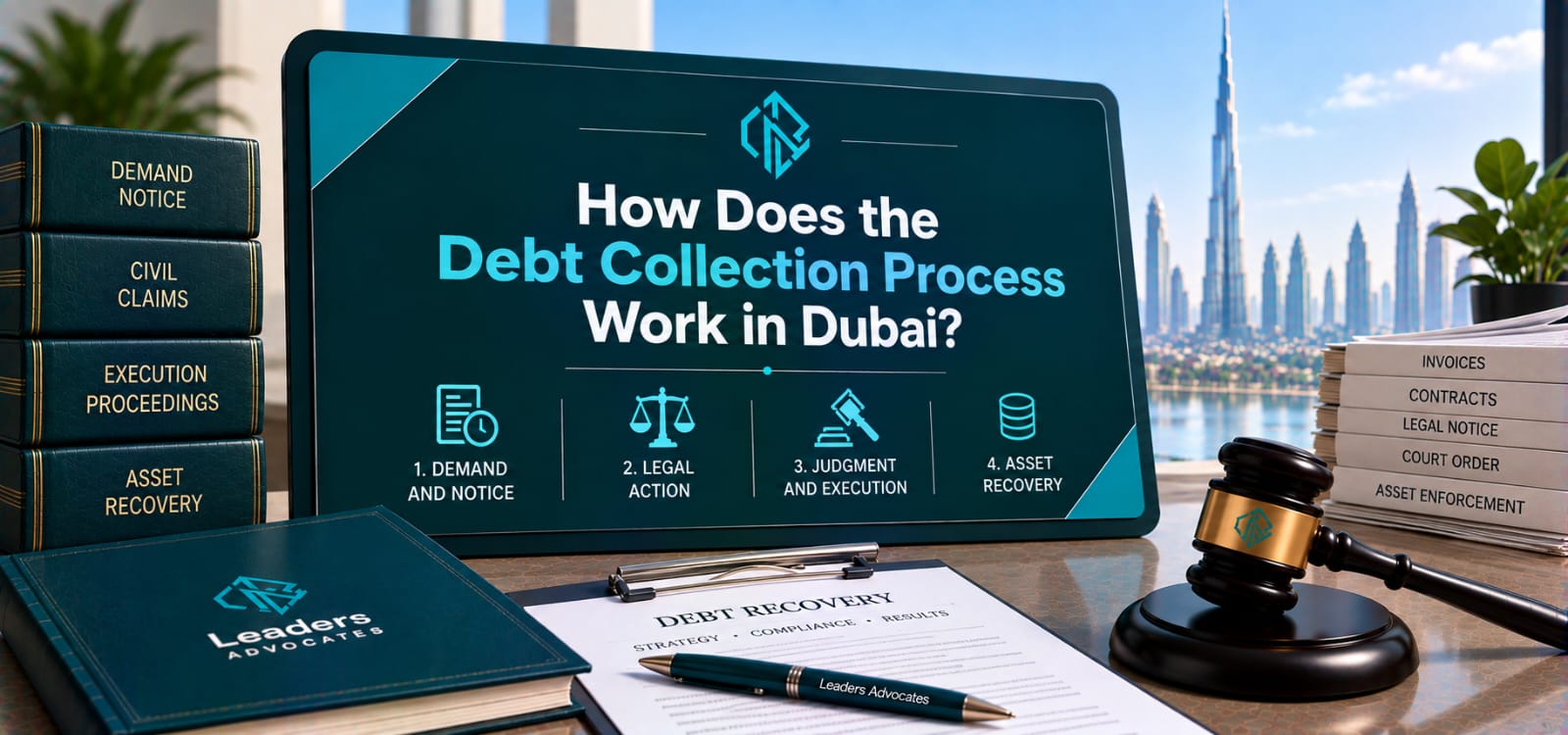

How does the debt collection process work in Dubai? It moves in stages: a formal demand, a court route that fits your proof, and then execution against the debtor’s assets. The route you choose decides how fast you can move.
This guide shows the timeline of each stage. For a general overview, read our main guide on debt recovery in the UAE.
How Does the Debt Collection Process Work in Dubai? Timeline
| Stage | What happens | Time set by law or practice | Legal basis |
|---|---|---|---|
| 1. Formal demand | You ask the debtor in writing to pay | Give at least 5 days before a payment order | Civil Procedure Code, Articles 143 to 150 |
| 2a. Payment order | A judge orders payment of a written, fixed and due debt without a full trial | Decided quickly, often within days | Civil Procedure Code, Articles 143 to 150 |
| 2b. Cheque execution | A cheque returned for no or insufficient funds goes straight to execution | No trial needed | Commercial Transactions Law, Article 667 |
| 2c. Civil or commercial claim | Full case before the court | Defence due within 10 business days of service. Judgment within 80 days of the first hearing | Civil Procedure Code, Articles 48 and 78 |
| 3. Execution | The execution judge enforces the order or judgment | Depends on the debtor’s assets | Civil Procedure Code |
The times in the table are legal limits or common practice. Real cases can take longer if the debtor objects or hides assets.
Stage 1: Prepare Your File and Send a Formal Demand
Start with a clean file. You need the contract, invoices, delivery notes, emails and a statement of account. Check that the debtor’s legal name matches the trade licence.
Then send a formal demand that states the amount, the due date and a deadline to pay. For a payment order, the debtor must get at least 5 days to pay before you apply. Keep proof that the demand was delivered.
Stage 2: Choose the Right Court Route
Your proof decides the route. Picking the wrong one wastes weeks.
- Payment order: use it when the debt is written, the amount is fixed and the payment is due. The judge decides on the papers, without hearings.
- Cheque execution: under Article 667 of the Commercial Transactions Law, a cheque returned for no funds or insufficient funds is an executive document. You can go straight to the execution court for all or part of the amount.
- Civil or commercial claim: use it when the debt is disputed or the amount needs proof. The defendant must file a defence within 10 business days of service. The court must then decide within 80 days of the first hearing (Civil Procedure Code, Articles 48 and 78).
- Arbitration: if your contract has an arbitration clause, the court may send the claim there.
Not sure which route fits your documents? Send them to our lawyers on WhatsApp or use the Contact Us page.
Stage 3: Protect Assets While You Wait
If the debtor may move money or leave the country, ask the court for urgent protection. Common options are a precautionary attachment on bank accounts or property, and a travel ban in qualifying cases. Read more in our guide on asset freeze orders in the UAE.
Stage 4: Execution
A judgment or payment order does not pay you by itself. You must open an execution file. The execution judge can then order steps such as:
- Attaching bank accounts.
- Attaching vehicles, shares or property.
- Asking banks and authorities about the debtor’s assets.
- Selling attached assets at auction.
This stage is often the longest. A debtor with clear assets in the UAE pays faster than one with assets abroad.
How Long Does the Whole Process Take?
- Cheque execution: often the fastest, because there is no trial.
- Payment order: fast if the debtor does not object.
- Full claim: usually a few months to judgment, plus appeals.
- Execution: from weeks to much longer, depending on the assets.
For more detail, see how long a debt recovery case takes in the UAE.
Common Mistakes That Slow Collection
- Suing the wrong company name.
- Waiting months before sending a formal demand.
- Filing a full claim when a payment order or cheque execution was possible.
- Ignoring an arbitration clause in the contract.
- Winning a judgment but never opening execution.
Frequently Asked Questions
What Is the First Step in Debt Collection in Dubai?
A written formal demand. It gives the debtor a final chance to pay and is required before a payment order.
Can I Collect a Debt Without Going to Court?
Yes, if the debtor agrees to pay or signs a payment plan. If they refuse, you need a court route to force payment.
Is a Bounced Cheque Enough to Collect a Debt?
Often, yes. A cheque returned for no or insufficient funds can go straight to execution under Article 667 of the Commercial Transactions Law.
What Is a Payment Order?
It is a fast court order for a written, fixed and due debt. The judge decides on the documents without a full trial.
What Happens if the Debtor Has No Assets in the UAE?
Execution in the UAE may not recover the money. You may need to enforce the judgment where the debtor’s assets are.
Start Your Debt Collection the Right Way
The right first step saves months. Our debt recovery lawyers in Dubai can review your documents, choose the fastest route and manage execution.
Speak to our lawyers on WhatsApp or use the Contact Us page.