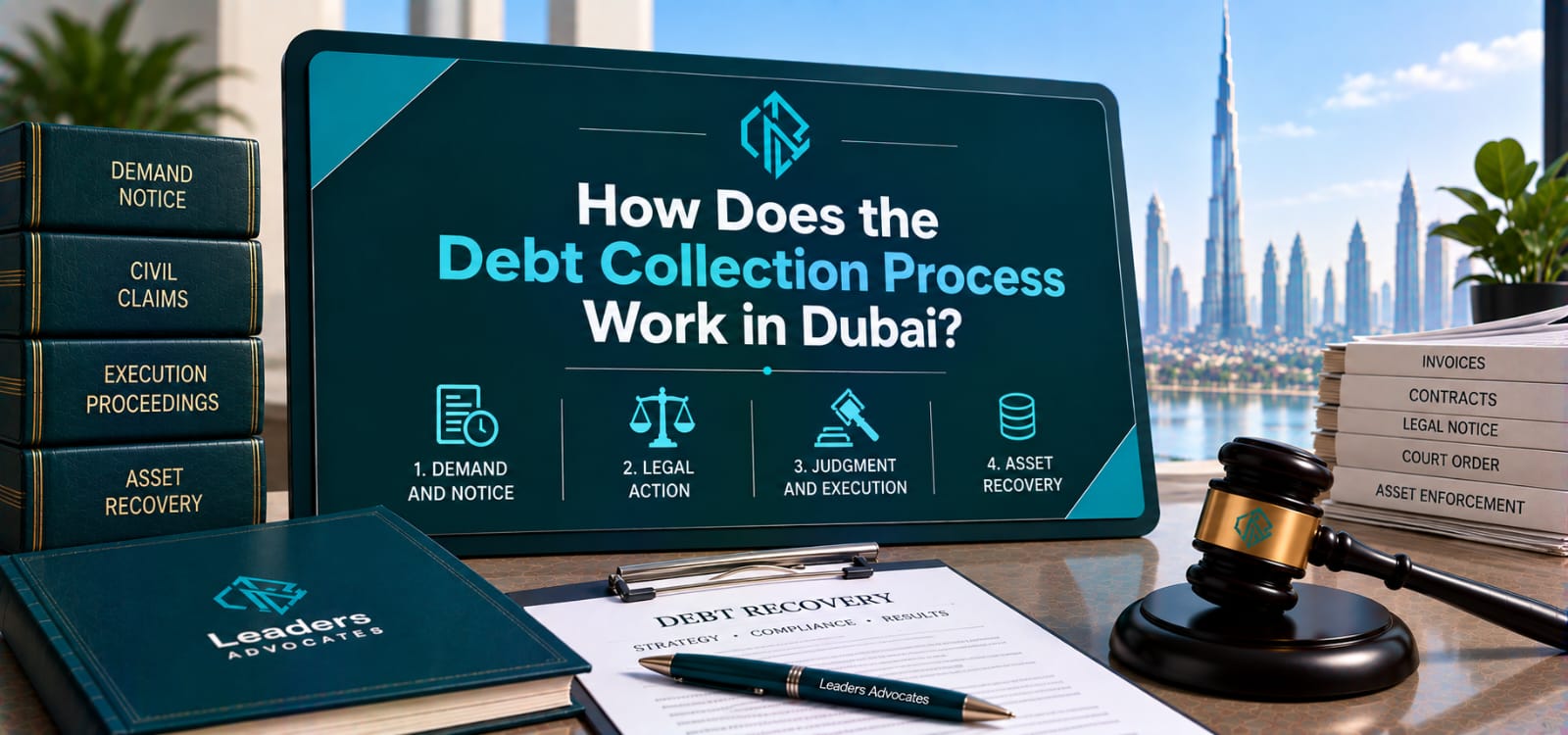

Many creditors describe debt collection as one court case. In practice, the process has separate stages, and each stage depends on the document supporting the debt.
A missing contract, wrong debtor name, weak delivery proof, or unsuitable forum can delay recovery before the court reaches the amount.
Quick Answer
Debt collection usually begins with document review and a clear account reconciliation. The creditor must identify the legal debtor, amount, due date, performance evidence, and any dispute.
A formal demand follows. It should meet the contract’s notice terms, state a payment deadline, and preserve proof of delivery.
The next route depends on the instrument and dispute. A qualifying cheque may support direct execution, while another debt may require a payment order, lawsuit, or arbitration.
After a judgment, award, or executive instrument, the creditor may seek court-controlled enforcement against reachable assets. Each attachment or travel request remains subject to legal conditions and judicial approval.
About the Legal Contributor
Faris Raian is a Founder Partner at Leaders Advocates.
His work covers UAE business disputes, debt recovery, and enforcement strategy.
In a recovery matter, he starts with the legal debtor, governing documents, available forum, asset position, and likely enforcement route.
That review helps the client choose steps that fit both the legal claim and the commercial objective.
Start with a recovery file and asset plan. Reconcile the balance, identify the debtor, check the forum, and preserve every original instrument.
Then move through demand, filing, decision, and enforcement. Choose the route that fits the evidence instead of treating every debt alike.
How Does the Debt Collection Process Work in Dubai
The process usually has four phases. The creditor prepares the file, makes a documented demand, establishes or enforces the debt, and then pursues assets.
Settlement can occur at any stage. A signed promise is useful only when its terms, security, and default consequences are clear.
Stage One: Identify the Creditor and Debtor
Confirm the claimant’s legal name and authority. An assignee, branch, owner, or collection agent may need documents showing the right to claim.
Identify the debtor through the trade license, contract, purchase order, and payment record. Do not sue a brand or group name without a legal entity.
Check addresses, license status, and known representatives. Accurate details support notice, service, and enforcement.
Stage Two: Reconcile the Account
Create a ledger for every invoice or advance. Show the issue date, due date, principal, tax, payment, credit, retention, and balance.
Separate interest, penalties, and costs. Each additional amount needs a legal or contractual basis.
Use one final calculation in the demand and claim. Inconsistent totals give the debtor an avoidable defense.
Stage Three: Collect the Evidence
The file may include a contract, accepted quotation, purchase order, invoices, delivery records, completion certificates, and messages.
Match each invoice to performance. A document showing the price may not prove that goods or services were accepted.
Preserve originals, attachments, and electronic records. Do not edit a message export or recreate a signed document.
Have Unpaid Invoices Sitting on Your Books?
Send your contract, invoices, and payment history on WhatsApp — we’ll tell you the fastest lawful route to recovery.
Stage Four: Review the Contract
Check the governing law, court or arbitration clause, notice method, payment terms, interest, guarantees, and security.
Some contracts require negotiation, mediation, or a formal notice before filing. Follow the agreed process where it applies.
If the documents conflict, obtain advice before selecting the forum. A late jurisdiction objection can increase cost.
Stage Five: Assess Assets and Solvency
Identify what may be available for enforcement. Assets can include accounts, receivables, vehicles, real estate, shares, inventory, or other rights.
Confirm ownership. A related company’s asset does not automatically answer another entity’s debt.
Check whether the debtor is operating, liquidating, or subject to insolvency proceedings. That may change the filing route.
Stage Six: Send a Formal Demand
The demand should state the parties, contract, invoices, performance, balance, due date, and final payment deadline.
Use the contractual notice address and method where required. Keep the courier receipt, email record, or other proof of delivery.
State the next legal step accurately. Do not threaten arrest or criminal reporting merely to collect an ordinary civil debt.
Debtor Response
The debtor may pay, ask for time, deny liability, raise a setoff, or remain silent. Record the response and supporting documents.
An admission can help, but verify the speaker’s authority. A partial payment also changes the balance.
Use the response to update the legal and commercial plan. Do not repeat the same demand without deciding what comes next.
Settlement Before Filing
A payment plan should identify the admitted debt, installments, method, security, costs, and default consequences.
State how existing cheques, guarantees, and claims are treated. Define when any release becomes effective.
Monitor compliance. A missed installment should trigger the agreed response rather than another open-ended negotiation.
Debtor Ignoring Your Settlement Offer?
Message us now on WhatsApp and we’ll map out the payment order, claim, or execution route that fits your case.
Payment Order
A payment order may be available for a qualifying debt supported by suitable written evidence. The current statutory conditions must be reviewed.
The amount, maturity, prior demand, jurisdiction, and nature of any dispute can affect eligibility.
Where the conditions are not met, the creditor may need an ordinary claim. The faster label does not override procedural requirements.
Ordinary Civil or Commercial Claim
An ordinary claim is often used when liability, performance, authority, calculation, or setoff is disputed.
The pleading should tell a clear transaction story. Attach the contract, invoices, performance records, ledger, demand, and company documents.
The debtor may file a defense or counterclaim. Anticipate likely issues and identify whether expert evidence may be required.
Arbitration
A valid arbitration agreement may require arbitration instead of an ordinary court claim. Review the clause before filing.
The creditor may need to send a notice and follow institutional or ad hoc appointment rules. Fees and tribunal costs should be budgeted.
An award may still require recognition and enforcement. Asset analysis remains important even when the merits are strong.
Cheque Backed Debt
A cheque returned for no or insufficient balance is an executive instrument under Article 667 of the Commercial Transactions Law.
The holder may request compulsory execution without first obtaining an ordinary civil judgment on the same qualifying cheque.
Keep the original cheque and dated bank statement. Reconcile partial payment and the underlying debt before filing.
Other Cheque Return Reasons
A signature issue, technical defect, disputed alteration, payment stop, or another reason may require different analysis.
Article 667 expressly concerns no or insufficient balance. Do not assume every return code creates the same execution route.
Criminal allegations also require specific statutory conduct and intent. An unpaid debt alone is not enough.
Holding a Bounced Cheque?
Send us the cheque and bank statement on WhatsApp — we’ll confirm whether you can go straight to execution.
Foreign Judgment or Award
A foreign court judgment generally needs recognition before it can be enforced against UAE assets. Treaties can affect the route.
A foreign arbitral award follows a separate enforcement framework. The agreement, seat, award, notice, and applicable convention matter.
Prepare authentication, finality, service, and certified Arabic translation early. Requirements depend on the decision.
Obtaining the Judgment or Order
Read the written decision. Confirm the principal, interest, costs, parties, payment obligations, and appeal status.
Do not rely on an oral hearing result or an incomplete translation. The enforceable amount must match the decision.
If an appeal is filed, obtain advice on its effect on enforcement. The answer depends on the order and procedure.
Opening Execution
Execution begins from an enforceable instrument, such as a qualifying judgment, award after required recognition, settlement in an enforceable form, or Article 667 cheque.
The creditor files the instrument, debtor details, balance, and requested steps. The court applies the Civil Procedure Law.
Keep the execution reference and record every amount received. Update the claim after partial payment.
Enforcement Measures
The execution court can consider measures against legally reachable assets. The requested step must satisfy current requirements.
Possible measures may involve bank accounts, vehicles, real estate, shares, receivables, or sale of attached assets.
A travel restriction is not automatic. The court reviews the legal conditions and evidence before making an order.
Execution Challenges
The debtor may challenge the amount, payment, identity, instrument, service, or requested measure. The court decides under the applicable procedure.
The creditor should keep the original records and a current balance. A response should address the exact objection.
Do not treat every challenge as delay. Some disputes reveal an error that should be corrected before further enforcement.
Insolvency
If the debtor enters insolvency or liquidation, individual execution may be affected. The creditor may need to submit a proof of debt.
Check deadlines, security, priority, and the appointed officeholder. Avoid continuing the wrong process after a formal insolvency event.
Related companies should be assessed separately. Group membership does not combine their liabilities or assets automatically.
Faris Raian on the Process
Faris Raian, Founder Partner at Leaders Advocates, has explained that people often underestimate the difference between a cheque-backed debt and an ordinary civil claim.
Confirming the instrument at the start can shorten the route. The original cheque, bank statement, and underlying records must still be preserved.
Creditor Checklist
- Correct claimant and debtor names.
- Contract and dispute clause.
- Reconciled balance.
- Proof of performance.
- Demand and delivery proof.
- Cheque, guarantee, or judgment.
- Debtor response and admissions.
- Lawful asset information.
- Current deadline schedule.
Review the checklist before authorizing a claim.
Related Success Story
Leaders Advocates publishes a debt recovery case involving successful loan recovery in Dubai. The Leaders Advocates Success Stories page provides the available summary.
That result arose from different evidence and parties. It does not guarantee another outcome, but it illustrates the link between proof, debtor identity, and enforcement.
Common Mistakes
- Using the wrong debtor name.
- Claiming inconsistent totals.
- Filing without performance evidence.
- Ignoring arbitration or notice terms.
- Losing an original cheque.
- Treating every cheque return alike.
- Waiting without tracking deadlines.
- Winning without an asset plan.
Final Takeaway
Dubai debt collection moves from file preparation to demand, claim, and enforcement. The instrument determines whether the creditor can seek direct execution or must first establish the debt.
Plan every stage around reliable evidence and reachable assets. That makes the process clearer and the recovery budget more disciplined.
Relevant Legal Services
- Debt Recovery Lawyers in Dubai — for demands, settlement, claims, and execution planning.
- Litigation Lawyer in Dubai — for disputed court claims, payment orders, and execution proceedings.
- Civil Lawyers in Dubai — for contracts, evidence, liability, and monetary disputes.
Follow Leaders Advocates on LinkedIn or Leaders Advocates on Facebook for more UAE legal updates.
Frequently Asked Questions
Owed Money in Dubai? Start Recovery Today.
Message Leaders Advocates on WhatsApp now for a free read on your debt, the right route, and your realistic recovery odds.