


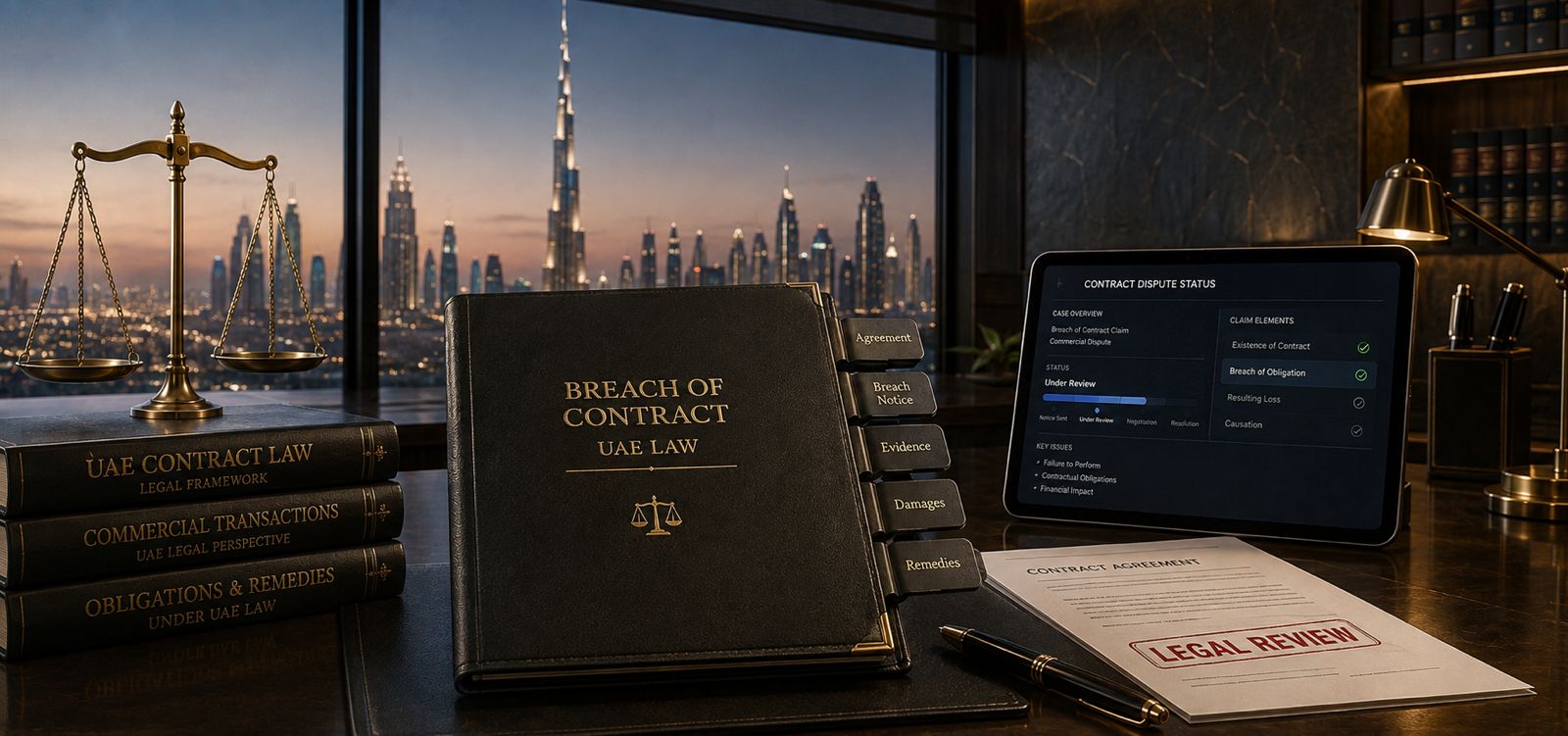

Breach of contract under UAE law is assessed against the obligation the parties actually agreed to perform. The source article explains that the Civil Transactions Law provides the general framework, while the wording of the specific contract remains central to the analysis.
A breach occurs where a party fails to perform a contractual obligation without a legally recognised excuse. The remedies identified in the source are compensation for actual loss, specific performance, and, for serious or repeated breaches, termination of the contract.
Breach of contract under UAE law occurs when a party fails to perform an obligation under a valid contract without a legally recognised excuse. The source identifies Federal Decree-Law No. 25 of 2025 as the current Civil Transactions Law and states that force majeure requires actual impossibility of performance, not simply greater difficulty, cost, or reduced profitability. The remedies described are compensation for actual and provable loss, specific performance requiring the original obligation to be fulfilled, and termination for serious or repeated breaches that undermine the contract’s core purpose. The article also states that the current law replaced the previous 1985 law from 1 June 2026, so the applicable version should be confirmed by reference to when the contract was entered into or the dispute arose.
What Counts as Breach of Contract Under UAE Law
If you need professional guidance, contract lawyer in dubai can help you understand your options.
This connects closely with our guide on what happens when a tenancy contract expires.
The starting point is a genuine contractual obligation. The source describes breach as a failure to perform that obligation without a legally recognised excuse.
The contract itself therefore matters. Before deciding what remedy may be available, the obligation that was promised and the way it was not performed need to be identified clearly.
Failure to Perform Is the Core Issue
The source focuses on non-performance of an agreed contractual obligation. It does not describe every commercial disappointment or difficult outcome as a breach.
The key distinction is between an obligation that was actually agreed upon and circumstances that merely made performance inconvenient, more expensive, or less profitable.
Where the dispute turns on the wording of the agreement and the obligation that was promised, contract lawyers in Dubai can review the contract and the alleged breach.
The Force Majeure Defence Has a High Bar
The source states that force majeure requires performance to have become genuinely impossible. It specifically rejects the idea that greater difficulty, higher cost, or reduced profitability is enough on its own.
That makes the distinction between impossibility and inconvenience central to the defence described in the article. A party relying on force majeure needs to show the type of impossibility identified by the source.
Has the Other Side Stopped Performing?
Being told the contract became too expensive to perform is not the same as it becoming impossible, and the difference decides the case. Send us the contract and we will tell you whether the excuse actually holds.
Compensation for Actual Loss
Compensation is one of the three remedies identified in the source. The article describes it as compensation for the actual financial harm caused by the breach.
It also states that the loss must be provable and specific rather than speculative. This makes evidence of the claimed financial harm important when compensation is the remedy being pursued.
Where the main remedy sought is financial recovery for provable loss, compensation claims lawyers in Dubai can review the claimed loss alongside the underlying contract dispute.
Specific Performance
Specific performance is the second remedy identified in the source. It is described as a court order compelling the breaching party to fulfill the original contractual obligation instead of simply paying damages.
The article also states that courts generally favour remedies that keep the contract alive where possible. On the source’s framing, specific performance can therefore matter where the original obligation can still be fulfilled.
Termination of the Contract
Termination is the third remedy described in the source. The article reserves it for serious or repeated breaches that undermine the contract’s core purpose.
The source does not treat termination as the automatic result of every breach. It presents compensation or performance as remedies that may preserve the agreement, with full termination reserved for the more serious situations described.
Choosing Between the Remedies in the Source
The three remedies serve different purposes. Compensation addresses actual provable loss, specific performance aims to secure the original obligation, and termination ends the contractual relationship where the breach is serious enough to undermine its core purpose.
The article warns against pursuing termination automatically where compensation or specific performance would be the more realistic remedy. The nature of the obligation and the effect of the breach should be considered before choosing the route.
Where the key objective is to compel performance of an existing obligation, an enforcement of obligations lawyer in Dubai can assess the non-performance issue and the available enforcement route.
Why the 2025 Civil Transactions Law Matters
Not sure who to choose? Our guide on who is the best contract lawyer in dubai breaks down what matters most.
Our related guide on what is a limited and unlimited contract in the UAE goes into this further.
The source states that Federal Decree-Law No. 25 of 2025 replaced the previous 1985 Civil Transactions Law, effective 1 June 2026. It also states that many provisions governing breach, force majeure, and remedies were renumbered.
For that reason, the article says a breach analysis should confirm which version applies. It states that this will generally be determined by when the contract was entered into or when the dispute arose. The full text is available through the official UAE legislation portal.
Working From Article Numbers That No Longer Exist?
Provisions on breach, force majeure, and remedies were renumbered when the 1985 law was replaced. Citing the wrong version weakens an otherwise strong claim. We confirm which framework governs your contract before anything is filed.
What to Review Before Choosing a Remedy
- Identify the exact contractual obligation said to have been breached.
- Record what performance was required and what did or did not happen.
- If force majeure is raised, separate genuine impossibility from increased cost, difficulty, or reduced profit.
- If compensation is sought, identify the actual and provable financial loss said to have resulted from the breach.
- Consider whether the original obligation can still be performed or whether the breach is serious or repeated enough to undermine the contract’s core purpose.
- Confirm which civil transactions law framework the source says applies by reference to when the contract was entered into or the dispute arose.
Evidence to Organise From the Contract and Dispute
The source repeatedly ties the analysis to the contract, the obligation, actual loss, and the circumstances said to excuse performance. Organising those points makes the dispute easier to assess without changing the legal framework stated in the article.
- The contract and the clause containing the obligation in dispute.
- Documents showing what performance was required.
- Documents showing the alleged failure to perform.
- Material supporting any claim of actual financial loss.
- Material relied on to support a claim that performance became impossible.
- Dates showing when the contract was entered into and when the dispute arose.
Where the agreement contains an arbitration clause, our arbitration lawyers in Dubai can confirm the correct forum before proceedings begin.
Common Mistakes
- Assuming increased cost or reduced profitability automatically excuses non-performance.
- Treating inconvenience as the same thing as impossibility of performance.
- Claiming compensation without identifying actual and provable loss.
- Pursuing termination automatically when specific performance or compensation may better match the dispute.
- Using article numbers from the previous 1985 law without checking the current framework identified in the source.
- Failing to confirm which version of the Civil Transactions Law applies to the contract or dispute.
The wider framework governing business agreements is set out in this overview of commercial law in the UAE, and our corporate lawyers in Dubai can review contractual risk across an ongoing commercial relationship.
People Also Ask
Conclusion
Breach of contract under UAE law begins with the obligation the parties actually agreed to perform. The source then asks whether non-performance occurred without a legally recognised excuse and which remedy best fits the result.
Compensation, specific performance, and termination serve different purposes, while force majeure is described as requiring genuine impossibility. The source also makes the timing of the contract or dispute important because of the transition to the current Civil Transactions Law.
Contract Broken and Unsure Which Route to Take?
Choosing termination when the court would have ordered performance can cost you the deal and the claim. Leaders Advocates reviews the obligation, the loss, and the applicable law, then pursues the remedy that actually fits your position.
4 Comments