


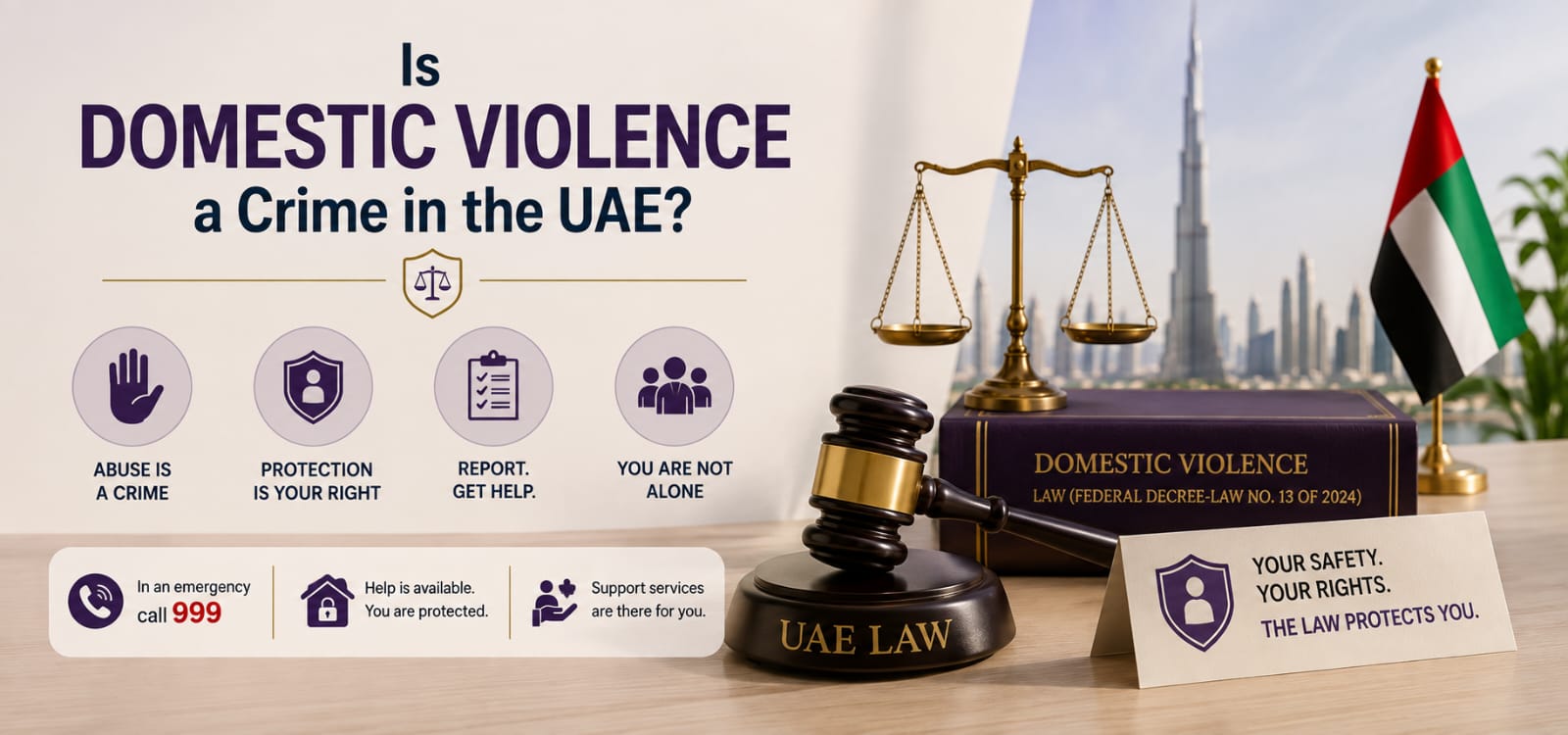

If there is immediate danger, call UAE Police on 999 or move to a safe public place if you can do so safely. A person who cannot speak freely should use a trusted device or ask someone nearby to contact the police. Medical care should not be delayed because a complaint has not yet been filed.
Is domestic violence a crime in the UAE? Yes. Conduct within a family or household may be prosecuted under the current federal domestic-violence framework and, depending on the act, under the UAE crimes and penalties law or another specialised law. The applicable charge and penalty depend on what occurred, the harm caused, the evidence, and any aggravating circumstances.
Yes. Federal Decree-Law No. 13 of 2024 on the Protection Against Domestic Violence replaced the earlier 2019 law and establishes the current federal protection framework.
Domestic violence can include physical, psychological, sexual, or economic abuse, as well as threats or other conduct covered by the law. A victim may report to the police or a competent protection authority, obtain medical assistance, ask for shelter and social support, and seek a protection order where the legal conditions are met.
Serious acts such as assault, threats, sexual offences, unlawful confinement, property damage, or online abuse may also be prosecuted under other criminal laws.
In an emergency call 999. Preserve evidence only when safe, and do not warn an alleged abuser if doing so could increase the danger.
The Current UAE Law on Domestic Violence
If you need professional guidance, domestic violence lawyers in dubai can help you understand your options.
The principal current federal framework is Federal Decree-Law No. 13 of 2024 on the Protection Against Domestic Violence. It replaced Federal Decree-Law No. 10 of 2019. Any article that presents the 2019 decree-law as the current standalone law is outdated.
The 2024 law is designed to prevent domestic violence, protect affected people, regulate reporting and intervention, and support social awareness. Its protective procedures operate alongside the UAE criminal law. This matters because “domestic violence” is not one fixed charge with one automatic sentence in every case.
What Can Count as Domestic Violence?
If you’re comparing your options, our guide on who is the best domestic violence lawyer in dubai is a useful starting point.
Domestic violence is broader than visible physical injury. The legal assessment may cover conduct that causes or threatens physical, psychological, sexual, or economic harm within a relationship covered by the law. A pattern of control can be relevant even when individual incidents look minor in isolation.
Physical abuse
Hitting, pushing, kicking, burning, strangulation, using an object as a weapon, denying urgent medical care, or restraining a person may constitute criminal conduct. The absence of a fracture or hospital admission does not make an assault lawful.
Psychological abuse and threats
Threats, intimidation, humiliation, coercive behaviour, repeated degradation, and conduct designed to create fear may be relevant. The exact criminal treatment depends on the words, medium, context, and evidence. A threat delivered by message can also raise issues under electronic-crime legislation.
Sexual abuse
Sexual conduct without lawful consent or conduct falling within a criminal prohibition should be reported promptly. A person seeking help can request medical attention and ask how to preserve forensic evidence. The classification of an alleged sexual offence is a matter for police and Public Prosecution based on the facts and applicable law.
Economic abuse
Economic abuse may include unlawfully controlling access to essential resources, taking property, destroying belongings, withholding documents, or using financial pressure as a means of harm or control. Not every disagreement about household spending is a crime, but financial conduct can form part of a wider abusive pattern.
Abuse involving children or vulnerable people
Where a child, older person, or person with disabilities is at risk, additional protection duties and specialised laws may apply. Reports involving children should be made urgently through the police or the official child-protection channels.
Need Protection?
Facing Domestic Violence or Threats in the UAE?
If there is immediate danger, contact UAE Police on 999. For legal guidance, our domestic violence lawyers can explain reporting options, protection orders, and the steps that may be available to protect you and your family.
Who Can Be Protected?
The law’s application depends on its statutory definition of family and domestic relationship, not only on whether two people are married. Spouses, former or separated family members in relevant circumstances, parents, children, relatives, and people linked through care or household relationships may fall within the framework.
Citizenship does not remove the protection. UAE citizens and expatriate residents can report violence and seek assistance. A visa sponsored by the alleged abuser does not prevent a victim from calling the police or requesting emergency protection.
Domestic Violence and Other Criminal Offences
A single incident can engage more than one legal provision. Police and Public Prosecution decide the legal classification after examining statements, medical evidence, messages, recordings lawfully obtained, witness accounts, and other material.
- Assault or injury offences where physical force causes harm.
- Threat, insult, harassment, or coercion offences where the statutory conditions are met.
- Sexual offences, which require sensitive and prompt investigation.
- Unlawful confinement or restriction of movement.
- Damage, theft, or misuse of the victim’s property or documents.
- Electronic offences involving threatening messages, account misuse, publication, or digital harassment.
- Child-protection offences or failures to protect a child from danger.
Because the classification controls the potential sentence, it is unsafe to publish one universal prison term or fine for every domestic-violence case. The court applies the provisions proved in the particular prosecution. Criminal Defense Lawyers in Dubai can explain the charge, evidence, bail position, and prosecution process in a specific file.
What Is a Protection Order?
You can read more about this in our guide on how to get a restraining order in dubai.
A protection order is intended to reduce immediate risk while the authorities address the complaint. Depending on the order and facts, it may restrict contact or approach, protect a residence or workplace, prevent interference with property, or impose other measures authorised by law.
A protection order is not the same as a final criminal conviction. It is a protective measure. Breaching it can have separate legal consequences, so both the protected person and the person subject to the order should obtain and follow the exact written terms.
How to Report Domestic Violence in the UAE
In an emergency
Call 999. Give the location first, then state whether anyone is injured, whether a weapon is present, whether children are inside, and whether the alleged abuser remains nearby. If speaking would increase danger, use a trusted person or safe opportunity to contact emergency services.
When there is no immediate attack
A report may be made through the police or the official protection and support channels in the relevant emirate. The UAE Government portal lists national and emirate-level channels for reporting violence and abuse. Current numbers should be verified on the official portal because service names and contact routes can change.
Medical care
Seek medical assistance for injuries, pain, breathing difficulty, pregnancy concerns, sexual assault, or severe distress. Tell the clinician how the injury occurred. A contemporaneous medical record can support treatment and may later become relevant evidence, but the first purpose is safety and health.
Reporting for someone else
A concerned relative, neighbour, colleague, teacher, healthcare worker, or other person may contact the police or a protection service when someone appears to be at risk. Do not confront the alleged abuser or attempt a rescue that could escalate the danger. Give the authorities concrete facts rather than assumptions.
What Happens After a Report?
- The police or competent authority records the report and assesses immediate safety.
- Emergency medical care, safe accommodation, or another protective step may be arranged where needed.
- Statements and available evidence are collected. A victim may be asked for devices, messages, photographs, or medical documents.
- The matter may be referred to the Public Prosecution for criminal investigation and legal classification.
- A protection order or another measure may be considered under the applicable procedure.
- Family-law issues such as divorce, custody, maintenance, or use of the family home may proceed separately.
- The case may conclude through a prosecution decision, court judgment, or another lawful outcome based on the evidence.
Do not delete or edit the original messages after taking screenshots. Keep the device, export the conversation where possible, and record the date and context. Never obtain evidence by hacking an account, secretly entering a protected device, or publishing private material online.
Evidence That May Help
- Police incident numbers and the names or badge details provided during attendance.
- Medical reports, prescriptions, discharge papers, and photographs taken safely.
- Original messages, voice notes, emails, call logs, and platform account details.
- A dated incident chronology written while events are fresh.
- Names and contact details of people who saw or heard relevant events.
- Photographs of damaged property and receipts or ownership records.
- Copies of passports, Emirates IDs, marriage records, children’s documents, and important financial information stored safely.
Evidence should be preserved, not circulated. UAE privacy, recording, and cybercrime rules can affect how material may lawfully be obtained or shared. Give it to the police, prosecutor, court, or lawyer rather than posting allegations on social media.
Preserve the Right Evidence
Unsure How to Report Abuse or Preserve Evidence Lawfully?
Medical records, messages, photographs, witness details, and police reports may become important evidence. Our lawyers can help you understand how to preserve relevant material without creating additional privacy or cybercrime issues.
Safety Planning Before Leaving
Leaving can be a high-risk moment. A safety plan should be discreet and realistic. If possible, identify a safe destination, a trusted contact, emergency transport, and a small set of essential documents. Do not make a plan on a shared device if the alleged abuser monitors it.
- Keep emergency numbers under a neutral name if that is safer.
- Prepare medication, keys, cash or a payment method, charger, and essential documents.
- Agree on a code word with a trusted person who can call police.
- Turn off location sharing only when doing so will not trigger immediate danger.
- Change passwords from a safe device and review recovery email and phone settings.
- Tell a school or nursery about authorised collection arrangements when children are involved.
- Follow the exact terms of any protection or custody order.
Domestic Violence, Divorce, and Child Custody
A criminal complaint does not automatically complete a divorce or decide custody. Criminal, protective, and personal-status proceedings can overlap but have different purposes. The family court considers the child’s welfare and the evidence placed before it, while criminal authorities investigate alleged offenses.
A victim considering separation may need advice on residence, financial support, interim child arrangements, travel restrictions, school documents, and possession of passports. A Family Lawyer in Dubai can coordinate the personal-status issues with the safety and criminal case.
Can a Complaint Be Withdrawn?
A victim may ask about withdrawing or reconciling but cannot assume that a criminal file will automatically end. Once authorities investigate conduct that may constitute an offense, the public prosecution and the court apply the law governing that offense. The legal effect of a waiver or reconciliation depends on the charge and procedural stage.
Pressure to withdraw can itself be relevant to safety. Before signing a statement, settlement, or waiver, obtain independent advice and confirm whether a protection order, housing arrangement, financial obligation, or child issue remains unresolved.
If the Accusation Is Disputed
The authorities must assess evidence fairly. A person accused of domestic violence should comply with police and prosecution directions, preserve relevant messages and records, and avoid direct or indirect contact that could breach an order or be understood as pressure on the complainant. Deleting data or asking another person to influence a witness can seriously damage the defence.
A disputed allegation does not justify retaliation, online publication, or removal of children contrary to an order. The accused person can present a statement, identify witnesses, request examination of relevant evidence, and obtain legal representation. Emergency protection and the presumption that a criminal charge must be proved perform different functions and should not be confused.
Privacy and Confidentiality
Domestic-violence matters involve highly sensitive family, medical, and child information. Keep reports, orders, and evidence in secure storage and share them only with the authorities, treating professionals, and legal advisers who need them. Publicly naming parties can create privacy, defamation, or cybercrime risks and may harm children connected to the case.
A victim who fears device monitoring should use a safe device, review cloud sharing, disable unknown linked sessions, and change passwords carefully. Sudden changes can sometimes alert an abusive person, so digital safety should form part of the wider safety plan rather than being treated as a purely technical task.
Common Mistakes That Can Increase Risk
- Warning the alleged abuser about a report before reaching safety.
- Meeting alone to negotiate after threats or escalating violence.
- Deleting original digital evidence after saving only cropped screenshots.
- Publishing accusations, private images, or recordings online.
- Assuming visa dependence removes the right to call police.
- Treating a protection order as a divorce or custody judgment.
- Relying on outdated summaries of the repealed 2019 law.
- Ignoring injuries because they are not externally visible.
Frequently Asked Questions
Is emotional abuse reportable in the UAE?
Yes.
Psychological harm and threats can fall within the domestic-violence framework. Give the authorities specific examples, dates, messages, witnesses, and the effect on safety rather than only a general label.
Can an expatriate report domestic violence against a visa sponsor?
Yes.
Sponsorship does not remove access to police or protection services. The person should also obtain advice about residence status and dependent children.
Do I need visible injuries to make a report?
No.
Domestic violence can include psychological, sexual, and economic abuse. Report the conduct and available evidence even when there is no visible injury.
Can the police remove an abusive person from the home?
The immediate action depends on the risk, alleged offence, and available legal measures. Ask the responding officers about safety steps and any protection-order process.
Can I record domestic violence secretly?
Recording and privacy rules are fact-sensitive. Do not hack devices or publish recordings. Ask a UAE lawyer how to preserve evidence lawfully and provide it directly to authorities.
Will a domestic violence report decide child custody?
Not by itself.
The report and resulting evidence may be relevant, but the family court decides custody and protective arrangements under the applicable personal-status rules.
What if the abuser threatens to cancel my visa?
Contact police if the threat creates immediate danger and obtain prompt immigration and family-law advice. Do not stay in danger solely because the other person is the sponsor.
What should I take when leaving an unsafe home?
Only what can be collected safely: identity documents, children’s papers, medication, keys, phone and charger, money, and evidence copies. Police or support services can advise when returning alone would be unsafe.
Get Confidential Legal Support
The answer to “is domestic violence a crime in the UAE?” yes, but the correct response depends on immediate risk, the evidence, the relationship, and the specific acts alleged. Emergency safety comes first, followed by medical care, reporting, evidence preservation, and coordinated criminal and family-law advice.
For confidential case-specific help with reporting, protection orders, criminal proceedings, or connected family issues, contact Domestic Violence Lawyers in Dubai.
When Family Issues Overlap
Domestic Violence Can Affect Divorce, Custody, Housing, and Residency
A police complaint does not automatically resolve divorce, child custody, maintenance, travel, or visa concerns. Our UAE family lawyers can help coordinate the connected legal issues while keeping immediate safety at the centre of the case.