


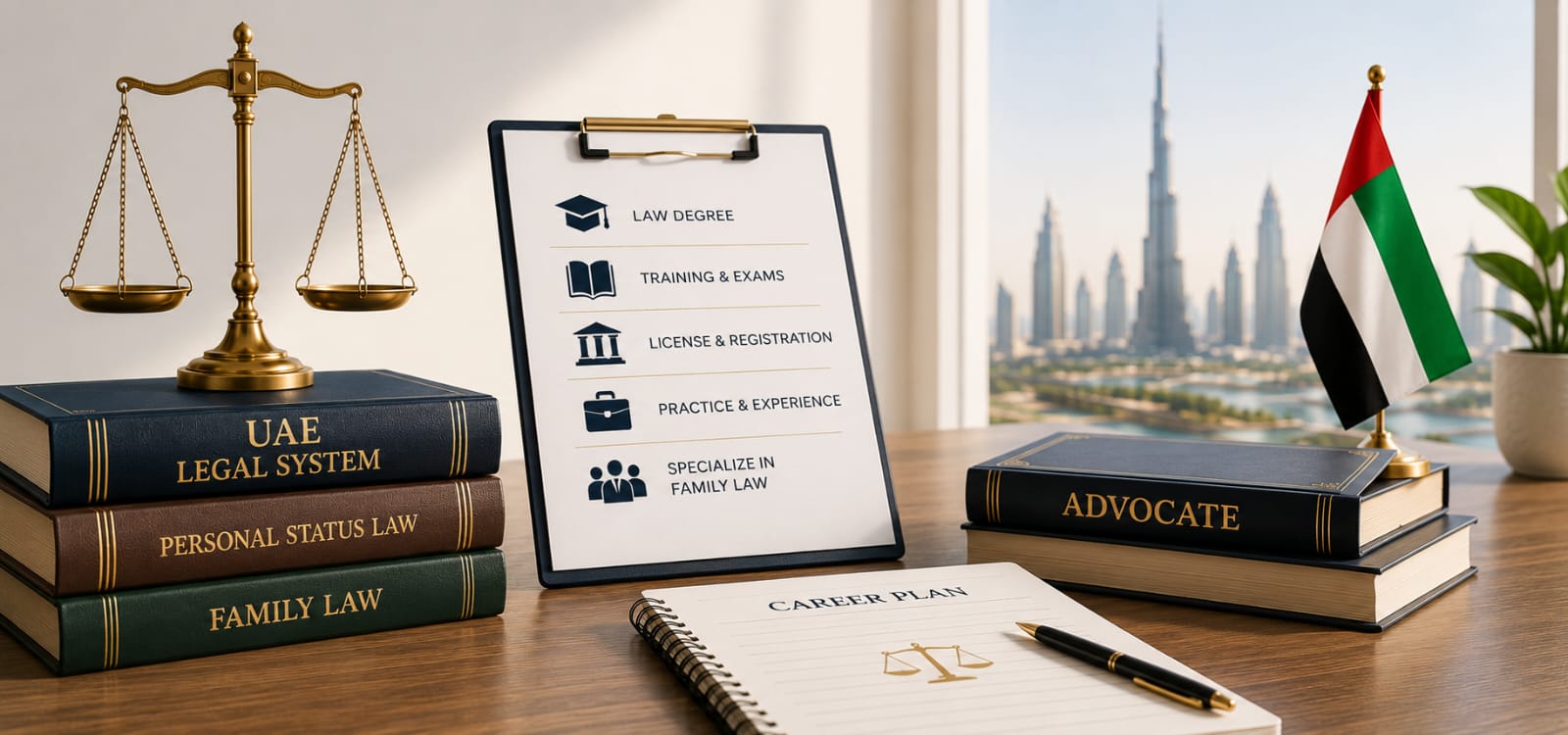

How to Become a Divorce Lawyer in the UAE is not answered by earning a degree and choosing divorce law as a title. The UAE regulates legal professionals through distinct roles, registers, licensing authorities, and practice rights. The route also changes according to nationality, experience, employer, emirate, and whether the person intends to advise clients or appear before a particular court.
A divorce lawyer is not a separate statutory licence category. It is a lawyer, advocate, or legal consultant who has the required professional authorization and develops a practice in personal-status and family disputes. Before choosing courses or applying to firms, identify the professional role you can lawfully pursue and the authority that regulates it.
Start with a recognized law or Sharia and law degree, then identify the correct professional track. A practising advocate can plead and represent clients before the courts covered by the advocate’s registration. A legal consultant provides legal services within the limits of the relevant registration but does not automatically receive rights of audience before mainland courts.
Under the federal framework, the standard practising-lawyer route includes nationality, age, capacity, character, degree, training, examination, interview, medical-fitness, insurance, and registration requirements. A narrow non-national lawyer route also exists, but it requires substantial prior practice and carries important limits, including restrictions concerning Muslim personal-status cases.
Dubai maintains its own advocate and legal-consultant rolls.
After licensing, build supervised experience in divorce, custody, maintenance, evidence, settlement, appeals, enforcement, and cross-border family law.
How to Become a Divorce Lawyer in the UAE: First Choose the Role
Working with divorce lawyers in dubai can help you avoid costly mistakes here.
The phrase “divorce lawyer” is used commercially, but legal authority comes from the underlying professional status. A person may work as a practising advocate, a legal consultant, a legal researcher or assistant, an in-house professional, or a foreign practitioner within a separately regulated forum. These roles are not interchangeable.
The governing federal framework is Federal Decree-Law No. 34 of 2022 Regulating the Legal Profession and Legal Consultation Profession, read with Cabinet Resolution No. 8 of 2025. Dubai also applies Legal Affairs Department registration bylaws and service requirements. Courts and free-zone forums may maintain separate rights-of-audience or practitioner rules.
Advocate and Legal Consultant Are Not the Same
Our related guide on who is the best female divorce lawyer in dubai can help you make that decision.
Practising Advocate
A practising advocate is registered to provide legal services and plead or represent third parties before the courts and judicial authorities covered by that registration. The roll may distinguish the court levels before which the advocate can appear. Registration with one authority should not be assumed to create unrestricted rights before every UAE or free-zone court.
Legal Consultant
A legal consultant may advise, research, negotiate, draft, and provide other permitted legal services through a licensed firm. Dubai’s official service description expressly excludes pleading and representing third parties before Dubai Courts from the legal-consultant role. Court appearances must be handled by a person with the required advocacy rights.
A consultant can still build a serious family-law career. Many matters require client counselling, settlement design, evidence analysis, cross-border coordination, and drafting before or alongside litigation. The professional must describe the role accurately and never imply court rights that the registration does not provide.
Step 1: Earn a Recognized Legal Qualification
Our related guide on how to get a divorce certificate in the UAE goes into this further.
The standard foundation is a bachelor’s degree in law, Sharia and law, or an equivalent recognized qualification. Dubai’s legal-consultant service also recognizes an academic qualification in law combined with valid professional membership in a jurisdiction where the applicant is authorized to provide legal services, subject to its rules.
- Choose a recognized institution and confirm equivalency requirements before relying on a foreign degree.
- Study civil procedure, evidence, contracts, criminal law, public law, and professional ethics, not only family law.
- Build a strong base in Islamic jurisprudence and personal status where the curriculum permits.
- Develop legal Arabic and precise English drafting for multilingual and cross-border work.
- Keep official transcripts, degree certificates, course records, and professional-membership documents ready for attestation.
Step 2: Authenticate and Recognize Foreign Qualifications
We cover this in more detail in our guide on iddah after divorce in the UAE.
A foreign degree does not become a UAE licensing credential merely because it is translated. The relevant authority may require attestation, legalization, equivalency, proof of course content, or evidence of professional membership. Requirements can differ between federal registration and Dubai registration.
Resolve name differences across passports, degrees, bar certificates, and experience letters before applying. Employment dates and job titles should be supported by clear records. An incomplete or inconsistent experience history can affect which registration category is available.
Step 3: Build the Required Practical Experience
Experience requirements depend on the route. Dubai’s current legal-consultant service states that a UAE national, and a non-UAE national graduating from a UAE institution, generally needs at least one continuous year of practical legal experience. A non-UAE national graduating outside the UAE generally needs three years, subject to the detailed service conditions.
Federal categories for legal researchers and consultants use their own conditions and experience thresholds. The 2025 Executive Regulations distinguish categories, including experience rules for UAE and non-UAE professionals. Do not combine federal and Dubai thresholds into one universal number.
Step 4: Complete Training, Examination, and Interview Requirements
For the standard federal practising-lawyer route, the Executive Regulations require completion of the approved training program unless a stated experience exemption applies, followed by the prescribed written examinations and personal interview. The training includes theoretical and practical elements.
Practical training is supervised through a qualifying practising lawyer and involves real exposure to courts, police stations, and Public Prosecution within the regulatory framework. A trainee should treat attendance records, supervisor reports, assigned cases, and deadlines as licensing evidence, not informal work experience.
- Confirm eligibility for trainee registration before beginning an unapproved placement.
- Complete the required theoretical program through the authorized institution or centre.
- Obtain the trainee membership or registration evidence required for practical training.
- Train under an eligible supervising lawyer and maintain accurate activity records.
- Complete the prescribed assessment, written examination, and interview where applicable.
- Take the required legal oath and apply for transfer to the appropriate roll within the permitted period.
Step 5: Apply to the Correct Registration Authority
The application must match the intended place and form of practice. Federal courts, Dubai Courts, local judicial authorities, and financial free-zone courts do not operate as one licensing desk. A job offer from a law firm is not itself professional registration.
- Identify the courts or legal services the role will involve.
- Confirm whether the employer is a licensed advocacy or legal consultancy firm.
- Select the correct practising, non-practising, trainee, researcher, consultant, or advocate category.
- Submit attested qualifications, experience proof, identity and residence records, and employer documents.
- Complete medical, insurance, examination, interview, and fee requirements where the route requires them.
- Do not provide legal services to the public until registration and employment conditions are satisfied.
Start With the Right Role
Not Sure Whether to Pursue Advocacy, Legal Consultancy, or Another UAE Legal Track?
The correct path depends on your nationality, qualifications, experience, intended employer, and the courts or legal services you want to work with. Understanding the professional role first can help you avoid pursuing the wrong registration route.
The Standard Federal Practising-Lawyer Route
Article 12 of Cabinet Resolution No. 8 of 2025 sets conditions for registration to argue before Courts of First Instance and Courts of Appeal. They include UAE nationality, a minimum age of 21 Gregorian years, full capacity, good conduct and reputation, a recognized legal qualification, training or qualifying experience, examination and interview, medical fitness, timely completion of approvals, professional liability insurance, and fees.
Registration before the Federal Supreme Court is a further level. The Regulations specify experience routes for lawyers and certain former judicial or legal professionals. A new graduate should not market themselves as entitled to appear at every court level merely after initial registration.
The Narrow Federal Route for Non-National Lawyers
It is inaccurate to say that a foreign national can never be registered as a practising lawyer. The 2025 Executive Regulations provide a specific non-national route. It is not the ordinary graduate path: the applicant must meet the applicable general conditions and must have practised for at least 15 years, maintain valid registration in the jurisdiction of prior practice, and be a partner in a foreign firm licensed in the UAE, among other conditions.
The authorization is limited. The non-national lawyer practises only through that firm and appears only before specialized chambers designated by the competent judicial authority. The route excludes criminal and administrative cases and Muslim personal-status cases. It therefore cannot be presented as a general path for a foreign graduate who wants to litigate all UAE divorces.
Dubai Advocate Registration
Dubai’s official practising-advocate service permits representation before Dubai Courts and judicial authorities. Its published standard requirements include UAE nationality, capacity, character, a recognized and attested legal qualification, completion of the relevant Ministry of Justice training period or another accepted route, full-time employment with a licensed advocacy firm, firm approval, and payment of the prescribed fee.
Because service requirements are updated, candidates should use the current Legal Affairs Department service card and bylaws at the date of application. Old articles can omit later training, employment, insurance, professional-development, or renewal obligations.
Dubai Legal Consultant Registration
Dubai’s practising-legal-consultant service is open to qualifying UAE and non-UAE applicants. Current published requirements include legal capacity, character, an accepted legal qualification, attestation, relevant practical experience, work through a licensed Dubai firm, full-time employment, and restrictions on other professional or commercial activity.
A non-UAE applicant must also have valid UAE residence and an employment contract with the firm through which the profession is practised. Registration authorizes legal consultancy within its scope, not pleading before Dubai Courts. The distinction should appear clearly in the employment title, client communications, and marketing.
Free-Zone and International Court Practice
DIFC Courts and ADGM Courts operate separate practitioner and rights-of-audience structures. A foreign qualification may be relevant there, but admission to a foreign bar or employment in the UAE does not automatically grant the required registration. Check the chosen court’s current rules and categories.
Family and divorce jurisdiction is also limited by the forum. A lawyer working on commercial disputes in a financial free-zone court should not assume that the same court hears ordinary mainland personal-status cases. Career planning must align forum admission with the disputes that forum can decide.
Step 6: Learn the Current Personal-Status Frameworks
Family practice requires more than knowing one statute. Federal Decree-Law No. 41 of 2024 is the current general Personal Status Law. Federal Decree-Law No. 41 of 2022 and its Executive Regulations establish a civil personal-status framework for qualifying non-Muslims. Abu Dhabi also has a civil family court framework under local law.
- Formation, validity, and proof of marriage.
- Divorce, judicial separation, talaq, khula, and civil no-fault routes where applicable.
- Custody, guardianship, contact, relocation, travel, and child passports.
- Child and spousal maintenance, housing, education, healthcare, dowry, and compensation.
- Evidence, interim orders, appeals, execution, and enforcement tools.
- Foreign law, foreign judgments, jurisdiction, service abroad, and recognition.
- Wills, inheritance, succession, and the family consequences of death.
Arabic Is a Professional Requirement, Not a Decorative Skill
Mainland UAE court proceedings and official court records are conducted in Arabic. A family practitioner must understand pleadings, judgments, expert reports, official terminology, and oral exchanges accurately. Relying on translation without understanding the legal Arabic can hide material differences.
A legal consultant who works primarily in English still benefits from strong Arabic because client instructions must be converted into legally precise documents and coordinated with advocates. Where the practitioner is not fully proficient, certified translators and Arabic-speaking colleagues should be used transparently.
Step 7: Obtain Supervised Family-Law Experience
Licensing creates permission to practise within a role; it does not create competence in divorce cases. Early-career professionals should work under experienced family practitioners and learn the whole lifecycle of a file, including intake, conflict checks, jurisdiction, settlement, litigation, judgment, appeal, and execution.
- Observe client interviews and learn to separate legal issues from relationship history.
- Draft chronologies, issue lists, settlement terms, pleadings, and evidence indexes.
- Attend guidance, mediation, case-management, expert, and court sessions where authorized.
- Review judgments and trace how evidence and legal requests affected the result.
- Learn urgent procedures involving violence, travel, child removal, maintenance, and protective measures.
- Develop referral relationships for foreign law, tax, valuation, immigration, property, and corporate issues.
Step 8: Develop Client and Case-Management Skills
Divorce clients may be distressed, angry, frightened, or under pressure to sign. A strong practitioner explains choices without escalating conflict or promising an outcome. Advice should distinguish legal rights, evidence, cost, timing, settlement risk, and the client’s personal priorities.
File management is equally important. Record instructions, maintain confidentiality, preserve deadlines, verify translations, control document versions, disclose conflicts, and explain fees in writing. Family-law mistakes can affect children, housing, immigration, assets, and safety long after the hearing.
Foreign Qualification?
Understand Which UAE Legal Registration Route May Be Available to You
A foreign law degree or overseas bar admission does not automatically grant UAE court rights. Qualification recognition, practical experience, employer status, residence, and the applicable advocate or legal-consultant rules must be considered separately.
Ethics and Confidentiality in Divorce Practice
A practitioner must avoid conflicts, protect client information, communicate honestly, and stay within licensed competence. They should not contact a represented opponent improperly, coach false evidence, use illegally obtained private data, or publish identifiable family details for marketing.
Professional promotion is regulated. The federal Executive Regulations prohibit false, misleading, or fabricated claims and insinuations of influence. Awards, success stories, titles, court rights, and experience should be described accurately and with the confidentiality required by the matter.
Continuing Professional Development
Registration is not permanent competence. Laws, regulations, court services, digital filing, evidence practice, and professional rules change. Dubai’s framework includes continuing legal professional development obligations for registered professionals, while other authorities apply their own renewal requirements.
A useful annual plan combines statutory updates, judgment review, drafting workshops, ethics, advocacy, negotiation, trauma-informed client care, cross-border procedure, and supervised file review. Attendance certificates should be retained where they support renewal.
A Realistic Career Roadmap
- Complete a recognized legal qualification and begin legal Arabic early.
- Identify whether advocate, consultant, researcher, or free-zone practice is the realistic route.
- Authenticate qualifications and gather reliable experience evidence.
- Join a properly licensed firm in a role that supports the intended registration.
- Complete training, examinations, interviews, medical, insurance, and registration steps.
- Build supervised experience across personal-status procedure and substantive law.
- Develop a focused practice through writing, case review, negotiation, and ethical client work.
- Maintain registration, professional development, and accurate public descriptions of practice rights.
Relevant Legal Practice
Divorce Lawyers in Dubai show how divorce advice and litigation are structured in practice. Family Lawyers in Dubai work across connected personal-status issues, while a Litigation Lawyer in Dubai focuses on court procedure, evidence, hearings, appeals, and enforcement within the lawyer’s authorization.
Common Career Mistakes
- Calling yourself an advocate when registered only as a consultant, researcher, or assistant.
- Assuming one registration grants rights before every UAE and free-zone court.
- Treating a foreign law degree or bar membership as automatic UAE admission.
- Ignoring Arabic until after applying for family-law roles.
- Studying only divorce rules and neglecting evidence, procedure, appeals, and execution.
- Relying on outdated nationality or experience summaries instead of the current service card.
- Handling complex custody or cross-border files without supervision or specialist support.
- Marketing guaranteed results, influence, or confidential case details.
Frequently Asked Questions
Is there a separate UAE license called a divorce lawyer license?
No.
Divorce law is a practice focus. The professional first needs the correct advocate, legal consultant, or other registration for the role and forum, then develops competence in family and personal-status law.
Can a new foreign law graduate plead UAE divorce cases?
Not through the narrow federal non-national practicing-lawyer route.
That route requires at least 15 years of practice and other conditions and excludes Muslim personal-status cases. A foreign graduate may instead pursue an eligible consultant or researcher path.
Does a Dubai legal consultant appear before Dubai Courts?
Dubai’s official service description excludes pleading and representing third parties before Dubai Courts from the practising legal consultant’s role. Court representation requires an advocate with the relevant rights.
Must an aspiring UAE family lawyer study Sharia?
A full law curriculum and the applicable licensing qualification come first, but serious knowledge of Sharia-based personal-status concepts is essential for relevant Muslim family matters. Civil non-Muslim frameworks must also be studied separately.
Can an LLM replace the required practical legal experience?
An LLM can deepen knowledge but does not automatically replace experience, training, examination, employment, or registration requirements. The competent authority decides whether a stated exemption applies.
Can a lawyer registered abroad give UAE divorce advice from Dubai?
Foreign admission alone does not authorize UAE public legal practice. The person and firm must comply with the relevant UAE or Dubai legal-consultancy and employment rules and must not imply rights of audience they do not hold.
How long does it take to build a UAE divorce-law practice?
The licensing timeline depends on nationality, education, experience, training, employer, and registration route. Competence takes longer than registration because supervised exposure to diverse family cases, judgments, appeals, and enforcement is essential.
How can clients verify a practitioner’s actual UAE role?
Check the current directory or registration information of the competent authority and ask which roll, firm, emirate, and court rights apply. A job title or social-media biography is not conclusive proof of authorization.
Build Real Family-Law Experience
Licensing Is Only the Beginning of a Divorce-Law Career
Strong family-law practice develops through supervised work involving divorce, custody, maintenance, evidence, settlement, appeals, enforcement, and cross-border matters. Practical exposure is essential to building professional competence.