


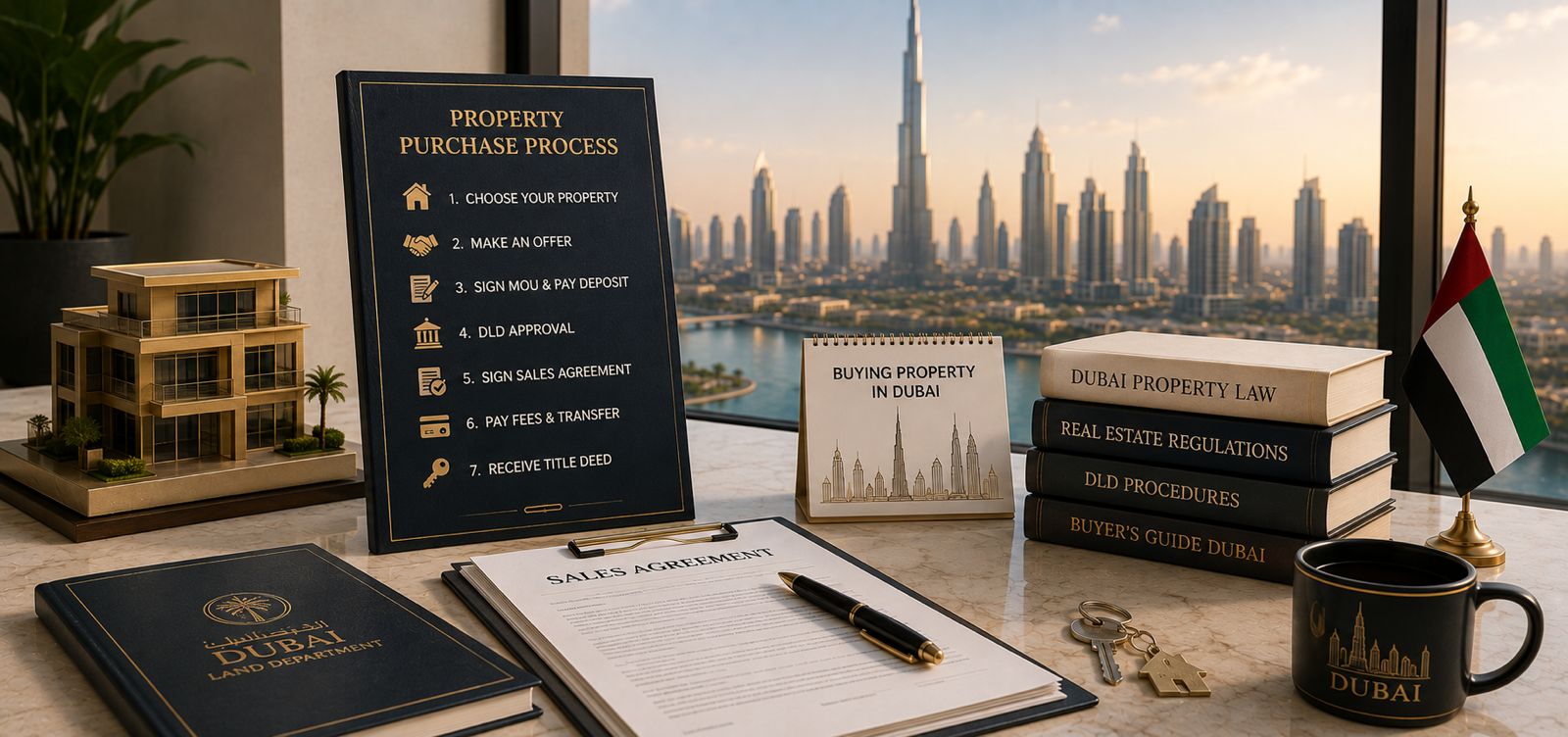

A buyer can lose money before the property transfer even begins. The usual causes are paying a deposit before checking ownership, signing the wrong contract, or sending off-plan payments outside the approved escrow account.
The correct process depends on whether the property is ready or off-plan. Each route uses different documents, payment stages, and registration steps.
For a ready property, verify the title and freehold status, arrange finance, sign Form F, pay the agreed deposit, obtain the developer NOC, clear any mortgage, and complete the transfer at a DLD trustee office. For an off-plan property, verify the developer, project, and escrow account; sign the reservation and SPA; confirm Oqood registration; follow the payment plan; and receive the title deed at handover. Buyers should also budget for DLD, agency, trustee, registration, and finance costs.
Choose the ready or off-plan route before paying anything. Verify the property, seller, developer, broker, title, escrow account, and contract through official channels. Real estate lawyers in Dubai can review Form F or the SPA and identify deposit, delay, default, and transfer risks before funds are committed.
Before You Start: Ready or Off-Plan?
In cases like this, it is worth speaking with real estate lawyer in dubai.
This single choice determines everything that follows, so it is worth making deliberately before looking at specific units.
- A completed, existing unit, bought from its current owner: A unit still under construction, bought directly from the developer
- Core document: Form F & Sales and Purchase Agreement (SPA)
- Full price due at or shortly after transfer: Payments staged across the construction period
- Typical completion: 10 to 14 days for cash purchases: Spans the construction timeline, often 1 to 3 years
- Market price, no discount: Often priced 10% to 30% below comparable ready units
Buying Ready or Off-Plan Property in Dubai?
The legal checks are different for each route. Get professional guidance before paying a deposit, signing Form F, or committing to an off-plan SPA.
The Process for Ready (Secondary Market) Property
If you’re comparing your options, our guide on who is the best real estate lawyer in dubai is a useful starting point.
This path is the more familiar one, closer to buying an established home anywhere, with a few Dubai-specific steps built in.
- Search and verify. Confirm the property sits in a freehold zone if you are a foreign buyer, and check its ownership status, any registered mortgage, and outstanding caveats through the Dubai REST app.
- Arrange financing, if needed. Non-resident buyers can typically borrow up to 50% to 60% of the property’s value.
- Sign Form F. This standardized sale contract, prepared by a RERA-certified agent, sets out the price, deposit, and completion deadline. A deposit, commonly 10%, is paid at signing, usually by the manager’s cheque.
- The seller obtains the developer’s NOC, confirming no outstanding service charges remain on the unit. The DLD will not process a transfer without it.
- Any existing mortgage on the property is cleared before the transfer can proceed.
- Both parties attend a DLD trustee office appointment, where documents and identities are verified and the transfer fee is paid.
- The new title deed is issued in the buyer’s name, often on the same day.
The Process for Off-Plan Property
You can read more about this in our guide on when to hire a real estate lawyer in dubai.
This path is longer and more staged, built around protecting buyer payments across a construction timeline that can run years.
Real estate lawyers in Dubai can check the title, Form F, SPA, escrow details, and completion conditions before the transaction reaches a stage where the deposit is at risk.
- Verify the project’s registration and escrow account. Every legitimate off-plan project must be registered with the DLD, and every buyer payment must go into a project-specific escrow account, not to the developer directly.
- Pay the reservation fee, typically 5% to 10% of the price, securing your chosen unit.
- Review and sign the Sales and Purchase Agreement, the single most important document in the transaction, covering price, payment schedule, and what happens in the event of delay or default. Independent legal review before signing is worth it here.
- Make the first major payment, typically 10% to 20% of the total price, alongside signing.
- The developer registers the sale through Oqood, generally within 90 days of signing, creating your interim ownership record.
- Further payments follow the staged schedule in your SPA, typically tied to construction milestones rather than fixed calendar dates.
- At handover, the Oqood registration converts into a full title deed in your name.
What the Process Costs
Beyond the purchase price, budget for several fees that apply regardless of which path you take.
- DLD transfer/registration fee: 4% of the purchase price. Both paths
- Agent commission: Around 2% plus VAT. Mainly ready property purchases
- Trustee office fee: AED 4,000 to AED 5,250. Ready property transfers
- Oqood registration fee: From around AED 1,000. Off-plan only
- Mortgage registration fee: 0.25% of the loan, plus AED 290. If financing
- Bank valuation fee: AED 2,500 to AED 3,500. If financing
Most buyers should budget roughly 7% to 8% of the purchase price for total transaction costs, on top of the price itself.
Due Diligence Checks Before Payment
A handful of checks, done at the right moment, prevent most of the problems buyers run into.
- Verify the broker’s license through the Trakheesi system before working with them.
- Check the property’s title status through Dubai REST, confirming there are no undisclosed mortgages or disputes.
- For off-plan, confirm the escrow account and RERA registration number independently, not just from the sales team’s word.
- Read the full contract, Form F or the SPA, rather than a summary, paying particular attention to default and delay clauses.
Financing the Purchase
If you are using a mortgage, timing matters as much as the rate.
Non-resident buyers can generally borrow up to 50% to 60% of a property’s value. Pre-approval typically lasts only 60 to 90 days, considerably shorter than an off-plan construction timeline, so buyers financing an off-plan purchase should expect to reapply closer to actual handover, with no guarantee the original terms will still be available.
Protect Your Deposit Before You Pay
A title check, broker verification, escrow review, and contract assessment can uncover risks before your money is committed. Have your transaction reviewed before signing or making payment.
Property and UAE Residency
Buying does not automatically grant residency, but it can open the door to it.
- AED 750,000 or more (completed property, sole owner): 2-year investor visa, renewable
- AED 1,000,000 or more: 5-year retirement visa, for applicants aged 55 and above
- AED 2,000,000 or more: 10-year Golden Visa
Our dedicated guide on residency through buying property in Dubai covers the current requirements and recent 2026 changes to each tier.
Common Mistakes to Avoid
A handful of recurring errors show up across both buying paths.
- Signing Form F or an SPA without reading the default, deposit, and deadline clauses.
- Paying an off-plan developer directly instead of confirming the payment lands in the registered escrow account.
- Skipping the Dubai REST title and mortgage check before paying a deposit on a resale property.
- Letting a mortgage pre-approval lapse without tracking its expiry date against the construction timeline.
- Assuming the deposit covers the DLD transfer fee. It does not, and 4% of the price is due separately
Frequently Asked Questions
The buying process is clear only when the correct route is followed in order. Verification must come before the deposit, and contract review must come before the signature.
For a ready or off-plan purchase, keep every payment, approval, registration record, and signed document until the title is issued.
Buying Property in Dubai? Get Legal Advice Before You Sign
Whether you are buying a ready property or an off-plan unit, the contract, deposit, payment schedule, title, escrow arrangements, and transfer requirements can affect your investment. A legal review can help identify problems before they become expensive.


2 Comments