


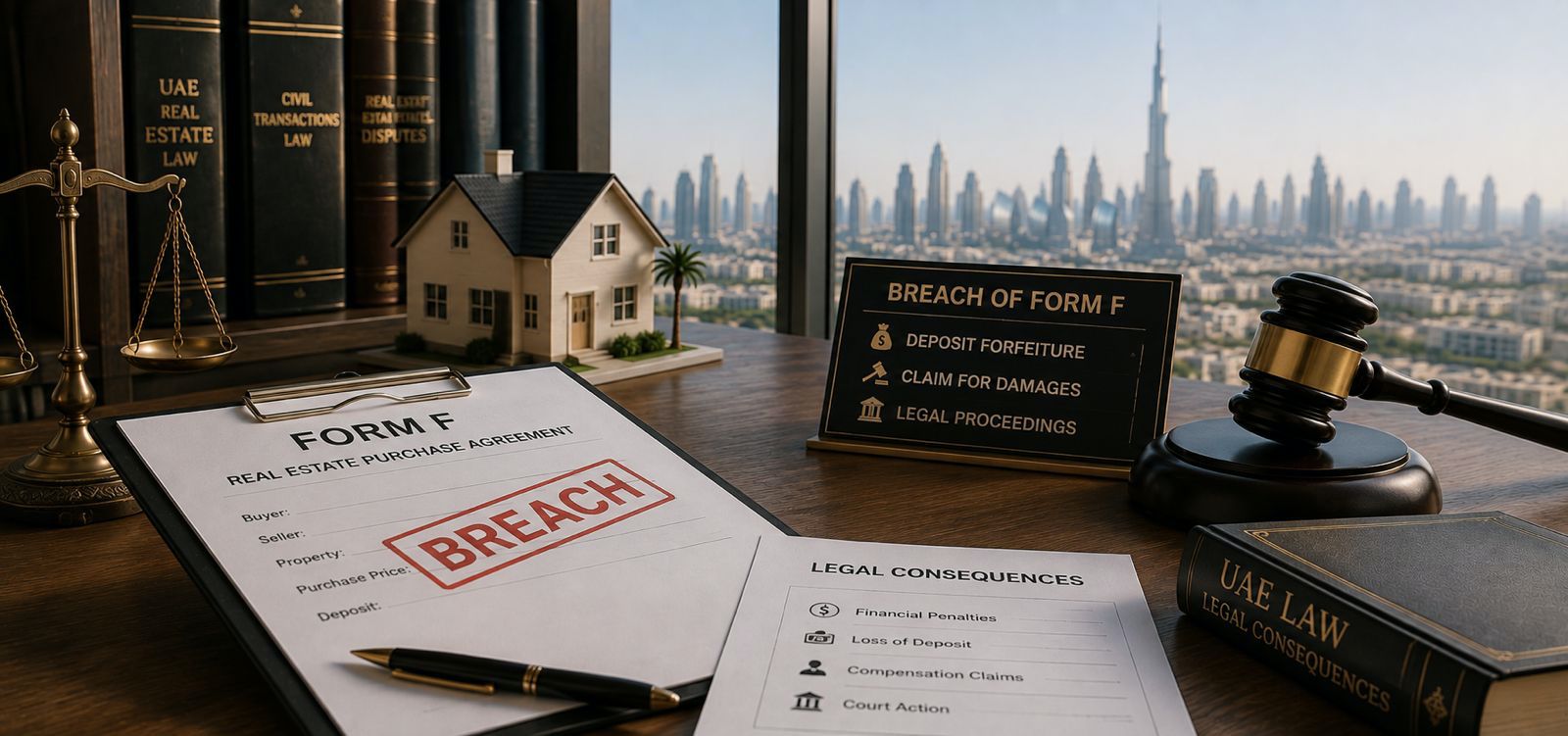

Most buyers think breaching Form F simply means losing the 10% deposit. In many cases, that’s true, but it is not always the end of the story.
If you are wondering what happens if a buyer breaches Form F in UAE, the answer depends on your contract, the seller’s actual loss, and how the agreement is written. In some situations, the consequences can go well beyond the deposit.
Quick Answer
A buyer who breaches Form F in the UAE will usually forfeit the 10% deposit, but that may not be the only consequence. Depending on the wording of the agreement and the seller’s actual losses, the seller may also pursue additional damages or, in some cases, ask the court to enforce the sale. Before making any decision, it is worth having the best advocates in Dubai review your Form F to understand your legal exposure.
The key is not to assume the deposit is your maximum liability.
Before walking away from a signed Form F, review the default clause carefully, understand what remedies it gives the seller, and explore whether the dispute can be negotiated before it becomes a legal claim. A quick legal review by experienced real estate lawyers in Dubai can often clarify your options, reduce risk, and help you avoid far more expensive consequences later.
What Counts as Buyer Breach
For matters like this, consulting property dispute lawyer in dubai can make the process easier.
Breach is broader than simply announcing you no longer want the property.
Each of these can trigger the same set of consequences, whether the failure was deliberate or simply the result of poor planning.
The Standard Consequence: Deposit Forfeiture
You can read more about this in our guide on how to handle a property handover delay in the UAE.
In the overwhelming majority of cases, this is where the matter actually ends. The 10% deposit is forfeited to the seller as liquidated damages, a pre-agreed measure of compensation that does not require the seller to separately prove their exact loss.
This outcome. And the exceptions to it, such as a subject-to-finance clause protecting the deposit where financing genuinely fails, are covered in full in our dedicated guide on Form F deposit refundability. The rest of this article covers what happens when deposit forfeiture is not the end of the story.
Beyond the Deposit: Three Further Exposures
This connects closely with our guide on is form F deposit refundable in the UAE.
UAE contract law does not automatically cap a seller’s remedy at the deposit amount. Three further exposures exist. And which ones actually apply depends on your specific Form F and the seller’s actual circumstances.
Additional damages for a resale shortfall
If the seller has to resell the property for less than your agreed price because the market moved or simply because a second buyer negotiated harder, the seller may pursue you for the difference beyond the deposit already retained, where the contract permits this and the loss can be evidenced.
Specific performance
This is the remedy buyers most often overlook. UAE law allows the non-breaching party to seek a court order for specific performance, compelling the other side to actually complete the agreed transaction, rather than simply accepting compensation. In the property context, this means a seller can, in principle, go to court asking a judge to force you to complete the purchase on the original terms, not just let you forfeit the deposit and move on. Whether a court grants this depends on whether completion remains possible and appropriate in the circumstances. But the option exists and is not merely theoretical.
The broker’s commission claim
A collapsed deal caused by the buyer’s decision does not necessarily mean the broker walks away empty-handed. Since the transaction failed due to the buyer’s own withdrawal rather than a defect in the deal itself, the agent may separately pursue their commission directly from the buyer.
The deposit is the floor of buyer breach exposure in the UAE, not necessarily the ceiling.
Could You Owe More Than the 10% Deposit?
Some Form F agreements allow sellers to claim additional damages beyond the deposit. Let our real estate lawyers in Dubai review your contract and explain your actual financial exposure before the dispute escalates.
Does the Seller Have to Give Notice First?
Generally, yes, and this protects both sides.
Under the UAE’s current Civil Transactions Law, where a party fails to perform its obligations, the other party is generally required to give notice before requiring either performance of the contract or its termination, with compensation where justified. In practice, this means a seller should formally notify a buyer who has missed a deadline or failed to perform, rather than immediately and silently treating the deal as over and disposing of the deposit.
For a buyer, this notice requirement is worth knowing. A seller who seizes a deposit or resells the property without any prior notice or communication has arguably not followed the proper process, which can matter if the dispute is ever formally contested.
Facing a possible breach, or a seller pursuing you for more than the deposit? Our real estate lawyers in Dubai can assess whether proper notice was given and whether the seller’s claimed loss is genuinely recoverable. And negotiate a resolution before the matter escalates to court.
Received a Legal Notice From the Seller?
Before responding or paying anything, let our best advocates in Dubai assess whether the seller’s claim is legally enforceable and advise you on the safest next step.
Can the Forfeiture Amount Be Challenged?
Yes, in specific circumstances, and this is a genuinely underused protection for buyers.
UAE civil law allows a court to adjust a liquidated damages or penalty clause where the pre-agreed amount is unconscionable or where it bears little relation to the loss the non-breaching party actually suffered. A seller whose actual loss from a buyer’s breach was minimal, the property resold within days at the same price, for example, may face a buyer’s argument that the full 10% forfeiture is disproportionate.
This is not a guaranteed reduction. And courts weigh it case by case. But it means deposit forfeiture is a strong default position for sellers, not an untouchable one.
Does Your Form F Cap the Seller’s Remedy?
This single question determines your realistic maximum exposure, and the answer is not the same in every contract.
Reading this specific clause before you sign, not after a deal collapses, is the clearest way to actually understand your worst-case exposure as a buyer.
Lessons From Dubai’s Market Downturns
This is not a purely theoretical risk. During the 2008 to 2010 downturn, a significant number of off-plan buyers across Dubai walked away from purchases rather than complete at prices that had fallen below what they had agreed to pay, forfeiting deposits on a large scale.
That period is part of why Dubai’s current regulatory framework, escrow protections, RERA dispute resolution channels, and standardized contracts like Form F exist in their present form. It also explains why sellers today are generally well aware of the remedies available to them beyond the deposit. And less inclined to simply accept a lost sale quietly.
If You Can See a Breach Coming
Buyers who act early, before a deadline passes, are in a meaningfully better position than those who let a default happen and hope for leniency afterward.
• Communicate immediately. A seller who hears about a genuine problem in advance is more likely to negotiate than one who discovers a missed deadline after the fact.
• Check for a protective clause. If your Form F includes a subject to finance or other condition precedent, confirm whether your specific situation actually triggers it.
• Propose a mutual cancellation. Ending the contract by agreement, even with a partial loss of deposit, is almost always better than a contested breach with additional damages at stake.
• Request a short extension in writing. if the issue is genuinely temporary, such as a delayed bank transfer, rather than a fundamental inability to complete.
Don’t Wait Until You’re in Breach
If mortgage approval is delayed or you cannot complete on time, early legal advice can often help you negotiate an extension and avoid unnecessary financial loss.
Common Mistakes to Avoid
A handful of recurring errors turn a difficult situation into a genuinely expensive one.
Frequently Asked Questions
So, what happens if a buyer breaches Form F in UAE? Deposit forfeiture, in the great majority of cases. And that is genuinely where it ends. But the law does not stop there if a seller’s loss goes further. And knowing that changes how a breach should actually be handled.
Notice requirements, the possibility of a reduced forfeiture. And the specific wording of your own contract matters more than a general assumption about what the worst case looks like.
If a breach is approaching or has already happened, our property lawyers in Dubai can review your Form F’s specific remedy clauses and help you understand exactly where you stand.
Unsure What Your Form F Really Means?
Whether you’re the buyer or seller, our real estate lawyers in Dubai can review your Form F, explain your legal rights, and help protect your money before the dispute reaches court.


3 Comments