


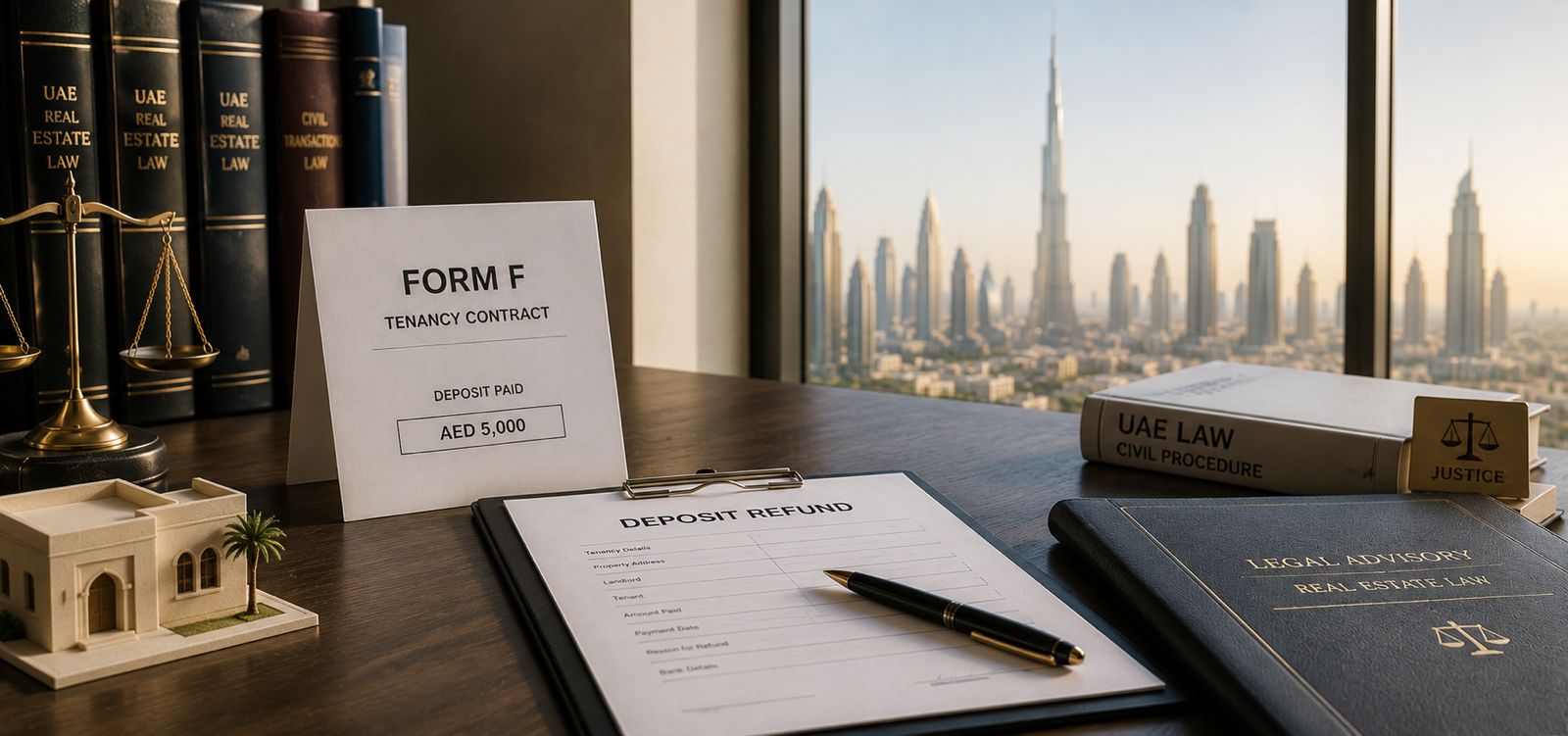

A property deal can fall apart in a moment. The bigger question is what happens to the 10% Form F deposit that is still being held by the broker.
The Default Position: Security, Not a Reservation Fee
If your situation involves this, it helps to speak with property dispute lawyer in dubai.
The 10% you pay when signing Form F is not a booking deposit you can cancel like a hotel reservation. It is security for both sides actually completing the deal. And UAE courts treat it that way.
Under UAE law, a deposit paid on signing a binding contract is treated as evidence of that binding commitment. Where the parties have agreed the deposit functions as a penalty for withdrawal, a defaulting party forfeits it. This is not a quirk of Form F specifically. It reflects a general principle of how earnest money works in UAE contract law.
Signing Form F and paying the deposit is the moment the deal stops being negotiable at no cost. Before that point, either side can walk away. After it, walking away has a price.
Unsure Whether Your Form F Deposit Is Refundable?
Get your Form F agreement reviewed by our experienced Dubai real estate lawyers before you lose your deposit or make the wrong decision.
When the Deposit Is Refundable
For a closer look at this, see our guide on is form F legally binding in dubai.
Refundability generally follows seller default. If the seller is the reason the deal collapsed, the buyer is normally entitled to the deposit back, often with something extra.
Many Form F contracts go further than a simple refund. Where the seller is at fault, the buyer is often entitled to compensation equal to the deposit amount, effectively receiving the original deposit back plus a matching penalty from the seller.
When the Deposit Is Not Refundable
Our guide on off plan handover delay rights UAE explains this further.
The reverse applies where the buyer is responsible for the deal falling through.
The deposit is not refundable simply because the buyer changed their mind, encountered financing difficulties, or found a different property they preferred. This is the single most common misunderstanding buyers have about Form F.
The “Genuine Impossibility” Test
Buyers sometimes assume that any real hardship, job loss, a bank declining a loan, or a family emergency automatically excuses non-completion. UAE courts have not generally accepted that.
The relevant legal question is not whether completing became difficult or unwelcome for the buyer. It is whether performance became genuinely impossible, an objectively higher bar. Financial difficulty, loss of employment, a failed funding application, or a change in personal circumstances do not, on their own, meet that standard. Whether a specific event clears the bar is a question of fact; the trial judge assesses case by case, not something a buyer can simply assert.
A seller facing a buyer’s cancellation request should not simply ask whether the buyer failed to complete. The sharper question is whether the buyer’s reason for failing to complete rises to genuine impossibility or is really just an inconvenient or commercially unattractive outcome for the buyer.
A Real Court Case: What It Actually Costs to Get This Wrong
A reported Dubai court ruling shows how far this can go when a buyer simply walks away.
A buyer pulled out of a signed property deal. And the case went to court after she did not appear at the scheduled hearings despite being properly notified. The court reviewed the sale contract and the title deed. And the correspondence between the parties. And found that the seller had met all his obligations, including preparing the property and completing the necessary transfer procedures. The buyer, by contrast, was found to be in default.
The contract’s deposit clause proved decisive. It stated clearly that on the buyer’s breach, the seller was entitled to terminate the agreement and enforce retention of the deposit, with the deposit itself split 70% to the seller and 30% to the broker. The court relied on UAE Civil Transactions Law provisions recognizing a deposit as evidence of a binding contract.
The final order required the buyer to pay AED 1.54 million, considerably more than the original deposit, once the court factored in the seller’s broader losses from the failed sale.
The lesson is not that every default produces a seven-figure judgment. It is that the deposit clause in your specific Form F, read carefully at signing, is what a court actually enforces when a deal collapses.
The Clause That Changes Everything for Mortgage Buyers
If you are financing your purchase, this single addition to Form F is the most valuable protection available to you.
A subject to finance, or mortgage contingency, clause makes your obligation to complete conditional on actually securing loan approval. Where this clause exists and is properly worded, a failed mortgage application can trigger a refund of the deposit rather than forfeiture, since the contract becomes void through no fault of the buyer.
Without this clause, a rejected mortgage application is treated as the buyer’s own failure to perform, not a protected outcome. Pre-approval is not the same as final approval. And the gap between the two is exactly where unprotected buyers lose deposits.
Sellers often resist including this clause, since it gives the buyer a clean exit route. It is a negotiation worth having before signing, not a term to assume is standard.
Deal falling through and unsure where the deposit actually stands? A UAE property lawyer from our team can review your specific Form F’s default and refund clauses and assess who is actually at fault under the contract. And advise on the realistic outcome before a dispute escalates.
Buying With a Mortgage?
Before signing Form F, let our property lawyers review your agreement and check whether your deposit is properly protected.
Mutual Cancellation: The Cleanest Exit
Not every collapsed deal needs to end in a fault-finding dispute.
Form F can be cancelled by mutual written agreement between buyer and seller at any point, with the parties free to agree on how the deposit is handled as part of that settlement, a full refund, a partial split, or any other outcome both sides accept. This route avoids the cost and delay. And uncertainty of a contested claim. And it is often the pragmatic choice even where one party technically has the stronger legal position.
The Dubai Land Department also provides a dedicated contract cancellation application service for certain Form F transactions, offering a more structured route than an informal written agreement alone.
Where Deposit Disputes Actually Get Resolved
A point worth clarifying, since it gets confused often: Form F disputes are not handled by the Rental Disputes Center. That body is specifically for tenancy matters, landlords and tenants, not property sale contracts.
A Form F dispute that cannot be resolved directly or through DLD’s cancellation service generally proceeds to the Dubai Courts, where the specific contract and the evidence of default. And the deposit clause itself are what the judge relies on. Some Form F agreements also permit or require arbitration, in which case that forum applies instead of the courts.
Common Mistakes to Avoid
A handful of recurring errors show up on both sides of a deposit dispute.
• Assuming financial hardship alone will excuse non-completion. Courts require genuine impossibility, a higher bar than inconvenience.
• Buying with a mortgage and not subject to a finance clause protecting the deposit.
• Assuming the Rental Disputes Center handles Form F disputes. It does not.
• Treating a verbal agreement to cancel as sufficient. Cancellation needs to be in writing to actually protect either party.
• Not reading the specific deposit split, some contracts allocate a share to the broker, as the reported AED 1.54 million case shows.
Thinking About Walking Away From the Deal?
One conversation with an experienced Dubai real estate lawyer could save your deposit and prevent a costly legal dispute.
Frequently Asked Questions
So, is Form F deposit refundable in the UAE? Only if the seller is the one who caused the deal to fail, or a protective clause you negotiated in advance covers your specific situation. Outside of that, the default position favors the party who did not cause the breakdown.
The reported AED 1.54 million case is a reminder that the deposit itself is often not the ceiling on what walking away can cost. The clause in your specific Form F, read before you sign, is what actually decides the outcome.
If a deal is falling apart and you need to know where you actually stand, a UAE property lawyer from our team can review your Form F’s default and refund provisions and advise on the realistic path forward.
Need Help Recovering Your Form F Deposit?
Our Dubai real estate lawyers can review your Form F, explain your legal position, and help you protect or recover your deposit before the dispute escalates.
3 Comments