

A death may reveal competing wills, disputed heirs, missing assets, unpaid debts, lifetime transfers, or property held in another person’s name. Delay can make records and assets harder to protect.
The legal question is not only each heir’s percentage. The estate, governing law, valid liabilities, will, heirs, and court procedure must be established first.
Quick Answer
An inheritance dispute lawyer dubai identifies the governing law, true estate assets, valid debts, heirs, will, and required court procedure. For Muslim estates, Federal Decree-Law No. 41 of 2024 contains inheritance rules in Articles 200 onward. Article 201 sets the order for estate expenses, debts, wills, and distribution. A will is generally effective within one-third unless the heirs consent to more. For non-Muslims within its scope, Article 11 of Federal Decree-Law No. 41 of 2022 addresses wills and default inheritance. A registered will may control UAE assets. Without one, the civil default may apply. The correct strategy depends on religion, nationality, domicile, asset ownership, documents, beneficiaries, debts, and any foreign proceedings.
Secure the death certificate, will, asset records, debt evidence, family records, and existing court papers. Do not distribute or transfer disputed assets informally.
Prepare an estate inventory showing each asset, registered owner, estimated value, location, supporting document, and dispute. List claimed debts separately.
Have counsel determine the governing framework before calculating shares. Protective applications, expert work, or parallel foreign advice may be required where assets or parties cross borders.
Start by Defining the Estate
Article 200 of Federal Decree-Law No. 41 of 2024 defines the estate. The practical task is identifying what the deceased owned or had a legal interest in at death.
Registered title is important but may not answer every issue. Joint ownership, beneficial arrangements, company shares, nominee holdings, loans, and pending claims can affect the estate.
Faris Raian, Managing Partner at Leaders Advocates, said families often describe inheritance disputes as arguments about shares. The real disagreement is frequently about what belongs to the estate.
He explained that resolving the asset question first can narrow the dispute substantially. This includes property registered in another relative’s name and transfers made shortly before death.
Every disputed item should be documented. The lawyer should identify whether the issue concerns ownership, validity of transfer, debt, gift, company law, or inheritance.
Not Sure What’s Actually in the Estate?
Message Leaders Advocates on WhatsApp for a quick review of the assets, heirs, and documents involved.
Apply Article 201 in the Correct Order
Article 201 of the 2024 law organizes rights connected to the estate. Distribution does not begin by immediately calculating heir percentages.
The sequence generally addresses funeral expenses, estate debts, the will within its lawful scope, and the remaining balance for heirs. The statutory wording and facts control each step.
Creditors should provide contracts, judgments, acknowledgments, invoices, transfers, or other reliable proof. Family assertions alone may not establish a debt.
Deferred mahr may be relevant as a debt owed by the deceased. It should be assessed before the net balance is distributed to heirs.
Administrative costs and asset-preservation expenses should also be recorded. Unexplained withdrawals or informal reimbursements can generate additional disputes.
Understand the One-Third Will Rule
For an estate governed by the 2024 law, a will is generally implemented within one-third of the estate after relevant liabilities. A larger disposition usually requires heirs’ consent.
The calculation should be based on the properly established net estate. Incorrect asset values or omitted debts can distort the one-third limit.
Validity can also be disputed. Questions may involve capacity, signature, form, interpretation, revocation, undue influence, or whether the document covers the asset.
Do not assume a handwritten or foreign will is automatically effective. The document, execution formalities, registration, and governing law require review.
Non-Muslim Estates Under the 2022 Civil Law
Federal Decree-Law No. 41 of 2022 provides a civil personal status framework for non-Muslims within its scope. Article 11 addresses inheritance.
A foreign non-Muslim may leave a will covering UAE assets under that framework. A registered will can provide greater certainty about intended beneficiaries and administration.
Without a registered will, Article 11 provides a civil default. Half generally passes to the surviving spouse, and the other half passes equally to the children.
Where there are no children, the statutory order addresses parents and siblings. The precise distribution depends on which relatives survive the deceased.
Article 11 also permits heirs of a foreigner to request application of the deceased’s national law in defined circumstances, unless a registered will provides otherwise.
Article 12 concerns estate procedures, while Article 13 concerns registration of wills. These provisions should be read with the implementing regulations and local procedure.
Identify Every Potential Heir Correctly
Collect official family records rather than relying on a family tree prepared from memory. Birth, marriage, divorce, and death documents may require legalization and Arabic translation.
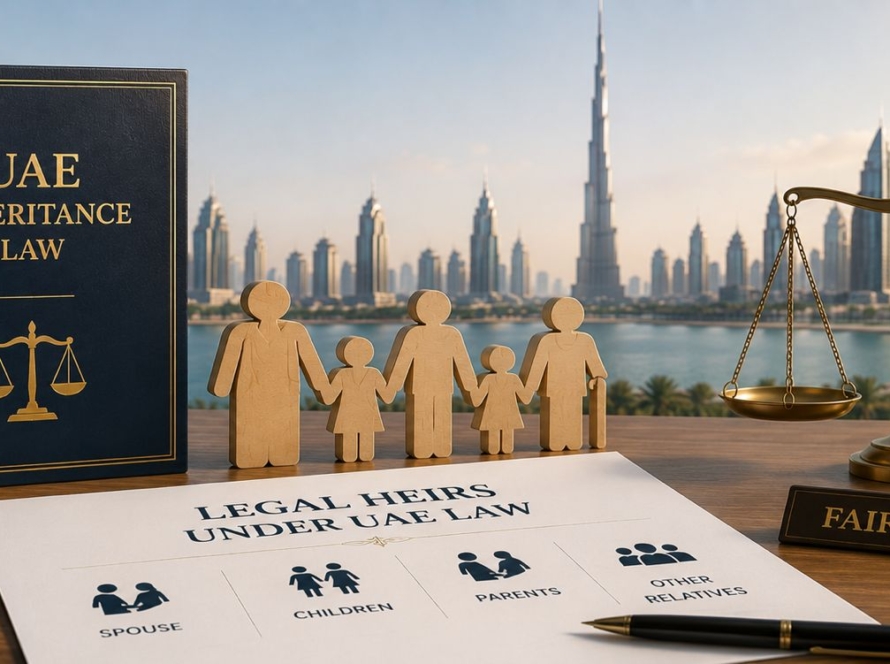
For Muslim estates, entitlement depends on the surviving relatives and their legally recognized relationships. Multiple wives, descendants, parents, and siblings can affect the distribution.
Where there is more than one surviving wife, any spouse portion is shared collectively among them under the applicable rules. It is not repeated in full for each wife.
Adoption, stepchildren, unregistered marriages, and disputed parentage may require separate analysis. Do not include or exclude a person without checking legal status.
Investigate Lifetime Transfers and Final Illness
Disputes often concern property transferred before death. The question may be whether the transfer was a genuine sale, gift, trust arrangement, nominee holding, or unauthorized act.
Bank records, title documents, payment evidence, correspondence, valuations, and possession history can help. The timing and the deceased’s health may also be material.
Transfers made during final illness can receive special legal treatment and may be analyzed similarly to testamentary dispositions in appropriate circumstances.
Allegations of forgery, incapacity, or undue influence require strong evidence. Medical records, original documents, signature examination, and witness evidence may become important.
Do not accuse a relative publicly. Keep the dispute within proper legal channels and preserve documents before they disappear.
Trace Bank, Property, and Company Assets
An estate may include bank balances, real estate, vehicles, company shares, receivables, digital assets, insurance proceeds, and personal property.
The legal treatment of each item can differ. A company asset is not automatically the personal property of a shareholder, even where the deceased controlled the company.
Company records should identify the deceased’s shares, shareholder loans, dividends, and contractual rights. Corporate liabilities must remain separate from personal liabilities.
For real estate, obtain title records, purchase documents, financing records, leases, and service-charge information. Joint ownership shares should be confirmed precisely.
Foreign assets may require proceedings in another country. A Dubai order may not transfer overseas title without local recognition or probate steps.
Protect the Estate During the Dispute
Where assets may be sold, withdrawn, concealed, or damaged, ask counsel about protective measures. The court will require a proper legal basis and supporting evidence.
Maintain insurance, necessary property expenses, and essential company operations where lawful. Preservation should not become unauthorized control by one heir.
Keep an account of money received or spent for the estate. Transparency can prevent routine administration from becoming a second dispute.
Settlement can be considered after the estate and heirs are known. Agreements reached too early may rest on incomplete information or inaccurate valuations.
Jurisdiction and Cross-Border Issues
Dubai courts may deal with UAE assets and parties according to jurisdictional rules. DIFC wills, free-zone interests, and foreign judgments can require specialized analysis.
The deceased’s nationality, religion, residence, will registration, and asset location may point to more than one legal system. Coordinated advice avoids inconsistent steps.
Foreign documents usually need authentication and certified Arabic translation for onshore proceedings. Obtain multiple official copies of the death certificate and will.
Deadlines can arise from appeals, interim orders, creditor claims, or foreign procedures. Build a single calendar covering every jurisdiction involved.
Practical Steps
- Obtain official death, family, marriage, and will documents.
- Freeze informal distribution and preserve the estate records.
- Prepare a complete asset and liability inventory.
- Identify the registered owner and evidence for every disputed asset.
- List all potential heirs and verify relationships officially.
- Determine the governing framework before calculating shares.
- Consider protective measures, valuation, experts, and foreign advice.
- Negotiate only after adequate disclosure and reliable valuations.
Evidence and Documents Needed
- Death certificate and evidence of the deceased’s nationality and residence.
- Original will, registration record, amendments, and revocation documents.
- Passports, Emirates IDs, family records, and heir certificates.
- Marriage, divorce, birth, adoption, and death documents.
- Property titles, sale contracts, mortgages, leases, and valuations.
- Bank statements, transfer records, deposit details, and loan documents.
- Company registers, share certificates, accounts, and shareholder agreements.
- Debt contracts, judgments, invoices, acknowledgments, and payment records.
- Medical records relevant to capacity or final illness.
- Communications concerning ownership, gifts, debts, or intended beneficiaries.
Common Mistakes and Risks
- Calculating shares before identifying the true net estate.
- Ignoring funeral expenses, debts, deferred mahr, or will priority.
- Treating registered title as conclusive without examining the transaction.
- Applying the non-Muslim civil default to an estate outside its scope.
- Assuming a foreign or informal will is automatically enforceable.
- Distributing assets before resolving creditor or ownership disputes.
- Moving money without records or agreement from the proper authority.
- Starting inconsistent proceedings in different countries.
Protect the Estate Before It’s Too Late
Send us your documents on WhatsApp and we’ll help you identify the right protective steps.
How a Lawyer Can Help
An inheritance lawyer can identify the framework, heirs, estate, liabilities, will, and distribution sequence. Counsel can challenge or defend ownership and validity claims.
The lawyer can seek protective measures, coordinate valuations, work with experts, and manage cross-border documents. They can also structure a settlement after reliable disclosure.
Faris Raian‘s preserved contribution focuses attention on the estate’s contents before percentages. That sequence often reveals the real issue and narrows the dispute.
Relevant Legal Services
The closest services for this matter are civil inheritance services for non-Muslims in Dubai, family lawyer services in Dubai, and civil lawyer services in Dubai. The right service depends on the facts, documents, governing law, forum, and requested remedy.
Relevant Success Story
The firm publishes selected completed matters in its Success Stories archive. A prior result does not guarantee a similar outcome. Every matter depends on its facts, documents, evidence, procedure, and legal circumstances.
Ready to Resolve Your Inheritance Dispute?
Get your estate documents and strategy aligned before you act. Contact Leaders Advocates on WhatsApp.
FAQs
Final Takeaway
An inheritance dispute should begin with the governing law, estate inventory, debts, will, and verified heirs. Percentages come after those questions are resolved.
The safest next step is to preserve assets and obtain a document-based legal assessment. Every outcome depends on ownership records, family status, governing law, and procedural facts.