


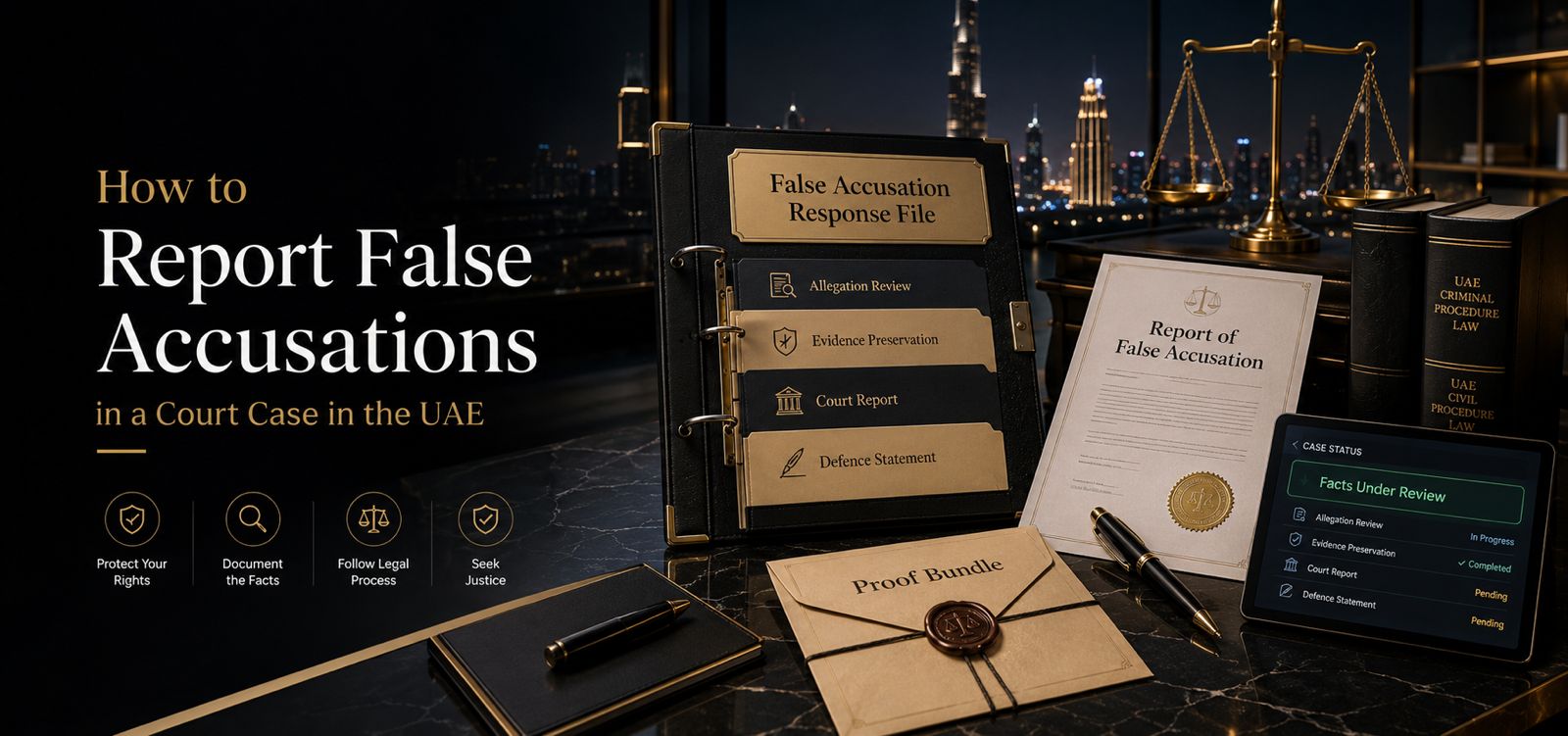

Facing a false accusation in a UAE legal matter, whether a false criminal complaint or fabricated testimony within an ongoing case, is genuinely serious, and the UAE legal system provides real, specific routes to address it, not just a general defense.
The practical challenge is that the person accused may need to manage more than one legal objective at the same time. The original allegation must be answered properly, while the material supporting a possible separate complaint should be preserved in a clear and reliable form.
This guide explains how to organise those two tracks, what evidence to collect, how to prepare a factual chronology, and how to document any harm without losing focus on the active case. A criminal defense lawyer in Dubai can advise on who is the best lawyer in Dubai, is a traffic violation a criminal offense in the UAE, and is abortion legal in the UAE where relevant.
Quick Answer
Where you’re falsely accused within an active court case, the immediate priority is mounting a proper defense, presenting contradicting evidence and, where relevant, exposing inconsistencies in the accuser’s claim directly to the court or public prosecution handling the matter. Separately, you can file a formal complaint specifically addressing the false accusation itself, particularly where you can show the accuser acted in genuine bad faith, knowingly making a false claim rather than an honest mistake.
Where a false accusation has caused real, demonstrable harm, financial loss, reputational damage, or wrongful legal proceedings against you, a separate civil claim can be pursued for the resulting harm, alongside or after the underlying case concludes. Keeping thorough documentation throughout, everything supporting your position and anything suggesting the accuser’s bad faith, genuinely strengthens both your defense and any separate complaint you later pursue.
The safest preparation method is to keep the original defence, the evidence of bad faith, and the records of harm in clearly labelled sections. They are connected, but each serves a different purpose.
Start With the Original Case
Your immediate priority when facing a false accusation is presenting contradicting evidence directly within the existing case, to the court or the public prosecution, rather than treating the false accusation as a separate matter to address only afterward.
Begin by confirming the case or complaint number, the authority handling the matter, the exact allegation, and the next known deadline. Work from the actual wording in the available file rather than a summary received through another person.
Then divide the allegation into specific factual points. For each point, identify the document, message, witness, transaction, location record, or other material that supports your position. This creates a usable response instead of a general denial.
Where the active matter is criminal, criminal defense lawyers in Dubai can help coordinate the response to the allegation with any later complaint so the two files do not contain inconsistent explanations.
Falsely Accused in a UAE Criminal Case?
The first priority is protecting your position in the active case. Our criminal defense lawyers in Dubai can review the allegation, evidence, deadlines, and inconsistencies before you submit a detailed response.
Separate an Honest Mistake From Knowing Bad Faith
The original article makes an important distinction: the separate complaint is particularly relevant where the accuser acted in genuine bad faith and knowingly made a false claim rather than an honest mistake.
That distinction should guide the evidence file. Material showing that a statement was inaccurate is important, but material showing what the accuser knew when the statement was made can be even more significant to the separate complaint.
Keep earlier messages, agreements, receipts, admissions, threats, prior versions of the story, and records showing that the accuser had access to the true facts. Do not edit the material to make it look stronger. Preserve the full context and identify what each item actually proves.
Step 1: Mount a Proper Defence in the Original Case
Prepare a point-by-point response to the allegation. State the disputed fact, the correct fact according to your position, and the supporting evidence. Keep assumptions separate from facts that can be demonstrated.
Do not let the preparation of a counter-complaint cause you to miss a hearing, statement, evidence request, or other requirement in the original file. A strong separate complaint does not replace the need to defend the matter already underway.
Step 2: Document Everything
Collect evidence directly contradicting the false accusation, anything suggesting genuine bad faith or knowing dishonesty rather than an honest mistake, and witness accounts or records supporting your actual position.
Useful categories may include:
• The original complaint, statement, or allegation as accurately recorded.
• Contracts, invoices, receipts, bank records, delivery records, or access records.
• Full message threads rather than isolated screenshots.
• Original photographs, videos, recordings, and file information where available.
• Names and contact details of witnesses who personally know the relevant facts.
• Earlier statements that differ materially from the later allegation.
• Documents showing where you were or what occurred at the relevant time.
• A dated list connecting each disputed statement to the evidence that contradicts it.
Keep the original files and a working copy. Name files consistently and avoid relying on a phone gallery containing hundreds of unrelated images.
Step 3: Prepare a Factual Chronology
A chronology should begin before the accusation was made and continue through the latest court or prosecution event. Record dates, participants, what happened, and the supporting document number.
Use exact dates when they are known. Where a date is estimated, label it honestly. Neutral wording is more useful than emotional descriptions because the reader can see the sequence without having to separate facts from argument.
A well-organised chronology can also reveal missing evidence. For example, it may show that a referenced payment receipt, message, or witness statement has not yet been obtained.
Step 4: File a Formal Complaint Addressing the False Accusation
Where you can show the accuser genuinely acted in bad faith, knowingly making a false claim, a formal complaint can be filed specifically addressing this, separate from your defense in the underlying matter.
The preparation should identify the exact statement said to be false, when and where it was made, why it was false, and what material indicates the accuser knew that. A long narrative without a clear link between statement and evidence can make the issue harder to follow.
Keep a copy of the submitted complaint, the supporting document list, and any official reference received. Continue updating the evidence file if the original case produces new documents or statements.
Step 5: Consider a Separate Civil Claim
Where the false accusation caused real, demonstrable harm, financial loss, reputational damage, or wrongful proceedings against you, a separate civil claim can pursue compensation for that specific harm, alongside or following the resolution of the underlying case.
Document the harm as carefully as the accusation. Keep employment correspondence, cancelled agreements, payment records, medical documents where directly relevant, and other records showing the loss claimed. A general statement that reputation was harmed is less useful than dated evidence showing what changed and when.
The related route where false statements have damaged reputation specifically is discussed in the firm’s guide to defamation law in the UAE. Complex compensation and court disputes may also require review by a litigation lawyer in Dubai.
Preserve Digital Evidence Carefully
Do not rely only on cropped screenshots. Keep the full conversation, account name, date, time, surrounding messages, and original device or export where available. A single image may remove the context needed to understand who sent the message and what came before it.
Avoid deleting embarrassing or unhelpful messages. Selective deletion can create gaps and may make the remaining material harder to trust. Preserve first, then decide with legal advice what is relevant to submit.
Do not access another person’s account or device without permission. The objective is to preserve lawful evidence supporting your position, not to create a new dispute while responding to the first one.
Organise Witness Information
Record what each witness personally saw, heard, received, or did. Avoid asking witnesses to repeat your conclusion or to use identical wording. Their value comes from their own knowledge of the relevant event.
Keep the witness’s full name, reliable contact details, relationship to the events, and the documents or communications they can identify. Distinguish a direct witness from someone who only heard the story later.
Do You Have Evidence the Accusation Was Knowingly False?
Proving that a statement was wrong is different from proving it was made in bad faith. Let our legal team review the messages, documents, prior statements, and chronology before you file a separate complaint.
What to Do in the First 48 Hours
- Confirm the case number and the authority handling the allegation.
- Record the next hearing, interview, or submission date.
- Preserve phones, messages, emails, contracts, payment records, and original files.
- Write a neutral chronology while the sequence is still fresh.
- List witnesses and what each person directly knows.
- Stop emotional exchanges with the accuser or other parties.
- Keep public posts and case details off social media.
- Separate evidence contradicting the allegation from evidence of knowing bad faith.
- Begin a separate folder for financial or reputational harm.
- Obtain advice before submitting a detailed statement or separate complaint.
Common Mistakes
• Focusing only on defending the underlying accusation without documenting the accuser’s bad faith for a potential separate complaint.
• Waiting too long to gather contradicting evidence before it becomes harder to obtain.
• Assuming a false accusation automatically resolves itself once the underlying case concludes favorably.
• Sending threats or emotional messages that can distract from the evidence.
• Using cropped screenshots while losing the complete conversation.
• Mixing the defence documents, bad-faith evidence, and claimed losses in one unlabelled file.
• Repeating unverified facts received from friends or relatives.
• Publishing the accusation or naming the parties online.
• Failing to keep copies of submissions and official reference numbers.
• Claiming harm without preserving records showing the actual consequence.
People Also Ask
Conclusion
Reporting a false accusation in a UAE court case requires two disciplined tracks: defend the original matter and preserve the material supporting a separate complaint where the accusation was knowingly made in bad faith.
Document the statement, contradicting evidence, chronology, witnesses, and any real harm. Careful organisation makes it easier to present a clear position without allowing the response to distract from the active case.
Has the False Accusation Cost You Money or Damaged Your Reputation?
If a false accusation caused financial loss, reputational damage, employment problems, or wrongful proceedings, a separate compensation claim may be possible. Preserve the evidence before the damage becomes harder to prove.


2 Comments