



A customer accepted goods or services but did not pay the invoice. The debtor may dispute quality, deny the purchase order, request more time, or stop responding altogether.
The issue matters because an invoice alone may not prove the entire debt. Recovery depends on the contract, delivery evidence, acceptance, notices, jurisdiction, and the debtor’s ability to pay.
Quick Answer
To recover an unpaid invoice in Dubai, organize the contract, purchase order, invoice, delivery evidence, account statement, and customer acknowledgments. Confirm the correct debtor and the exact due amount. Send a formal demand that explains the transaction, due date, principal, and payment deadline. A payment order may be available under Articles 143 to 150 of Federal Decree-Law No. 42 of 2022 when the debt is established, due, and sufficiently clear in writing. Otherwise, use the appropriate civil or commercial claim, arbitration, or agreed forum. Settlement can save time, but it should be documented and enforceable. Do not delay because limitation rules differ. The result depends on the contract, evidence, dispute clause, service, defenses, and assets available for enforcement.
Begin with a ledger reconciliation and a legal review of the transaction documents. Correct errors, identify credits, and match every invoice to proof of order, performance, and acceptance.
Next, send a measured demand with a short deadline. If payment does not follow, choose between settlement, conciliation, a payment order, arbitration, or an ordinary court claim.
Plan enforcement before filing. A judgment is valuable only when the debtor has reachable funds, receivables, vehicles, property, or other assets.
The Legal Basis of an Invoice Claim
An invoice records a payment request, but the underlying obligation normally comes from a contract or completed transaction. The claimant should prove offer, acceptance, performance, price, and due date.
Federal Decree-Law No. 50 of 2022 Promulgating the Commercial Transactions Law may apply to commercial dealings. Federal Decree-Law No. 42 of 2022 governs federal civil procedure and payment orders.
The Civil Transactions Law can also govern contractual duties and remedies. The governing rules depend on the transaction, parties, and any special legislation.
Identify the Correct Debtor
Compare the trade license name, contract party, purchase order, invoice addressee, and bank payer. A brand name or branch may not be the legal person that owes the debt.
Check whether a director, shareholder, parent company, or guarantor signed a personal or corporate guarantee. Liability should not be assumed merely because one person negotiated the deal.
Confirm Jurisdiction and Dispute Resolution
Review clauses for UAE courts, Dubai courts, arbitration, DIFC courts, ADGM courts, or another forum. Also check governing law and notice requirements.
An arbitration clause may require the dispute to be referred to arbitration. Starting in the wrong forum can lead to jurisdiction challenges, delay, and unnecessary cost.
Client Not Paying Your Invoices?
Message Leaders Advocates on WhatsApp for a quick review of your invoice trail and options.
Build a Reliable Invoice Ledger
Prepare one schedule covering every invoice. The schedule should show the invoice number, date, due date, amount, currency, payment, credit note, and remaining balance.
Reconcile the schedule against bank records and the debtor’s statement of account. Remove duplicated invoices, reversed transactions, and amounts already settled.
Separate principal from other items:
- Contractual interest or compensation requested.
- Late fees and administrative charges.
- Value added tax shown on valid tax invoices.
- Delivery, storage, or service charges.
- Legal and collection costs.
Each additional amount needs a lawful or contractual basis. An inflated demand may provoke a legitimate dispute and weaken a summary application.
Evidence That Strengthens Recovery
The strongest file shows the complete transaction from order to nonpayment. It does not depend on the invoice alone.
Useful documents include:
- Signed contract, quotation, proposal, or terms and conditions.
- Purchase order or written work instruction.
- Invoice and tax invoice records.
- Delivery note, completion certificate, or signed timesheet.
- Email approving milestones or accepting performance.
- Statement of account sent to and accepted by the customer.
- Messages admitting the balance or requesting installments.
- Partial payment records.
- Credit notes and complaint correspondence.
- Guarantee, security cheque, or other security document.
Electronic evidence is recognized under Federal Decree-Law No. 35 of 2022 Concerning Evidence in Civil and Commercial Transactions. Preserve complete records, dates, senders, and original files.
Screenshots can be useful, but context matters. Export the full conversation where lawful and retain the device or system record supporting authenticity.
Send a Formal Payment Demand
The demand should be accurate, professional, and addressed to the correct legal entity. State the contract, invoice numbers, due dates, payments credited, and total balance.
Include payment instructions and a clear response deadline. Reserve relevant rights without making threats that are unlawful or unrelated to debt recovery.
Serve the demand using the contractually required method. Also preserve courier receipts, registered mail records, notarial service, or electronic delivery confirmation.
For a payment order under Article 143, the creditor must first demand payment for at least five days. The precise content and service evidence should support the later application.
Payment Order for an Unpaid Invoice
Articles 143 to 150 provide a summary route for qualifying debts. The debt must satisfy the statutory conditions, including being established and due.
A signed acknowledgment, confirmed statement, accepted invoice, or clear documentary chain may support the application. The judge decides whether the written evidence is sufficient.
A payment order is not automatic merely because an invoice has expired. If the debtor raises a genuine dispute about delivery, quality, scope, or price, an ordinary claim may be necessary.
The application and supporting documents generally need Arabic presentation or certified translation. Court rules and electronic filing requirements should be checked before submission.
Ordinary Civil or Commercial Claim
An ordinary lawsuit allows fuller consideration of contested facts. The court may appoint an expert to examine contracts, accounts, deliveries, correspondence, and competing calculations.
The statement of claim should explain the transaction chronologically. It should connect each requested amount to its evidence and legal foundation.
Interim or protective relief may be considered when statutory conditions exist. Such measures are discretionary and often require evidence of urgency and risk.
Conciliation and Settlement in Dubai
Dubai Law No. 18 of 2021 Regulating Conciliation in Dubai created a framework for designated disputes and settlements. The applicable route depends on the dispute category and current court procedure.
A settlement should identify the admitted debt, currency, payment dates, default consequences, costs, dispute release, and enforcement mechanism. Avoid vague promises to pay when assets may disappear.
If installments are accepted, consider security and acceleration wording. The agreement should also address what happens to pending proceedings after payment or default.
Limitation Periods
Article 92 of the Commercial Transactions Law generally states that claims between merchants are not heard after five years from the due date when denied. A shorter specific period can apply.
Not every invoice claim is a claim between merchants. Transport, insurance, employment, construction, agency, and other transactions may have special rules.
Do not assume reminders extend the deadline. Acknowledgment, partial payment, filing, and other events require legal analysis under the applicable law.
Enforcement After Judgment
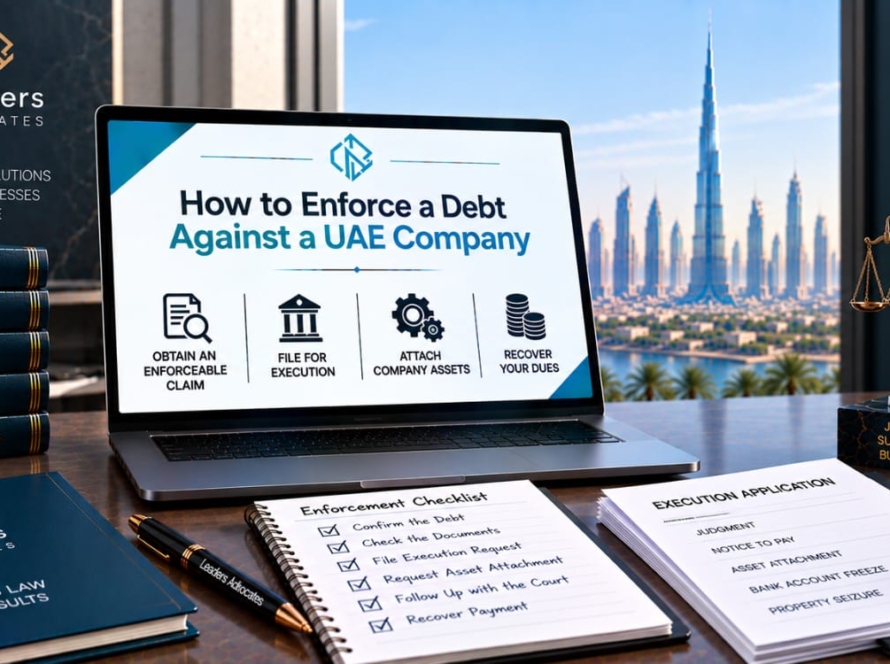
If the debtor still does not pay, an executable judgment or order can be opened for enforcement. The creditor may request lawful measures against identifiable assets.
Possible measures can include attachment of bank funds, receivables, vehicles, business interests, or real property, subject to ownership and procedural requirements.
Article 324 of the Civil Procedure Code permits a civil travel ban in specified circumstances when the debt is at least AED 10,000. It is not automatic and requires the statutory conditions.
Enforcement should target assets proportionately and avoid duplicate recovery. Update the balance for payments, costs, and amounts awarded by the court.
Practical Steps
- Confirm the debtor’s legal name, license, address, and contractual capacity.
- Reconcile invoices, credits, payments, and tax records.
- Link each invoice to an order and proof of performance.
- Review jurisdiction, arbitration, notice, and governing-law clauses.
- Send a precise demand and preserve proof of service.
- Consider conciliation or a secured settlement.
- File the correct payment order, court claim, or arbitration.
- Locate assets and begin enforcement when an instrument becomes executable.
Documents Needed
Prepare originals where possible and a clean digital set.
- Trade licenses and company records for both parties.
- Contract, accepted quotation, and standard terms.
- Purchase orders and change instructions.
- Invoices, account statements, and credit notes.
- Delivery notes and completion certificates.
- Emails, messages, and meeting confirmations.
- Bank statements and partial payment records.
- Formal demand and proof of service.
- Guarantee, cheque, or security documents.
- Arabic translations required for filing.
Common Mistakes and Risks
Relying Only on the Invoice
The debtor may deny the order or performance. Support the invoice with contract and delivery evidence.
Suing the Wrong Entity
A trade name, affiliate, or employee may not be liable. Verify the contracting party and any guarantee.
Ignoring a Dispute Clause
An arbitration or special court clause can change the forum. Review it before issuing proceedings.
Overstating Interest and Fees
Claim only amounts supported by law, contract, and evidence. Separate principal from additional relief.
Waiting Until Assets Disappear
Assess enforceability early. A strong merits case does not guarantee practical recovery from an insolvent debtor.
Not Sure If a Payment Order Applies?
Send us your invoices and contract on WhatsApp and we’ll help you identify the fastest route.
How a Lawyer Can Help
A lawyer can test the documents, calculate the claim, prepare the demand, and select the correct procedure. Early review may identify a missing acceptance record or a jurisdiction issue.
Faris Raian and the legal team can assess whether the file supports a payment order, ordinary claim, arbitration, conciliation, settlement, or enforcement strategy.
Relevant Legal Services
The closest services for this matter are debt recovery lawyer services in Dubai, contract lawyer services in Dubai, and litigation lawyer services in Dubai. The suitable service depends on the facts, documents, regulator, forum, procedural stage, and requested remedy.
Relevant Success Story
The firm publishes selected completed matter examples in its Success Stories archive. A prior result does not guarantee a similar outcome. Every matter depends on its facts, documents, evidence, procedure, and legal circumstances.
Ready to Recover What You’re Owed?
Get your demand, filing, and enforcement strategy aligned. Contact Leaders Advocates on WhatsApp.
FAQs
Final Takeaway
Successful invoice recovery needs more than an overdue invoice. Verify the debtor, contract, performance, deadline, forum, and assets before choosing a demand, settlement, payment order, or lawsuit.