


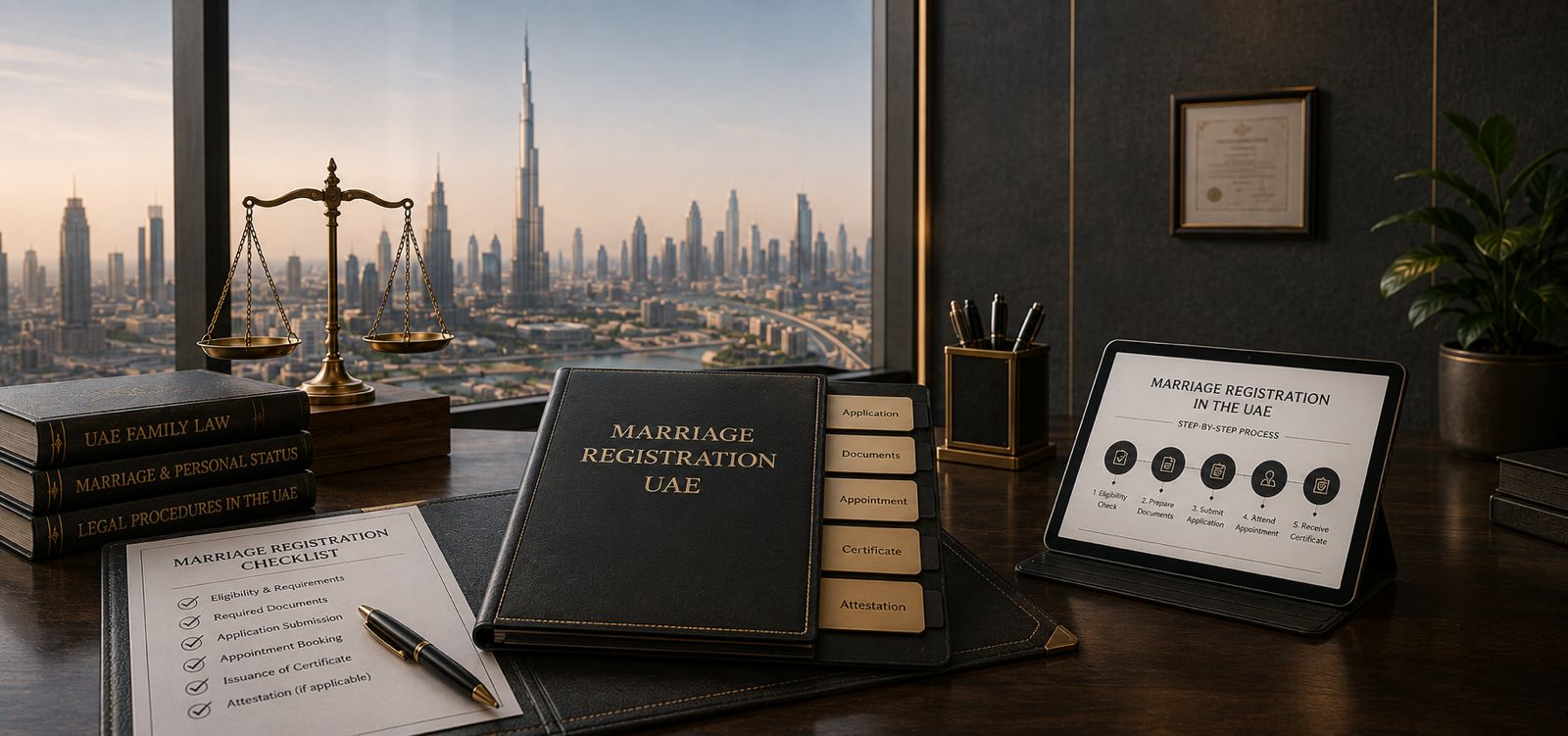

A marriage certificate issued outside the United Arab Emirates may need a chain of authentication before a UAE ministry, immigration authority, court, school, insurer, bank, or other organisation will accept it. The correct chain depends on the issuing country, the certificate format, and the UAE authority that will receive it.
Foreign marriage certificate attestation UAE procedures should therefore begin with two checks: whether the certificate is an eligible original public document and exactly what the receiving authority requires. Completing unnecessary steps can waste time, while missing one competent authority can cause rejection.
For a foreign marriage certificate, the usual UAE route is to obtain the original certificate, complete any authentication required by the competent authorities in the country of issue, obtain attestation through the UAE embassy or consulate responsible for that country, and complete UAE Ministry of Foreign Affairs attestation. MoFA states that documents issued outside the UAE must first be attested by the issuing country’s foreign ministry, then by the UAE mission, and finally through MoFA in the UAE. Some UAE missions now offer a digital process that may combine the mission and UAE MoFA stages, but availability and document eligibility vary by country. Use a legally certified Arabic translation if the receiving authority requires Arabic, and verify whether translation must occur before or after attestation for that particular submission.
What Legalization and Attestation Actually Confirm
Our related guide on who is the best marriage lawyer in dubai can help you make that decision.
Attestation verifies the official seals and signatures in the authentication chain. It does not decide whether the marriage was valid under the law governing the spouses, resolve a dispute about marital status, or guarantee that every UAE authority will accept the document for every purpose.
The word legalization is often used for the full cross-border chain. Attestation may refer to an individual step within that chain. An apostille is a different authentication certificate used between jurisdictions where the relevant convention applies. Do not assume that an apostille by itself completes the UAE process. Follow the current instructions of the relevant UAE mission and the authority that will receive the document.
Step 1: Identify the UAE Purpose
For a closer look at this, see our guide on marriage leave under UAE labor law.
The destination determines the practical requirements. A certificate may be requested for a spouse residence application, health insurance, a birth registration, a court claim, inheritance, banking, school records, or another family-related process. Ask the receiving body for its current document checklist before paying for authentication or translation.
- Record the exact UAE authority, emirate, service, and application type.
- Confirm whether it needs the original, an attested copy, or an electronically verifiable document.
- Ask whether Arabic translation is mandatory and whether the translation must also be attested.
- Check whether the certificate has an expiry policy for that service, even though the underlying marriage record itself may not expire.
- Confirm whether names must match passports and Emirates ID records exactly.
Step 2: Obtain the Correct Marriage Certificate
Working with marriage lawyer in dubai can help you avoid costly mistakes here.
Use the official certificate issued by the civil registry, court, religious authority, or other competent body in the country where the marriage was registered. A ceremonial document, church souvenir, scan, wallet card, family-book extract, or unofficial online printout may not be accepted as the original public record.
Check that the certificate is complete, legible, and undamaged. MoFA’s published requirements state that a document submitted through the physical attestation route must not be laminated. If the certificate is laminated, ask the issuing authority for a replacement rather than attempting to remove the laminate.
Step 3: Complete Authentication in the Country of Issue
Our guide on sharia law for marriage in islam in the UAE explains this further.
MoFA’s current guidance says a document issued outside the UAE must be attested by the Ministry of Foreign Affairs of the issuing country before it goes to the UAE embassy or consulate. Some countries require earlier authentication by a registry, court, notary, state authority, or another designated body before their foreign ministry will act.
The exact domestic sequence is country-specific. The authority that issued the marriage record or the UAE mission responsible for that country should be used to confirm the route. A process used for a UK certificate may not match the process for a certificate from India, the United States, Pakistan, the Philippines, South Africa, or another jurisdiction.
Step 4: Use the Responsible UAE Embassy or Consulate
After the issuing-country stage, submit through the UAE mission that has responsibility for the issuing country. MoFA allows applications through its official channels and directs applicants outside the UAE to the relevant embassy or consulate. Each mission may publish its own submission, payment, courier, and eligibility instructions.
A mission may require the original certificate, proof of prior foreign-ministry authentication, an online application, identity details, and courier arrangements. Do not mail an original until the official mission page confirms where and how it should be sent.
Digital Attestation May Change the Route
Several UAE missions now publish a digital attestation service for documents issued in specified countries. Their guidance may describe one application covering both the UAE mission and MoFA attestations. This can remove a separate in-person or courier stage, but it is not a universal rule for every country or every certificate.
Use the country list and document rules on the relevant UAE mission’s current page. If the marriage certificate is not eligible for the digital route, follow the physical or approved-courier process shown for that mission. Keep the application reference and use the official verification facility when a digital attestation is issued.
Step 5: Complete UAE MoFA Attestation
Where the process has not already combined both UAE stages, apply for MoFA attestation in the UAE through the official website or smart application. The service requires UAE pass. For documents handled through an approved courier, collection and return options, processing times, and delivery charges depend on the selected service.
MoFA’s service page lists the original document in Arabic or English, or an official translation, prior authentication by the appropriate governing bodies, and a prohibition on laminated documents. The system determines the available route based on document type and issuing authority.
Step 6: Arrange Arabic Translation Where Required
Many UAE court and government submissions operate in Arabic. A non-Arabic certificate may therefore need a translation prepared or certified by a translator accepted for the intended UAE process. Translation is not a substitute for authentication of the original certificate.
Do not rely on a fixed internet rule saying translation must always happen at one particular stage. The receiving authority may want the authenticated original plus a UAE-certified Arabic translation, while a mission may accept an original in English or Arabic or an official translation. Confirm the sequence before commissioning the translation.
Not Sure Which Attestation Route Applies to Your Marriage Certificate?
The correct sequence depends on the country of issue, the responsible UAE mission, the document format, and the authority that will receive it. Our legal team can review the certificate before you begin the process.
Documents and Details to Prepare
- The original foreign marriage certificate in acceptable condition.
- Passports and, where applicable, Emirates ID and UAE residence details for both spouses.
- Evidence of authentication by the competent authorities in the issuing country.
- The UAE mission application, payment confirmation, and courier reference where applicable.
- The MoFA application reference and UAE Pass access for an in-country application.
- A legally certified Arabic translation if required for the intended use.
- Supporting evidence for any name difference, transliteration issue, prior name, or corrected civil record.
- The receiving authority’s current checklist and any case or application reference.
Name Differences and Translation Errors
A small spelling difference can become a major problem when Arabic and Latin-script records are compared. Check every name, date of birth, nationality, passport number, marriage date, place, and registry number before submission. A translator should not silently correct a source certificate.
If the original public record is wrong, ask the issuing authority about correction or an official explanatory document. If the difference results from transliteration or a lawful name change, prepare the supporting civil-status or identity evidence requested by the receiving UAE authority.
Using the Certificate for a UAE Visa or Family Application
Attestation is only one part of a spouse or family application. Immigration authorities may also request passports, photographs, residence and identity documents, salary or housing evidence, insurance, entry-status documents, and application-specific forms. Requirements can differ by emirate, sponsor category, and current immigration policy.
Submit the certificate through the immigration channel named in the current checklist. Do not treat successful MoFA attestation as automatic approval of the visa or assume that a checklist for one emirate applies in another.
Using the Certificate in a UAE Court
A UAE court may require an authenticated original, certified Arabic translation, and procedural evidence connecting the certificate to the parties. The court may separately consider applicable law, jurisdiction, the legal effect of the marriage, and any challenge to authenticity or validity.
For personal-status use, Family Law Services can help identify the court and supporting record. Civil Lawyers in Dubai can assist where document recognition forms part of a broader civil matter, while a Litigation Lawyer in Dubai can advise when acceptance or authenticity is disputed.
Name Mismatch, Missing Attestation, or Translation Issue?
A rejected or delayed application may result from the wrong certificate, missing authentication, inconsistent names, or an unsuitable translation. Our lawyers can review the underlying issue before you resubmit.
Common Reasons for Rejection or Delay
- Submitting an unofficial marriage document instead of the recognised civil or official record.
- Missing authentication by the issuing country’s competent authority or foreign ministry.
- Using the wrong UAE embassy or consulate for the country of issue.
- Assuming an apostille automatically replaces every UAE attestation step.
- Sending a laminated, damaged, incomplete, or illegible certificate.
- Using an uncertified translation or translating the wrong version of the certificate.
- Failing to explain name, date, or transliteration differences.
- Following an old checklist instead of the relevant mission and receiving authority’s current instructions.
- Booking travel or a government appointment before the original is returned and verified.
How Long Does the Process Take?
There is no reliable single timeframe for the full chain. The issuing authority, domestic authentication, UAE mission, international courier, MoFA route, and translation each have separate processing periods. Corrections, public holidays, incomplete records, and country-specific checks can add time.
MoFA currently publishes a service range tied to the selected route and delivery service, while some participating missions publish digital processing estimates. Those estimates do not include the time needed to obtain or authenticate the certificate in the country of issue. Build a buffer before a visa, birth registration, court, insurance, or relocation deadline.
Practical Checklist Before Submission
- Identify the exact UAE purpose and receiving authority.
- Obtain the correct original marriage certificate and check every personal detail.
- Confirm the domestic authentication chain with the issuing country and relevant UAE mission.
- Complete the issuing-country foreign-ministry stage where required by the official route.
- Apply through the responsible UAE embassy or consulate, using its current digital or physical process.
- Complete UAE MoFA attestation unless the approved digital route already includes it.
- Arrange the required certified Arabic translation without altering the source record.
- Verify the final attestation and retain scans, receipts, references, and courier records.
- Submit the certificate with the receiving authority’s remaining documents.
People Also Ask
Final Takeaway
Treat foreign marriage certificate attestation as a documented chain, not a single stamp. Start with the receiving authority, use the competent issuing-country bodies and responsible UAE mission, complete MoFA attestation through the current route, and control translation and identity details carefully.
Make Sure Your Foreign Marriage Certificate Is Ready for Its Intended UAE Use
Visa, court, inheritance, banking, and other UAE procedures may require different supporting documents in addition to attestation. Our marriage lawyers in Dubai can assess whether the certificate and supporting records are aligned with the intended application.