


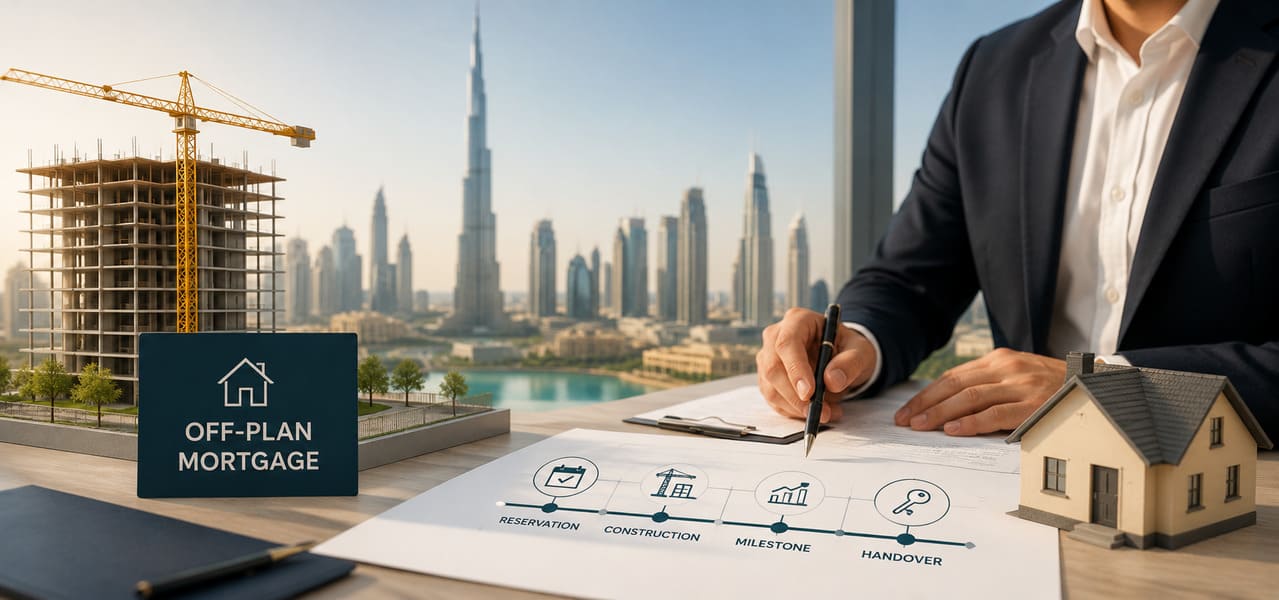

Off Plan Mortgage Dubai work differently from mortgages for completed properties because the bank is financing a property that is still under construction. Loan limits, payment timing, and bank disbursements therefore follow a different structure. from loan limits to payment timing, reflects that added risk.
So how does an off-plan mortgage actually work in Dubai?
Off-plan mortgages generally come with more conservative loan-to-value limits than completed properties, reflecting the construction risk involved, and disbursement is typically tied to construction milestones rather than paid out in full upfront. Many buyers also combine an off-plan mortgage with the developer’s own payment plan during the construction period, only drawing on the mortgage more heavily as handover approaches.
This guide covers the specific mechanics of financing an off-plan purchase in Dubai. Our detailed guide on what a mortgage is covers the general UAE mortgage framework in full.
The firm’s guide to the property-buying process in Dubai covers the wider purchase sequence.
How does an off-plan mortgage work in Dubai?
An off-plan mortgage finances a property still under construction, and banks generally apply more conservative loan-to-value limits than for completed, ready properties, reflecting the added risk of lending against something not yet built. Rather than disbursing the full loan amount upfront, banks typically release funds in stages tied to actual construction progress, verified against the project’s specific milestones, mirroring the developer’s own payment plan structure.
Many buyers structure an off-plan purchase using the developer’s own payment plan for the early construction stages, only bringing a mortgage into the picture as handover approaches and a larger balloon payment comes due. This can reduce the amount actually financed through a bank loan compared to financing the full purchase price from day one, though it requires genuinely managing two payment structures, the developer’s schedule and the bank’s, in coordination.
The core planning task is to place the developer schedule and the expected bank disbursement schedule side by side. A financing gap can arise even when both documents look workable on their own.
Article by Faris Raian
Faris Raian, Founder Partner and Managing Director of Leaders Advocates, begins with timing rather than the headline loan figure. The focus in this guide is therefore on whether the developer’s payment milestones, the bank’s drawdown conditions, and the processing time for each release will actually meet at handover.
How Off Plan Mortgage Dubai Work?
Banks generally apply tighter loan-to-value limits to off-plan properties than completed ones, since lending against a property that doesn’t exist yet carries genuinely more risk than lending against a finished, verifiable asset.
Do not treat a maximum or indicative percentage as a confirmed loan offer. Keep the bank’s written approval, conditions, property or project eligibility, expiry date, and any updated requirements in the file.
A mortgage lawyer in Dubai can review the financing agreement and conditions connected to the purchase.
Construction-Linked Disbursement
Rather than releasing the full mortgage amount at signing, banks typically disburse funds in stages, tied to verified construction progress against the project’s specific milestones, mirroring how the developer’s own payment plan is structured.
Off-Plan Mortgages in Dubai require careful coordination between the developer’s payment schedule and the bank’s disbursement timeline.
Ask for a written explanation of who confirms a milestone, what documents trigger release, how long the bank needs to process a drawdown, and which party must supply the request. Record any difference between the developer’s due date and the bank’s processing timetable.
Do not assume that a construction update sent by the developer automatically triggers bank payment. Preserve the notice, milestone evidence, bank response, and proof of each disbursement.
Combining a Developer Payment Plan With a Mortgage
- Many buyers use the developer’s own payment plan for the early construction stages, delaying the mortgage until closer to handover.
- Buyers should also understand their rights if an off-plan property handover is delayed.
- This can reduce the total amount financed through a bank loan compared to mortgaging the full price from the outset.
- It requires coordinating two separate payment schedules, the developer’s and the bank’s, rather than a single, simpler structure.
Considering financing an off-plan purchase in Dubai? A UAE property lawyer from our team can review the specific payment plan and financing structure before you commit.
If the developer misses the expected completion date, see our guide on how to handle a property handover delay in the UAE.
Review the Payment Plan Before You Commit
Your developer instalments and mortgage disbursements need to work together. Our UAE property lawyers can review the SPA, payment schedule, bank conditions, and expected funding structure before you proceed.
Build a Combined Payment Timeline
Create one timeline beginning with the reservation payment and ending after handover. Include every developer instalment, milestone, balloon payment, expected mortgage application date, valuation or bank review, approval expiry, drawdown, registration step, and remaining buyer contribution.
For each line, record:
- The contractual due date.
- The amount or percentage due.
- Whether the buyer or bank is expected to pay it.
- The construction milestone connected to the payment.
- The notice or document that triggers payment.
- The bank processing time stated to the buyer.
- The consequence written in the SPA if the payment is late.
- The source document and clause number.
The timeline should come from the SPA, bank offer, and formal notices rather than a broker’s summary alone.
Plan for the Handover Payment
The original article highlights the larger balloon payment that may arise as handover approaches. Calculate that amount early and update it after every developer payment or financing change.
Do not assume an old pre-approval will remain available until handover. Keep its date and conditions visible in the schedule and confirm what must be refreshed closer to the required mortgage drawdown.
Prepare a funding-gap line showing the handover amount, expected bank contribution, buyer cash contribution, fees in the supplied documents, and any amount not yet allocated. This is a planning tool, not a substitute for the lender’s final written approval.
Handover Approaching?
Check Your Mortgage Funding Before the Final Payment Is Due
A mortgage approval does not automatically mean every handover payment is covered. Review the expected bank contribution, your cash contribution, outstanding conditions, and any potential funding gap before the deadline arrives.
Review the Developer and Bank Documents Together
The SPA controls the buyer’s payment obligations to the developer. If your purchase is a secondary-market transaction rather than off-plan, see our guide on whether the Form F deposit is refundable in the UAE.
The mortgage documents control the lender’s conditions and disbursement. One does not automatically amend the other.
Compare names, unit details, purchase price, payment dates, milestone descriptions, handover assumptions, and notice details across both files. If a bank condition cannot be met by the developer’s timetable, resolve the mismatch before relying on the loan.
Keep written confirmation of any approved extension or revised schedule. A verbal assurance should not replace the underlying document.
Documents to Collect
- Reservation form and receipt.
- Sale and Purchase Agreement and every schedule.
- Developer payment plan and updated account statement.
- Project, unit, and interim registration documents supplied to the buyer.
- Construction notices and milestone confirmations.
- Mortgage application, pre-approval, final offer, and conditions.
- Bank requests for valuation, project approval, or further documents.
- Drawdown notices and proof of each bank payment.
- Buyer payment receipts and current balance statement.
- Handover notice and the calculation of the final amount due.
- Written extensions, amendments, waivers, or revised schedules.
Use consistent unit and project references. Similar project names, tower numbers, or unit descriptions can cause serious confusion when documents are circulated to several parties.
Questions to Ask Before Relying on Off-Plan Finance
- Is the specific project and unit acceptable to the proposed lender?
- What loan amount is indicated, and what conditions remain outstanding?
- When does the approval expire?
- Which construction stages can trigger disbursement?
- Who submits each drawdown request and supporting document?
- How long does the lender need to process payment?
- Which developer instalments must the buyer fund before mortgage release?
- What amount is expected at handover?
- What happens in the SPA if a bank payment is late or finance is unavailable?
- Which written approval is needed if the payment schedule changes?
Common Mistakes
- Assuming off-plan mortgage terms mirror those for a completed property, when the limits and structure are genuinely different.
- Not coordinating the developer’s payment plan with the mortgage disbursement schedule properly.
- Underestimating the handover balloon payment if relying heavily on the mortgage only at that late stage.
- Treating an indicative approval as unconditional finance.
- Ignoring the expiry date or conditions in the lender’s documents.
- Assuming a developer milestone notice automatically produces a bank drawdown.
- Keeping separate schedules without reconciling them in one timeline.
- Failing to record written extensions or revised payment dates.
Build One Payment and Funding Timeline
An off-plan purchase usually involves more than one schedule. The developer sets instalments and milestone dates, while the bank applies its own approval, valuation, document, and drawdown process. Put both schedules on one timeline before committing so that every expected source of funds is matched to a payment date.
For each instalment, record:
- The developer’s due date and the event that triggers payment.
- The amount or percentage payable.
- The portion expected from personal funds.
- The portion expected from mortgage funds, if any.
- The bank documents or approvals needed before a release.
- A contingency date for resolving missing paperwork or funding gaps.
Do not mark a payment as “financed” simply because a mortgage was discussed or initially approved. Link it to the relevant bank document and the conditions that still need to be completed. Where the source article describes staged releases, the timeline should show each expected release separately rather than treating the loan as one immediate lump sum.
People Also Ask
Conclusion
So, how does an off-plan mortgage actually work in Dubai? Tighter limits, staged disbursement, and often combined with the developer’s own payment plan. A UAE property lawyer from our team can review your specific financing structure.
The key control is a combined timeline. Match the SPA obligations to the bank conditions and drawdowns, update the handover figure, and keep written evidence for every payment, milestone, and change.
Developer and Bank Timelines Don’t Match?
Resolve the Financing Gap Before It Becomes a Payment Problem
The SPA controls what you owe the developer, while the mortgage documents control when the bank can release funds. Our legal team can review both sets of documents and identify timing or payment conflicts before they affect your purchase.


4 Comments