


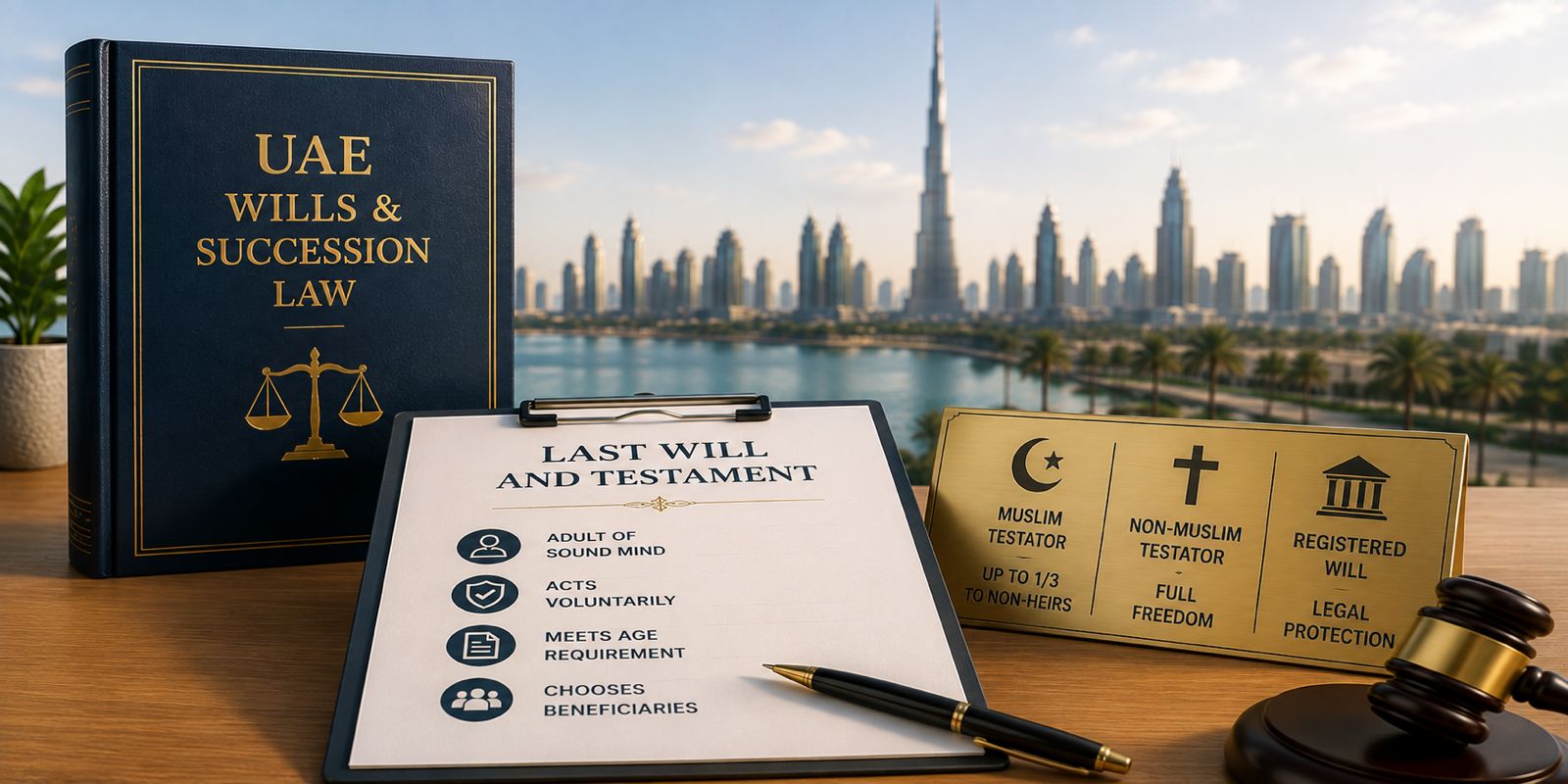

Who can make a will in the UAE depends on age, mental capacity, religion, registry eligibility, and whether the person is acting freely.
Both Muslims and non-Muslims can prepare wills, but their freedom to distribute an estate is not the same. An inheritance lawyer in Dubai can help explain the applicable rules, while those choosing legal representation may also consider who is the best inheritance lawyer in Dubai for their circumstances. The analysis may also involve specific estate-related issues such as dowry under UAE personal status law and whether how to make a will without a lawyer in the UAE is appropriate for the individual’s situation.
Who can make a will in the UAE? An adult of sound mind who acts voluntarily may make a will, subject to the route used. Non-Muslims can have broad testamentary freedom through DIFC, ADJD, Dubai Courts, or ADGM under the relevant civil framework.
Muslims can also make a will under Federal Decree-Law No. 41 of 2024, but generally only one third may be directed to non-heirs, while the remainder follows fixed Sharia shares unless all heirs agree otherwise.
The minimum age is in transition between 18 Gregorian years and the older 21-year position across registries. Residency is generally not required for UAE-based assets or dependents.
Who Can Make a Will in the UAE by Legal Track?
The legal rules distinguish Muslim and non-Muslim testators and explain the current age transition. The practical planning steps follow those rules.
The Two Tracks: Muslim and Non-Muslim Testators
A Muslim testator may direct up to one third of their estate to non-heirs under Federal Decree-Law No. 41 of 2024, while the remaining estate follows fixed Sharia rules unless all legal heirs agree otherwise.
A non-Muslim resident or non-resident may have full testamentary freedom under Federal Decree-Law No. 41 of 2022 and Abu Dhabi Law No. 14 of 2021 through an appropriate registration route, including DIFC, ADJD, Dubai Courts, or ADGM, subject to that registry’s requirements.
- Muslim testator: limited testamentary freedom within the one-third rule.
- Non-Muslim testator: broader freedom to name beneficiaries and determine distribution through a valid registered will.
Eligibility to make a will in the UAE splits cleanly along religious lines, and this single distinction shapes almost everything else about the process.
General Eligibility Requirements
Regardless of religion, a small set of baseline requirements apply to anyone making a will in the UAE.
- Reaching the minimum age of majority, currently in transition, covered in detail below.
- Sound mind and mental capacity, meaning the testator is genuinely capable of making independent legal decisions.
- Acting freely, without coercion or undue influence.
- For non-Muslim will registries specifically, holding a valid Emirates ID is generally required, alongside actually being non-Muslim, which is itself an eligibility gate for that particular route.
The Age Question: A Genuine Transition Underway
This is worth understanding clearly, because different parts of the UAE court system are not all in the same place on it right now.
Federal Decree-Law No. 51 of 2024, the New Civil Transactions Law, reduced the UAE’s general age of majority from 21 lunar years to 18 Gregorian years, a substantive change to civil capacity with direct implications for testamentary capacity.
- The DIFC Courts have expressly adopted the new 18-year threshold for will registration through the DIFC Wills and Probate Registry.
- The Abu Dhabi Judicial Department’s position remained pending formal confirmation as of recent reporting, meaning ADJD may still be applying the older 21-year requirement in practice.
- Older guidance and some registries still reference 21 years as the standard, reflecting the historic position under instruments like Dubai Law No. 15 of 2017.
Given this genuine variation between registries, confirming the current age requirement directly with whichever specific court or registry you plan to use, rather than relying on a single general figure, is worth doing before drafting anything.
Choose the Right Will Route
Not Sure Which UAE Will Registry Applies to You?
Religion, age, residency, asset location, and family circumstances can affect the correct registration route. Our UAE inheritance lawyers can review your eligibility and help identify the appropriate will structure before drafting begins.
Muslim Testators: Limited but Real Testamentary Freedom
A Muslim testator, whether a UAE national or a foreign Muslim resident, can absolutely make a will under Federal Decree-Law No. 41 of 2024. What they cannot do is override the mandatory Sharia framework entirely.
- Up to one third of the estate can be directed to beneficiaries who are not already legal heirs, charities, friends, or organizations, for example.
- The remaining mandatory shares for spouses, children, and other Sharia-recognized heirs follow the fixed Faraid formula, regardless of what the will states, unless every legal heir agrees to a different arrangement.
- Foreign Muslims may, in some circumstances, apply their home country’s inheritance law instead, where permitted under the specific Emirate’s rules, offering an alternative path for expatriate Muslims who prefer their own jurisdiction’s framework.
Non-Muslim Testators: Full Testamentary Freedom
This is where the UAE’s approach genuinely diverges by religion. Non-Muslims are not bound by Sharia distribution rules at all, provided they register a will properly.
- The DIFC Wills and Probate Registry, operating on English common law principles, available to non-Muslim expatriates.
- The Abu Dhabi Judicial Department, for bilingual or Arabic wills under UAE civil law.
- Dubai Courts, as a further registration option.
- ADGM, Abu Dhabi’s own financial free zone registry.
Once properly registered through any of these, a non-Muslim testator can name any beneficiaries they choose, appoint guardians for minor children, and structure their estate however they wish, without Sharia’s fixed shares applying at all.
Do You Need to Be a UAE Resident?
No. UAE will registration is generally open to residents and non-residents alike, provided the person has UAE-based assets, real estate, bank accounts, business interests, or dependents in the country worth planning for.
This matters for anyone with UAE property or investments who lives elsewhere, since a will covering those specific assets can still be registered without the testator being based in the UAE at all.
Executors and Guardians Face the Same Rules
Eligibility requirements are not limited to the testator alone. Anyone appointed as an executor or trustee under a UAE will generally needs to meet the same age and capacity standards as the testator themselves, meaning the same transitional question around 18 versus 21 applies to them too.
Why Appointing a Guardian Matters
Beyond asset distribution, this is one of the strongest practical reasons to make a will at all, particularly for parents of young children.
Under the default Sharia framework, if a father passes away, guardianship of minor children generally passes to paternal male relatives, even where the mother is still alive and capable. A properly registered will can proactively name a different guardian, overriding this default outcome.
Common Mistakes
- Assuming the same age requirement, 18 or 21, applies uniformly across every UAE registry, when the transition is not yet complete everywhere.
- Assuming a Muslim testator has no testamentary freedom at all, when up to one third of the estate can still be freely directed.
- Assuming UAE residency is required to register a will covering UAE-based assets.
- Not appointing a guardian for minor children, and leaving the default Sharia guardianship outcome to apply by omission.
- Choosing a registry without checking whether its specific eligibility and language requirements fit your situation.
Who Can Make a Will in the UAE: Eligibility Checklist
Eligibility should be checked before drafting because religion, age, capacity, registry choice, and asset location affect the route.
- Confirm whether the testator is Muslim or non-Muslim.
- Confirm the age rule currently applied by the intended registry.
- Confirm that the testator understands the document and acts voluntarily.
- List the UAE assets and dependents the will is intended to cover.
- Check whether the chosen registry accepts the testator’s status and intended scope.
- Identify beneficiaries, executors, substitute executors, and guardians clearly.
- Collect identity, ownership, family, and foreign-will documents.
- Check the final wording against public order and the applicable inheritance limits.
How Mental Capacity Is Prepared and Recorded
Sound mind and independent decision-making are required. Capacity is therefore not a box to tick after the will is drafted; it is central to whether the instructions genuinely belong to the testator.
The person should understand the nature of a will, the property being addressed, the intended beneficiaries, and the effect of the proposed distribution. Any concern should be raised before the registration appointment.
- Use a meeting where the testator can give instructions directly.
- Record the reasons for unusual or unequal gifts in the legal file where appropriate.
- Avoid using a beneficiary as the only source of drafting instructions.
- Address language, hearing, or communication needs before signing.
- Seek suitable professional evidence if capacity is genuinely in doubt.
- Keep pressure, coercion, and conflicts of interest away from the process.
Choosing a UAE Will Registry
DIFC, ADJD, Dubai Courts, and ADGM are available routes in relevant cases. The correct choice depends on eligibility, language, assets, family needs, and how the UAE will interacts with documents elsewhere.
- Confirm whether the registry accepts Muslim or non-Muslim testators in the relevant route.
- Check the registry’s current minimum-age and identification requirements.
- Confirm whether the will can cover the intended UAE assets and minor-child arrangements.
- Check the language, translation, witnessing, and appointment process.
- Review executor and guardian eligibility under that route.
- Compare the UAE scope with any foreign will before signing.
- Keep the final registration confirmation with the current signed document.
The firm’s guide on how to register a will in Dubai explains the registration stage, while its inheritance lawyers in Dubai can review eligibility and scope.
Non-Residents With UAE Assets
UAE residency is generally not required. A non-resident may still need a UAE will where property, accounts, business interests, or dependents are located in the country.
The practical task is to define the UAE scope precisely and coordinate it with the law and estate documents used in the country of residence.
- List every UAE asset and confirm the registered owner.
- Identify any UAE-based minor child or dependent arrangement.
- Collect the latest foreign will and related estate documents.
- Check for broad revocation wording that could cancel another will unintentionally.
- Use consistent names and identification details across jurisdictions.
- Record which executor handles each part of the estate plan.
Muslim Testators and the One-Third Limit
A Muslim can make a will, but the freely directed portion is limited to one third for people who are not already legal heirs. The remaining shares follow Faraid unless all legal heirs consent otherwise.
Drafting should identify which intended recipients are already heirs and which are non-heirs. That classification affects whether the intended gift fits within the discretionary portion.
- Prepare the full family tree and identify the expected Sharia heirs.
- List intended gifts to friends, charities, organizations, or non-heir relatives.
- Map those gifts against the discretionary one-third portion.
- Avoid wording that assumes the will can replace all fixed Sharia shares.
- Review the plan after changes to the family or asset base.
Appointing Executors and Guardians
An executor administers the will. A guardian nomination addresses the care or legal protection of minor children. These roles should be selected for practical ability as well as trust.
- Confirm each person’s full legal name and current contact details.
- Ask whether the first choice is willing and able to act.
- Name a suitable substitute for each important role.
- Consider location, language, family relationships, and access to UAE records.
- Check the current registry rules that apply to the appointee.
- Tell the executor where the registered will and asset inventory are held.
The same age-and-capacity transition may affect executors and trustees, so the intended registry’s current position should be checked.
Documents to Prepare Before Drafting
- Passport, Emirates ID where applicable, and current contact details.
- Proof of religion where the registry requires it.
- Marriage, divorce, birth, and death documents relevant to the family structure.
- Property titles, company records, account details, and other ownership evidence.
- The latest signed or registered version of every existing will.
- Beneficiary, executor, trustee, and guardian identification details.
- A clear asset-and-debt inventory kept separately from changing passwords.
- Instructions showing the intended UAE and foreign territorial scope.
For the civil framework, review wills and estates under the Civil Personal Status Law for non-Muslims.
Common Events That Trigger a Will Review
- Marriage, divorce, or a new long-term family responsibility.
- The birth or adoption of a child.
- The death or incapacity of a beneficiary, executor, or guardian.
- A change of religion, nationality, residence, or domicile relevant to the plan.
- The purchase or sale of major UAE property.
- A material business, shareholding, or ownership change.
- A new foreign will or estate-planning document.
- A legal or registry change affecting age, capacity, or registration requirements.
Protect Your Family
Have You Named the Right Beneficiaries, Executor, and Guardian?
A UAE will can address more than asset distribution. Our lawyers can help structure beneficiary instructions, executor appointments, guardian nominations, and substitute choices so the document reflects your family plan clearly.
Final Will-Eligibility Review
- Religion and the applicable testamentary track are confirmed.
- The intended registry’s current age rule has been checked.
- The testator has sound mind and gives instructions voluntarily.
- Residency and non-resident eligibility have been addressed.
- The asset scope is clear and supported by ownership records.
- The one-third rule is respected where the testator is Muslim.
- Beneficiaries, executors, and guardians are correctly identified.
- Foreign wills have been reviewed for overlap or accidental revocation.
Complete the review before the signing appointment. A missing identity record, unclear asset description, unavailable appointee, or conflict with a foreign will can delay registration or leave the final document harder to use.
Keep a dated record of the eligibility and scope checks completed for the chosen registry so later reviewers can identify the assumptions used when the will was prepared.
Frequently Asked Questions
Eligibility is the first step; correct drafting and registration make the plan usable. Contact Leaders Advocates for tailored advice.
UAE & Cross-Border Estate Planning
Own UAE Assets but Live Abroad?
A UAE will should be coordinated carefully with any foreign will so that assets are covered correctly and broad revocation wording does not create unintended conflicts. Our inheritance lawyers can review both documents and define the UAE scope clearly.


3 Comments