


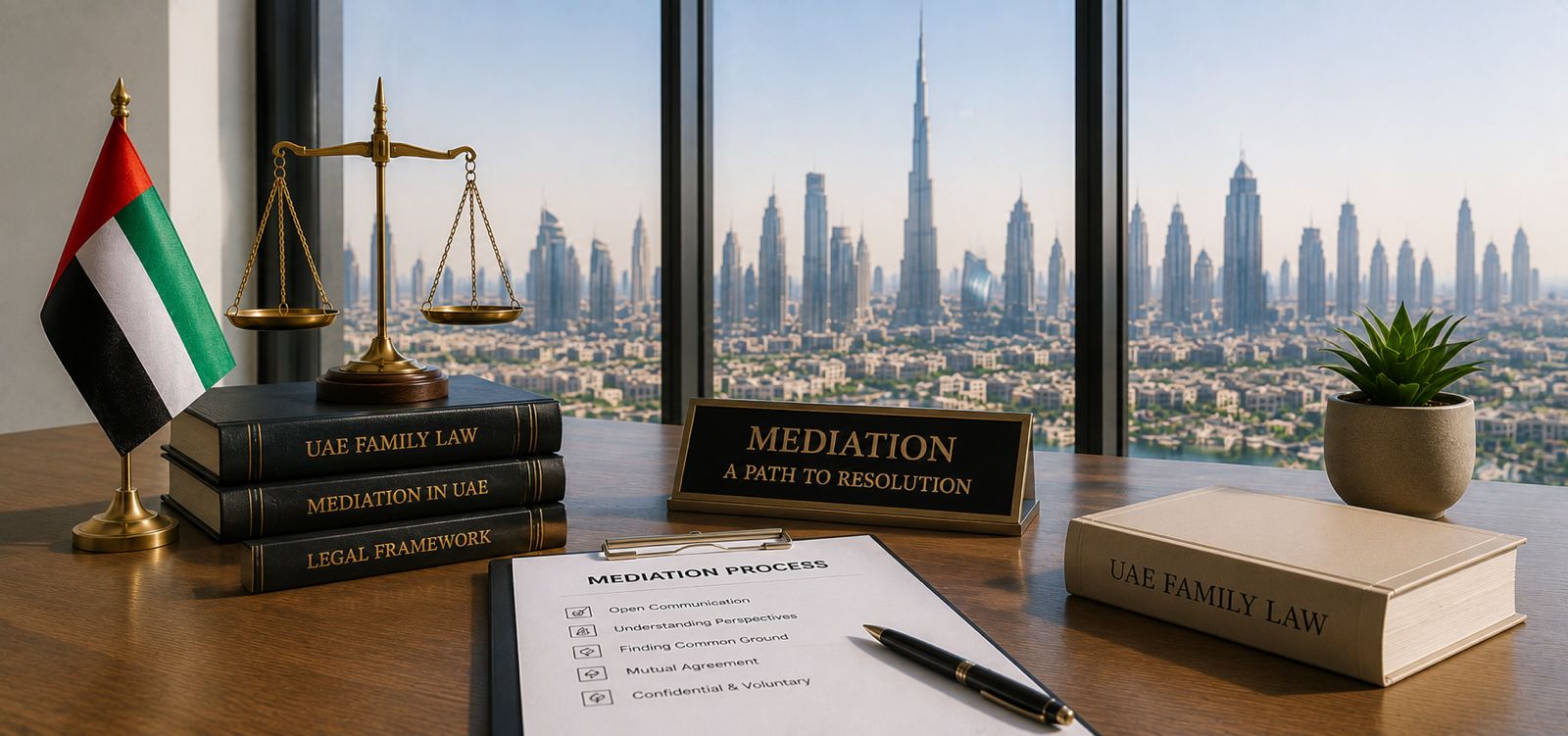

Mediation shows up across UAE law in more places than most people expect. Commercial disputes, civil claims, family matters, and small claims cases all touch it in some form. The legal framework behind it was also substantially rewritten at the end of 2023, which means some still-circulating explanations of UAE mediation law describe a system that no longer exists in its old form.
Mediation is a voluntary, confidential process where a neutral mediator helps disputing parties negotiate their own settlement rather than having an outcome imposed by a judge. The current governing law is Federal Decree-Law No. 40 of 2023 on Mediation and Conciliation in Civil and Commercial Disputes, effective 29 December 2023. It repealed and replaced the earlier Federal Law No. 6 of 2021 and Federal Law No. 17 of 2016.
Identify whether the dispute falls within the Mediation and Conciliation Centre’s jurisdiction, then choose the court-ordered or voluntary route. Confirm the three-month timetable, possible renewal, private mediator fee, confidentiality protection, and the steps required to record an enforceable settlement.
Myth: “Federal Law No. 6 of 2021 Is Still the Current Mediation Law”
You can read more about this in our guide on what is an arbitration clause under UAE law.
Federal Law No. 6 of 2021 introduced a dedicated standalone mediation law, including freedom to select a private mediator and protection for confidential settlement discussions.
Federal Decree-Law No. 40 of 2023, effective 29 December 2023, repealed both the 2016 and 2021 laws and consolidated mediation and conciliation into a single current framework.
An explanation that still cites Federal Law No. 6 of 2021 as the governing statute is outdated under the article’s stated framework.
Not Sure If Mediation Is the Right Route?
The right process depends on the type, value, and stage of your dispute. Get a clear view of your options before taking the next step.
Myth: “Mediation Only Applies to Family Disputes”
A family mediation lawyers in dubai can guide you through situations like this.
Federal Decree-Law No. 40 of 2023 applies broadly to any civil or commercial dispute capable of settlement, provided it does not conflict with existing law or public order and morals in the UAE.
Family disputes represent one category within that broader framework. Disputes between spouses or relatives up to the fourth degree fall within the Centre’s exclusive jurisdiction regardless of value, alongside a separate Family Guidance Committee process for divorce and related matters.
Mediation extends across civil, commercial, and family disputes rather than belonging to family law alone.
Myth: “A Mediator Decides the Outcome Like a Judge”
This connects closely with our guide on what is the difference between a litigator and a lawyer.
A mediator facilitates negotiation between the parties but does not impose the result.
Any settlement has to be agreed upon by the parties themselves. This distinguishes mediation from a judicial decision even when a court referred the dispute to mediation.
The process is structured and legally recognized, but the settlement remains voluntary.
Myth: “Mediated Settlements Are Not Really Enforceable”
The current law gives mediation genuine legal weight.
Settlement agreements reached through the process can be enforced through the courts once properly recorded, rather than relying only on the parties’ goodwill to honor what they agreed.
Recording the settlement properly is what gives the agreement enforceable weight through the courts.
Myth: “There Is No Cost Limit on Private Mediation”
A private mediator’s fee is agreed directly with the parties.
The fee is capped at a maximum of 5% of the value of the matter in dispute under the framework described in the article.
The parties negotiate the fee, but the stated maximum cap still applies.
Why the Mediation Route Changes the Process
Mediation in the UAE operates through two distinct routes, with separate jurisdiction and timing considerations.
• Court-ordered mediation: A judge refers an active case to mediation at any stage of litigation, either on the court’s own proposal or at a party’s request, before the normal court process continues.
• Voluntary mediation: The parties appoint a private mediator directly, either before a case is filed or while one is ongoing, without waiting for a judicial referral.
• Civil and commercial disputes up to AED 5,000,000: These fall exclusively within the Mediation and Conciliation Centre’s competency.
• Disputes between spouses or relatives up to the fourth degree: These fall within the Centre’s exclusive jurisdiction regardless of value.
• Disputes exceeding AED 5,000,000: The parties can agree to use the Centre voluntarily before filing or while a case is already underway.
Worried About Choosing the Wrong Dispute Process?
Before filing a claim or responding to a dispute, speak with a UAE dispute resolution lawyer about mediation, settlement, and your available legal options.
Proof: The Current Framework Defines Scope, Time, Cost, and Confidentiality
Mediation in the UAE has deep roots in the local concept of sulh, or reconciliation. The codified system was developed through Federal Law No. 26 of 1999, Federal Law No. 17 of 2016 as later amended, and Federal Law No. 6 of 2021 before the current consolidated law took effect.
A mediation generally runs for up to three months from the date the mediator is formally notified of the assignment. It can be renewed once for a further period of the same length by court decision at the mediator’s request. A referral decision sending a case to judicial mediation generally cannot be challenged or appealed by either party.
Communications made during mediation are protected as without prejudice. In practice, what is said or offered during mediation cannot generally be used against a party later if the dispute proceeds to litigation, allowing the parties to negotiate candidly.
The Dubai International Arbitration Centre, established under Decree No. 34 of 2021, launched dedicated Mediation Rules effective 1 October 2023. Dubai also maintains Law No. 18 of 2021 regulating conciliation and the Dubai Courts’ Centre for Amicable Settlement of Disputes established under Law No. 16 of 2009.
Family matters sit within the Centre’s exclusive jurisdiction regardless of value, while divorce and closely related personal status matters also pass through the separate Family Guidance Committee process. The systems operate alongside each other, with the specific personal status framework generally governing the divorce and custody side of a family dispute.
Mediation is not an informal side process; the current framework gives it defined routes, protected communications, capped private fees, and enforceable outcomes.
Common Mistakes to Avoid
Most misunderstandings come from relying on the repealed law or confusing mediation with a court judgment.
• Citing Federal Law No. 6 of 2021 as the current governing mediation law.
• Assuming mediation is limited to family disputes.
• Treating a mediator as someone who can impose a binding decision on the parties.
• Assuming a mediated settlement cannot be enforced once properly recorded.
• Ignoring the Centre’s exclusive competency for civil and commercial disputes up to AED 5,000,000.
• Overlooking the three-month period and the possibility of one renewal for the same length.
• Assuming a private mediator’s fee has no maximum cap.
• Using confidential mediation communications as if they were ordinary litigation evidence.
Frequently Asked Questions
So, what is mediation in UAE law? A structured, legally recognized process for resolving civil, commercial, and family disputes without a judge imposing the outcome, now governed by a single consolidated law since the end of 2023, with defined timelines, capped fees, and genuinely enforceable results.
Knowing which type of mediation fits the dispute and which institution or center has jurisdiction over it matters more than knowing the concept exists at all.
Whether you are facing a commercial dispute or a family matter that could benefit from mediation, a UAE dispute resolution lawyer from our team can confirm the right route and represent you through it.
Need Help Resolving a UAE Dispute?
Our dispute resolution lawyers can review your situation, explain whether mediation is appropriate, and help you pursue a practical resolution.

2 Comments