

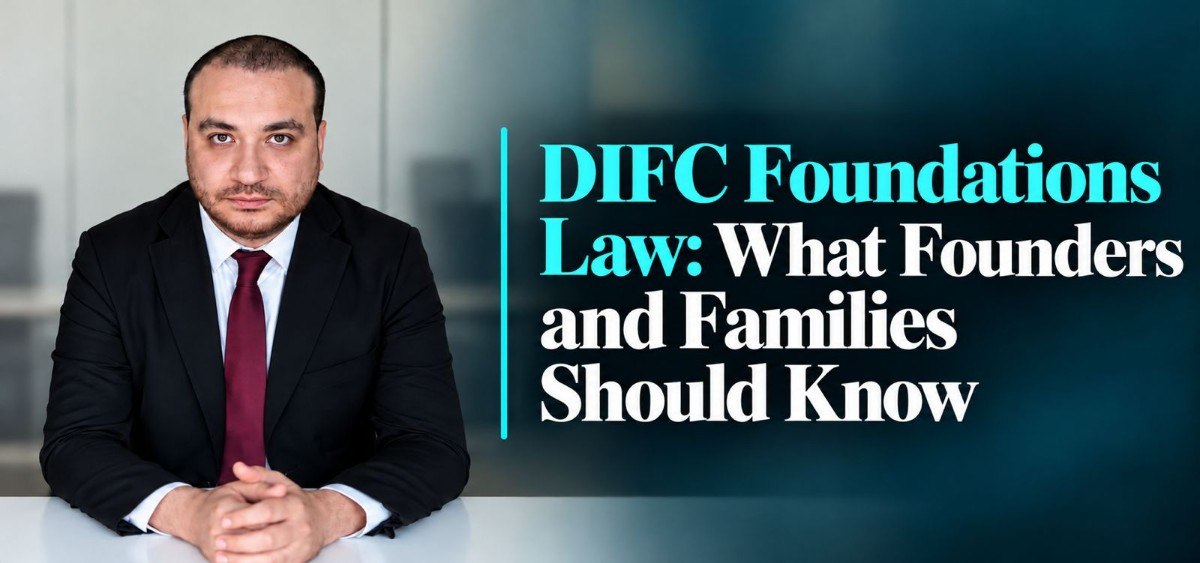
DIFC Foundations Law becomes relevant when a family or business wants one legal structure to hold assets, support succession planning, and operate under defined governance rules.
The structure can be useful, but registration alone does not solve ownership, tax, creditor, succession, property-transfer, or family-governance problems. The documents and assets determine the result.
Quick Answer
A DIFC foundation is a separate body corporate governed by DIFC Law No. 3 of 2018, its Charter, and its By-laws. It has no shareholders and acts through a Council. A Guardian is mandatory for charitable or specified non-charitable objects and optional in other stated cases. The structure can hold and administer property, but it cannot conduct unrelated commercial activity, defeat valid creditor rights, or bypass asset-transfer laws. Its effectiveness depends on drafting, ownership, compliance, and documents.
Define the foundation’s objects, assets, recipients, decision rights, and succession goals before filing. Then design the Charter and By-laws around those facts instead of copying a generic template.
Complete legal, tax, regulatory, and asset-specific due diligence before transferring property. Establish ongoing Council, accounting, licensing, reporting, and conflict-management procedures from the first day.
Planning To Establish A DIFC Foundation In Dubai?
Contact Leaders Advocates for legal guidance on DIFC foundation formation, the Charter and By-laws, Council appointments, family wealth structures, and asset ownership planning.
DIFC Foundations Law And The Current Framework
The principal statute is the Foundations Law, DIFC Law No. 3 of 2018. The current official consolidated version is Consolidated Version No. 3 dated March 2024.
That version incorporates DIFC Laws Amendment Law No. 1 of 2024, DIFC Law No. 2 of 2022, and DIFC Law No. 8 of 2018.
The DIFC legal database also lists later amendment material, including DIFC Law Amendment Law No. 3 of 2024. Current text and transaction dates should therefore be checked.
The Law applies within the DIFC to foundations established under it, recognized foreign foundations within Article 62, and foreign foundations continuing their registration into the DIFC.
What A DIFC Foundation Is
Article 10 states that a foundation is a body corporate with legal personality separate from its founders and other persons. It has the capacity, rights, and privileges of a natural person.
The foundation owns its property in its own name. Its assets are not held on trust for another person merely because recipients may receive benefits under the documents.
A founder has only the rights provided by the By-laws. A qualified recipient has the rights created under the By-laws, including a payment right when the stated conditions arise.
The foundation has no shareholders. It is administered by a Council, may have a Guardian, and may appoint one qualified Registered Agent.
Permitted Objects And Commercial Limits
Article 12 requires the objects to be certain, reasonable, possible, lawful, and consistent with DIFC public policy. Objects may be charitable, non-charitable, or benefit named or described persons.
Article 12(5) prohibits commercial activities except those necessary for, ancillary to, or incidental to the foundation’s objects. A foundation should not be used as an ordinary trading company.
The structure may hold company shares, investments, or other property. However, the operating business should generally remain in the appropriate licensed entity.
Creation And Registration
Article 17 allows the founders to apply by signing and filing the prescribed application. It identifies required information about the foundation, founders, Council members, office, and Registered Agent.
The application includes the Charter and, where no Registered Agent is proposed, the By-laws. The Registrar may register, request more information, or refuse the application.
On registration, the Registrar issues a certificate, registered number, and license. Article 17(7) requires the foundation to hold a license under Article 9 of the Operating Law.
Current DIFC onboarding guidance requires at least one founder, at least two Council members, and a registered office in the DIFC. The live checklist should be verified before filing.
The Charter And The By-laws
The Charter
Article 19 requires an English-language Charter. It must state the name, objects, initial capital description, any limited duration, and each founder’s request that the Council comply with it.
The Charter may include matters otherwise placed in the By-laws. Any provision must remain consistent with the Law and Regulations.
A Charter amendment must be filed within 30 days after completion of the internal process. It takes effect when registered by the Registrar.
The By-laws
Article 20 requires rules for Council functions, appointments, removals, remuneration, decision-making, delegation, and the destination of remaining property on dissolution.
The By-laws may regulate distributions, additional endowments, recipient changes, investment powers, approval rights, and conditions attached to benefits.
If all required and permitted matters are placed in the Charter, Article 20(4) allows a foundation to operate without separate By-laws.
Changes to the By-laws must be notified and supplied to the Registered Agent or Registrar within 30 days, as applicable.
Need Your DIFC Foundation Charter Or By-laws Reviewed?
Speak with Leaders Advocates about drafting or reviewing foundation governance documents, founder rights, Council authority, Guardian oversight, and amendment procedures before registration.
The Council The Guardian And The Registered Agent
The Council
Article 22 requires a Council with at least two members. It administers the property, carries out the objects, and must keep accurate accounting records.
Council members must act honestly, in good faith, and in the foundation’s best interests. They must exercise appropriate care and declare interests in foundation transactions.
A founder or body corporate may serve on the Council. However, the same person cannot simultaneously act as a Council member and Guardian.
The Guardian
Article 23 requires a Guardian for a charitable object or a specified non-charitable object. A Guardian may be appointed for other stated recipient-focused objects.
The Guardian monitors the Council and may require it to account for property administration and pursuit of the objects. The By-laws may give approval or disapproval powers.
A Guardian must keep accurate guardianship records during the appointment and for six years afterward. Changes must be notified to the Registrar within 30 days.
The Registered Agent
Article 24 allows, but does not always require, a Registered Agent. The agent must be qualified and performs the functions assigned by the Law and By-laws.
Only one Registered Agent may serve at a time. A change must be reported to the Registrar within 30 days.
What The Structure Can And Cannot Do
What It Can Do
- Own shares, investment accounts, contractual rights, and other transferable property in its own name.
- Create long-term governance rules that continue after an individual founder’s death.
- Provide benefits to persons, categories, classes, or charities under written distribution rules.
- Separate asset ownership from the personal estate of a founder, subject to valid transfer and creditor rules.
- Use a Council, Guardian, approvals, reserved powers, and dispute provisions to manage family decision-making.
What It Cannot Do
- Conduct commercial activities unrelated to or beyond those ancillary or incidental to its lawful objects.
- Transfer an asset the founder does not own or lacks legal power to transfer.
- Override the law governing an immovable asset outside the DIFC or ignore local registration formalities.
- Guarantee secrecy from regulators, courts, banks, tax authorities, or lawful disclosure requirements.
- Protect a transfer intended to defraud a creditor where Article 14(3) is established.
Creditor Succession And Foreign Law Limits
Article 13 generally applies DIFC law to foundation administration and dispositions. It preserves important exceptions concerning ownership, foreign immovable property, testamentary validity, capacity, and local formalities.
Article 14 limits certain foreign-law attacks on valid dispositions. However, Article 14(3) addresses transfers intended to defraud a creditor that leave the transferor insolvent or without sufficient property.
The foundation may then be liable to satisfy the creditor within the statutory limits connected to the transferred property and its accumulation.
Articles 15 and 16 address heirship rights and inconsistent foreign judgments. Cross-border effectiveness still requires analysis where assets or proceedings exist outside the DIFC.
Planning To Transfer Property Or Investments Into A DIFC Foundation?
Contact Leaders Advocates for guidance on asset-transfer formalities, foundation ownership, creditor exposure, foreign property rules, and succession arrangements before moving assets.
Accounts Amendments And Disputes
Article 33 requires accounts and accounting records. The Council approves the accounts, and at least two Council members sign them.
Within 30 days after approval, accounts go to the Registrar if there is no Registered Agent. Otherwise, they are provided to the Registered Agent.
The current consolidated version places the Court’s amendment power in Article 41, not Article 44. Earlier versions used different numbering, so citations should match the applicable version.
Article 41 allows amendment when it assists administration or attainment of objects. It also permits rectification of an error, defect, or omission on a founder’s application.
Article 42 allows directions about document meaning, Council functions, recipients, administration, and other relevant matters. Article 51 recognizes qualifying arbitration clauses in the foundation documents.
Practical Steps And Documents
- Write a statement of purpose covering assets, intended recipients, time horizon, control, succession, and risk.
- Prepare founder, Council, Guardian, and Registered Agent identification and consent documents.
- Draft the Charter and By-laws with clear voting, deadlock, removal, replacement, distribution, and amendment rules.
- Map every proposed asset, its current owner, transfer formalities, liabilities, and governing jurisdiction.
- Obtain valuations, corporate approvals, lender consents, property approvals, and tax advice before transfer.
- Prepare registers, accounting policies, conflict declarations, meeting procedures, and compliance calendars.
- Review wills, shareholder agreements, family arrangements, and insurance to prevent contradictory instructions.
Common Mistakes And Risks
- Using standard documents without reflecting the family’s actual decision process.
- Giving the founder control that conflicts with the intended governance or succession outcome.
- Failing to distinguish the Council’s management role from the Guardian’s oversight role.
- Transferring property without checking ownership, restrictions, tax, finance, or local registration rules.
- Treating the foundation as an automatic creditor shield or ordinary trading vehicle.
- Ignoring the 30-day notification and filing duties for specified changes.
How A Lawyer Can Help
A lawyer can test whether a foundation fits the objectives, coordinate cross-border advice, draft the constitutional documents, and complete asset-specific transfer checks.
Counsel can also review Council decisions, Guardian powers, reserved powers, information rights, disputes, regulatory filings, and amendments under the current consolidated law.
Professional Perspective From Faris Raian
Faris Raian’s original professional contribution is preserved: a foundation should not be treated as a form. Its value depends on precise rules for decisions, benefits, and disagreements.
Relevant Legal Services
- corporate lawyers in Dubai can advise on foundation structure, company holdings, and governance.
- corporate and business law services can coordinate entity, ownership, and compliance planning.
- contract lawyers in Dubai can review asset transfers, shareholder agreements, and related contracts.
Related Legal Guidance
Further Legal Publications And Professional Profiles
Explore professional legal publications and firm information through Leaders Advocates on Mondaq, the firm’s Lexology contributor profile, and its Legal 500 lawyer profiles.
Relevant Success Story
See the firm’s Success Stories for examples of completed legal work. No prior matter guarantees the same result. Each foundation depends on its objects, assets, documents, parties, jurisdictions, and legal circumstances.
Frequently Asked Questions
Final Takeaway
The DIFC Foundations Law provides a flexible legal person for holding and administering assets, but its effectiveness comes from accurate documents and valid asset transfers.
The safest next step is a coordinated review of the objects, Charter, By-laws, Council, Guardian, assets, taxes, creditor exposure, succession goals, and cross-border rules.
Need Legal Guidance On DIFC Foundations Law?
Speak with Leaders Advocates about DIFC foundation setup, foundation governance, Charter and By-laws drafting, Council and Guardian responsibilities, asset transfers, succession planning, and DIFC foundation disputes.